I wrote about our exploration of Sittannavasal by bicycle earlier. Later during 2000s I had a chance to understand the meaning of the paintings, as elaborated by scholars.
The Samava-sarana theme is a central figure of the Sittannavasal cave paintings. It is dated back to 7th century AD. This beautiful mural depicts a scene from Jain cosmology belief, a delightful Jain heaven containing a hall called Samava Sarana.
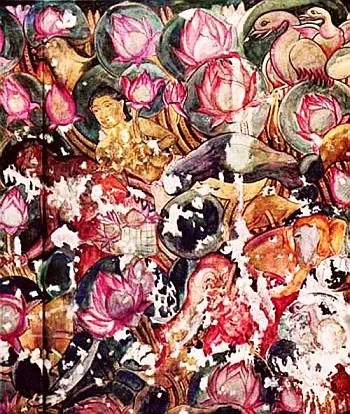
Samava-sarana or Samo-sharana means refuge-to-all. It is a preaching hall of the Tirtankara-s, stated to have more than 20,000 stairs in it. It is believed that the Samava-sarana seems to have replaced the Jain stupa as an object of worship.
Key aspect of the Samava-sarana painting at Sittannavasal includes the following –
- The lotus tank (Khatika-bhumi) where the bhavya-s (jain faith followers attained the heaven) gather to hear the preaching of Tirtankara.
- Bhavya-s collecting lotus flowers, carrying baskets
- Animal motives makes the painting interesting. We see fishes, birds, bulls/buffaloes and elephants.
The face of the bhavya‘s looks neat, with arranged hair and pendant ear lobes.


Similar motives can be found in other Jain worshiping places. But Sittannavasal paintings are considered as one of the earliest examples of Jain frescoes in South India.
Further reading:
- Sittannavasal heritage study by Prof S Swaminathan
This post is part of Blogchatter’s WRITE A PAGE A DAY 2025 campaign.
Discover more from dwaraka
Subscribe to get the latest posts sent to your email.