Before the advent of cave temples, gods took shelters in structures made of brick, bamboo, or similar materials. These structures were vulnerable to time and eventually vanished.
To overcome this, excavation of cave temples started.
Mandagapattu is recognized as one of the earliest cave temples in Tamil Nadu, built by Pallava king Mahendravarman I in the early 7th century. Mahishasura Mardini cave of Mamallapuram was also mentioned often when we discussed about similar early structure. It is dated back to late 7th century during the reign of Pallava Narasimha Varman.
Mahishasura Mardini Cave, Mamallapuram
Mahishasura Mardini, Mamallapuram
Upon visiting, I stood in awe of the life-sized bas-relief of Mahishasura Mardini, considered one of the finest examples of Pallava art. The bas-relief depicts Goddess Durga fiercely battling with eight arms, wielding a sword, bow, and arrow, as she forces Mahishasura into retreat.
The bas-relief also depicts her attendants, including female warriors and gana-s (dwarfs) in action. Notably, one servant is shown holding an umbrella over the goddess’s head.
Vietnam: Po Nagar Temple
Mahishasura Mardini, Po Nagar Temple | Picture (c) Linda De Volder
Mahishasura mardini is widely depicted in southeast Asia as well. We talked about 7th century caves. Around the same time or later, we have a sample from Vietnam – Po Nagar Temple.
The goddess of this temple is believed to be worshiped for agricultural prosperity. She is linked with Bhagavati. But there is a doorway which represents goddess Durga with four hands, dancing on top of a buffallo, holding a chakra, lotus and trident. The face and crown resembles Chamba artistry. Yet it has the same concept.
Indonesia: Prambanan Temple
In Indonesia, Mahishasura Mardini is depicted in the 9th-century Prambanan Temple complex, showcasing the influence of Hindu mythology on Javanese art.
Durga Mahishasuramardini aka Loro Jonggrang, Prambanan, Central Java, Indonesia. Picture (c) rarebooksocietyofindia.org
Cambodia: Sambor Prei Kuk
Sambor Prei Kuk is an important archaeological site having over 100 brick temples from the pre-Angkorian period, primarily dedicated to Hindu deities. The site is renowned for its early Khmer architecture and art.
Durga Mahishasuramardini, Sambor Prei Kuk, Khmer, 1st half of the 7th century National Museum of Cambodia | Picture (c) art-and-archaeology.com
Durga story is perceived as the triumph of good over evil. There are several Mahisha-s roam around freely in Tamil Nadu right now. Just as Mahishasura threatened harmony, modern societal issues like drug abuse disrupt our communities, and we hope for a similar triumph of good over evil.
Kiran and I had a memorable early morning journey to Narttamalai (nārttāmalai/नार्त्तामलै) before two decades. I can’t quite recall how we traveled; I believe it was by car. As the sun began to paint the sky, we started our climb up Narttamalai hill.
Narttamalai, though a remote village along the Trichy-Pudukkottai highway, is a site of national importance. This entire village is a historical gem, though perhaps not as well-known as it deserves to be, even among locals.
Vijayalaya Cholisvaram | MV Kiran June 2003
The hill cradles six treasures
There are two rock-cut temples,
Pazhiyili Isvaram (பழியிலி ஈஸ்வரம்/paḻiyili īśvaram/पळियिलि ईश्वरम्) and
One magnificent structural temple called Vijayalaya Chozhisvaram (விஜயாலய சோழீஸ்வரம்/vijayālaya cōḻīśvaram/विजयालय चोळीश्वरम्), which is a marvellous piece of art, on the hill.
A famous living temple of Mariamman (மாரியம்மன்/māriyammaṉ/मारियम्मन्).
The Kadambar temple (கடம்பூர் கோயில்/kaṭampūr kōyil/कडम्पूर् कोयिल्) at the foot of a hill nearby is another beautiful temple.
The natural cavern of Aluruttimalai (ஆளுருட்டி மலை/āḷuruṭṭi malai/आळुरुट्टि मलै) contains polished stone beds and other Jaina vestiges.
Kiran, well-prepared with research, led the way. My main role, as I saw it, was to offer moral support.
As the rising sun showered the landscape in a warm and golden light, we carefully climbed the sloping, slick rock, eager to capture a beautiful photograph of Vijayalaya Cholisvaram. Later within the temple campus, we were struck by the richness of its cultural heritage.
24 Jun 2003 | Pandian Ramaiah
Vijayala Cholisvaram is a structural Siva temple, Opposite it, excavated into steep hillside, are two cave temples. One is Samanar Kudagu, the cave of Jains.
Samanar Kudagu Cave Temple | June, 2003
Today, let’s focus on the yali – also known as vyali or vyala or vyalaka – a recurring lion-like figure. The motif is often seen in Hindu and Buddhist temples and royal spaces. Samanar Kudagu is not an exception too.
The cave temple seems to have begun as a Jain site around 7th century, later becoming to shrine of vishnu. Mango trees and bushes create a serene atmosphere. A facade or mandapam stands before the cave, and it’s this facade that I want to highlight.
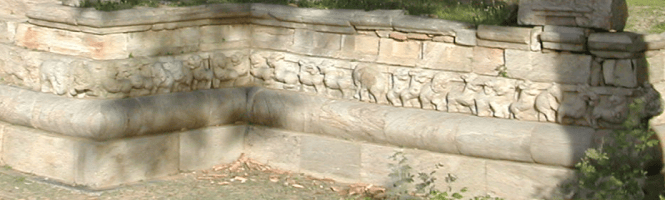
The facade’s base is adorned with procession of yalis. Sculpted to convey power and fierceness, these yalis often serve as brackets, or pillars supporting the structure. Simetimes they feature elephant trunks or bird wings.
Statue of Gajasimha Tower (Gaja yali) of Cham Da Nang Sculpture Museum (photo provided by nv) Picture (c) archives.org.vn
We observed various types of yali-s. The simha yali has a lion’s head and body. The Gaja yali combines an elephant’s head with a lion’s body. The Makara yali features the body of a lion and the head of a crocodine. Similarly, the architecture boast a variety of yalis, such as Sarpa yali and Nara yali.
The yala frieze, Samanar Kudagu, Narttamalai | MV Kiran, June 2003
The plinthe of this facade features makara heads in the corners devouring humans in their mouth. These connect to frieze of elephants and Simha yalis. Though relatively small, they contribute to the basement’s beauty. Carved with dynamic energy, the playful nature of these yalis brought smiles to our faces. What a skill and imagination!
The yala frieze, Samanar Kudagu, Narttamalai | MV Kiran, June 2003
Scholars suggest several reasons for these depictions: protection, good luck and fertility among them. But beyond any symbolic meaning, they contribute an immense beauty that broadens our prospective as we enter these sacred spaces.
Kiran and I traveled to Kunnandarkoil. Kiran had already read the documentation and was on his way to verify his readings on-site. As a web developer, I recklessly accompanied him. I went there without any expectations, as I had never traveled that route before.
When we entered into the temple complex, the Ratha Mandapam immediately grabbed our attention. It looked majestic despite its dilapidated condition.
The Chariot, Ratha Mandapam, June 2002 | M V Kiran
We rushed to see the rock cut shrine first, as it was evening and we might not be able to see the cave the dark. The cave temple was similar to the cave of Thirukokarnam. We saw similar mandapam supported by pillars, whose sirsa/heads were decorated with simple, folds of carvings.
When we came out of the complex, we walked past boys playing cricket toward the Ratha Mandapam.
This is a chariot-shaped mandapa with 90 pillars. Picture (c) puratattva.in
The chariot wheels of the Konark Sun Temple are famous, and I wrote about the Ratha Mandapam of Darasuram earlier. The one at Kunnandarkoil is relatively small. Yet, the wheels are elegantly carved, and the majestic facade is striking. It is attached to a mandapam with 101 pillars, but most of the mandapam is in a dilapidated condition, and it is not safe to walk inside. If it were well-maintained, the people of this place wouldn’t need a marriage hall.
Sometimes, artifacts from unexpected places are extraordinarily special and unforgettable.
Maharashtra is a treasure trove of archeological wonders. I had no plans to visit any of them but it happened all of a sudden. When can driver took a turn to car park, I spotted the Kailasanatha cave and urged him to stop the car. He shut me up and suggested me to start from the beginning of all caves.
Cave 14 is a remarkable specimen. One of its bas-reliefs is the focus of today’s post.
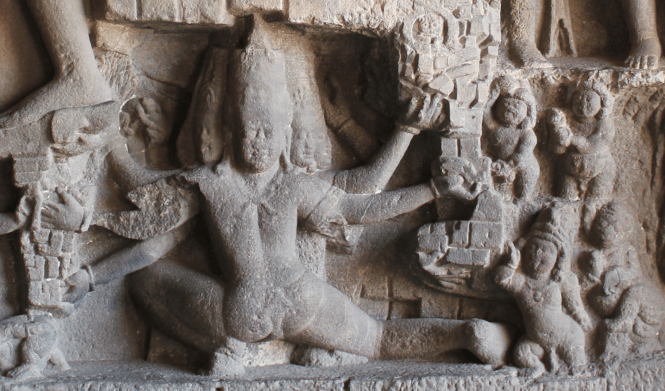
Ravananugrahamurti – Ravana shaking Mount Kailash.
The story goes like this. Kailash was not under the Chinese control as we see now. So Ravana did not need to wait for a visa in their Embassy. Ravana, one day Ravana reached Kailash to offer his prayers eagerly, like I stepped into cave 14. Shiva and Parvati were spending time together, because of which Ravana was asked to wait.
After waiting for long time, he lost his patience. Why would Shiva make a devoted follower and powerful ruler like Ravana wait so long? Out of impatience and so much confidence on his confidence, he tried to lift and shake mount Kailash. He wanted to grab Shiva’s attention, to remind him to come for darshan, the meeting.
His actions caused tremors in Mount Kailash. Everybody came to Siva Parvati in fear. Parvati too look confused, but Shiva knew Ravana’s intentions. As he liked Ravan, he wanted him to teach a lesson to kill his ego. With his thumb finger in his toe, he pressed the hill slightly. He doesn’t want to crush Ravana but it shot up the physical and mental stress for Ravana, he couldn’t hold the mountain any more.
Given up and realized about his mistake, Ravana wanted to do something to pacify Shiva. He pulled his nerves in his thigh tightly and made them as strings. Treating his body as Veena and his nerves as its strings, he played an enjoyable rhythm.
This story is sculpted in life size bas-relief in cave 14, a Hindu cave temple at Ellora dating from the early 7th century AD. It features a large mandapa with massive decorated pillars.
It has a notable panel depicting Ravana shaking Mount Kailash. This relief sculpture is located on the south wall of the cave and is based on a mythological theme from the Hindu epic Ramayana.
Ravana and Mount Kailash, Pandian Ramaiah, 07 Dec 2007. We may even have a treasure hunt to see how many panels depicts this story in Ellora.
When I saw the scale, the intricate details and dynamic composition, I opened my mouth in wonder. Because I never saw such bas-reliefs.
At the bottom of the panel, Ravana is depicted with ten heads and twenty arms, emphasizing his power. His multiple hands are carved in various positions to convince us about his effort to lift Mount Kailash.
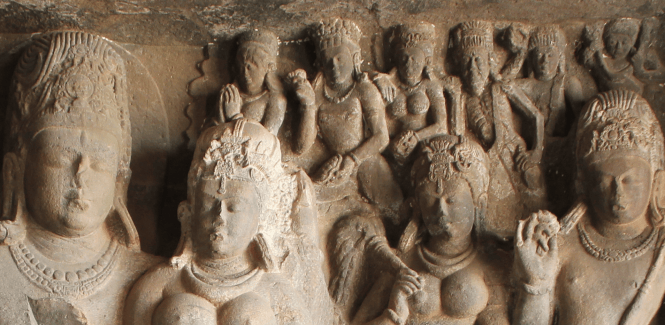
Lord Shiva positioned at the top of the panel, Shiva is shown seated calmly on Mount Kailash. His jatamakuta (hair crown) is carved with detail to form a respectable crown. Not only Shiva, it is so beautiful to see the stylish hair adornment and jewelry of Parvati, her chowry bearer too.
Parvati, seated beside shiva, reclining to her husband. Somebody say her face shows alarm. Her face reaction tells me that, she too aware of what’s happening and curious to know what will eventually unfold with a knowing smile. Her vaddanam (ornamental belt/oddiyanam), mathapatti (ornament that decorates the border of the hair in forehead) and nethichutti (jewelry at the centre of the forehead) are carved with fine details..
The panel includes terrified maidservants and rishis rushing about. These figures would be comparatively smaller, but still richly detailed, with expressive gestures that add depth to the scene.
Last but not least, look the four dwarfs below, who are depicted mocking Ravana, adding a touch of humor to the scene. Their small stature and exaggerated expressions would contrast with the more serious main figures.
Sites like Ellora will make any visitor crazy. Because such places has enormous to offer. They carry piles of arts and cultural heritage knowledge and stand as a silent witness for our past and how different beliefs or way of life originated in India and find their ways of betterment. Like Andal sings in her Thiruppavai, எல்லே இளங்கிளியே! இன்னும் உறங்குதியோ!, these artifacts asks us to wake up and gather more knowledge. This life is like our mother, takes effort to carry us, and offer us wisdom.
Pandian Ramaiah, 15 Dec 2007.
I’ll meet you with another post with another artifact. Until then have a blessed day.
Have you been to Thirumayam? If you are a orthodox Vaishnavite, it is a revered divyadesam – one of the 108 holy shrines celebrateed by Alwars in their hymns. The Vishnu shrine here predates the famous Srirangam temple. The Ananta Sayani – Vishnu reclining on his serpent bed with Lakshmi beside him – is larger than that of the one at Srirangam.
Shaivaites also find significance in Thirumayam, home to a magnificent Siva temple. The consort of Lord Shiva here is beutifully named as Venuvaneswari. That means ‘Eswari of Venu Vanam‘ (bamboo forest). The temple is attached with an octagonal shaped uruni – the holy pond.
Satyagirisvara temple (Shiva temple), Pandian Ramaiah, 28 Feb 2010. There are two famous rock-cut shrines, one of Siva [shown here] and the other of Vishnu, adjacent to each other.
Historians will find Thirumayam brimming with centuries of historical facts. The cave temples are believed to date back to 7th century AD. From a chronology perspective, I need to highlight that work at Ellora caves might have started around this time. It features one of the Tamil Nadu’s largest inscriptions. The site witness the stories of colonial aggression too.
Thirumayam Fort, Pandian Ramaiah, 28 Feb 2010. Before reaching the town, one can see a fort atop a large hill. In past centuries, the fort was much larger than what now obtains; this is affirmed by the fact that the main entrance to the old fort lies about one kilometer south of the present-day fort. This extrance to the old fort still stands, it has a courtyard with pillared corridors and shrines of various deities. The sculptures on the pillars are truly beautiful. The Thirumayam fort, set in 40 acres, is of great historical importance. It was built by Sethupathi Vijaya Ragunatha Thevar, ruler of Ramanathapuram in AD 1687.
But I write this post to mention about one of the icons, that left a profound impression on me – Lingodbhava.
How ever this post focuses on a particular icon that deeply captivated me – the bas-relief of Lingodbhava.
It shows the supremacy of Lord Shiva. It begins with a dispute between Brahma and Vishnu over who is superior. To resolve this, Shiva manifested as a colossal pillar of fire, challenging them to find its beginning or end. Brahma transformed into a swan and flew upwards. Vishnu became a boar and dug downwards.
After a long search, Vishnu accepted defeat, recognizing Shiva’s greatness. In contrast, Brahma falsely claimed he found the top with the help of a tāḻampū – screw pine flower (or Ketaki flower in some version). Angered by this deceit, Shiva cursed Brahma to be un-worshipped, thazhampoo and Ketaki flower are banned from using it to adorn gods and declared that the Lingodbhava would symbolize his eternal presence.
Tamil revolutionary poet Bharati’s poem captures this.
Tamil: அடியும் முடியும் அறிய முடியான் Diacritics: aḍiyum muḍiyum aṟiya muḍiyāṉ Hindi: अडियुम् मुडियुम् अऱिय मुदियान्. Meaning: The one whose start and end could not be found.
Usually Lingodbhava statue is found at the rear of Shiva sanctums. The one in Thirumayam, carved inside the 7th century cave temple, is truly inspiring. Rising from the floor to the ceiling, it is a colossal representation of the story. By the time I saw for the first time, it was breathtaking, unable to avert my eyes.
The entire cave temple was likely adorned with vibrant murals in the past. I can only wonder the splendor of the cave with its decorated walls and ceiling. Sadly, most of these murals are lost. mirroring the fate of similar paintings in Sittannavasal and Kanchipuram.
This Lingodbhava in Thirumayam is one of the earliest such artifacts in India.
Since that encounter, whenever I see Lingodbhava, it inevitably evokes the memory of the one in Thirumayam.
The realization of truth in life mirrors this philosophy. The more we dig, more we learn.
Pandian Ramaiah, 28 Feb 2010. There is no connection between this picture and this post. It is the memory of the road and bus existed a decade ago, before taken over by National Highways.
Jaggu was anxiously waiting at one of the platforms of Dadar station. He looked like a lost child at a temple festival. He was waiting for Devagiri Express bound for Secunderabad.
It was a tiresome day at his iron scrap company. By the time he left the godown, it was almost 7pm. His train was scheduled for 9pm. He rushed to Borivali to take dresses for 2 days and rushed to Dadar station like a 108 ambulance.
Boss of his very first company was a master in Ajanta and Ellora. Jaggu called him a couple of weeks back to get his suggestion to visit those places.
“What a kollan (scrap iron seller) is going to do in an artistic place? Are you going to dig any iron mine there?”
“Ayo sir. No. Just to enrich my..”
“Enrich what?”
Our hero Jaggu removed all his ornamental romanticisms in his words and put it in black & white.
“No sir. I have a weekend. I’d like to visit Ajanta and Ellora”
He suggested reaching Jalgaon first. It is easier to reach Ajanta from there. It was not convincing for Jaggu. It was true. Ajanta is nearer to Jalgaon. But Ellora is far away, more than 200 KMs. Travel time will ruin his plan. Mumbai to Jalgaon; Jalgaon to Ajanta; Ajanta to Ellora; Ellora to Aurangabad; Aurangabad to Mumbai. Jaggu decided it wouldn’t work out. He finalized one option finally
Mumbai – Aurangabad (1 night trip by train – onward)
Jaggu found good reviews about the travels on Wiki Travel site. He dialed them from the dusty and rusty phone of his iron scrap company. Pankaj picked up the phone on the other end. Jaggu spoke to him few simple sentences.
“I will come to Aurangabad after one week. Hindi and Marathi letters are like Karasev and Seenisev (sweet sev) for me. I can not speak both of them. I like to visit Ajanta and Ellora. I need someone who can pick me from railway station on Saturday morning, take me to those places, and drop me the same railway station by Sunday night. Could you help me?”
Pankaj was so confident, “You just come over. Don’t worry”.
Jaggu asked for one more assistance, “Could you book a hotel room as well, please?”.
“No problem”.
A reliable business man like Pankaj are the Gems of Indian tourism. If Jaggu was the president of India, he would make him a tourism minister. Jaggu’s colleage said that the travel agent may get a commission for booking the room, etc etc. So what? He work for Jaggu, right? As long as he helps his guests to have a memorable journey, nothing wrong with giving him minister post! No. Not to get more commission; but to establish trusted tourism environment. It’s rare to see such sincere guys in India – or at least in Jaggu’s native place.
The next step was to book the tickets in Devagiri Express, all within 15 minutes! The search for caves would be sweet like a jilebi only if there was no travel problem!
All was well, except that Dadar station, where Jaggu was waiting for his train then. There were plenty of platforms like Chennai Central. There was a parade of night trains. They came and stopped on the platforms with a screeching sound one after another. At no time, they left the platform with a paaang horn. In between, they wait for 1 or 2 minutes to board the passengers. Miserably some of the trains do not have name boards at all. Jaggu enquired here and there, and finally he was waiting on that platform. Despite being a nationalistic, he was blaming himself.
‘Indians do wonders; sometimes blunders too.’
Was it that difficult to keep the name boards and arrival and departure screens? Indian railway should learn to serve its guest like Pankaj!
The train arrived late by 10 minutes. The crowd of passengers started running back and forth on the platforms like the warriors running in war fields in Baahubali movie. Jaggu saw all passengers start running back and forth furiously, like the Kaalakeya-s of Baahubali movie. He, too, ran across the mob to find his S8 coach.
Representational picture (c) Wikipedia
Jaggu was sitting in his aisle seat. There was a white lady sitting in the opposite seat with an North (or east) Indian guy, who looked younger than her. With an oily face and a kadukkan (ear ring) he looked weird. It was like Pakoda Kathar (a comedian in old Tamil movies) and Padmini (Leading heroine in old Tamil movies) acting in the lead roles. Whatever. It is up to an individual.
There was an elite-bald-gentleman sitting besides Jaggu. He took out baby cucumbers, a knife and a plastic plate. While he started cutting the cucumbers, he tried to socialize with the white lady. Bored Jaggu eavesdropped into their conversation.
“Haaai”
“Haai”
“Are you a tourist here?”
“Ya. I’m a traveler” *smiles*
“Interesting.. Which country are you from?”
“Belgium”
“Oh you travel alone? That’s great. European ladies are usually bold in nature..” (The discussion was not annoyed by the tuk tuk sound of cutting the cucumber in plastic plate).
“Na Na.. He is my companion.” Her fingers pointed at the kadukkan guy with the oily face. Kadukkan guy smiled at the elite for the sake of doing it.
“Oh.. Wonderful. “. (To the kadukkan guy) “How do you know her?”
“…”
(To the European) “How do you know him? You need to be careful while traveling alone”. Jaggu understood the elite man got suspicious.
“He is my Facebook friend”
Jaggu felt he should jump out of the train immediately.
The elite-balded-head took out a bottle and glass. A transparent liquid with a savor smell was poured into the glass with bup bup sound.”
“You want to have some wine?”
“No Thank You. I have mine”.
Jaggu stood up to push his bag on his upper birth. Like an angry monkey, he jumped to his birth at no time. He could not tolerate the discussion any more as he was so jealous of the kadukkan and elite. Still the discussion was going on, like the one between Indian and Chinese armies.
“Why don’t you have some salads”
The kadukkan boy was still looking out side the window on the opposite side.
“No. Thank you. I don’t like cucumbers”
She might be bored as well. She too got up and came up to the opposite upper birth. She smiled at Jaggu and thanked him, as he helped her to switch on the fan. Before she completed her odomos coating, Jaggu went to a deep Zzz mode with a light snoring.
While he was asleep, he woke up on hearing the noise of stone pelting on the train. Aurangabad was marked as a district of concerns due to naxalism.
There are two unsolvable problems in India – one is diabetes; the other one is stone-pelting!
As promised, Pankaj’s driver was waiting with a name plate early in that cold morning. It was written as JAGGU, Mumbai. Jaggu got goosebumps. He became a Mumbaikar in just 3 weeks :-). A nice room was reserved for him in a nice hotel as well.
At Aurangabad station
The punctual driver Easwar told Jaggu, “You take a nap first. We may leave at 8 a.m. Hotel breakfast may not be suitable for you. I will take you to another South Indian restaurant for breakfast”.
Jaggu slept for two hours. He still felt the jolting of the train compartment. He went to the reception at 7:50. Easwar came on time, as promised. There was a hotel nearby. Easwar preferred to have Kesari after Jaggu compelled him to give him company. On his recommendation, Jaggu ordered for dosa. Actually, it was not that good. Jaggu should have ordered local food.
They started after breakfast. Easwar liked Aurangabad very much. He kept on praising his town. Jaggu was not amused as it was like Trichy or Madurai in Tamilnadu. They came out of the city and joined the beautiful highway in 15 minutes.
The attractions started from Khuldabad. They visited Aurangzeb’s tomb. It was a wrong choice to have a tomb as the first stop; that too belongs to a tyrant. Jaggu asked Easwar to avoid the local attraction as he wanted to spend time at Ellora.
The high way was like any other Tamil Nadu highway (of 2007). It had pits like the dents of Moon. There were mountains, ridges, and bushes all over. Jaggu was wondering, if there were a bunch of mountains, it would be surprising only if Ellora had not been constructed!
Daulatabad was another town on the way. It had a fort with artillery. It became the capital of Mohammed bin Tughluq. Later that place was abandoned due to water scarcity. Devagiri was its old name. Changing Devagiri into Daulatabad is secular and renaming it back to Devagiri is communal in India!
Jaggu avoided that port, as his time did not allow him. The road contained different entrances; they might have been the entrances to the old fort. The ghat road starts immediately after Daulatabad. Ridges of fort walls were seen even on the hills.
Daulatabad FortChamber of guards?!The ghat road beginsSecurity chamber?Travel through dry land on a breezy morningGrishneshwar Jyotirlinga Temple, sometimes referred to as the Ghrneshwar or Ghushmeshwar Temple, is one of the shrines dedicated to Lord Shiva that is referenced in the Shiva Purana. It was on their way.
This place was not in Jaggu’s plan. Still, he respected his driver’s choice as he insisted “How come you come to our place and refuse to see this?” :-). That was one of the 12 Jyotirlinga Lingam temples. It is located in the village of Verul, very close to Ellora.
Siva Siva!
They went down and down like a cobra moves among piles of straws to reach Ellora at 11am.
Elluru village
Upon entering, Jaggu saw the Kailasanatha cave and screamed in joy. But Easwar did not stop the car.
“Hey, Stop Stop. where are you going?” Jaggu shouted. Easwar got worried if he would jump out of the window.
“Wait. Look the way I suggest you” Easwar replied with a determination. He stopped the car in one place. Jaggu will look at the nearby caves and return. Both of them will drive to the next cave. Thus he was able to see all the caves in 4 hops.
A total of 34 caves. Hindu caves, Buddhist caves and Jain caves. It is a treasure trove of art.
It will become a book, if the caves are explained one after the other. Readers can enjoy the pictures below.
The journey begins, directly to the last cave 32. This is called Indra-sabhaThe kodi-maram or dhwaja sthambham (flag pole) had grown tall. Taller than you and Jaggu.The stone elephant – opposite to the flagpole.Caves carved like bird cages, beside the dhwaja sthambham
What made me so excited was the grandeur of it! Floors and canopies in the cave. Very fine sculptures. And, its size! WOWW!! Massive!
TerraceDecorated entrance.34th Cave, Jain Acharya and his disciplesWhat a cave, not at all. It is a palace with multiple attics!Cave 33 – Indrani (There was a connecting path between the caves. Jaggu played hide and seek)The majestic pillar, in which the wavy ornaments and small and large reliefs are sculpted elegantly. I do not know what to say, adornment for stone, adornment for God Himself?Possible to do in a stone? Yes!Is it to support the roof or to soak us in dreams?Cave 33 – Indra Sabha.Is this an unfinished art work?? Even so, it looks like appeared and dissolved in the stoneThe reminiscences of paintingThe reminiscences of paintingAcharya-sCave 33 – Indra Sabha. (50 pictures over already, but still we did not finish 2 caves). Multi story caves is something we can not see in Tamil Nadu.கண்களுக்கு விருந்தாகCave 33 – Indra SabhaCave 33 – Indra SabhaCave 34Cave 33 – Indra SabhaThis cave appeared as Jaggu roamed around leisurely.. What a strange place! What a treasure! Eyes were given just to view this, dear readers; just to view this!Cave 29. Lord Siva was boiling with anger. It is of the height of two men. You may see the face only if you stand on Jaggu’s shoulder!Cave 26 – Ravana and Mount Kailash. This sculpture can be put up as a treasure hunting competition. You can find it so many places across the Ellora caves.Cave 26 – Siva Parvati weddingCave 26 – The kailayaHmm.. seems there is a path here.Wow. there are some caves on the other side..Later, he ran to the other side and came back. The path is a bit difficult. Make sure you do not fall off the cliff. This is where the waterfall is located during the rainy season. It may pour for six or seven months. Jaggu is not lucky to view that.The same place during rainy season. Picture (c) tripotoCave 27 – Balarama, Sri Krishna, Seshasai VishnuCave 27 – VarahaCave 27 – The hall with all the sculptures seen above, starts from Mahishasura MardiniCave 26Cave 26Cave 26, 27Cave 25 – Sanctum, (Bass relief of Sun god in the canopy),23, 24A, 24BKannika-s / Kannimar-s / Saptamatrika-sCave 21 – EntranceCave 21Cave 21Cave 21 – Ganga standing on a crocodile. This sculpture glistened in the afternoon sunlight.Cave 21 Cave 21 – Ganga and other women standing in a lotus flower to welcome the devotees. This is the most beautifully carved cave in Ellora.கைலாயம்Cave 21 – Ananda thandavaCave 21 – Is it a rock or clay? They rendered the hair style like a beautiful drawingCave 21Cave 21Cave 17ACave 17ACave 17ACave 17A – it may look like an mediocre. But it is a heaven of sculpturesCave 12. Rows and columns of caves -3 storiesCave 12. Rows and columns of caves -3 storiesCave 10 – The only cave in Buddhist Chaitya structureCave 10. The ornated cave is said to be dedicated to the divine engineer Vishwakarma. What has he got to do with Buddhism? Mahayana is inclusive. It says ok-lah!Cave 10Cave 14Cave 14Cave 1: The origin. The first cave. It is said that the cave was probably built for lodging and then started to be used by Buddhist monks. 6th century AD
To this day, Kailasa Temple is the reminiscent of the Ellora caves. Why? Because of its beauty? But everything there was beautiful! Its structure made the difference. It did not belong to West Indian architecture. The temple belongs to South Indian architecture. The big temple was carved out of a single rock, from top to bottom. Not from bottom to top! Remember the monoliths of Mahabalipuram.
The Kailasa Temple is a fine example of South Indian-Rashtrakuta temple architecture. Rashtrakuta King Krishna-I – ruled in the 7th century – extended his rule until Karnataka. It is said to have been built in the form of the Virupaksha Temple at Pattadakal.
The awful work of rock carving. South Indians may feel at home, on alien soil. As if in a trance, you may be wandering in and out of that temple. It may be one of your enchanting moments, in which you burst into endless soliloquy.
On the way back
Did those caves get carved into the rock, or were they sculpted in our minds? Jaggu’s mind was overwhelmed with Ellora. This is our address, our identity, our ancestral home. Jaggu’s desire was that everyone should go at least once in their life time. Perumal thirumozhi renders a beautiful line ‘கோனேரி வாழும் குருகாய்ப் பிறப்பேனே’, that expresses the poet’s eagerness to rebirth as a stork in Venkata hill (Tirupati). Jaggu wondered, what if Ellora rejuvenate itself with all the monks of Hinduism, Jainism and Buddhism pursuing their duties. If that happens, he wanted to rebirth as a rat, that can steal the ghee of the lamps of these cave temples and eat it secretly 🙂
***
I’m participating in #BlogchatterA2Z 2022 with theme Yātum ūrē!