Tirtankara, Thekkattur

Thekkattur was a sleepy village. I missed my own village, when I went there. The rhythms of villege life contrast sharply with the frenetic pace of urban living. If we pause to reflect on the purpose behind our hurried urban existence, we might struggle to justify it.

Probably, many people think this way and realize the other side of economy-driven countries. Many nations face declining birth rates and aging population, with some individuals forbids marriage and parenthood.

However, our focus shifts from these global trends to more localized societal phenomenon. We went to Thekkattur to trace our ancient society.

Pudukkottai was one of the Jaina settlements. In this series itself, I wrote about Sittannavasal, Samanar Kudagu and Kudumiyamalai. There are so many other places where you can see Tirtankara image. One of them was Thekkattur.

Kiran (Or the Professor) had learned about this site from historical documentation. With no knowledge of its whereabouts, we went there. We were confident to reach the place by enquiring the locals, but it does not take much time to prove us wrong.

None of them know words like Tirtankara, or Jain. One lady on the outskirts of the village sounds like she understood what we search for. She pointed to direction, we went there without any second thought. With a barb wire fencing, Tirtankara was sitting alone with traces of Kunkumam on his shoulders.

Tirtankara, Thekkattur (latest image) | Picture: @Jainismrevival

The lady said it was Kali image, anyway she wanted us to view it first. Yes, the image was worshiped as Kunkuma kali.

Jainism spread in this southern part of India during late of BCE. They contributed to Tamil literature and grammar. Kings, specifically, Pandya-s, patronized Jainism. I have written about Srimaran Srivallabhan in this series.

Jain ascetics used the beds, polished in the natural caverns, over 1000 years, to perform penance. The beds are testament to the lineage of teachers, as some of their names are mentioned in the beds. One of the oldest Tamil Brahmi inscription, found in Sittannavasal mention this history.

erumi nāṭu kumuḻūr piṟanta kāvuṭi īteṉku ciṟu pōcil iḷayar
ceyta atiṭṭāṉam.

எருமி நாடு குமிழூர் பிறந்த காவுடி ஈதென்கு சிறு போசில் இளயர்
செய்த அதிட்டனம்.

एरुमि नाडु कुमिळूर् पिऱन्त कावुडि ईतेन्कु चिऱु पोचिल् इळयर्
चेय्त अतिट्टनम्।

Let me quote from prof S Swaminathan –

It mentions that one iḷayar of teṉku ciṟu pōcil made this seat for kāvuṭi born in Kumiḻūr in Erumi nāṭu. It is believed that the Kumiḻūr in Erumi nāṭu refers to a place in the present Vellore district.

This part of land accepted them as teachers and their abode was considered as school or Palli. Names of cities like Tiruchirappalli (abode of saint Siraa), Thirukattupalli (temple of Mahavira) have direction mention of Jain monasteries.

Other than this, there are many places, where isolated sculptures of Tirtankara was found. Thekkattur was one of them. What made me happy was, this image was in better place compared to its counter part at Annavasal and Bommadi Malai. The Annavasal surrounding was so horrible that made us to double think before we go near by. This was more than two decades ago, well before the Jaina association cleaned and erected boards.

Let it be worshipped as Tirtankara or Kali, it will make the one who erected that sculpture happy!

This post is part of Blogchatter’s WRITE A PAGE A DAY 2025 campaign.

Devapaladeva’s copper plate, Nalanda

While preparing for museum tours, I learned that kings from both India and Southeast Asia made donations to religious institutions of each other. I researched more and came to know about a valuable artifact – The Devapaladeva’s copperplate inscription.

Hiranand Shastri, the Indian historian and epigraphist, mentioned that he found this copper plate during his exploration of Nalanda University in 1921 in Monastery B (Wiki says Monastery 1). Despite the campus was destroyed heavily, this was not affected much. He looks to be happy to find this copper plate intact. With the help of Archaeological chemist, he was able to read the characters.

He is fascinated by this discovery, as it talks about kings of other countries, which made this copper palate of International value.

Devapaladeva inscription | Picture source: Reddit

Devapaladeva, a king of the Pala dynasty, issued this copper plate inscription granting permission to build a monastery at the request of the King of Suvarṇadvīpa, conveyed through a messenger. It also talks about the purpose of the offering in detail.

Suwarnadvipa or Suvarṇadvīpa is the island – south and central Sumatra in particular.

The southeast Asian Srivijayan king is mentioned as King Balaputradeva. His lineage and his relatives were also mentioned.

His mother was Tārā, daughter of King Dharmasetu of the lunar race. She was the consort of mighty king who was the son of YavaBhumi (yava is Java – remember the famous Yavanarani novel from Sandilyan!). The name of the father of Palaputradeva is not given at all but the name of the grandfather is said to have been something like Śrī-vira-vairi-mathana meaning the illustrious destroyer of heroic foes.

He strongly wrote that the Yavabhumi and the Suvarṇadvīpa are evidently identical with the Yavadvīpa and the Suvarṇadvīpa islands spoken of in Sanskrit works like the Ramayana or the Kathāsaritsāgara and are unquestionably the modern Java and Sumatra.

The Kathāsaritsāgara is a famous 11th-century collection of Indian legends and folk tales as retold in Sanskrit by the Shaivite Somadeva from Kashmir.

Hirananda Shastri, referencing various sources, concludes that Yavadvipa refers to Java proper, while Suvarṇadvīpa corresponds to Sumatra.

With other artifacts, he mentions that Srivijaya ruled Java and Sumatra from 7 to 10th century.

The historical evidence suggests that cultural and economic connections between India and Southeast Asian countries were more extensive in the past than in recent centuries. The decline of these relationships after the 14th century CE marks a notable shift in regional dynamics. This change in international relations and India’s global influence over time presents an interesting area for further historical research and analysis.

This post is part of Blogchatter’s WRITE A PAGE A DAY 2025 campaign.

Javanese golden armlet, Singapore

Recently I joined an nparks tour of Fort Canning Hill. During my Singapore Heritage training last year, I learned about the jewelry excavated from this site, formerly known as Bukit Larangan.

In the British colonial period, construction of a reservoir began in 1927 and finished in 1929 atop the hill, an area now closed to the public. In 1928, workers made a significant archaeological discovery: a treasure of 11 gold objects, including an exquisite Javanese-style gold armlet.

Picture source: wikipedia

This 14th-century armlet features the face of a kala (kirti-mukha or yali), a demon face from Hindu mythology. This motif, common feature on Javanese temples, was believed to offer protection. Please see my post on this motive to know more. The armlet’s intricate design includes skillfully crafted chains and clasps allowing for easy wear and removal.

The discovery suggests that Singapore (then Temasek) might be connected with 14th century Java, possibly belonging to royalty from the Kingdom of Singapura. While talking about Temasek and Javanese, I need to mention about Gaja Mada’s vow for a nusantara which annex Temasek, to show how connected these islands were.

Descriptive picture to show armlets | Generated by Gemini AI

This armlet is displayed at National Museum of Singapore. I blame myself for not visiting it yet!

This is a compelling evidence of medieval cultural exchanges between India and southeast Asia, show casing extensive trade networks that facilitated religious and artistic influences across the region.

For further reading:

This post is part of Blogchatter’s WRITE A PAGE A DAY 2025 campaign.

Barus Tamil Inscription

When I traced the path of Islam to southeast asia, I came across the Tamil inscription of Barus in Indonesia. This inscription mentions about marakkala-nayan, which is maraikayar today, a term used to note the South Indian muslim traders. But when I went behind the inscription, it offers much more than Tamil Muslim connection.

This inscription was found in in 1873 in the village of Lobu Tua (Loboe Toewa), near Barus (Baros), North-western Sumatra province of Indonesia. It is dated back to Saka year 1010 and 1088 CE. This archaeological discovery was reported in Madras epigraphy report of 1891-92 by E Hultzsch, an English Epigraphist based in India. Y. Subbarayalu, an eminent historian and epigraphist says, this text falls within the reign of Kulottunga Chola I of Tamil Nadu.

Barus inscription. Picture source: facebook

The text:

Let me quote –

1 svasti śrī cakarai
1 ஸ்வஸ்தி ஸ்ரீ சக ரை
2 āṇṭu ayirattu[p pa]-
2 ஆண்டு ஆயிரத்து[ப் ப]
3 ttu cellāni[n]-
3 த்து செல்லானி[ன்]
4 ra mācit tingal
4 ற மாசித் திங்கள்
5 vārōcāna mātan-
5 வாரோசான மாதன்-
6 kari vallavat tēci u-
6 கரி வல்லவத் தேசி உ-
7 yyak konta paţ-
7 ய்யக் கொண்ட பட்-
8 ṭinattu vēļāpurattu
8 டிணத்து வேளாபுரத்து
9 kūţi niranta tē[cit ticai]
9 கூடி நிரந்த தே[சித் திசை]
10 viļangu ticai āyira-
10 விளங்கு திசை ஆயிர-
11 ttaiññürruvarō-
11 த்தைஞ்ஞூற்றுவரோ-
12 m nammakanār nakara sēnāpa-
12 ம் நம்மாகனார் நகர சேனாப-
13 ti nattuceţţi
13 தி நாட்டுசெட்டி
14 yārkkum patineņpūmi
14 யார்க்கும் பதினெண்பூமி
15 tēci apparkku mā[ve]t-
15 தேசி அப்பர்க்கு மா[வே]ட்-
16 tukaļukkum nā vaittuk
16 டுகளுக்கும் நா வைத்துக்
17 kututta paricāvatu marak[ka]
17 கொடுத்த பரிசாவது மரக்க[க]
18 la… …
18 ல … …
19 la marakkala nāyanun kēvi-
19 ல மரக்கல நாயனுங் கேவி-
20 kaļum kastū[ri] vilai mu[tala]kappa[ta]
20 களும் கஸ்தூ[ரி] விலை மு[தல]க்கப்ப[ட]
21 ańcu tun[tā]yam ponnum ku[tu]
21 அஞ்சு துண்[டா]யம் பொன்னும் கு[டு]
22 ttup pāvāţai ērakkațavatākavum
22 த்து பாவாடை ஏறக்கடவதாகவும்
23 ippaţikku [i]kkal eluti nāţţi
23 இப்படிக்கு [இ]க்கால் எழுதி நாட்டி
24 k kututtom patineņpūmi tēcit ticai viļa
24 க் கொடுத்தோம் பதினெண்பூமி தேசித் திசை விள
25 ńku ticai āyirattainnūrruvarōm a
25 ங்கு திசை ஆயிரத்தைஞ்ஞூற்றுவரோம் அ
26 ramaraverka aramēy tuṇai.
26 றமறவர்க்க அறமே துணை.

Interpretation

ஸ்வஸ்தி ஸ்ரீ சாகரை ஆண்டு ஆயிரத்து[ப் ப] த்து செல்லானி[ன்]ற மாசித் திங்கள் வாரோசான மாதங்கரி வல்லவத் தேசி உய்யக் கொண்ட பட்டினத்து வேளாபுரத்து கூடி நிரந்த தே[சித் திசை] விளங்கு திசை ஆயிரத்தைஞ்ஞூற்றுவரோம் நம்மாகனார் நகர சேனாபதி நட்டுசெட்டியார்க்கும் பதினெண்பூமி தேசி அப்பர்க்கு மா[வே]ட்டுகளுக்கும் நா வைத்துக் கொடுத்த பரிசாவது மரக்க[க]ல … …ல மரக்கல நாயனுங் கேவிகளும் கஸ்தூ[ரி] விலை மு[தல]க்கப்ப[ட] அஞ்சு துண்[டா]யம் பொன்னும் கு[டு]த்து பாவாடை ஏறக்கடவதாகவும் இப்படிக்கு [இ]க்கால் எழுதி நாட்டிக் கொடுத்தோம் பதினெண்பூமி தேசித் திசை விளங்கு திசை ஆயிரத்தைஞ்ஞூற்றுவரோம் அறமறவர்க்க அறமே துணை. (Text converted from English to Tamil by Gemini AI and proof read by me!)

In the Saka year 1010 current, month Masi, we, the Five Hundred of the Thousand Directions, having met at the Vēlāpuram in Vārōsu (Barus), also called Mātańkari vallavat tēci uyyak konta pattinam (literally “the pattinam (commercial town) for the welfare of the merchant body blessed by Mātańkari, that is, Durga”), decided to grant as follows to ‘our sons’, the nagara-sēnāpati Nattu-cettiyar, to Patinen-būmi-dēsi-appar, and to the māvettu-s (elephant-trainers?): [On each of the] ships’ [cargoes?], the ship’s captain (marakkala nāyan) and crew (kēvi) will pay the fee añju-tundāyam in gold, pegged to the price of kasturi (musk), and [then only] may ‘step on the cloth spread’ (that is, enter the settlement to trade). Thus we, the Five Hundred of the Thousand Directions, known in every direction in all the Eighteen Lands, had the stone inscribed and planted. Do not forget charity; charity alone will help you.

Barus beach, Indonesia | Picture source: Wikipedia

Noboru Karashima of Tokyo University mentioned in his paper INDIAN COMMERCIAL ACTIVITIES IN ANCIENT AND MEDIEVAL SOUTHEAST ASIA published in the Plenary Session Papers of Wold Tamil Conference 1995 – P5 mentions that,

K.A. Nilakanta Sastri discussed the problem of the ainnurruvar (five hundred , I wonder why it was stated in inscription as āyirattainnūr which mean one thousand and five hundred) mentioned in the inscription by examining several South Indian inscriptions referring to it. As he pointed out for the first time in his article, ainnurruvar is another merchant guild that flourished in South India from the tenth to the sixteenth centuries. This big corporate body of merchants that originated in Aihole in Karnataka in the eighth century or so seems to have extended its activities afterwards to Tamil Nadu and Andhra Pradesh, incorporating many other merchant bodies under its banner. It also seems to have kept some groups of soldiers for protection of their commercial activities.

We observe interesting points –

āyirattaiññürruvar: This is the merchant guild or big corporate body of merchants that originated in Aihole in Karnataka in the eighth century. They are also known as Ayyāvoḷe guild. Kanakalatha Mukund, in her book The trading world of the Tamil merchant: evolution of merchant capitalism in the Coromandel says that they had a presence in Kodumbalur which is near to my native.

Nagara-sēnāpati: This is a title that likely refers to a high-ranking military or administrative official within a city or urban center (nagara).

Nāṭṭu-ceṭṭiyār: “Ceṭṭiyār” is a term used to denote a member of the Chetti community, which is traditionally associated with trade and commerce in South India.

Marakkala-nayan: seems to relate to the term marakkayar used to denote the seafaring
Muslim merchants of the Tamil Nadu and Kerala coasts in the later period.

Matankari vallava-dési-uyyakkonda-pattinam: One who is loved by Mataṅkari. vallav means ‘beloved of’ in Sanskrit. This phrase can also be read as beloved of Mataṅkari. Since Matankari in Sanskrit is a form of Durga and the Ayyāvoḷe guild considered themselves as sons of Parameshwari (Subbarayulu Pg.41) it seems appropriate to simplify the translation as beloved of Parameswari.prasasti

Saka calendar: Saka calendar is the traditional Indian calendar system based on lunar months. It consists of 12 months, each with 29 or 30 days. It is used to calculate the dates of Hindu festivals and ceremonies. In Indonesia, particularly Bali and Java, the saka calendar was in practice for centuries. It was in use until 17th centuries. It is believed that Sultan Agung replaced it with Javanese calendar. It is still in practice by Indonesian Hindus in Bali and Java. I read an interesting note in Majapahit: Intrigue, Betrayal and War in Indoesia’s Greatest Empire by Herald Van Der Linde. It goes like this.

Historical Significance

This inscription highlights:

  1. The organized nature of Indian merchant guilds like āyirattaiññürruvar.
  2. Barus’s importance as a thriving port city as Vēļāpuram in medieval Sumatra.
  3. The integration of trade, religion, and governance in regulating commerce.
  4. The influence of Tamil merchants in Southeast Asia during this period.

It serves as a testament to the inter-connectedness of south and southeast Asia through maritime trade and cultural exchanges.

If I had a chance to visit this part of land, I need to visit National Museum at Jakarta to look at this artifact.

For further reading –

  • Ancient and Medieval Tamil and Sanskrit Inscriptions Relating to the Southeast Asia and China, Noboru Karashima and Y Subbarayalu
  • INDIAN COMMERCIAL ACTIVITIES IN ANCIENT AND MEDIEVAL SOUTHEAST ASIA, Noboru Karashima, Tokyo University
  • Maritime History of the Coramandel Muslims, A Socio-Historical Study on the tamil Muslims 1750 – 1900, Raja Mohamad
  • The திசை ஆயித்தைந்நூற்றுவர் – The five hundred (merchants) of a thousand directions, 4prasasti.wordpress.com
  • Lobu Tua Inscription, Wikipedia
  • Five Hundred Lords of Ayyavolu, Wikipedia

This post is part of Blogchatter’s WRITE A PAGE A DAY 2025 campaign.

Samava Sarana, Sittannavasal

I wrote about our exploration of Sittannavasal by bicycle earlier. Later during 2000s I had a chance to understand the meaning of the paintings, as elaborated by scholars.

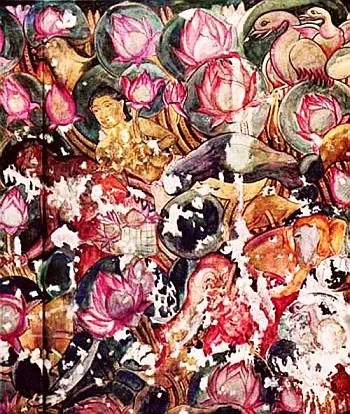
The Samava-sarana theme is a central figure of the Sittannavasal cave paintings. It is dated back to 7th century AD. This beautiful mural depicts a scene from Jain cosmology belief, a delightful Jain heaven containing a hall called Samava Sarana.

Picture source: pudukkottai.org

Samava-sarana or Samo-sharana means refuge-to-all. It is a preaching hall of the Tirtankara-s, stated to have more than 20,000 stairs in it. It is believed that the Samava-sarana seems to have replaced the Jain stupa as an object of worship.

Key aspect of the Samava-sarana painting at Sittannavasal includes the following –

  • The lotus tank (Khatika-bhumi) where the bhavya-s (jain faith followers attained the heaven) gather to hear the preaching of Tirtankara.
  • Bhavya-s collecting lotus flowers, carrying baskets
  • Animal motives makes the painting interesting. We see fishes, birds, bulls/buffaloes and elephants.

The face of the bhavya‘s looks neat, with arranged hair and pendant ear lobes.

Picture source: Karwaan Heritage

Similar motives can be found in other Jain worshiping places. But Sittannavasal paintings are considered as one of the earliest examples of Jain frescoes in South India.

Further reading:

This post is part of Blogchatter’s WRITE A PAGE A DAY 2025 campaign.

Bodhisattva, Gandhara

The Asian Civilisations Museum (ACM) in Singapore recently received Buddhist artifacts from Kolkata. I had been a visitor there. Upon entering the museum, visitors are immediately captivated by the striking Gandhara Bodhisattva head, its arresting composure sought attention even before they reach the special exhibition. With it’s intricate decorated ornaments, curly hair/mustache/beard. It does not look like conventional Buddhist artifacts.

As I stood before the stunning Gandhara Bodhisattva head, memories of my school days flooded my mind. In class 9, we had studied about Gandhara artistry, but without any background in artistry, it was hard for us to fully appreciate its significance at the time. However, life has a way of circling back. Recently I had a visitor from India, who specifically asked about this artifact. It was heartening to see people taking interest in understanding this piece of history and artistry.

From being just another topic in school to becoming a tangible connection with someone else’s curiosity decades later, it underscored the power of personal experiences and shared interests in deepening our understanding and connection with cultural artifacts.

This is likely a representation of Avalokiteśvara, the Bodhisattva of compassion. But we can not definitely confirm. The short description on roots website did not explain this too. I’ve written in details about Avalokiteśvara in another post of the same series. Hence I am not going to repeat it once again. But let’s focus on this artifact of ACM. This terracotta sculpture is believed to be 4th – 5th centuries AD, the peak period of Gandhara art. This art form is believed to be in practice since 1st Century BC to 7th Century AD.

The style began as an influence of Greco-Roman artistic traditions mixed with Indian art forms. Historians say the refined facial expression of this is influenced by early Gandharan sculpture styles.

Gandharan region, Western Pakistan – Eastern Afghanistan, was of central importance in the development of Mahayana Buddhism from 1st Century BC. It embraced the art forms of Hellenic (ancient and modern Greek), ancient Iran and China, made a fusion with Indian art forms, reflecting the cultural exchange along the silk roads.

Back then, Gandhara art was just another topic in my history textbook, a distant concept without much personal relevance, introduced horribly by my history teachers. Now, standing before the magnificent Gandhara Bodhisattva head, I’m in awe of the rich heritage it represents. Life is interesting, though stressful at times!

For further reading

This post is part of Blogchatter’s WRITE A PAGE A DAY 2025 campaign.

Mula Malurung Copperplate, Kediri, Indonesia

India, also known as Bharat, is a Union of States. As India has a name Bharat from it’s historical background, Nusantara is an equivalent in Indonesia. Nusantara is the name of Indonesian Archipelago or Malay Peninsula.

Indonesians, with diversified cultures and dialects, promise a unified region in the name of Nusantara. From where this word came into usage? That’s what we will see today.

Gajah Mada is a popular prime minister of Majapahit kingdom lived in late 13th and early 14th century. He took a oath, not to give up until uniting ‘Nusantara’ aka the archipelago, during the ceremony of his appointment. It is recorded in Pararaton, the Javanese literature. It is believed to happen in 1336 AD.

The oath goes like this –

Lamun huwus lost the archipelago of amukti palapa, seagrass defeat of the Desert, Seram ring, Tanjung Pura, Ring Haru, Ring Pahang, Dompo, ring Bali, Sunda, Palembang, Tumasik, saman isukti palapa.

I understood that the translation is somewhat equivalent to this –

If I have united Nusantara, I will break my fast. If I have conquered Gurun, Seram, Tanjung Pura, Haru, Pahang, Dompo, Bali, Sunda, Palembang, Tumasik, only then will I break my fast.

Does Tumasik refer to Singapore? Should be. He listed several territories he vowed to conquer before he would ‘amukti palapa‘ (break his fast or enjoy rest). Tumasik was one of the places mentioned in this ambitious oath, representing the island that would later become modern-day Singapore.

But the archeological evidences predates the coining of the word Nusantara. It should be first coined by King Kertanagara in Mula Malurung inscription dated 1255 AD.

To understand this we need to see the successive kings of Singasari of Tumapel, the Javanese Hindu-Buddhist kingdom located in east Java between 1222 and 1292. The list of Kings names them – Tunggul Ametung (overthrown) > Ken Angrok / Ken Arok (assassinated) > Anusapati >Wisnuwardhana > Kertanagara.

The fifth king Kertenagara, based in Kediri, located near the Brantas River in the province of East Java, positioned himself as a combined embodiment of Siva and Buddha. Both Hinduism and Buddhism flourished in Java at that time. In a way, I see his positioning as a way to unify the followers of both religion.

I have a reason to believe so. During later years 1365 AD (1287 Saka year), Mpu Prapanca, authored Desawarnana (also known as Nagarakretagama), under King Hayam Wuruk, registers the competency of religions gaining traction.

During his journey to Darbaru monastery, people on the way raise concerns to Prapanca over people started worshiping Parameswara instead of Buddha. So the kingdom, known for its support to both religion, should have a way to nurture both followers.

But all these lineage existed as Javanese poetry/literature. There was no artifact found to convince the modern historians, until suitable evidences were discovered. One of the significant discovery is existence of the Kingdom is the Mula Malurung Inscription, dated 1255 AD (or 1177 Saka).

The inscription was in the form of a copper plate issued by King Kertanegara, who at that time was still a young king. It was issued to legalize Malurung Village and Mula Village. The gift of the village is offered to one Pranaraja, who is the loyal and diligent employee of Kediri Kingdom. As ordered by his father Wisnuwardana aka Seminingrat, his son Kertanagara carried it out.

The inscription contains the first recorded use of the term “Nusantara”, showcasing Kertanagara’s vision of a vast, interconnected kingdom beyond Java.

As dreamed, Kertanagara formed an alliance with Champa, another dominant state in Southeast Asia, indicating his interest in extending influence beyond immediate borders. During his reign, he subjected Bali to vassalage likely in 1284 AD (1206 Saka), gained control of the Melayu Kingdom in eastern Sumatra, and possibly established hegemony over the Strait of Malacc. These actions demonstrate the practical implementation of his expansionist vision.

It is considered as an evidence of Kertanegara’s vision to unite maritime kingdoms as a defense against the expanding Mongol-led Yuan dynasty of China.

The new capital of Indonesia, which was conceived before Covid pandemic period is named as Nusantara to reflect Indonesian nationalistic pride. I am still searching for the right image of this copper plate. I do not have a verified one. Hence this post goes without any images.

I am just learning about Javanese history. There are high chances of misrepresentation or misunderstanding. Hence, I would be making corrects to this text, as and when I found one.

This post is part of Blogchatter’s WRITE A PAGE A DAY 2025 campaign.
Veerabhadra, Madurai

Madurai‘s bustling street, or ‘kasakasa‘ as we call them in Tamil, were my frequent haunt during my under-graduate years. I’d navigate the crowded Town hall road, hunting for electronic parts for my often-unsuccessful projects. The city’s energy was intoxicating, allowing me to venture there after classes and return home late in the night. Evenings often found me at Periyar bus stand, happily munching onion bajji-s that filled my belly with utmost happiness!

Sri Meenakshi Temple, (mīnākṣī/मीनाक्षी) a stone’s throw from Town Hall Road, became my sanctuary. My reverence for the queen of Madurai grew with each visit, continuing even after I started working, with frequent trips between July and October 2002.

Madurai | Pandian Ramaiah, Oct 2002

Armed with newfound passion for photography and digital camera, I set out to verify my readings about the temple in person. Sadly many of those captured moments have been lost over time.

The temple stands as testament to magnificent sculpture, with Nayaka dynasty’s contributions during 16th and 17th centuries, being particularly impressive. In the mukha-mandapa of the Sri Sundareswara shrine (śrī sundarēśvarā/श्री सुन्दरेश्वरा), The Agni veerabhadra (agni vīrabhadrā/अग्नि वीरभद्रा) and Agora Veerabhadra sculptures captivate visitors.

Agora Veerabhadra, Madurai | Picture (c) Giridhar

Veerabhadra, born from Shiva’s wrath, is a formidable figure Hindu purana-s. The sculpture’s imposing presence is really scary with its four arms on each side wielding various weapons, including a bow in his right hand and left hand taking an arrow from quiver at his back. Notably a long sword – instrument of Daksha’s demise – is in one of his left hands.

As per iconography, Daksha should be depicted with the head of a goat nearby with his hands in a worshiping position. This representation symbolizes his resurrection and humility after Shiva restored him.

Agora Veerabhadra | Picture source: Unknown.

Additionally Bhadrakali, who was also created from Shiva’s anger along with Veerabhadra should be beside him. I don’t recall seeing them. I’ll have to check next time to be sure.

One concerning practice I observed was people throwing butter balls at the sculpture. This ritual, of unclear origin, mars the sculpture’s beauty and combined with inadequate maintenance, is a worrying sight.

The story of Daksha resonates even today, reminding us of the consequences of unchallenged ego. His transformation, symbolized by the goat’s head, represents the potential self-recovery and ensure we are on the way to enlightenment.

This post is part of Blogchatter’s WRITE A PAGE A DAY 2025 campaign.

Laboring women, Darasuram

I had an opportunity of attending a temple tour of Sri Airavatesvara Temple (Airāvatīśvara, ऐरावतीश्वर) at Darasuram (Dārāsūram, दारासुरम) by one of the best historian Mr Kudavayil Balasubramaniam. That was my first time visiting this temple. I had been there alone few times to explore. Yet, I need to read and understand about this temple in detail.

Airavateshwarar Temple, Darasuram | Picture: Pandian Ramaiah 27 Dec 2011

This a marvel in south Indian temple architecture. Built by RajaRaja Chola II and later renovated by Kulothunga III as per the inscriptions in this temple.

This marvelous temple is a gallery of fine carvings of Periyapuranam (Periyapurāṇam, पेरियपुराणम्), stories about 64 Saivite devotees. In addition it has micro carvings, small sculptures, ornamental pillars. It makes any visitors mad and forcing them to come back to this temple again and again.

One of the small sculptures in the rear prakaram (pathway) of the temple is the focus of today’s discussion. The panel is of half foot or even lesser. This unique carving shows a pregnant woman giving birth, assisted by two other women, while one other woman is watching near by (probably waiting to hold baby).

Laboring woman, Darasuram | Picture: Pandian Ramaiah 27 Dec 2011

This carving is notable for its detailed portrayal of child birth and the support provided by women during delivery at that time. Giving birth in standing position is widely practiced in many parts of the world. The techniques may vary. When I search for similar sculptures, there a few within in Tamil Nadu itself. But this is one of the best in aesthetically.

People there says, these sculptures are worshiped by conceived ladies for better laboring. In addition to spiritual symbolism, it stands still as a documentation of ancient delivery (which was practiced until recently), the skillful artistry of Chola kingdom.

This post is part of Blogchatter’s WRITE A PAGE A DAY 2025 campaign.

Bodhisattva Manjushri, Central Java

Java had several small villages. During earlier periods, Indians traders believed the cities in Indonesian archipelago were made of Silver and Gold. This piece of world is called in swarnabhoomi in Sanskrit in India. So when the monsoon starts, they board on ships to reach the islands. They realize what they believed was not fact, yet they do their trade – mainly spices, precious metals, aromatics – and go back to India with several travel baggage.

Those who want more valuable spices stayed back to continue their exploration. They were accompanied by Brahmins who shared stories of the Hindu trinity and Buddhist enlightenment in various villages. Over time, these group of villages developed into power centers, eventually giving rise to the kingdoms of Srivijaya and Sailendra.

Candi Plaosan | Picture : Wikipedia

Sailendra-s controlled central Java where as Srivijaya-s dominated Sumatra. Both of them had trade and cultural relationship. Sailendras formed a powerful Buddhist kingdom. Its rulers were known for their patronage of Buddhism and the construction of numerous temples including Buddhist temple complex at Borobudur and Hindu temples at Prambanan.

The bodhisattva Manjushri, Candi Plaosan | Picture researchgate.net

One of the sculptures – belongs to Sailendra period, from their capital Central Java – is the focus of today’s post – The Bodhisattva Manjushri. He is a significant figure in Mahayana Buddhism. He is one of the four great Bodhisattva-s in Chinese Buddhism – Avalokiteshvara (Compassion), Manjushri (Wisdom), Samantabhadra (conduct) and Maitreya (future enlightenment).

The specific sculptor of this piece remains unknown. It is likely attributed to the Sailendra rulers who were prominent patrons of Buddhist art and architecture during the 9th century. The presence of Manjusri statues in Central Java such as Candi Sewu, suggests a strong reverence.

The sculpture embodies the cultural and religious influences that spread gradually through the interactions of Indian traders, sailors, and monks, who brought Hindu and Buddhist ideas to the region, blending these with local Javanese elements.

This post is part of Blogchatter’s WRITE A PAGE A DAY 2025 campaign.