The Asian Civilisations Museum (ACM) in Singapore recently received Buddhist artifacts from Kolkata. I had been a visitor there. Upon entering the museum, visitors are immediately captivated by the striking Gandhara Bodhisattva head, its arresting composure sought attention even before they reach the special exhibition. With it’s intricate decorated ornaments, curly hair/mustache/beard. It does not look like conventional Buddhist artifacts.
As I stood before the stunning Gandhara Bodhisattva head, memories of my school days flooded my mind. In class 9, we had studied about Gandhara artistry, but without any background in artistry, it was hard for us to fully appreciate its significance at the time. However, life has a way of circling back. Recently I had a visitor from India, who specifically asked about this artifact. It was heartening to see people taking interest in understanding this piece of history and artistry.
From being just another topic in school to becoming a tangible connection with someone else’s curiosity decades later, it underscored the power of personal experiences and shared interests in deepening our understanding and connection with cultural artifacts.
This is likely a representation of Avalokiteśvara, the Bodhisattva of compassion. But we can not definitely confirm. The short description on roots website did not explain this too. I’ve written in details about Avalokiteśvara in another post of the same series. Hence I am not going to repeat it once again. But let’s focus on this artifact of ACM. This terracotta sculpture is believed to be 4th – 5th centuries AD, the peak period of Gandhara art. This art form is believed to be in practice since 1st Century BC to 7th Century AD.
The style began as an influence of Greco-Roman artistic traditions mixed with Indian art forms. Historians say the refined facial expression of this is influenced by early Gandharan sculpture styles.
Gandharan region, Western Pakistan – Eastern Afghanistan, was of central importance in the development of Mahayana Buddhism from 1st Century BC. It embraced the art forms of Hellenic (ancient and modern Greek), ancient Iran and China, made a fusion with Indian art forms, reflecting the cultural exchange along the silk roads.
Back then, Gandhara art was just another topic in my history textbook, a distant concept without much personal relevance, introduced horribly by my history teachers. Now, standing before the magnificent Gandhara Bodhisattva head, I’m in awe of the rich heritage it represents. Life is interesting, though stressful at times!
India, also known as Bharat, is a Union of States. As India has a name Bharat from it’s historical background, Nusantara is an equivalent in Indonesia. Nusantara is the name of Indonesian Archipelago or Malay Peninsula.
Indonesians, with diversified cultures and dialects, promise a unified region in the name of Nusantara. From where this word came into usage? That’s what we will see today.
Gajah Mada is a popular prime minister of Majapahit kingdom lived in late 13th and early 14th century. He took a oath, not to give up until uniting ‘Nusantara’ aka the archipelago, during the ceremony of his appointment. It is recorded in Pararaton, the Javanese literature. It is believed to happen in 1336 AD.
The oath goes like this –
Lamun huwus lost the archipelago of amukti palapa, seagrass defeat of the Desert, Seram ring, Tanjung Pura, Ring Haru, Ring Pahang, Dompo, ring Bali, Sunda, Palembang, Tumasik, saman isukti palapa.
I understood that the translation is somewhat equivalent to this –
If I have united Nusantara, I will break my fast. If I have conquered Gurun, Seram, Tanjung Pura, Haru, Pahang, Dompo, Bali, Sunda, Palembang, Tumasik, only then will I break my fast.
Does Tumasik refer to Singapore? Should be. He listed several territories he vowed to conquer before he would ‘amukti palapa‘ (break his fast or enjoy rest). Tumasik was one of the places mentioned in this ambitious oath, representing the island that would later become modern-day Singapore.
But the archeological evidences predates the coining of the word Nusantara. It should be first coined by King Kertanagara in Mula Malurung inscription dated 1255 AD.
To understand this we need to see the successive kings of Singasari of Tumapel, the Javanese Hindu-Buddhist kingdom located in east Java between 1222 and 1292. The list of Kings names them – Tunggul Ametung (overthrown) > Ken Angrok / Ken Arok (assassinated) > Anusapati >Wisnuwardhana > Kertanagara.
The fifth king Kertenagara, based in Kediri, located near the Brantas River in the province of East Java, positioned himself as a combined embodiment of Siva and Buddha. Both Hinduism and Buddhism flourished in Java at that time. In a way, I see his positioning as a way to unify the followers of both religion.
I have a reason to believe so. During later years 1365 AD (1287 Saka year), Mpu Prapanca, authored Desawarnana (also known as Nagarakretagama), under King Hayam Wuruk, registers the competency of religions gaining traction.
During his journey to Darbaru monastery, people on the way raise concerns to Prapanca over people started worshiping Parameswara instead of Buddha. So the kingdom, known for its support to both religion, should have a way to nurture both followers.
But all these lineage existed as Javanese poetry/literature. There was no artifact found to convince the modern historians, until suitable evidences were discovered. One of the significant discovery is existence of the Kingdom is the Mula Malurung Inscription, dated 1255 AD (or 1177 Saka).
The inscription was in the form of a copper plate issued by King Kertanegara, who at that time was still a young king. It was issued to legalize Malurung Village and Mula Village. The gift of the village is offered to one Pranaraja, who is the loyal and diligent employee of Kediri Kingdom. As ordered by his father Wisnuwardana aka Seminingrat, his son Kertanagara carried it out.
The inscription contains the first recorded use of the term “Nusantara”, showcasing Kertanagara’s vision of a vast, interconnected kingdom beyond Java.
As dreamed, Kertanagara formed an alliance with Champa, another dominant state in Southeast Asia, indicating his interest in extending influence beyond immediate borders. During his reign, he subjected Bali to vassalage likely in 1284 AD (1206 Saka), gained control of the Melayu Kingdom in eastern Sumatra, and possibly established hegemony over the Strait of Malacc. These actions demonstrate the practical implementation of his expansionist vision.
It is considered as an evidence of Kertanegara’s vision to unite maritime kingdoms as a defense against the expanding Mongol-led Yuan dynasty of China.
The new capital of Indonesia, which was conceived before Covid pandemic period is named as Nusantara to reflect Indonesian nationalistic pride. I am still searching for the right image of this copper plate. I do not have a verified one. Hence this post goes without any images.
I am just learning about Javanese history. There are high chances of misrepresentation or misunderstanding. Hence, I would be making corrects to this text, as and when I found one.
Java had several small villages. During earlier periods, Indians traders believed the cities in Indonesian archipelago were made of Silver and Gold. This piece of world is called in swarnabhoomi in Sanskrit in India. So when the monsoon starts, they board on ships to reach the islands. They realize what they believed was not fact, yet they do their trade – mainly spices, precious metals, aromatics – and go back to India with several travel baggage.
Those who want more valuable spices stayed back to continue their exploration. They were accompanied by Brahmins who shared stories of the Hindu trinity and Buddhist enlightenment in various villages. Over time, these group of villages developed into power centers, eventually giving rise to the kingdoms of Srivijaya and Sailendra.
Candi Plaosan | Picture : Wikipedia
Sailendra-s controlled central Java where as Srivijaya-s dominated Sumatra. Both of them had trade and cultural relationship. Sailendras formed a powerful Buddhist kingdom. Its rulers were known for their patronage of Buddhism and the construction of numerous temples including Buddhist temple complex at Borobudur and Hindu temples at Prambanan.
The bodhisattva Manjushri, Candi Plaosan | Picture researchgate.net
One of the sculptures – belongs to Sailendra period, from their capital Central Java – is the focus of today’s post – The Bodhisattva Manjushri. He is a significant figure in Mahayana Buddhism. He is one of the four great Bodhisattva-s in Chinese Buddhism – Avalokiteshvara (Compassion), Manjushri (Wisdom), Samantabhadra (conduct) and Maitreya (future enlightenment).
The specific sculptor of this piece remains unknown. It is likely attributed to the Sailendra rulers who were prominent patrons of Buddhist art and architecture during the 9th century. The presence of Manjusri statues in Central Java such as Candi Sewu, suggests a strong reverence.
The sculpture embodies the cultural and religious influences that spread gradually through the interactions of Indian traders, sailors, and monks, who brought Hindu and Buddhist ideas to the region, blending these with local Javanese elements.
I wrote about an elegant Nataraja bronze from South India in my previous post. Let’s talk about another artifact from Eastern Java today.
The discovery
By 1818, during the era of European colonization that gripped Southeast Asia, Java was under Dutch colonial rule. There was growing interest in Europe in the archaeological and cultural heritage of their colonies. Officers like Stamford Raffles and Willem Stutterheim made journeys through Java and documented their findings.
Much before Stamford Raffles (why I mention him is because he is a venerated British colonial administrator of the Straits Settlements!), D. Monnereau, a Dutch East Indies official, was likely on an official trip or exploratory mission in the Malang area of Eastern Java.
Within the ruins of Cungkup Putri near the Singhasari temple, he identified (or perhaps looted?) the treasure called Prajnaparamita statue.
Buddhist Goddess and her Javanese connection
Prajnaparamita is considered the Goddess of the Perfection of Wisdom in Mahayana Buddhism. She is worshipped as the mother of all Buddhas. Some say this sculpture is a depiction of the first queen of Singhasari—Ken Dedes (also called Dyah Ayu Sri Maharatu Mahadewi or Nareswari). Ken Dedes herself has a captivating story behind her, but that is not the focus of this post. I will write about it another day.
Based on my readings, this is the Buddhist Goddess Prajnaparamita, but it might have been sculpted with resemblances to Ken Dedes. A few suggest this sculpture might have been erected where Ken Dedes was buried. Others write that it may depict Queen Gayatri, wife of the first king of Majapahit. However, this idea is not widely said due to the place it was found.
(c) the sculptor and wikipedia
Javanese art
This Buddhist mother Goddess was sitting in padmasana, on a padma peetam on top of a minimally decorated square platform. Her face is striking us, with a serene expression with downcast gaze. Her hair is arranged into an decorated crown (jata-makuta).
She is adorned with rich jewelry with beautifully carved necklaces, ear rings that matches with her face. A string of pearl wraps gracefully around her body. A lotus creeper with flower is intertwined in her left arm, holding Prajnaparamita sutra.
We need to talk about the fine-carved details of her Batik Sarong which was skillfully rendered. It provides a look of a sensuous drape of real cloth, depicting the goddess as a queen.
This 126 cm tall statue was made from pale rose volcanic andesite stone and is believed to date back to the 13th century. It is one of the finest sculptures representing Hindu-Buddhist Javanese art forms.
Later, this treasure was shipped to the Netherlands and displayed at the Rijksmuseum voor Volkenkunde in Leiden.
The Netherlands, which exerted enormous effort to maintain its colonial rule in Indonesia, later faced protests from Indonesia and international pressure. In 1978, they returned this sculpture to Indonesia as a “gift.” 🙂 This act improved relations between Indonesia and the Netherlands.
Of course, this Javanese mother taught her Javanese children to forgive their colonial rulers.
Bagan is an ancient city, filled with archeological sites, located on the banks of the Irrawaddy River in Mandalay, Myanmar. During 9AD and 13BC it served as the capital of Pagan Kingdom. During this time, astonishingly, over 10,000 temples pagodas and monasteries were constructed. Today, an estimated 2,200 of these still remain. This Ancient city was home to various forms of schools such as Theravada/Mahayana/Tantric Buddhism, Shaivism and Vaishnavism.
Pagan (c) Wikipedia
In 2017, Kannan and I attended a lecture at Asian Civilization Museum by Associate Prof Koh Geok Yian about the daily life of Pagan between 1000-1300. During this talk she discussed the excavation project being carried out at Pagan and showed us artifacts, of course in slides, that had been discovered.
The rise of Pagan
Every Archeological site has a rising or flourishing period. Later they move to saturation before a gradual or sudden decline. Bagan is not an exception too. Buddhism and ancient trade tied these regions closely to India.
Pagan empire (c) Wikipedia
I was searching based on Prof Goh’s talk that night. I came to know something very interesting.
Monks from India, Sri Lanka and the Khmer Empire went to Pagan.
It may have the style inherited from Buddhist stupas of Amaravati and Nagarjunakonda in current day Andhra Pradesh and some parts of Sri Lanka.
The ancient name of Pagan was Ari-madana-pura.
It seems there were some similarities between the temples of Pagan with temples of Pala empire of Bengal. There was trade and cultural exchanges between India and Bagan.
The canopy paintings at Pagan were interesting. Before that let’s see the list of places we may need to visit.
Bagan’s Flourishing period.
Kyansittha Palace – Excavation
Kyansittha was the king of Bagan Empire in the tenth century. Following his father Anawrahta, he continued social, economic and cultural exchanges. Excavation pictures from today’s tourist attraction from Bagan Palace were interesting.
Excavations show Pagal’s influence from China. A lot of Chinese vases, Southeast Asian artifacts, pottery, and fragmentary Buddha head sculptures have been found.
A lot of circular structures have been found. It can be seen in the pictures.
Who doesn’t marvel at Buddhist canopy paintings? I have already written about Ajanta briefly in this post. Similar beautiful canopy paintings exist in Bagan temples too. Tap on Google Images.
Being a riverside city, water journeys are depicted in their paintings.
What will be the daily life of a Bagan? I guess it could be like a peaceful life with blooming worship in monasteries, recitation of mantras and agriculture.
Fall of Pagan
Bagan has reached its peak in 11th and 12th century, starting from 10th century. Culture and economy flourished during Anawrahta’s reign. Bagan used to be known as a city of money. The influx of money brought its own problems. Lured by wealth, the sevak-s and the military destroyed the Bagan constitution.
Like the Ghazni Mahmud’s repeated invasion of India, the Mongolians invaded Pagan multiple times and plundered. The city has also been corrupted by Burmese ethnic groups such as the Rakhine-s, the Mon-s, and the Shan-s (seems they are the descendants of Assamese), a Southeast Asian ethnic group.
Pagan looks like a hamlet today, reminds me of Kodumbalur.
Thanks to the following sites for their images and text –
The upper berths of Indian railways are like attics without a window! He appreciated himself for his philosophy and lying with crossed legs in his ‘attic’ of Devagiri Express bound for Mumbai. Travels – especially traveling alone – were the moment of dhyana for him. He used to get dazzling ideas during such travels. But he will forget all of them when he gets down at his destination. Disturbing his contemplation, TTE knocked on his legs and asked for his ticket.
His chauffeur Easwar had dropped him at Aurangabad station after visiting a bustling attraction – Ajanta. He was so punctual since Saturday morning. He came at 8am sharp on Sunday morning, too, to take him to the promenade that day! The driving time to Ajanta was more than that of Ellora. Instead of any distractions, they went to Ajanta. The view point on the way to Ajanta was an important attraction, he did not visit.
Aurangabad: The journey to Ajanta begins, Aurangabad-Jalgaon-Indore Highway. Approximately 100 km from here.Aurangabad-Jalgaon-Indore Highway.Trail from hill to hill! They say Japan paid for that roadFrom the view point. (c) columbia.edu
If we look at the very old Indian paintings, we have no significant evidences. Paintings of Sigiriya of Sri Lanka, Kanchipuram of Chennai, Sittannavasal of Pudukkottai and Brihadeeswara temple of Thanjavur belong to 5th, 7th, 9th and 11th centuries AD. The paintings at Ajanta help as evidence of Indian painting from the 2nd century BC till the 6th and 7th centuries AD.
Painting at Kailasanatha temple, Kanchipuram – 7th century AD (c) blogvirasatehind.wordpress.comPainting at Brihadeeswara temple, Thanjavur – 11th century (c) Benoy K BehlPainting of Jain ascetic, Sittannavasal – 9th Century (c) Prof S SwaminathanPainting from Sigiriya, Sri Lanka – 5th century (c) lankapura.com
The discovery of Ajanta is an interesting tale. John Smith, Madras Presidency Officer, went out for a hunt in Ajanta hills. He might be an explorer like Jaggu. But Jaggu hates hunters, but that is not our topic of discussion today. John did not find a tiger. But he find a rock-cut-cave on a distance from a hilltop in the midst of the dense forest; there must have been the light of the Buddha – glowing on the banks of a Waghur river, flowing in a horse shoe shaped path – identified itself and asked him to bring to the attention of outer world. The art treasure was later nationalized and became a feast for our eyes and topic of research for our minds.
Jaggu reached Ajanta around 11:30. He needed to escape from the ‘compulsion selling’ of tourist shops from there. Easwar had warned about them earlier. He just kept quiet and passed through the shops. Still, there was one rogue who tried to pull him out to sell something.
No. It is not Pilgrimage to Sabarimala. ‘Explorimage’ to Ajanta
By the time he entered Ajanta, he felt as if he had done a time travel and reached the 10th century. The view was breathtaking.
Caves have been carved here during the time of the Satavahanas (2 BC) and the Vakatakas (AD 6, 7). All are Buddhist monasteries. Their side-walls, canopies or wherever you touch them were filled with impeccable paintings. Buddhist Jataka stories were painted as well. Are you interested in Jataka stories and archeology? Mark my words, you will not be able to visit Ajanta in one day.
Despite the morals of Jataka tales, many granular details, such as costumes, musical instruments, and birds, continue to amuse researchers even today. Analysts are amazed at the continued tradition since the Ajanta painting period till the contemporary period.
The first two caves themselves will show the most important paintings to fill your mind with immense pleasure. That was a place of humble Buddhist monks. Those caves, sculptures and paintings are where their souls are frozen, though they are deceased already.
Cave 1
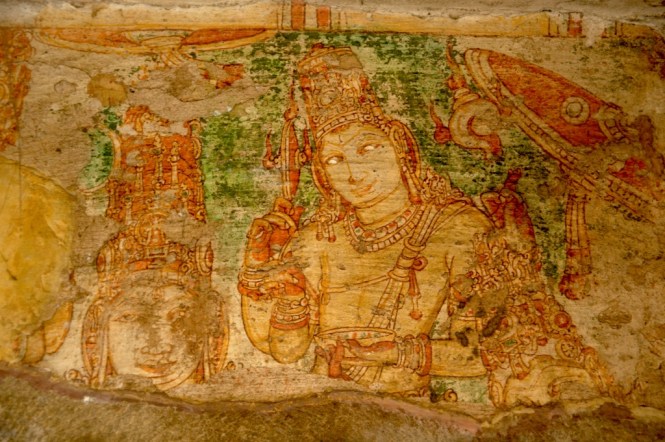
Bodhisattva is any human being who is on the way to enlightenment or path towards ‘Buddha’. Padmapani is a Bodhisattva with compassion. Jaggu was familiar with this painting through books.
Padmapani, Cave 1
Similarly, Vajrapani – holder of thunderbolt – is a God of protection.
Padmapani, Cave 1 (Right side of Sanctum)Padmapani, Karuvarai, VajrapaniMurals, Cave 1Cave 1Cave 2Treasures at Cave 2Cave 2Miracle of Sravasti – Cave 2Cave 2: The sanctum and the muralCave 2: The floral designs. Still we use such type of decorative elements.Cave 6Cave 7
Large symmetrical caves could be seen here, like a tall palm tree, dating back to the 2nd century BC. One of these caves, number ten, was what was discovered by John during the colonial period.
The first-century Chaitya-shaped cave – Cave 9Cave 9Cave 9: There were sculptures depicting the daily life of humansCave No. 10 is probably the oldest of the Ajanta Caves. This majestic look identified itself to John during his hunting. This cave has another specialty. It has the oldest painting of India, that belongs to 2nd century BC.
It is awe-inspiring to see the paintings of the caves of 2nd century BC. Yes. Really. Those paintings have the most perfect measurements for face, makeup, jewelry sets, despite being very old!! Who’d drawn this? What’s his/her name? Was he/she short or tall? That was the land where so many intellectuals lived at those times!!
2nd century BC painting. Neat. Belonging to the Hinayana period The costumes found in those paintings, surprise us. These should be the most interesting paintings for girls.Cave 10Cave 10The cavesDying princess, cave 16Elephant story – Cave 17Indra flying in the clouds Cave 1The Waghur riverThe drinking Couple, Cave 17Cave 17: Decorated entrance to heaven 🙂Cave 17: A feast for the eyes. What kind of place was that? The wall and the canopy of enormous height were filled with painting – everywhere! Jataka tales glittered in paintings!The caves should be visited after a rainy season for a better view!
In addition to the paintings, beautiful sculptures could also be found there. How decorative the arches were! How perfect the elegance of the sculptures were!
Cave 19: This shrine belongs to the late Mahayana period. Chaitya type. The most beautiful and elegant sculptures were found in the cave.Cave 19: A feast for the eyesCave23: Tell me. Which is perfect? the design at the top or the one at the bottom? Cave 19: NagarajCave 23Cave 23Cave 23
When someone dies, his/her unresolved karma passes on to a new birth instantaneously. However, when a person attains nirvana, they are free from rebirth. When such a person dies, it is the end of his/her rebirth. He attains the mahaparinirvana, the eternal divinity.
This cave 26 is the result of your search; the rise of your soul.
Cave 26: This was the last chapter of the Ajanta trip. Exterior decoration and The sculptures will take your time here.A man stands on the right side, helping to infer the height of the caveThis shape is simulated to the sternum of the BuddhaCave 19hmm. so many caves! so many paintings!
Was there no one to disturb the Buddha?! Mara was there. He was known to be a king, who had the contrasting view of life to that of Buddha. Buddha pulled the people towards eternity. Mara liked to pull them towards worldly pleasures. Mara was drawn in cave 1. He has been sculpted in cave 26.
Buddha and Mara. The painting in the first cave was sculpted hereMara climbed on the elephant and came with his evil forces to attack the BuddhaMara climbed on the elephant and came with his evil forces to attack the BuddhaMara’s daughters: Despite the large relief, each of these small sculptures in it is very realistically carvedThe answer to why Jaggu could not be a Buddha was clear. This stone-shaped Mara daughter itself had captivated his mind! How could he practice penance elsewhere! What a dynamic posture it was!Mahaparinirvana: My leader was with us.. walked with us.. shared food with us.. told moral stories.. Performed miracles.. Defeated the evil that resisted. He solved the misery of poor people. Here is where he left me. He quits his job and falls asleep. Om mani padme hum.The final moment. Siddhartha, you came to uplift us, the poor. Let your compassion be with us – ever.
For Jaggu, who hails from Tamil Nadu – the land of small-rock-cut temples carved out of granite rock – Elephanta, Ellora and Ajanta are like swargapuri (heaven). If someone can go with some preparation, like gathering a quick knowledge of Buddhism & Jainism, Indian paintings and Jataka tales these places will be wonderful.
Tiresome early morning at Dadar station.
The Mahan Buddha born on this earth, left his kingly life, abandoned Rahula, and Yosodara, to demonstrate us…. the compassion! Let’s be compassionate with each other! Om Mani Padme Hum!
End of travelogue – Jaggu’s search for cave temples.
I’m participating in #BlogchatterA2Z 2022 with theme Yātum ūrē!
Jaggu was anxiously waiting at one of the platforms of Dadar station. He looked like a lost child at a temple festival. He was waiting for Devagiri Express bound for Secunderabad.
It was a tiresome day at his iron scrap company. By the time he left the godown, it was almost 7pm. His train was scheduled for 9pm. He rushed to Borivali to take dresses for 2 days and rushed to Dadar station like a 108 ambulance.
Boss of his very first company was a master in Ajanta and Ellora. Jaggu called him a couple of weeks back to get his suggestion to visit those places.
“What a kollan (scrap iron seller) is going to do in an artistic place? Are you going to dig any iron mine there?”
“Ayo sir. No. Just to enrich my..”
“Enrich what?”
Our hero Jaggu removed all his ornamental romanticisms in his words and put it in black & white.
“No sir. I have a weekend. I’d like to visit Ajanta and Ellora”
He suggested reaching Jalgaon first. It is easier to reach Ajanta from there. It was not convincing for Jaggu. It was true. Ajanta is nearer to Jalgaon. But Ellora is far away, more than 200 KMs. Travel time will ruin his plan. Mumbai to Jalgaon; Jalgaon to Ajanta; Ajanta to Ellora; Ellora to Aurangabad; Aurangabad to Mumbai. Jaggu decided it wouldn’t work out. He finalized one option finally
Mumbai – Aurangabad (1 night trip by train – onward)
Jaggu found good reviews about the travels on Wiki Travel site. He dialed them from the dusty and rusty phone of his iron scrap company. Pankaj picked up the phone on the other end. Jaggu spoke to him few simple sentences.
“I will come to Aurangabad after one week. Hindi and Marathi letters are like Karasev and Seenisev (sweet sev) for me. I can not speak both of them. I like to visit Ajanta and Ellora. I need someone who can pick me from railway station on Saturday morning, take me to those places, and drop me the same railway station by Sunday night. Could you help me?”
Pankaj was so confident, “You just come over. Don’t worry”.
Jaggu asked for one more assistance, “Could you book a hotel room as well, please?”.
“No problem”.
A reliable business man like Pankaj are the Gems of Indian tourism. If Jaggu was the president of India, he would make him a tourism minister. Jaggu’s colleage said that the travel agent may get a commission for booking the room, etc etc. So what? He work for Jaggu, right? As long as he helps his guests to have a memorable journey, nothing wrong with giving him minister post! No. Not to get more commission; but to establish trusted tourism environment. It’s rare to see such sincere guys in India – or at least in Jaggu’s native place.
The next step was to book the tickets in Devagiri Express, all within 15 minutes! The search for caves would be sweet like a jilebi only if there was no travel problem!
All was well, except that Dadar station, where Jaggu was waiting for his train then. There were plenty of platforms like Chennai Central. There was a parade of night trains. They came and stopped on the platforms with a screeching sound one after another. At no time, they left the platform with a paaang horn. In between, they wait for 1 or 2 minutes to board the passengers. Miserably some of the trains do not have name boards at all. Jaggu enquired here and there, and finally he was waiting on that platform. Despite being a nationalistic, he was blaming himself.
‘Indians do wonders; sometimes blunders too.’
Was it that difficult to keep the name boards and arrival and departure screens? Indian railway should learn to serve its guest like Pankaj!
The train arrived late by 10 minutes. The crowd of passengers started running back and forth on the platforms like the warriors running in war fields in Baahubali movie. Jaggu saw all passengers start running back and forth furiously, like the Kaalakeya-s of Baahubali movie. He, too, ran across the mob to find his S8 coach.
Representational picture (c) Wikipedia
Jaggu was sitting in his aisle seat. There was a white lady sitting in the opposite seat with an North (or east) Indian guy, who looked younger than her. With an oily face and a kadukkan (ear ring) he looked weird. It was like Pakoda Kathar (a comedian in old Tamil movies) and Padmini (Leading heroine in old Tamil movies) acting in the lead roles. Whatever. It is up to an individual.
There was an elite-bald-gentleman sitting besides Jaggu. He took out baby cucumbers, a knife and a plastic plate. While he started cutting the cucumbers, he tried to socialize with the white lady. Bored Jaggu eavesdropped into their conversation.
“Haaai”
“Haai”
“Are you a tourist here?”
“Ya. I’m a traveler” *smiles*
“Interesting.. Which country are you from?”
“Belgium”
“Oh you travel alone? That’s great. European ladies are usually bold in nature..” (The discussion was not annoyed by the tuk tuk sound of cutting the cucumber in plastic plate).
“Na Na.. He is my companion.” Her fingers pointed at the kadukkan guy with the oily face. Kadukkan guy smiled at the elite for the sake of doing it.
“Oh.. Wonderful. “. (To the kadukkan guy) “How do you know her?”
“…”
(To the European) “How do you know him? You need to be careful while traveling alone”. Jaggu understood the elite man got suspicious.
“He is my Facebook friend”
Jaggu felt he should jump out of the train immediately.
The elite-balded-head took out a bottle and glass. A transparent liquid with a savor smell was poured into the glass with bup bup sound.”
“You want to have some wine?”
“No Thank You. I have mine”.
Jaggu stood up to push his bag on his upper birth. Like an angry monkey, he jumped to his birth at no time. He could not tolerate the discussion any more as he was so jealous of the kadukkan and elite. Still the discussion was going on, like the one between Indian and Chinese armies.
“Why don’t you have some salads”
The kadukkan boy was still looking out side the window on the opposite side.
“No. Thank you. I don’t like cucumbers”
She might be bored as well. She too got up and came up to the opposite upper birth. She smiled at Jaggu and thanked him, as he helped her to switch on the fan. Before she completed her odomos coating, Jaggu went to a deep Zzz mode with a light snoring.
While he was asleep, he woke up on hearing the noise of stone pelting on the train. Aurangabad was marked as a district of concerns due to naxalism.
There are two unsolvable problems in India – one is diabetes; the other one is stone-pelting!
As promised, Pankaj’s driver was waiting with a name plate early in that cold morning. It was written as JAGGU, Mumbai. Jaggu got goosebumps. He became a Mumbaikar in just 3 weeks :-). A nice room was reserved for him in a nice hotel as well.
At Aurangabad station
The punctual driver Easwar told Jaggu, “You take a nap first. We may leave at 8 a.m. Hotel breakfast may not be suitable for you. I will take you to another South Indian restaurant for breakfast”.
Jaggu slept for two hours. He still felt the jolting of the train compartment. He went to the reception at 7:50. Easwar came on time, as promised. There was a hotel nearby. Easwar preferred to have Kesari after Jaggu compelled him to give him company. On his recommendation, Jaggu ordered for dosa. Actually, it was not that good. Jaggu should have ordered local food.
They started after breakfast. Easwar liked Aurangabad very much. He kept on praising his town. Jaggu was not amused as it was like Trichy or Madurai in Tamilnadu. They came out of the city and joined the beautiful highway in 15 minutes.
The attractions started from Khuldabad. They visited Aurangzeb’s tomb. It was a wrong choice to have a tomb as the first stop; that too belongs to a tyrant. Jaggu asked Easwar to avoid the local attraction as he wanted to spend time at Ellora.
The high way was like any other Tamil Nadu highway (of 2007). It had pits like the dents of Moon. There were mountains, ridges, and bushes all over. Jaggu was wondering, if there were a bunch of mountains, it would be surprising only if Ellora had not been constructed!
Daulatabad was another town on the way. It had a fort with artillery. It became the capital of Mohammed bin Tughluq. Later that place was abandoned due to water scarcity. Devagiri was its old name. Changing Devagiri into Daulatabad is secular and renaming it back to Devagiri is communal in India!
Jaggu avoided that port, as his time did not allow him. The road contained different entrances; they might have been the entrances to the old fort. The ghat road starts immediately after Daulatabad. Ridges of fort walls were seen even on the hills.
Daulatabad FortChamber of guards?!The ghat road beginsSecurity chamber?Travel through dry land on a breezy morningGrishneshwar Jyotirlinga Temple, sometimes referred to as the Ghrneshwar or Ghushmeshwar Temple, is one of the shrines dedicated to Lord Shiva that is referenced in the Shiva Purana. It was on their way.
This place was not in Jaggu’s plan. Still, he respected his driver’s choice as he insisted “How come you come to our place and refuse to see this?” :-). That was one of the 12 Jyotirlinga Lingam temples. It is located in the village of Verul, very close to Ellora.
Siva Siva!
They went down and down like a cobra moves among piles of straws to reach Ellora at 11am.
Elluru village
Upon entering, Jaggu saw the Kailasanatha cave and screamed in joy. But Easwar did not stop the car.
“Hey, Stop Stop. where are you going?” Jaggu shouted. Easwar got worried if he would jump out of the window.
“Wait. Look the way I suggest you” Easwar replied with a determination. He stopped the car in one place. Jaggu will look at the nearby caves and return. Both of them will drive to the next cave. Thus he was able to see all the caves in 4 hops.
A total of 34 caves. Hindu caves, Buddhist caves and Jain caves. It is a treasure trove of art.
It will become a book, if the caves are explained one after the other. Readers can enjoy the pictures below.
The journey begins, directly to the last cave 32. This is called Indra-sabhaThe kodi-maram or dhwaja sthambham (flag pole) had grown tall. Taller than you and Jaggu.The stone elephant – opposite to the flagpole.Caves carved like bird cages, beside the dhwaja sthambham
What made me so excited was the grandeur of it! Floors and canopies in the cave. Very fine sculptures. And, its size! WOWW!! Massive!
TerraceDecorated entrance.34th Cave, Jain Acharya and his disciplesWhat a cave, not at all. It is a palace with multiple attics!Cave 33 – Indrani (There was a connecting path between the caves. Jaggu played hide and seek)The majestic pillar, in which the wavy ornaments and small and large reliefs are sculpted elegantly. I do not know what to say, adornment for stone, adornment for God Himself?Possible to do in a stone? Yes!Is it to support the roof or to soak us in dreams?Cave 33 – Indra Sabha.Is this an unfinished art work?? Even so, it looks like appeared and dissolved in the stoneThe reminiscences of paintingThe reminiscences of paintingAcharya-sCave 33 – Indra Sabha. (50 pictures over already, but still we did not finish 2 caves). Multi story caves is something we can not see in Tamil Nadu.கண்களுக்கு விருந்தாகCave 33 – Indra SabhaCave 33 – Indra SabhaCave 34Cave 33 – Indra SabhaThis cave appeared as Jaggu roamed around leisurely.. What a strange place! What a treasure! Eyes were given just to view this, dear readers; just to view this!Cave 29. Lord Siva was boiling with anger. It is of the height of two men. You may see the face only if you stand on Jaggu’s shoulder!Cave 26 – Ravana and Mount Kailash. This sculpture can be put up as a treasure hunting competition. You can find it so many places across the Ellora caves.Cave 26 – Siva Parvati weddingCave 26 – The kailayaHmm.. seems there is a path here.Wow. there are some caves on the other side..Later, he ran to the other side and came back. The path is a bit difficult. Make sure you do not fall off the cliff. This is where the waterfall is located during the rainy season. It may pour for six or seven months. Jaggu is not lucky to view that.The same place during rainy season. Picture (c) tripotoCave 27 – Balarama, Sri Krishna, Seshasai VishnuCave 27 – VarahaCave 27 – The hall with all the sculptures seen above, starts from Mahishasura MardiniCave 26Cave 26Cave 26, 27Cave 25 – Sanctum, (Bass relief of Sun god in the canopy),23, 24A, 24BKannika-s / Kannimar-s / Saptamatrika-sCave 21 – EntranceCave 21Cave 21Cave 21 – Ganga standing on a crocodile. This sculpture glistened in the afternoon sunlight.Cave 21 Cave 21 – Ganga and other women standing in a lotus flower to welcome the devotees. This is the most beautifully carved cave in Ellora.கைலாயம்Cave 21 – Ananda thandavaCave 21 – Is it a rock or clay? They rendered the hair style like a beautiful drawingCave 21Cave 21Cave 17ACave 17ACave 17ACave 17A – it may look like an mediocre. But it is a heaven of sculpturesCave 12. Rows and columns of caves -3 storiesCave 12. Rows and columns of caves -3 storiesCave 10 – The only cave in Buddhist Chaitya structureCave 10. The ornated cave is said to be dedicated to the divine engineer Vishwakarma. What has he got to do with Buddhism? Mahayana is inclusive. It says ok-lah!Cave 10Cave 14Cave 14Cave 1: The origin. The first cave. It is said that the cave was probably built for lodging and then started to be used by Buddhist monks. 6th century AD
To this day, Kailasa Temple is the reminiscent of the Ellora caves. Why? Because of its beauty? But everything there was beautiful! Its structure made the difference. It did not belong to West Indian architecture. The temple belongs to South Indian architecture. The big temple was carved out of a single rock, from top to bottom. Not from bottom to top! Remember the monoliths of Mahabalipuram.
The Kailasa Temple is a fine example of South Indian-Rashtrakuta temple architecture. Rashtrakuta King Krishna-I – ruled in the 7th century – extended his rule until Karnataka. It is said to have been built in the form of the Virupaksha Temple at Pattadakal.
The awful work of rock carving. South Indians may feel at home, on alien soil. As if in a trance, you may be wandering in and out of that temple. It may be one of your enchanting moments, in which you burst into endless soliloquy.
On the way back
Did those caves get carved into the rock, or were they sculpted in our minds? Jaggu’s mind was overwhelmed with Ellora. This is our address, our identity, our ancestral home. Jaggu’s desire was that everyone should go at least once in their life time. Perumal thirumozhi renders a beautiful line ‘கோனேரி வாழும் குருகாய்ப் பிறப்பேனே’, that expresses the poet’s eagerness to rebirth as a stork in Venkata hill (Tirupati). Jaggu wondered, what if Ellora rejuvenate itself with all the monks of Hinduism, Jainism and Buddhism pursuing their duties. If that happens, he wanted to rebirth as a rat, that can steal the ghee of the lamps of these cave temples and eat it secretly 🙂
***
I’m participating in #BlogchatterA2Z 2022 with theme Yātum ūrē!