Zeal for Heritage

Singapore’s War Heritage

Part 6: Liberation & Legacy

Recap: Singapore’s wartime experiences, including periods of starvation and the realization that foreign powers could not guarantee their safety, instilled a deep sense of national self-reliance. This history led to the adoption of a total defense policy and culminated in Singapore’s achievement of freedom in 1965.

Previous posts in this series:

  1. Ancient Roots
  2. British Fortress
  3. Colonial Defense
  4. December 1941
  5. Entry into Malaya
  6. Fall of Sarimbun
  7. Gap in Defense
  8. Heroism of Malay Regiment
  9. Infantry
  10. Junction of Pasir Panjang
  11. Killings at Alexandra
  12. Lieutenant Adnan Saidi
  13. Massacre at the Ridge
  14. Negotiation at Ford Factory
  15. Occupation Begins
  16. Prisoners of War (PoW)
  17. Quarters of Changi
  18. Religious Solace (Changi Chapel)
  19. Stanley Warren’s Murals
  20. Treatment of POWs
  21. Underground Resistance
  22. Victory & Liberation
  23. War Memorials
  24. X-perience of Civilians
  25. Yearning for Peace

26/26: Yearning for Peace

This is not an end, but the beginning of passing history to the next generation, offering solace to the descendants of the victims, testing the practicalities of modern days and moving ahead.

History is not limited to history books; it resides in the land beneath our feet and the buildings we see.

Reflections at Bukit Chandu at Pasir Panjang, Singapore proudly remembers the sacrifice of the Malay Regiment. It commemorates Captain Rix, Adnan Saidi, and their troop, who fought until their last breath.

Changi Chapel and Museum explains the hardships and resilience of Prisoners of War. A replica of the Chapel and the sacred cross are maintained here.

Kranji War Memorial is a deeply poignant place where the sacred souls of soldiers rest.

INA Memorial: The Indian National Army (INA) Monument was once a historical site. Mountbatten ordered its demolition in 1945 after Britain recaptured Singapore. Thanks to the National Heritage Board, the site was marked as historic in 1995, and a new monument commemorating the original was erected there.

Former Ford Factory Museum is a historically profound location that marks a dramatic and pivotal moment in Singapore’s history. This commemorates the surrender of British forces, serving as a powerful reminder of the island’s profound strategic importance and its turbulent past.

It is not enough merely to share information.

As the generation that survived the war disappears, passing the torch of memory is our responsibility. They must discuss such sorrowful incidents repeatedly to ensure that history does not repeat itself.

Peace is not merely a situation without war; it is a state we must maintain daily. We need to remember the sacrifices of the past and ensure social unity, as this is what will help us secure lasting peace.

The A to Z journey is not simply a war story; it is a story of humanity. Whether it is the Malay soldier who fell at Pasir Panjang or the Indian/British/Australian POW, the message from all of them is the same:
We sacrificed today to save your tomorrow.

The End!

This post is a part of BlogchatterA2Z Challenge 2026 http://www.theblogchatter.com/

This 26-post series for the 2026 A2Z challenge explores Singapore’s WWII heritage, from the initial invasion to the liberation of Changi Prison. Using concise storytelling, I try to connect historical lessons of sacrifice and the need for peace all around the world.

Lieutenant Adnan Saidi

Singapore’s War Heritage

Part 3: The Battle for Pasir Panjang

Recap: This series details the fall of Singapore during World War II, explaining how British strategic overconfidence and flawed defenses allowed Japanese forces to rapidly conquer the region. It specifically highlights the bravery of the Malay Regiment at Pasir Panjang and the tragic war crimes committed during the final stages of the invasion.

Previous posts in this series:

  1. Ancient Roots
  2. British Fortress
  3. Colonial Defense
  4. December 1941
  5. Entry into Malaya
  6. Fall of Sarimbun
  7. Gap in Defense
  8. Heroism of Malay Regiment
  9. Infantry
  10. Killings at Alexandra

11/26: Lieutenant Adnan Saidi

This post talks about Second Lt. Adnan Saidi, who is at the heart of the theme of Reflections at Bukit Chandu, a World War II interpretative center in Singapore. The bravery and prudence demonstrated by him as a platoon commander are praised even now.

As I mentioned in my earlier post, the Japanese tried to infiltrate C Company at the Pasir Panjang ridge in the early afternoon, disguised as Punjabi soldiers. This was uncovered by 2nd Lieutenant Adnan Saidi and 2nd Lieutenant Abbas bin Abdul Manan, who noticed the troops were marching in columns of four instead of the usual three (the British norm). C Company then opened fire at close range, killing and wounding around 22 Japanese soldiers and forcing the rest to retreat. That awareness saved many lives at that moment. But it is not over.

The final battle that took place later at Bukit Chandu was even more cruel. Artillery attacks wounded many. Adnan suffered severe injuries to his body and legs. Despite losing blood, he did not leave the battlefield. He continued supporting his company with his Lewis machine gun, attacking the Japanese. Until his ammunition was exhausted, he kept firing and guiding his platoon.

What happened a few hours before – the British surrender of Singapore – made Adnan a national hero.

He was captured by the Japanese on the evening of February 14. The Japanese asked him to surrender, which he refused. He was hung upside down from a cherry tree and killed by bayonets. Until he died, he did not give up his loyalty to the British or his aim to safeguard Singapore.

A soldier does not win only in triumph; he wins in the reason why he gave his life.

Straits Times Feb 14, 1996. Image (c) https://eresources.nlb.gov.sg/newspapers/digitised/page/straitstimes19960214-1.1.41

This post is a part of BlogchatterA2Z Challenge 2026 http://www.theblogchatter.com/

This 26-post series for the 2026 A2Z challenge explores Singapore’s WWII heritage, from the initial invasion to the liberation of Changi Prison. Using concise storytelling, I try to connect historical lessons of sacrifice and the need for peace all around the world.

Heroism of Malay Regiment

Singapore’s War Heritage

Part 3: The Battle for Pasir Panjang

Recap: This series details the lead-up to and beginning of the Battle of Singapore in WWII, highlighting British overconfidence and strategic failures. Despite believing Singapore was an impenetrable fortress due to its naval base and perceived natural defenses, the British were unprepared for the speed and innovative tactics of the Japanese, who successfully invaded by land and quickly overwhelmed defenses, ultimately leading to a swift surrender.

Previous posts in this series:

  1. Ancient Roots
  2. British Fortress
  3. Colonial Defense
  4. December 1941
  5. Entry into Malaya
  6. Fall of Sarimbun
  7. Gap in Defense

8/26: Heroism of Malay Regiment

Pasir Panjang Ridge holds an important place in Singapore’s WWII history. In the 1910s, the British established an opium packaging factory at the foot of Pasir Panjang Hill, earning it the name “Opium Hill” (Bukit Chandu in Malay). Opium, along with tin, rubber and tea, was a key revenue source for the British crown in Asia.

Today, Reflections at Bukit Chandu, a WWII interpretation center, occupies a former “black and white” bungalow that once housed the British officer managing the opium plant. While some believe it served as a defensive point during the war, its role remains debated.

With Author Stuart Lloyd at Reflections at Bukit Chandu, 1 Nov 2025

C Company, led by Major Rix, was stationed at Pasir Panjang, consisting of approximately 150-200 soldiers. They faced a significant challenge from the much larger 18th Division of Japanese soldiers. They were the one landed in Sarimbun, as I wrote earlier. See: Fall of Sarimbun

Lieutenant Adnan Saidi, 7th platoon commander, played a crucial role when Japanese troops disguised themselves as Punjabi soldiers to infiltrate C Company. Adnan correctly identified them as Japanese and ordered his men to open fire, a key moment in the battle.

After Major Rix and other officers were incapacitated, Adnan likely assumed command of the remaining soldiers.

Despite being inexperienced in combat, C Company bravely defended their position for two days.

Biar Puteh Tulang” (Death before dishonor) was the motto of the Malay Regiment, embodied by Adnan and his men. Though isolated and eventually running low on ammunition, they refused to surrender, engaging in fierce hand-to-hand combat.

On February 14, 1942, C Company remained steadfast, refusing to retreat even as other troops withdrew, and were among the last organized forces to fight before the overall surrender.

The battle at Bukit Chandu stands as a testament to the sacrifice of hundreds of soldiers, including Captain Rix and Lieutenant Adnan. Their courage in an unequal fight has transformed the site into a monument to bravery.

This post is a part of BlogchatterA2Z Challenge 2026 http://www.theblogchatter.com/

This 26-post series for the 2026 A2Z challenge explores Singapore’s WWII heritage, from the initial invasion to the liberation of Changi Prison. Using concise storytelling, I try to connect historical lessons of sacrifice and the need for peace all around the world.

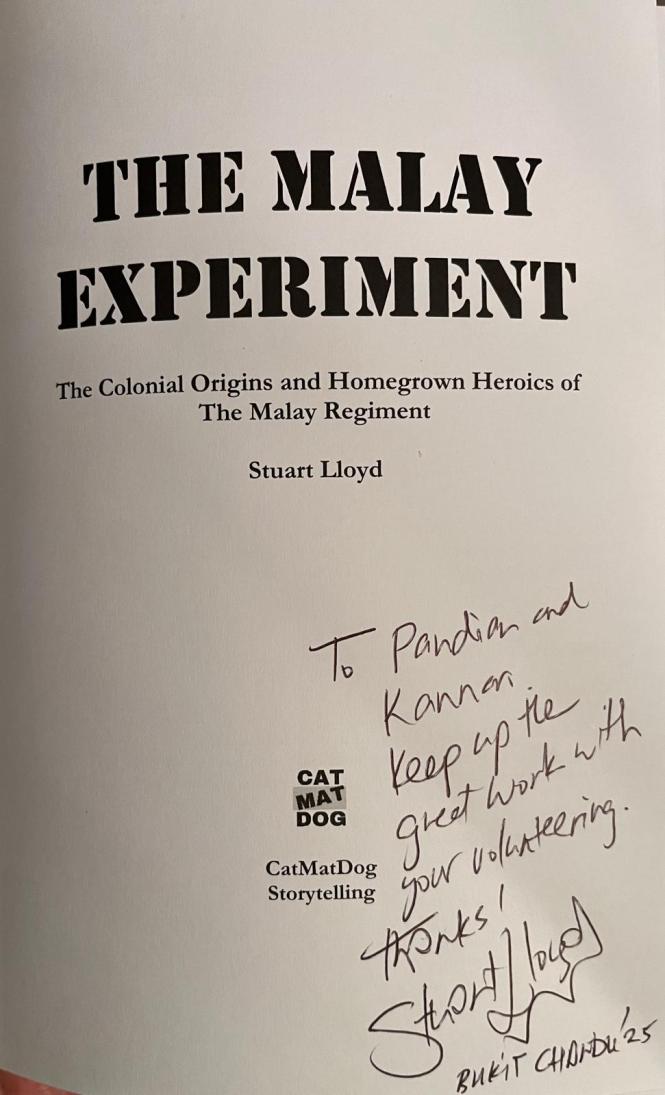
The Malay Experiment | Stuart Lloyd

It was never expected that the full thrust of 18 Division would be thrown against the Malay Regiment directly. 13,000 seasoned Japanese versus 1400 untested Malays.
– Chapter 6: The Battle of Pasir Panjang

Malaysia and Singapore offer a different perspective to foreigners like me. This is the land where WW-II was fought, as we say in Tamil raththamum sathaiyumaaga (ரத்தமும் சதையுமாக) – meaning “with blood and flesh”. My friends have taken me to the Kranji War Cemetery a couple of times. It is always stressful and depressing to realize what happened here in 1940s.

This book by Stuart Lloyd explains the valor bravely expressed by a novice military force – The Malay Regiment – during WW-II. In twelve chapters, this easy-to-read book, (under 100 pages), portrays a chronological note of their beginning, development, training, brutal war and its aftermath, recovery and finally their role in post-independence border clashes and world peacekeeping.

Recently Stuart spoke at Reflections at Bukit Chandu Museum, Singapore (located on the hill where the Battle of Pasir Panjang was fought, just before British Surrendered to Japanese). I bought this book a week ago. His effective storytelling kept us engaged at the museum and eventually pushed me to read the book during my morning commute. He vividly portrays figures like Major Bruce, Brigadier Raja Lope and Lt Adnan Saidi.

This book provides not only the swift action by the Japanese but also their unexpected approaches and failure of Allied forces. It provides convincing facts about the unchallenged airspace advantage enjoyed by the Japanese. Where might British resources might have been spent? Perhaps in Europe and the Middle East? Stuart highlights the superior war equipment, communication and strategy of Japanese. On the other hand, Allied forces lacked these resources – At one point, they even attacked their own forces due to poor communication.

For me, it was important to read Stuart’s documentation about how the Japanese convinced Indian soldiers to switch sides, by assuring them of Indian freedom, mentioning figures like Mohan Singh. (His relationship with Japanese was broken later miserably). While the complex politics of the Indian National Army is not the main scope of this book, the propaganda used to convince Indian forces makes me feel nervous. It feels as though Indian forces were just human resources pulled into different directions by world powers.

The post-war rejuvenation of Malay Regiment is documented in crisp language, covering conflicts all the way upto Malaysia-Indonesia and Malaysia – Phillipines clashes. The way Stuart stacks his historical storytelling – connecting the events on a timeline and providing background about officers – makes the book important. I wonder the amount of effort he put in to collect all these.

When I finish introducing this book, I find myself thinking about those soldiers who died at the Battle of Pasir Panjang or were executed later. None of them accepted the change to remove their uniforms to survive. For example, Lt Adnan Saidi left behind his wife and kids. His wife too died in late 1940s years due to illness, leaving the kids without father or mother. His brother too sacrificed his life to save the British throne.

The war devastated the family of every Malay solider. They might have faced hardship surviving the Japanese occupation due to their identity, and later faced financial crisis during the British reoccupation. The posthumous award were given, and identities established. Stuart doesn’t ask this explicitly, but the events make the reader think: does a symbolic honor compensate for their personal losses and material hardships. That is the life of a soldier!

Click here to borrow this book at NLB