The Malay Experiment | Stuart Lloyd

It was never expected that the full thrust of 18 Division would be thrown against the Malay Regiment directly. 13,000 seasoned Japanese versus 1400 untested Malays.
– Chapter 6: The Battle of Pasir Panjang

Malaysia and Singapore offer a different perspective to foreigners like me. This is the land where WW-II was fought, as we say in Tamil raththamum sathaiyumaaga (ரத்தமும் சதையுமாக) – meaning “with blood and flesh”. My friends have taken me to the Kranji War Cemetery a couple of times. It is always stressful and depressing to realize what happened here in 1940s.

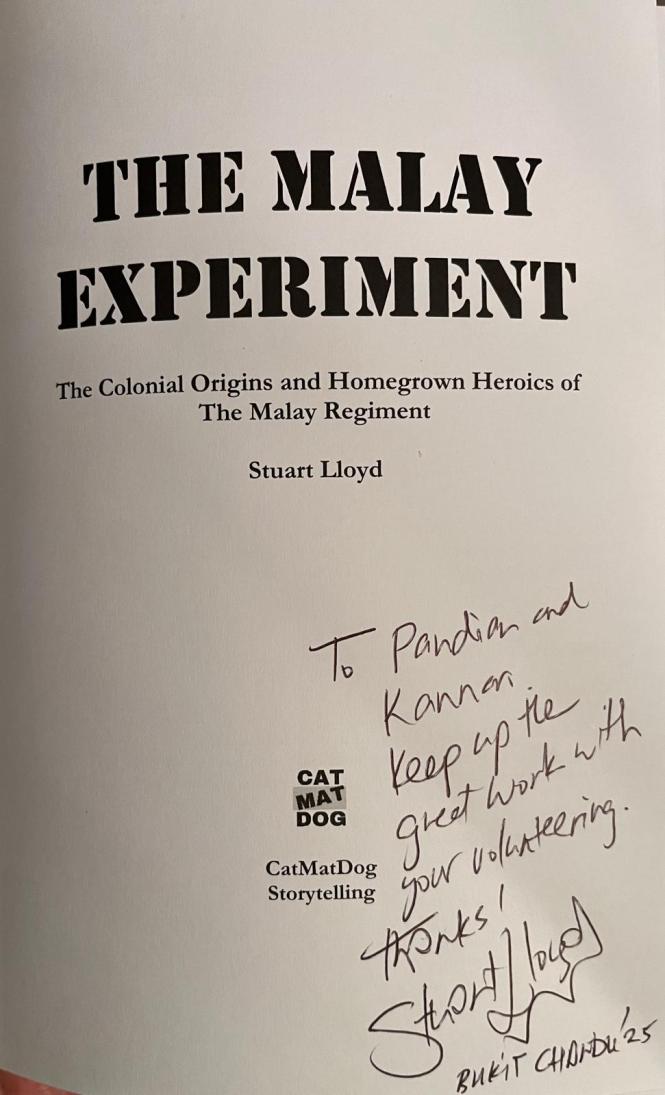
This book by Stuart Lloyd explains the valor bravely expressed by a novice military force – The Malay Regiment – during WW-II. In twelve chapters, this easy-to-read book, (under 100 pages), portrays a chronological note of their beginning, development, training, brutal war and its aftermath, recovery and finally their role in post-independence border clashes and world peacekeeping.

Recently Stuart spoke at Reflections at Bukit Chandu Museum, Singapore (located on the hill where the Battle of Pasir Panjang was fought, just before British Surrendered to Japanese). I bought this book a week ago. His effective storytelling kept us engaged at the museum and eventually pushed me to read the book during my morning commute. He vividly portrays figures like Major Bruce, Brigadier Raja Lope and Lt Adnan Saidi.

This book provides not only the swift action by the Japanese but also their unexpected approaches and failure of Allied forces. It provides convincing facts about the unchallenged airspace advantage enjoyed by the Japanese. Where might British resources might have been spent? Perhaps in Europe and the Middle East? Stuart highlights the superior war equipment, communication and strategy of Japanese. On the other hand, Allied forces lacked these resources – At one point, they even attacked their own forces due to poor communication.

For me, it was important to read Stuart’s documentation about how the Japanese convinced Indian soldiers to switch sides, by assuring them of Indian freedom, mentioning figures like Mohan Singh. (His relationship with Japanese was broken later miserably). While the complex politics of the Indian National Army is not the main scope of this book, the propaganda used to convince Indian forces makes me feel nervous. It feels as though Indian forces were just human resources pulled into different directions by world powers.

The post-war rejuvenation of Malay Regiment is documented in crisp language, covering conflicts all the way upto Malaysia-Indonesia and Malaysia – Phillipines clashes. The way Stuart stacks his historical storytelling – connecting the events on a timeline and providing background about officers – makes the book important. I wonder the amount of effort he put in to collect all these.

When I finish introducing this book, I find myself thinking about those soldiers who died at the Battle of Pasir Panjang or were executed later. None of them accepted the change to remove their uniforms to survive. For example, Lt Adnan Saidi left behind his wife and kids. His wife too died in late 1940s years due to illness, leaving the kids without father or mother. His brother too sacrificed his life to save the British throne.

The war devastated the family of every Malay solider. They might have faced hardship surviving the Japanese occupation due to their identity, and later faced financial crisis during the British reoccupation. The posthumous award were given, and identities established. Stuart doesn’t ask this explicitly, but the events make the reader think: does a symbolic honor compensate for their personal losses and material hardships. That is the life of a soldier!
Click here to borrow this book at NLB

The Parsis of Singapore | Suna Kanga & Subina Khaneja

The book tells us about the Parsi people, who they are, and how they came to live in India, migration of few of them to Singapore. It shares stories about famous Parsis in Singapore and describes different Parsi families living in Singapore and Malaysia.

The book shows how the adopted to Indian culture but still keep up their own tradition.

One of the panels in Zoroastrian museum highlighted this – “In numbers Parsis are beneath contempt, but in contribution, beyond compare!” – M.K. Gandhi. Similarly, within the small society of Singapore, tiny population of Parsis has interesting stories to tell us. Framroz and Pheonix aerated water factory story is something which most of them would be aware. I need to write about it one day.

This coffee-table book explains Parsi culture, how they are involved in the journey of Singapore, and their delicious food in detail.

My first boss used to say, every village will have a story to tell us. Similarly every family has a story to tell either their family or to the society. But the time and money involved in documenting such tales is enormous. From that perspective, the author’s work is commendable.

Written by Suna Kanga and Sabina Khaneja.


Related links:

Labour of love started by late wife comes to life as book on local Parsi community launched

To Buy: Kinokuniya | from author/publisher

To Rent: NLB | MBPJlibrary

Nimitham / நிமித்தம் by S. Ramakrishnan

Is there anything worse in this world than being rejected and neglected?

Plot

This Tamil novel tells the story of Devaraj, a man who faces challenges because he can’t hear well. Life throws many obstacles his way: sometimes it’s his own insecurities, sometimes it’s bad luck, and sometimes it’s just the way things turn out. A rude teacher at school forces him to quit, and a trip to a sign language school exposes him to the darker side of people. Everywhere he goes, he seems to return home empty-handed or feeling guilty. Back at home, he faces the disappointment of his angry father and frustrated mother. But his friend Ramasubbu stays by his side, encouraging him and helping him find a new path. The story follows Devaraj until he’s 47, leaving the reader wondering if he’ll ever find his place in the world and settle down with a wife.

Compelling Narrative

The interesting thing about this book isn’t just the story, but how it portrays different characters. Each chapter focuses on a different person, or even a few people! “Sumitra” by Kalpatta Narayanan narrates the story in similar approach too. So what makes this style of storytelling so engaging? It’s because we get to see human relationship, behaviour unfold through these characters, some of whom are listed here.

  • Devaraj’s mother
  • Ramasubbu, Devaraj’s childhood friend
  • Devaraj’s father
  • Razak sir, Devaraj’s rude teacher at school
  • Kanthi akka
  • Sreenivasan, the communist leader during emergency period
  • Daniel, The supervisor of the Sign school
  • Naomy, Maid of the Sign school
  • Rajamani, A Gandhian and the proprietor of Gandhi Vilas hotel
  • Man Udaiyar, Devaraj’s Grandfather at Timmalapuram
  • Vairavan Chettiar, Timmalapuram and his 2nd wife BhuvanSri from Penang
  • Sudharsanam sir and teacher
  • Thambaiyah from Vandipettai
  • Veppankulam Reddiar
  • Sangunni Pandaram
  • Perumal Nayakar and Manga
  • Gopal ayyar, owner of Gopalar Canteen at Vandipettai
  • Kesava Reddy, commission broker at Vandipettai
  • Joseph, printer training batch mate at Tuticorin
  • Grace Ammal, oldie at Sangu Thurai, native of above said Joseph.
  • Savari Muthu, the rationalist
  • Joslyn, Devraj’s first lover
  • The Sri Lankan refugees
  • The unnamed lady at Madurai town bus
  • Saveetha, coworker at Khadi shop at Ooty
  • Dr Balaiya, Mrs Balaiya, son Prabu, maid Subbamma
  • Pulenthiran, the passerby during new year
  • Valli Aachi and Meena Aachi from Chettinad
  • Guna, the assistant boy at Kaashi
  • Hemavathy, the spirit at Kaashi
  • Sadhu Siddhalingam
  • Devaraj’s brother and sister-in-law
  • Chakarapani, the scammer at Meenatchi Chit fund
  • Sivasu, the late married man

It feels almost like reading a collection of blog posts, each one revealing a different perspective on the story.

Emotional Depth

Many of us get discouraged when we keep failing. We try our best, but come home empty-handed or feeling ashamed. Ideally, eventually one of those attempts pays off, and things take off. But what if that breakthrough never comes? The constant disappointment can drain your energy and make it hard to keep trying. It’s like being trapped in a cycle of negativity, and it’s tough to break free. Very few stays energized and continue their hunt. Nimitham delves into profound such human emotions.

I liked all the chapters, to name a few, –

  1. There’s a particularly interesting chapter titled “கனவுகளும் வளர்கின்றன / Kaṉavukaḷum vaḷarkiṉṟaṉa” (which literally translates to “Dreams Grow”). It dives into Devaraj’s nightmare. It brings out a gambler who gambles against himself. This reminded me of a similar concept in “Venmurasu” by Jeyamohan, where characters like Draupadi or Yudhisthira gamble against themselves. I’ve even tried it myself, but it never seems to work out! Gambling against yourself requires a unique skillset. But it is a strong metaphor. It fits into the narrative of Devaraj’s life gambling against himself. It’s a very thought-provoking chapter!
  2. There’s another great chapter called “The World of Vandipettai” (வண்டிப்பேட்டை எனும் உலகம் / Vaṇṭippēṭṭai eṉum ulakam), which focuses on the bustling Vandipettai cotton market. It introduces us to a bunch of fascinating characters, like ‘well maintainer’ Thambaiya, ‘Penang’ BhuvanSri, ‘Efficient housewife’ Manga, ‘Gopallar canteen’ Gopal Ayyar, and ‘Commission Broker’ Kesava Reddy. The author makes a great point: every place has its own story, whether it’s the village you grew up in, the temple you visit, or even the tree where you used to play. And when someone tells the story of a place, it leaves a lasting impression on you. This chapter does exactly that – it captures the rise and fall of the Vandipettai market, along with the stories of the people who made it what it was. It’s a truly captivating read.
  3. The novel explores Devaraj’s relationships with women throughout his life. We see this theme play out in Naomi, Joslyn, Vanarani and RangaNayagi – relationships filled with hope, and a brief encounter with an unnamed lady in Madurai. The stark contrast between experiences with Naomi and the Madurai lady leaves a lasting impression on the reader. It’s interesting to see how Devaraj, despite facing limitations in his life, might subconsciously expect certain qualities from his partners. However, it’s important to remember that limitations shouldn’t dictate expectations. Just because someone faces challenges doesn’t mean they can’t have desires, and general human nature plays a role. This point is tragically mirrored by a real-world incident: a worker, enraged by a woman refusing service due to his race, ended up taking her life. This horrifying event reminds us that limitations shouldn’t justify prejudice.

Conclusion

What truly elevates Nimittam is its exploration of human relationships. The way the story unfolds through different characters, allows us to experience a rich tapestry of connection, rejection, and hope. Overall, it’s a deeply satisfying read that leaves a lasting impression.

Five on the Treasure Island – Enid Blyton (Review)

Five on the treasure island by Enid Blyton is an engaging and delightful adventure story for kids. It takes over the reader from page 1 (in which many children or even adult books fail). It is packed with excitement all the way till the end. That makes this novel a perfect read for young readers of 7 – 12 years of age group. Do you dare to ask me why I am reading this?? it was published in 1942 and I were not born at that time 🙂 But great stories never get old!

Julian, Dick and Anne visit their cousin George (Her name is Georgina, but she likes to be called as George!, Hey! she is much tougher, huh!) for summer holidays. She can be a bit grumpy sometimes. But Julian behaves in a matured manner and pave way for a better friendship.

George takes them (along with her dog Tim) to explore Kirrin Island, belongs to her mother and a shipwreck nearby. When a big storm hits, the shipwreck actually washes ashore. That’s when things get really, really interesting. Kids encounter with mysterious clues, traps, strangers etc on a treasure hunt.

No need to mention, this story is so engaging, similar The Secret Seven | Enid Blyton. It sugarcoats the thriller with friendship and bravery for kids. It has a compelling message for adults on parenting too. This book is like a roller coaster ride! Every page throws you into a new adventure, making you want to race to see what happens next. There are no super-confusing words, so you can keep up with the action easily.

The renowned English children’s author, Enid Mary Blyton (1897 – 1968), had a fascinating background behind her highly successful series of books. According to Wiki, her first story was published in 1947, which was followed by several other successful books. Her works were a global sensation and she even held the 4th place as the most translated author – an incredible feat!

I suggest this to my children and I would recommend it for your children to read too.

In Tamil Nadu, the widespread news of drug addiction among children is diminishing the trust in our society. Let our children continue their addiction towards story, not narcotics. Have a nice weekend. Happy Weekend.

I’m participating in the #TBRChallenge 2024 by Blogchatter

Mission – IIT-R | Jeyanthi Manikandan

I’ve never had the chance to attend an IIT, only ever visiting as a guest. It seems like the IIT-JEE has become a tool for parents in India to exploit their children. There was a company that promised to get kids into IIT, but it now seems to be headed for bankruptcy. These modern-day edutech companies create a FOMO among parents and line their own pockets. Nevertheless, the idea still holds merit.

Due to the minimum benefit required for an idea to be successful, companies offer the highest pay scale to IIT graduates. This degree is highly valued around the world and can be attained at an affordable cost, leading to intense competition.

Not only IITs but other Indian government and private colleges also attract candidates based on their scores in the JEE Mains.

On that note, let’s look at this book ‘Mission IIT-R’ now.

Is this a guidebook to help crack the IIT JEE exam? Is it a source of motivation to energize you for the IIT JEE? Is it a step-by-step guide to ace the placements? These are some questions from a reader.

This book tells the story of a mother and child, starting from the preparations for an entrance exam and continuing until placement and graduation. I particularly enjoyed the chapter discussing the extra effort expected of a child during their higher secondary studies. The chapter about the IIT placement season was especially moving, bringing me back to my college days. It was beautifully written. The book also documents the impact of the pandemic.

This book is a quick read, totaling around 80 pages. It would be even more useful if it included information on preparing for admission to +1, as well as the pros and cons of modern-day methods (some students choose not to pursue +1 and +2, instead opting to focus solely on IIT JEE coaching). However, the author made it clear in the preface that the book would document her journey through those four years, and in that regard, the book successfully delivers what was promised.

I suggest you give it a go!

About the author, in her words.

Jayanthi Manikandan holding degrees in Computer Science (B.E) and Information security (M.S.) found the best way to put her degree to use is by blogging about them. She accidentally stepped into writing as a second career and has stayed there ever since. She writes technical and personal blogs and they can be found at blogtech.online and jayanthiweb.wordpress.com. She has also written for various organizations such as Whizlabs, Simplilearn, InfoSec Train, InfoSec Institute and Practical DevSecOps. She has published one print book and three e-books. You can find them on Amazon from this link and on her blog at blogtech.online.

Links to buy the book:

Amazon (International)

Amazon (India)

(Review) Strong Poison – Dorothy L Sayers

Dorothy L Sayers’ Lord Peter Wimsey series of novels includes the thrilling mystery, Strong Poison.

RV had written about this novel a few months ago. I figured I should give it a try.

Peter Wimsey is a Detective with a small but effective team. Bunter, a shrewd companion of Wimsey, is one of them. Miss Climpson, who has a habit of infiltrating even the most remote places to retrieve artifacts for her boss, is another. Wimsey also has allies in the Police and Attorneys, such as Parker, a police officer who is also fond of Wimsey’s sister.

Strong Poison (1930) –

Lord Peter Wimsey encountered a prisoner by the name of Miss Harriet Vane during her trial for the murder of her ex-boyfriend, Philip Boyes. Harriet had been living with Philip for a year. Philip sounded as if he did not believe married life and relationship. Though Harriet wanted to get married with him, but he convinced her.

But although he wanted to marry her after a year, Harriet refused, feeling that a marriage between them would be a mistake. Because she thought Philip deceived her even though he believed in married life. She felt down as Philip did a trial with her to find out if she would be a fit to be his wife.

Philip was left heartbroken at Harriet’s refusal. He was desperate to meet her one last time in order to try and convince her to change her mind. He did meet her but was unable to persuade her. He fell ill on his journey home, eventually passing away three days later. The circumstantial evidence pointed to Harriet as the murderer.

Wimsey fell in love with her at first sight, just as Kamban wrote of Rama and Sita’s first meeting: ‘அண்ணலும் நோக்கினார் அவளும் நோக்கினாள்’ :). However, Harriet is not Sita and Wimsey is not Rama, right? She did not return his feelings, and Wimsey only wanted her to marry him if she truly liked him, not because he had saved her. Throughout the novel, there were two moments which I truly enjoyed. The first was the conversation between Wimsey and Parker when Wimsey is discussing about Paker’s love for his sister. It was a pleasure to read. The second was when Miss Climpson managed to find the will using a seance; the chapter raced by!

This novel is a must-read!

I’m participating in the #TBRChallenge by Blogchatter!

HTML format

Borrow – NLB

Buy – Amazon India, Kobo

Related pages – STRONG POISON – Characters By Chapter

(Review) The Secret Seven | Enid Blyton

Hello readers,

I hope you’re either enjoying your weekend by watching movies, reading newspapers, taking kids to classes, or getting in some strenuous workouts. I’m not here to add to your stress, but to stimulate your prefrontal cortex with this book review.

The Secret Seven – this exciting novella for kids serves as a captivating introduction to the series. The group of seven child detectives, headed up by Jack, stumble across a mysterious scene on a snowy night. An abandoned house, looked after by a deaf caretaker with an ill-temper, leads Jack to suspect that someone has been held prisoner inside. With the help of the Secret Seven, the mystery is resolved.

The story starts with an engaging conversation between Peter, Janet, and their pup Scamper. The transitions between the scenes were so smooth, it was hard to put the book down! There are no negatives to be seen in this story, which makes it a great gift for kids aged 6-9. One might even wonder why an uncle with a pair of power glasses and a shiny bald head is reading this! Age is only a number, and this book is enjoyable by people of all ages.

This story was recommended by fellow blogger Charmila M Sankar in her recent blog post. I thought I can give a try during my morning walk today. This would be in my recommendation too.

The renowned English children’s author, Enid Mary Blyton (1897 – 1968), had a fascinating background behind her highly successful series of books. According to Wiki, her first story was published in 1947, which was followed by several other successful books. Her works were a global sensation and she even held the 4th place as the most translated author – an incredible feat!

I suggest this to my children and I would recommend it for your children to read too.

Happy Weekend.

Buy: India

Read for free: PDF

Library Reservation: National Library Board | Delhi Public Library | Connemara Chennai
(It seems that Tamilnadu libraries are going backward by removing the public catalogue. They are in 1940s despite their PR effort!)

I’m participating in the #TBRChallenge by Blogchatter!

The Secret Seven by Enid Blyton

My rating: 5 of 5 stars


The Secret Seven – this exciting novella for kids serves as a captivating introduction to the series. …
I suggest this to my children and I would recommend it for your children to read too.


View all my reviews

Here are the young men | Rob Doyle

This is the debut novel of Rob Doyle, which I eagerly obtained from the Writer’s Festival Bookstall in 2017.

Showcasing the story of protagonists – Mathew, Rez, and Kearny- who have recently graduated from school, this novel follows the Irish blend of these young adults and the substances they consume, such as tobacco, liquor, drugs, and video games, making it a heavy read.

I have dropped the novel multiple times, but I have always picked it up again at some point. Recently, however, there was an incident at one of the nearby schools, where a 16-year-old student attacked a 13-year-old student out of the blue. They were not familiar with each other and the assailant’s motive seemed to be to harm the first person he saw enter the rest room.

I completely comprehend the character of Kearny from the novel after this event. The novel portrays the friends of well-off families and their age-related necessities – No plans about future studies or jobs; Just roaming around the city; going behind some excitements – scares the reader. Kearny ascended the ladder of addiction, eventually leading to a disastrous conclusion.

Matthew’s failed ordeal with Jen was interesting. Out of cowardish behaviour, the way he conceiled behind his fears, yet he tried to pass the blame to Jen is totally understandable. Still he was a child who to be consoled and to be moved on. The reader could see Jen did it and failed. The maturity which is missing in Matthew, helps Jen to move on!

Matthew’s unsuccessful experience with Jen was intriguing. Out of fearfulness, his attempt to hide behind his apprehensions and shift the blame onto Jen is completely understandable. Despite this, he was still a child who needed consolation and support in order to move forward. The reader can see that Jen tried to do this but ultimately failed. The lack of maturity in Matthew prevented Jen from being able to help him move on!

We’re just not real people any more, we’re all just types, it’s like our personalities are these costumes we wear, and we choose them and mix and match from a fuckin pre-designed range of possibilities.’

The result of my reading of the novel was that Rez, although he had been a dull and uninteresting person, came to understand the worth of life after his unsuccessful suicide attempt. The author used Rez as a way to communicate the importance of life. No one, not even Matthew or Jen, can do this despite their disapproval of Kearny’s actions. I respect the author’s decision to bring Rez in to decide the verdict of dharma!

At first, I feared it would be one of the worst novels I had ever read, but it turned out to be one of the most memorable.

About the Author:

(c) blogs.ntu.edu.sg

Rob Doyle, an Irish author, has released several novels and anthologies. His first novel was released in 2014 and was well-received as an Irish classic. It was adapted into a movie in 2020. It was selected as one of the Hot Press magazine’s ’20 greatest Irish novels 1916-2016′.

I’m participating in Blogchatter’s #TBRChallenge 2023

Here Are The Young MenHere Are The Young Men by Rob Doyle
My rating: 4 of 5 stars

This is the debut novel of Rob Doyle, which ……

https://dwaraka.wordpress.com/2023/04…

View all my reviews

சொப்பனசுந்தரி | Neerajanam | నీరాజనం | Yaddanapudi Sulochana Rani

Despite coming from a poor background, Menaka places a great emphasis on her self-respect. Society has disgraces her family due to a mistake made by her mother, however Grandma Mangalam has stood by her daughter and her two granddaughters. Through her determination and hard work, Menaka has achieved success as an actress.

She deeply loves Harikrishna, yet she cannot secure a place in his life. When Rekha marries Harikrishna, her attitude causes disruption in his life and his ambitions.

After Menaka achieved fame in the film industry, her estranged father rejoined her. Despite Menaka’s aversion to him, she endured his presence at her mother’s request.

At some point, Rekha is murdered and Harikrishna is the prime suspect. The novel paints a vivid picture of the lives of Menaka and Harikrishna, and ends in an unexpected way.

Popular Telugu writer Yaddanapudi Sulochana Rani’s Telugu novel Neerajanam has been translated into Tamil as ‘Soppana Sundari’.

Oh, the disgrace! The way this generation’s youth think is completely backwards. It’s like taking a knife of shame and stabbing yourself with it. What kind of shame is there? If you fail an exam, shame; if you can’t get a job, shame; if you don’t get married, shame; if your friends bully you, shame; if your husband leaves you, shame! My goodness! He clenched his fists with rage.

-Harikrishna

Rather than a novel, it could be described as a long story. The story starts in a poverty-stricken community, and follows the ‘forced-dating’ of Menaka and the disgrace that came from it. The plot appears to be set in Chennai, but Menaka’s family does not even have a ration card. Menaka is portrayed as a strong character from the beginning to the end, like a freshly cut chilli, sparkling with vigour.

If you wish to test someone’s honesty, they can be placed in one of two scenarios. Firstly, put them in complete poverty. Secondly, put them in a position of extreme wealth. Those who pass both of these tests are known as Menaka-s!

Despite being a feminist novel, it also highlights positive male figures such as Harikrishna, Ramanathan, and Nagalingam. While some of the plot twists may be a bit over-the-top, it is best to overlook these and continue reading the story.

Grandma Mangalam and Harikrishna demonstrate what a life can be when lived in a positive manner. In contrast, Madhavi and Balaraman illustrate the opposite. The ultimate example is Amma Ranjani, whose behavior I could not endure. Many times, her attitude caused me to clench my teeth in anger. Even Menaka scolded her as if she was mad.

Thanks to Gowri Kirupanandan, the translation from Telugu to Tamil is remarkably smooth.

Yaddanapudi Sulochana Rani (2 April 1940 – 18 May 2018) was an Indian Telugu language novelist. She had a strong fan following since the 1970s and early 1980s, especially among women. Several of her stories were made into films and television serials. She won two Nandi Awards.

சொப்பனசுந்தரி | Neerajanam | నీరాజనం
Author: Yaddanapudi Sulochana Rani
Telugu to Tamil translation – Gowri Kirupanandan
Publisher: vaanavil puthakalayam – 1e – Sep 2015
Borrow: NLB
Buy: Tamil | Telugu

I wrote it in 2016 in Tamil initially, and translated now for Blogchatter’s WRITE A PAGE A DAY 2023 campaign.

புஷ்பாஞ்சலி – Vijetha – విజేత | Yaddanapudi Sulochana Rani

The library in our area has been closed for renovation for the past four months. Recently, while browsing the shelves of the nearby library, I stumbled upon Soppanasundari (a Tamil translation of the Telugu novel Vijetha) by Yathanapudi Sulochana Rani in the new arrivals section. Along with it, I also found another novel, Pushpanjali by the same author. The smell of fresh ink and paper suggested that I was the first one to read both novels.

Let me start by discussing Pushpanjali, a simple novel of few pages that helps for a faster reading, like a Pallavan Express train!

The story is narrated by Madhavan, who was believed to be dead after being captured by enemies during a freedom struggle. He comes back alive later. Upon receiving the false news of his passing, his fiancée Sudha, the daughter of his uncle, is married off to another groom. Disheartened by this, Madhavan misbehaves with a young woman travelling alone on a train. Feeling remorseful for his actions, he exits the train with the intention of taking his own life. However, the train suddenly begins to move again, leaving Madhavan with a renewed desire to find the woman he wronged and apologize. Will he be successful in his mission?

It sounds like a captivating ‘typical-70s styled cinematic tale’ with all the right ingredients! No wonder it has been shot as a movie too.

This novel has many twists and turns, creating a dramatic and cinematic atmosphere. He spotted someone on the street, and the same woman later arrived on the train alone. A rich girl suddenly finds herself impoverished and wearing tattered garments. The husband of his ex-fiancée turns out to be the hero’s former classmate. There are so many more surprises like this – it’s quite amazing, huh!

The story begins with Madhavan’s accusations towards Sudha. She had been deeply in love with someone and when she realized that he was dead, was it really so wrong for her to make the decision to marry someone else? When he came back to life, would she still be able to embrace him and cry for him, despite being married to someone else? This is what we can understand from Madhavan’s narrative. He lives within his own thoughts and gets lost in a whirlwind of confusion. His perplexed musings put him in a labyrinth of obstacles.

My sister always said it is wrong to accept anything for free from anyone; shoplifting is a crime and it is a disgrace to compromise our values in order to make money, but when we work hard to survive, we should not have to be subservient to anyone.

-Vasu

Yaddanapudi’s Madhavan and Jeyakanthan’s Prabu (featured in the novel Sila Nerangalil Sila Manidhargal) have a similar outlook on life. However, Madhavan lacks the maturity of Prabu and is not as wise. Prabu is a clear winner in his ability to show us the truth of life – despite being a negative character – while Madhavan is depicted as a foolish, immature, and self-tormenting person.

The novel is crafted with typical masculine expectations of women. It is an easy-to-read book and I was able to finish it quickly between a lunch at Andhra mess and an evening coffee at the food court. Undoubtedly, this was thanks to the translation done by Gowri Kirubanandan.

Yaddanapudi Sulochana Rani (2 April 1940 – 18 May 2018) was an Indian Telugu language novelist. She had a strong fan following since the 1970s and early 1980s, especially among women. Several of her stories were made into films and television serials. She won two Nandi Awards.

புஷ்பாஞ்சலி – Vijetha – విజేత
Author: Yaddanapudi Sulochana Rani
Telugu to Tamil translation – Gowri Kirupanandan
Publisher: vaanavil puthakalayam – 1e – Sep 2015
Borrow: NLB
Buy: Tamil | Telugu

I wrote it in 2016 in Tamil initially, and translated now for Blogchatter’s WRITE A PAGE A DAY 2023 campaign.