Massacre at the Ridge

Singapore’s War Heritage

Part 3: The Battle for Pasir Panjang

Recap: This series details the fall of Singapore during World War II, explaining how British strategic overconfidence and flawed defenses allowed Japanese forces to rapidly conquer the region. It specifically highlights the bravery of the Malay Regiment at Pasir Panjang and the tragic war crimes committed during the final stages of the invasion.

Previous posts in this series:

  1. Ancient Roots
  2. British Fortress
  3. Colonial Defense
  4. December 1941
  5. Entry into Malaya
  6. Fall of Sarimbun
  7. Gap in Defense
  8. Heroism of Malay Regiment
  9. Infantry
  10. Killings at Alexandra
  11. Lieutenant Adnan Saidi

12/26: Massacre at the Ridge

This post recalls the final and cruel battle of Singapore before we talk about the surrender.

The highest peak of Pasir Panjang Ridge is called Point 226. It was the location of the 1st Battalion of the Malay Regiment.

After bullets and bombs were exhausted, the battle reached a cruel stage. Malay soldiers used the bayonets on their guns and their hands to fight with the Japanese. This is the place where the worst hand-to-hand combat happened.

Image (c) The Role of the Malay Regiment in the Battle of Singapore, National Museum of the Pacific war, Stuart Lloyd

The Japanese were upset and angry that a small company had held them for a long time. Because, they had huge plans after capturing Singapore. After capturing Peak 226, they did not treat the survivors in the Malay Regiment as Prisoners of War (POWs). Instead, they tied them to trees and murdered them by stabbing.

The Japanese offered them their lives, but they wanted them to surrender (giving up their uniforms and loyalty). Their refusal to do so led to this massacre.

After the fall of Bukit Chandu, the biggest obstacle vanished for the Japanese.

When I look from this peak now, I can see the city at close range. The Japanese might have seen important places around the Alexandra region, like the British Military Hospital (Now Alexandra Hospital), ammunition depots, and the city’s government centers.

The fall of this ridge led to the complete wipe-out of the city’s defenses. Within a few hours, the British surrendered Singapore to the Japanese. Let’s talk about it tomorrow.

***End of Part 3 – The Battle for Pasir Panjang***

This post is a part of BlogchatterA2Z Challenge 2026 http://www.theblogchatter.com/

This 26-post series for the 2026 A2Z challenge explores Singapore’s WWII heritage, from the initial invasion to the liberation of Changi Prison. Using concise storytelling, I try to connect historical lessons of sacrifice and the need for peace all around the world.

Lieutenant Adnan Saidi

Singapore’s War Heritage

Part 3: The Battle for Pasir Panjang

Recap: This series details the fall of Singapore during World War II, explaining how British strategic overconfidence and flawed defenses allowed Japanese forces to rapidly conquer the region. It specifically highlights the bravery of the Malay Regiment at Pasir Panjang and the tragic war crimes committed during the final stages of the invasion.

Previous posts in this series:

  1. Ancient Roots
  2. British Fortress
  3. Colonial Defense
  4. December 1941
  5. Entry into Malaya
  6. Fall of Sarimbun
  7. Gap in Defense
  8. Heroism of Malay Regiment
  9. Infantry
  10. Killings at Alexandra

11/26: Lieutenant Adnan Saidi

This post talks about Second Lt. Adnan Saidi, who is at the heart of the theme of Reflections at Bukit Chandu, a World War II interpretative center in Singapore. The bravery and prudence demonstrated by him as a platoon commander are praised even now.

As I mentioned in my earlier post, the Japanese tried to infiltrate C Company at the Pasir Panjang ridge in the early afternoon, disguised as Punjabi soldiers. This was uncovered by 2nd Lieutenant Adnan Saidi and 2nd Lieutenant Abbas bin Abdul Manan, who noticed the troops were marching in columns of four instead of the usual three (the British norm). C Company then opened fire at close range, killing and wounding around 22 Japanese soldiers and forcing the rest to retreat. That awareness saved many lives at that moment. But it is not over.

The final battle that took place later at Bukit Chandu was even more cruel. Artillery attacks wounded many. Adnan suffered severe injuries to his body and legs. Despite losing blood, he did not leave the battlefield. He continued supporting his company with his Lewis machine gun, attacking the Japanese. Until his ammunition was exhausted, he kept firing and guiding his platoon.

What happened a few hours before – the British surrender of Singapore – made Adnan a national hero.

He was captured by the Japanese on the evening of February 14. The Japanese asked him to surrender, which he refused. He was hung upside down from a cherry tree and killed by bayonets. Until he died, he did not give up his loyalty to the British or his aim to safeguard Singapore.

A soldier does not win only in triumph; he wins in the reason why he gave his life.

Straits Times Feb 14, 1996. Image (c) https://eresources.nlb.gov.sg/newspapers/digitised/page/straitstimes19960214-1.1.41

This post is a part of BlogchatterA2Z Challenge 2026 http://www.theblogchatter.com/

This 26-post series for the 2026 A2Z challenge explores Singapore’s WWII heritage, from the initial invasion to the liberation of Changi Prison. Using concise storytelling, I try to connect historical lessons of sacrifice and the need for peace all around the world.

Killings at Alexandra

Singapore’s War Heritage

Part 3: The Battle for Pasir Panjang

Recap: Despite being established as an invincible “Gibraltar of the East” protected by sea-facing defenses, Singapore fell when Japanese forces bypassed British reliance on naval power through rapid land maneuvers and air superiority. This culminated in the heroic but ultimately doomed last stand of the Malay Regiment at Bukit Chandu, marking the final collapse of the island’s defenses.

Previous posts in this series:

  1. Ancient Roots
  2. British Fortress
  3. Colonial Defense
  4. December 1941
  5. Entry into Malaya
  6. Fall of Sarimbun
  7. Gap in Defense
  8. Heroism of Malay Regiment
  9. Infantry
  10. Junction of Pasir Panjang

11/26: Killings at Alexandra

The Alexandra Hospital Massacre is a dark page in Singapore’s war history. Generally, Western narratives describe this as unnecessary violence. But, when we analyze the reasons behind the Japanese attack on a Red Cross hospital, we may understand the anger and confusion that clouded the battlefield.

The Japanese did not plan to attack a military hospital. A few important reasons are generally cited. The Battle of Pasir Panjang caused casualties on the Japanese side as well. It is believed that a few from the retreating British forces entered Alexandra Hospital and killed Japanese soldiers (or used the hospital as shield to attack the Japanese).

L0026874 Alexandra Hospital, Singapore.
Credit: Wellcome Library, London. Wellcome Images
images@wellcome.ac.uk
http://wellcomeimages.org
Alexandra Hospital, Singapore.
Main Entrance.
Published: –

Copyrighted work available under Creative Commons Attribution only licence CC BY 4.0 http://creativecommons.org/licenses/by/4.0/

Singapore Infopedia says that the most widely accepted explanation for this massacre is that Japanese soldiers were after a group of retreating Indian soldiers who had been firing at them from a location near the hospital. The loss of their fellow military personnel, combined with the fire coming from the hospital, caused the Japanese to turn violent. They considered the hospital to be a combat zone as well.

When Japanese forces entered, doctors showed white flags, which did not work. Roughly 200 people, including patients, doctors, and nurses, were killed on the spot. The remaining people were locked in a nearby area and shot the next day.

Alexandra Hospital was located at the rear of Pasir Panjang Hill. After capturing the peak, this was the first building the Japanese needed to pass to enter the city. This may be another reason for this sorrowful event.

The Alexandra Massacre is an event that shows the worst face of war. It was valentines day and the next day was the Chinese New Year, when it happened. This has been happening century after century. The clash of egos or interests between the so-called leaders of the world’s powerful nations leads to such inhuman attacks – even in this decade!

This post is a part of BlogchatterA2Z Challenge 2026 http://www.theblogchatter.com/

This 26-post series for the 2026 A2Z challenge explores Singapore’s WWII heritage, from the initial invasion to the liberation of Changi Prison. Using concise storytelling, I try to connect historical lessons of sacrifice and the need for peace all around the world.

Junction of Pasir Panjang

Singapore’s War Heritage

Part 3: The Battle for Pasir Panjang

Recap: This series details the events leading up to and including the Fall of Singapore in 1942, framing it within the context of British colonial strategy and the broader outbreak of WWII. It highlights the perceived invincibility of Singapore as a fortress, the miscalculations of British military planning, and the surprising effectiveness of the Japanese invasion, culminating in the fierce resistance – and ultimate sacrifice – of the Malay Regiment at Pasir Panjang. Ultimately, the text argues that a combination of strategic errors, communication failures, and underestimated enemy capabilities led to the swift collapse of the British stronghold.

Previous posts in this series:

  1. Ancient Roots
  2. British Fortress
  3. Colonial Defense
  4. December 1941
  5. Entry into Malaya
  6. Fall of Sarimbun
  7. Gap in Defense
  8. Heroism of Malay Regiment
  9. Infantry

10/26: Junction of Pasir Panjang

This post discusses a pivotal event: the destruction of Singapore’s defenses.

The junction of Pasir Panjang Road and Alexandra Road (the junction in bottom right corner, near 15-2-42 (A.M) ) was a critical point – the last line of defense for British forces protecting Singapore City. If the Japanese were able to break through, British ammunition depots, the military hospital, and government offices would be under direct attack. You may get it clearly if you see the picture below.

View of Pasir Panjang Port from Pasir Panjang ridge (likely point 226) now. Thanks to the historians arranged the tour.

To secure this junction, C Company took control of Opium Hill. By the evening of February 14, 1942, the Japanese advanced towards this position. Despite a valiant fight, the Malay soldiers were overwhelmed by the Japanese’s superior weaponry and larger forces.

Picture (c): untouristsingapore.wordpress.com

With the junction under Japanese control, the entire defensive line collapsed. The Japanese advanced rapidly into the city without significant resistance.

This fall was the breaking of the final lock. As Pasir Panjang fell, Singapore’s fate was sealed. The soldiers sacrificed their lives to defend the junction – a point that represented more than just two roads; it was the border between freedom and colonial rule.

Battle of Pasir Panjang – historic marker.

This post is a part of BlogchatterA2Z Challenge 2026 http://www.theblogchatter.com/

This 26-post series for the 2026 A2Z challenge explores Singapore’s WWII heritage, from the initial invasion to the liberation of Changi Prison. Using concise storytelling, I try to connect historical lessons of sacrifice and the need for peace all around the world.

Infantry

Singapore’s War Heritage

Part 3: The Battle for Pasir Panjang

Recap: I outlined the events leading to and including the Fall of Singapore in 1942, highlighting strategic errors by the British and the innovative tactics employed by the Japanese forces. From the initial context of global tensions to the final stand at Pasir Panjang, the text emphasizes the crucial role of military bases, air superiority, and the bravery of soldiers like those in the Malay Regiment.

Previous posts in this series:

  1. Ancient Roots
  2. British Fortress
  3. Colonial Defense
  4. December 1941
  5. Entry into Malaya
  6. Fall of Sarimbun
  7. Gap in Defense
  8. Heroism of Malay Regiment

9/26: Infantry

Malay regiment in bayonet practice. When they ran out of bullets at battle of Pasir Panjang, this was their last defence, before they mortared. Picture (c) Wikipedia

Different people planned to have a military force comprised of Malays, the native people of Malaya. They may have attempted to implement a strategy similar to what succeeded in India – Indian soldiers commanded by British officers.

However, it wasn’t officially accepted until 1933. The Malay Regiment officially began with 25 recruits at Port Dickson in the state of Negeri Sembilan, Malaya, as a “proof of concept.”

Negeri Sembilan wasn’t a Straits Settlement, so how the British established a military base there is an interesting question. It likely followed the same tactics they used in India – a topic we’ll explore another day.

These weren’t ordinary volunteers; they were trained to British standards. This was the first time a military group comprised of Malay people was formed to defend Malaya.

The 1st Battalion took Point 226, the highest peak of the Pasir Panjang ridge, also known as Opium Hill due to the opium packaging factory at its foothills. C Company, led by Captain Rix, attempted to hold this point with a strong defense. After visiting Reflections at Bukit Chandu museum, I went with my friends to Kranji war memorial, where I saw his head stone.

Picture showing point 🔺226
source: https://www.flickr.com/photos/sivasothi/8442226561/

There was intense fighting on February 13th and 14th, 1942. The Malay soldiers fought bravely, without hesitation. By the end of the battle, most of the 1st Battalion soldiers were killed or severely wounded. Even after the surrender, when the Japanese asked them to switch sides, they refused. Displaying ultimate loyalty, most were executed, though a few survived to become witnesses.

The Malay Regiment isn’t just a military group; it’s a symbol of hope for the Malays. A small unit, started in 1933, rose to become one of the last defenses of Singapore. The British training made them a loyal force until their officers were mortared. Let’s talk about the fierce fighting tomorrow.

This post is a part of BlogchatterA2Z Challenge 2026 http://www.theblogchatter.com/

This 26-post series for the 2026 A2Z challenge explores Singapore’s WWII heritage, from the initial invasion to the liberation of Changi Prison. Using concise storytelling, I try to connect historical lessons of sacrifice and the need for peace all around the world.

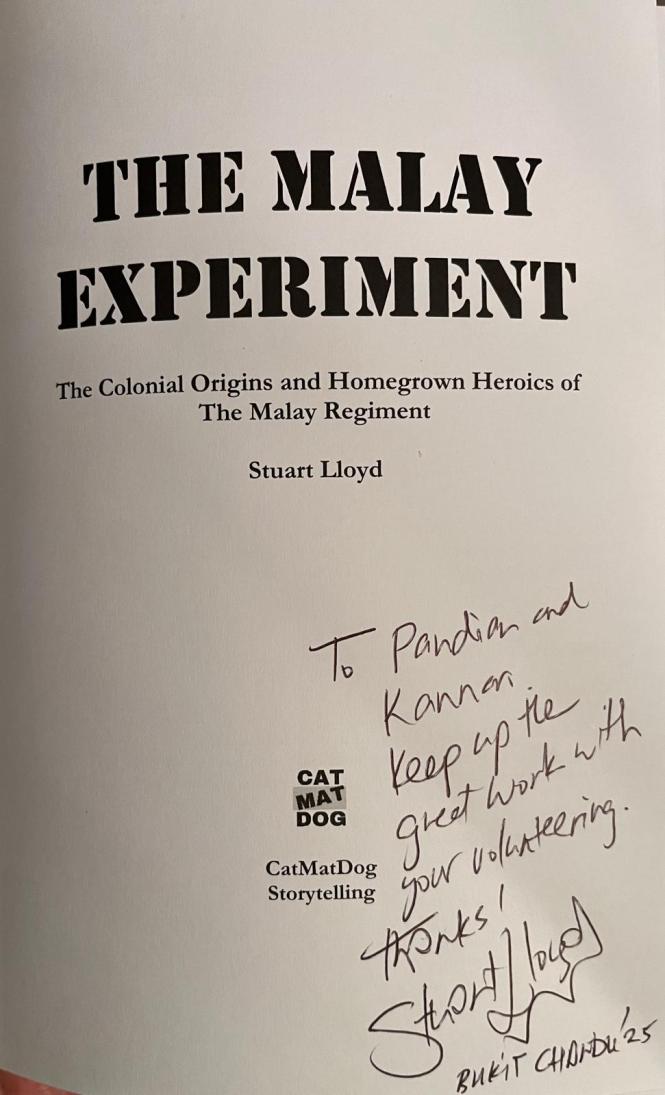
The Malay Experiment | Stuart Lloyd

It was never expected that the full thrust of 18 Division would be thrown against the Malay Regiment directly. 13,000 seasoned Japanese versus 1400 untested Malays.
– Chapter 6: The Battle of Pasir Panjang

Malaysia and Singapore offer a different perspective to foreigners like me. This is the land where WW-II was fought, as we say in Tamil raththamum sathaiyumaaga (ரத்தமும் சதையுமாக) – meaning “with blood and flesh”. My friends have taken me to the Kranji War Cemetery a couple of times. It is always stressful and depressing to realize what happened here in 1940s.

This book by Stuart Lloyd explains the valor bravely expressed by a novice military force – The Malay Regiment – during WW-II. In twelve chapters, this easy-to-read book, (under 100 pages), portrays a chronological note of their beginning, development, training, brutal war and its aftermath, recovery and finally their role in post-independence border clashes and world peacekeeping.

Recently Stuart spoke at Reflections at Bukit Chandu Museum, Singapore (located on the hill where the Battle of Pasir Panjang was fought, just before British Surrendered to Japanese). I bought this book a week ago. His effective storytelling kept us engaged at the museum and eventually pushed me to read the book during my morning commute. He vividly portrays figures like Major Bruce, Brigadier Raja Lope and Lt Adnan Saidi.

This book provides not only the swift action by the Japanese but also their unexpected approaches and failure of Allied forces. It provides convincing facts about the unchallenged airspace advantage enjoyed by the Japanese. Where might British resources might have been spent? Perhaps in Europe and the Middle East? Stuart highlights the superior war equipment, communication and strategy of Japanese. On the other hand, Allied forces lacked these resources – At one point, they even attacked their own forces due to poor communication.

For me, it was important to read Stuart’s documentation about how the Japanese convinced Indian soldiers to switch sides, by assuring them of Indian freedom, mentioning figures like Mohan Singh. (His relationship with Japanese was broken later miserably). While the complex politics of the Indian National Army is not the main scope of this book, the propaganda used to convince Indian forces makes me feel nervous. It feels as though Indian forces were just human resources pulled into different directions by world powers.

The post-war rejuvenation of Malay Regiment is documented in crisp language, covering conflicts all the way upto Malaysia-Indonesia and Malaysia – Phillipines clashes. The way Stuart stacks his historical storytelling – connecting the events on a timeline and providing background about officers – makes the book important. I wonder the amount of effort he put in to collect all these.

When I finish introducing this book, I find myself thinking about those soldiers who died at the Battle of Pasir Panjang or were executed later. None of them accepted the change to remove their uniforms to survive. For example, Lt Adnan Saidi left behind his wife and kids. His wife too died in late 1940s years due to illness, leaving the kids without father or mother. His brother too sacrificed his life to save the British throne.

The war devastated the family of every Malay solider. They might have faced hardship surviving the Japanese occupation due to their identity, and later faced financial crisis during the British reoccupation. The posthumous award were given, and identities established. Stuart doesn’t ask this explicitly, but the events make the reader think: does a symbolic honor compensate for their personal losses and material hardships. That is the life of a soldier!

Click here to borrow this book at NLB