Maharashtra is a treasure trove of archeological wonders. I had no plans to visit any of them but it happened all of a sudden. When can driver took a turn to car park, I spotted the Kailasanatha cave and urged him to stop the car. He shut me up and suggested me to start from the beginning of all caves.
Cave 14 is a remarkable specimen. One of its bas-reliefs is the focus of today’s post.
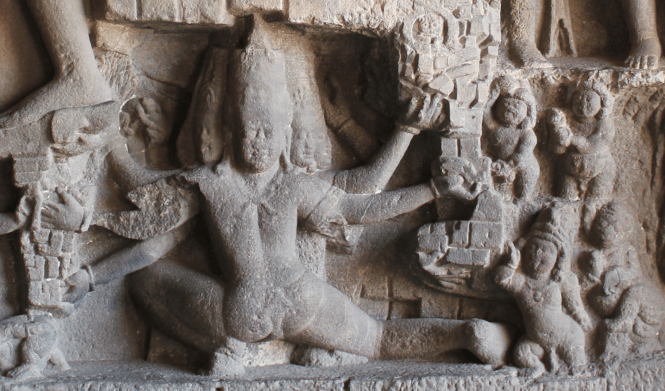
Ravananugrahamurti – Ravana shaking Mount Kailash.
The story goes like this. Kailash was not under the Chinese control as we see now. So Ravana did not need to wait for a visa in their Embassy. Ravana, one day Ravana reached Kailash to offer his prayers eagerly, like I stepped into cave 14. Shiva and Parvati were spending time together, because of which Ravana was asked to wait.
After waiting for long time, he lost his patience. Why would Shiva make a devoted follower and powerful ruler like Ravana wait so long? Out of impatience and so much confidence on his confidence, he tried to lift and shake mount Kailash. He wanted to grab Shiva’s attention, to remind him to come for darshan, the meeting.
His actions caused tremors in Mount Kailash. Everybody came to Siva Parvati in fear. Parvati too look confused, but Shiva knew Ravana’s intentions. As he liked Ravan, he wanted him to teach a lesson to kill his ego. With his thumb finger in his toe, he pressed the hill slightly. He doesn’t want to crush Ravana but it shot up the physical and mental stress for Ravana, he couldn’t hold the mountain any more.

Given up and realized about his mistake, Ravana wanted to do something to pacify Shiva. He pulled his nerves in his thigh tightly and made them as strings. Treating his body as Veena and his nerves as its strings, he played an enjoyable rhythm.
This story is sculpted in life size bas-relief in cave 14, a Hindu cave temple at Ellora dating from the early 7th century AD. It features a large mandapa with massive decorated pillars.
It has a notable panel depicting Ravana shaking Mount Kailash. This relief sculpture is located on the south wall of the cave and is based on a mythological theme from the Hindu epic Ramayana.

We may even have a treasure hunt to see how many panels depicts this story in Ellora.
When I saw the scale, the intricate details and dynamic composition, I opened my mouth in wonder. Because I never saw such bas-reliefs.
At the bottom of the panel, Ravana is depicted with ten heads and twenty arms, emphasizing his power. His multiple hands are carved in various positions to convince us about his effort to lift Mount Kailash.
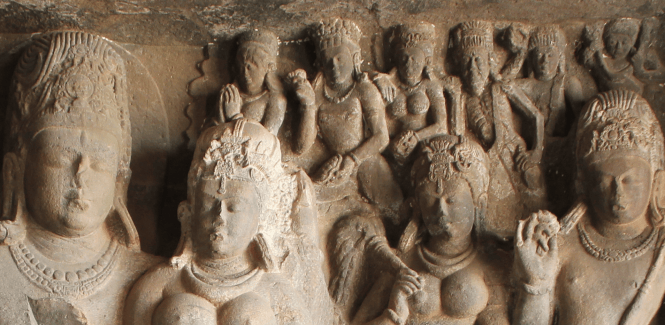
Lord Shiva positioned at the top of the panel, Shiva is shown seated calmly on Mount Kailash. His jatamakuta (hair crown) is carved with detail to form a respectable crown. Not only Shiva, it is so beautiful to see the stylish hair adornment and jewelry of Parvati, her chowry bearer too.

Parvati, seated beside shiva, reclining to her husband. Somebody say her face shows alarm. Her face reaction tells me that, she too aware of what’s happening and curious to know what will eventually unfold with a knowing smile. Her vaddanam (ornamental belt/oddiyanam), mathapatti (ornament that decorates the border of the hair in forehead) and nethichutti (jewelry at the centre of the forehead) are carved with fine details..
The panel includes terrified maidservants and rishis rushing about. These figures would be comparatively smaller, but still richly detailed, with expressive gestures that add depth to the scene.
Last but not least, look the four dwarfs below, who are depicted mocking Ravana, adding a touch of humor to the scene. Their small stature and exaggerated expressions would contrast with the more serious main figures.
Sites like Ellora will make any visitor crazy. Because such places has enormous to offer. They carry piles of arts and cultural heritage knowledge and stand as a silent witness for our past and how different beliefs or way of life originated in India and find their ways of betterment. Like Andal sings in her Thiruppavai, எல்லே இளங்கிளியே! இன்னும் உறங்குதியோ!, these artifacts asks us to wake up and gather more knowledge. This life is like our mother, takes effort to carry us, and offer us wisdom.

I’ll meet you with another post with another artifact. Until then have a blessed day.
This post is part of Blogchatter’s WRITE A PAGE A DAY 2025 campaign.
Discover more from dwaraka
Subscribe to get the latest posts sent to your email.