Kiran and I had a memorable early morning journey to Narttamalai (nārttāmalai/नार्त्तामलै) before two decades. I can’t quite recall how we traveled; I believe it was by car. As the sun began to paint the sky, we started our climb up Narttamalai hill.
Narttamalai, though a remote village along the Trichy-Pudukkottai highway, is a site of national importance. This entire village is a historical gem, though perhaps not as well-known as it deserves to be, even among locals.

The hill cradles six treasures
- There are two rock-cut temples,
- Pazhiyili Isvaram (பழியிலி ஈஸ்வரம்/paḻiyili īśvaram/पळियिलि ईश्वरम्) and
- Samanar-kudagu (சமணர் குடகு/camaṇar kuṭaku/चमणर् कुडकु),
- One magnificent structural temple called Vijayalaya Chozhisvaram (விஜயாலய சோழீஸ்வரம்/vijayālaya cōḻīśvaram/विजयालय चोळीश्वरम्), which is a marvellous piece of art, on the hill.
- A famous living temple of Mariamman (மாரியம்மன்/māriyammaṉ/मारियम्मन्).
- The Kadambar temple (கடம்பூர் கோயில்/kaṭampūr kōyil/कडम्पूर् कोयिल्) at the foot of a hill nearby is another beautiful temple.
- The natural cavern of Aluruttimalai (ஆளுருட்டி மலை/āḷuruṭṭi malai/आळुरुट्टि मलै) contains polished stone beds and other Jaina vestiges.
Kiran, well-prepared with research, led the way. My main role, as I saw it, was to offer moral support.
As the rising sun showered the landscape in a warm and golden light, we carefully climbed the sloping, slick rock, eager to capture a beautiful photograph of Vijayalaya Cholisvaram. Later within the temple campus, we were struck by the richness of its cultural heritage.

Vijayala Cholisvaram is a structural Siva temple, Opposite it, excavated into steep hillside, are two cave temples. One is Samanar Kudagu, the cave of Jains.

Today, let’s focus on the yali – also known as vyali or vyala or vyalaka – a recurring lion-like figure. The motif is often seen in Hindu and Buddhist temples and royal spaces. Samanar Kudagu is not an exception too.
The cave temple seems to have begun as a Jain site around 7th century, later becoming to shrine of vishnu. Mango trees and bushes create a serene atmosphere. A facade or mandapam stands before the cave, and it’s this facade that I want to highlight.
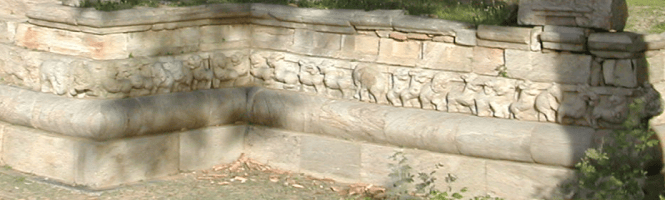
The facade’s base is adorned with procession of yalis. Sculpted to convey power and fierceness, these yalis often serve as brackets, or pillars supporting the structure. Simetimes they feature elephant trunks or bird wings.

Picture (c) archives.org.vn
We observed various types of yali-s. The simha yali has a lion’s head and body. The Gaja yali combines an elephant’s head with a lion’s body. The Makara yali features the body of a lion and the head of a crocodine. Similarly, the architecture boast a variety of yalis, such as Sarpa yali and Nara yali.

The plinthe of this facade features makara heads in the corners devouring humans in their mouth. These connect to frieze of elephants and Simha yalis. Though relatively small, they contribute to the basement’s beauty. Carved with dynamic energy, the playful nature of these yalis brought smiles to our faces. What a skill and imagination!
Scholars suggest several reasons for these depictions: protection, good luck and fertility among them. But beyond any symbolic meaning, they contribute an immense beauty that broadens our prospective as we enter these sacred spaces.
For more readings –
- Narttamalai – Prof S Swaminathan/MV Kiran
- Travelogue – travel.bhushavali.com