I had an opportunity of attending a temple tour of Sri Airavatesvara Temple (Airāvatīśvara, ऐरावतीश्वर) at Darasuram (Dārāsūram, दारासुरम) by one of the best historian Mr Kudavayil Balasubramaniam. That was my first time visiting this temple. I had been there alone few times to explore. Yet, I need to read and understand about this temple in detail.
Airavateshwarar Temple, Darasuram | Picture: Pandian Ramaiah 27 Dec 2011
This a marvel in south Indian temple architecture. Built by RajaRaja Chola II and later renovated by Kulothunga III as per the inscriptions in this temple.
This marvelous temple is a gallery of fine carvings of Periyapuranam (Periyapurāṇam, पेरियपुराणम्), stories about 64 Saivite devotees. In addition it has micro carvings, small sculptures, ornamental pillars. It makes any visitors mad and forcing them to come back to this temple again and again.
One of the small sculptures in the rear prakaram (pathway) of the temple is the focus of today’s discussion. The panel is of half foot or even lesser. This unique carving shows a pregnant woman giving birth, assisted by two other women, while one other woman is watching near by (probably waiting to hold baby).
Laboring woman, Darasuram | Picture: Pandian Ramaiah 27 Dec 2011
This carving is notable for its detailed portrayal of child birth and the support provided by women during delivery at that time. Giving birth in standing position is widely practiced in many parts of the world. The techniques may vary. When I search for similar sculptures, there a few within in Tamil Nadu itself. But this is one of the best in aesthetically.
People there says, these sculptures are worshiped by conceived ladies for better laboring. In addition to spiritual symbolism, it stands still as a documentation of ancient delivery (which was practiced until recently), the skillful artistry of Chola kingdom.
Kiran and I had a memorable early morning journey to Narttamalai (nārttāmalai/नार्त्तामलै) before two decades. I can’t quite recall how we traveled; I believe it was by car. As the sun began to paint the sky, we started our climb up Narttamalai hill.
Narttamalai, though a remote village along the Trichy-Pudukkottai highway, is a site of national importance. This entire village is a historical gem, though perhaps not as well-known as it deserves to be, even among locals.
Vijayalaya Cholisvaram | MV Kiran June 2003
The hill cradles six treasures
There are two rock-cut temples,
Pazhiyili Isvaram (பழியிலி ஈஸ்வரம்/paḻiyili īśvaram/पळियिलि ईश्वरम्) and
One magnificent structural temple called Vijayalaya Chozhisvaram (விஜயாலய சோழீஸ்வரம்/vijayālaya cōḻīśvaram/विजयालय चोळीश्वरम्), which is a marvellous piece of art, on the hill.
A famous living temple of Mariamman (மாரியம்மன்/māriyammaṉ/मारियम्मन्).
The Kadambar temple (கடம்பூர் கோயில்/kaṭampūr kōyil/कडम्पूर् कोयिल्) at the foot of a hill nearby is another beautiful temple.
The natural cavern of Aluruttimalai (ஆளுருட்டி மலை/āḷuruṭṭi malai/आळुरुट्टि मलै) contains polished stone beds and other Jaina vestiges.
Kiran, well-prepared with research, led the way. My main role, as I saw it, was to offer moral support.
As the rising sun showered the landscape in a warm and golden light, we carefully climbed the sloping, slick rock, eager to capture a beautiful photograph of Vijayalaya Cholisvaram. Later within the temple campus, we were struck by the richness of its cultural heritage.
24 Jun 2003 | Pandian Ramaiah
Vijayala Cholisvaram is a structural Siva temple, Opposite it, excavated into steep hillside, are two cave temples. One is Samanar Kudagu, the cave of Jains.
Samanar Kudagu Cave Temple | June, 2003
Today, let’s focus on the yali – also known as vyali or vyala or vyalaka – a recurring lion-like figure. The motif is often seen in Hindu and Buddhist temples and royal spaces. Samanar Kudagu is not an exception too.
The cave temple seems to have begun as a Jain site around 7th century, later becoming to shrine of vishnu. Mango trees and bushes create a serene atmosphere. A facade or mandapam stands before the cave, and it’s this facade that I want to highlight.
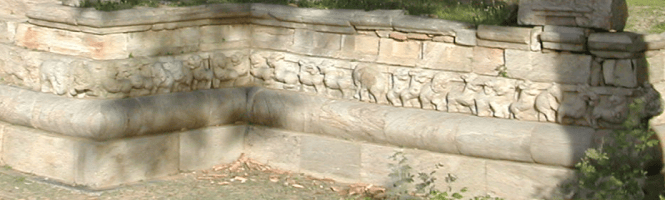
The facade’s base is adorned with procession of yalis. Sculpted to convey power and fierceness, these yalis often serve as brackets, or pillars supporting the structure. Simetimes they feature elephant trunks or bird wings.
Statue of Gajasimha Tower (Gaja yali) of Cham Da Nang Sculpture Museum (photo provided by nv) Picture (c) archives.org.vn
We observed various types of yali-s. The simha yali has a lion’s head and body. The Gaja yali combines an elephant’s head with a lion’s body. The Makara yali features the body of a lion and the head of a crocodine. Similarly, the architecture boast a variety of yalis, such as Sarpa yali and Nara yali.
The yala frieze, Samanar Kudagu, Narttamalai | MV Kiran, June 2003
The plinthe of this facade features makara heads in the corners devouring humans in their mouth. These connect to frieze of elephants and Simha yalis. Though relatively small, they contribute to the basement’s beauty. Carved with dynamic energy, the playful nature of these yalis brought smiles to our faces. What a skill and imagination!
The yala frieze, Samanar Kudagu, Narttamalai | MV Kiran, June 2003
Scholars suggest several reasons for these depictions: protection, good luck and fertility among them. But beyond any symbolic meaning, they contribute an immense beauty that broadens our prospective as we enter these sacred spaces.
Kiran and I traveled to Kunnandarkoil. Kiran had already read the documentation and was on his way to verify his readings on-site. As a web developer, I recklessly accompanied him. I went there without any expectations, as I had never traveled that route before.
When we entered into the temple complex, the Ratha Mandapam immediately grabbed our attention. It looked majestic despite its dilapidated condition.
The Chariot, Ratha Mandapam, June 2002 | M V Kiran
We rushed to see the rock cut shrine first, as it was evening and we might not be able to see the cave the dark. The cave temple was similar to the cave of Thirukokarnam. We saw similar mandapam supported by pillars, whose sirsa/heads were decorated with simple, folds of carvings.
When we came out of the complex, we walked past boys playing cricket toward the Ratha Mandapam.
This is a chariot-shaped mandapa with 90 pillars. Picture (c) puratattva.in
The chariot wheels of the Konark Sun Temple are famous, and I wrote about the Ratha Mandapam of Darasuram earlier. The one at Kunnandarkoil is relatively small. Yet, the wheels are elegantly carved, and the majestic facade is striking. It is attached to a mandapam with 101 pillars, but most of the mandapam is in a dilapidated condition, and it is not safe to walk inside. If it were well-maintained, the people of this place wouldn’t need a marriage hall.
Sometimes, artifacts from unexpected places are extraordinarily special and unforgettable.