Victoria Arch – A historical ignorance of Pudukkottai

I lived in and around this town. This has many historical buildings, fit to be museums, but encroached by Government agencies. These buildings, once offices of autocratic kings, became the abode of democracy. If you cross this town, you may visit the collector office, district courts and colleges. You will know how badly are they maintained. This place, once directly connected to British rule, has seen its historical charm fade under democracy.

One of them was the ornamental archway built in 1897 by King of Pudukkottai princely state to commemore the Diamond Jubilee of Queen Victoria as a token of his respect for a queen. East Main Stree is the high street (even now!) in Pudukkottai. He built the arch at the beginning of the high street.

Diamon Jubilee arch, Pudukkottai | Pandian Ramaiah, 16 July 2006

It was notable for its beauty. Thanjavur has such a arch too. Aesthetically, this arch was more appealing. It featured a unique image of Queen Victoria with black hair, her face resting on her left arm. Ironically, when the arch was built, the Queen had lost her husband and had retreated into an isolated life, often wearing mourning dresses. She stopped attending much public meetings. In addition, she never visited India. People used to say, she looks like an Indian queen than British!

The close-up | Pandian Ramaiah 16 July 2006

It provided a good look to the landscape, despite some political statues were erected later, as the entrance of high street.

Until recent days, the arch was standing with its glory. When I get my first camera, I went here to take my first few photographs. The town was under direct influence of British, due to which it was managed by no-nonsense people.

Dewan Seshaya Shastry improved the balance sheet of the state and planned the city with squared streets and roads with excellent water management with multiple ponds.

B.C. Holdsworth, another administrator, built a dam in Kadayakkudi. Present day Gandhi park was originally named after him. As per Indian antique records, a clock tower was declared open in 1933 by him. Swaminatha Pillai was the architect who designed the tower. The actual execution of the structure was entrusted to a contractor named M.K. Mahamadhaneef.

Holdsworth park during colonial times, renamed to Gandhi park | Pandian Ramaiah 16 July 2007

Unfortunately, these structures were poorly maintained over time. Political and cinema posters were stuck on the arch, and the park became uninviting due to poor maintenance. Recently there was some improvement in the maintenance of Park.

But a devastating destruction of legacy happened on Nov 14, 2009.

Erasing the legacy. Picture (c) The Hindu, 14 Nov 2009

as a vehicle rammed into the arch. Despite the arch did not lose its shape and fit to be conserved in other places, the district management demolished it into pieces. The legacy stood majestically for 112 years, vanished leaving a void that reflecting such minds.

You can never object to the justifications given by the management. But historians raised their concerns. Despite being led by highly qualified individuals, the management seemed to lack the historical awareness needed to preserve these remnants in a museum for future generation.

Similar demolition happened in Thanjavur as well. Though the people were different, common denominator is the historical ignorance of democracy and its bureaucracy.

After all, that is the town, had my history teacher, received Government salary, taught me that Ghajini Mohamed came, saw the pulchritude of the sculptures, felt it is fit for his bedroom and smuggled away! Despite this series talks about cultural traces, we need to talk about our own ignorance too.

For further reading –

This post is part of Blogchatter’s WRITE A PAGE A DAY 2025 campaign.

The elegant dancers of Sittannavasal

We, few boys of age between 11 and 13, traveled to Sittannavasal from Pudukkottai by our bicycles. I think it would be 1990 or 1991. We started with enthusiasm. By the time we came out of the town, the vast landscape and free air soothed our eyes and lungs. Soon we felt a sense of accomplishment, despite having only cycled a short distance!

Before crossing our tenth kilometer, we felt the ache in our legs. We were not sure, there was considerable distance on both sides. We carry no cash to buy any snacks. Then we took short break now and then. By the time the Sittanavasal hill came to our vision, we rejoiced despite losing our gallop.

With full force, we cycled further. The problem is, the entire route from Pudukkottai to Sittanavasal is a gentle uphill. So you can feel our pain. Yet, we decided to reach our target. On the way, another obstacle came in. Yes, It rained. In fact, it was a down pour. We found our shelter in nearby bus stop.

Sittannavasal hill, 12 July 2003 | M V Kiran

By the time rain subsided, we took a decent break. With streams of rainwater flowing alongside the road, we cycled and reached the place. It was so scenic because it was deserted due to rain and there were small streams flowing from the top of the hill, which we never imagined we could see.

We read about that place in our history. Unfortunately, for five years, from class 6 to 10, history was taught in a manner that did not engage me. As I crossed by forties, I won’t even consider them as teachers. I feel they did not effectively convey the importance and interest of history. Coming back, this place Sittannavasal is important for many reasons.

  1. It has one of the earliest Tamil inscription, dating back to 3rd or 5th century BC.
  2. It has the cave temple that is entirely dedicated to Jains (We have many caverns and beds. But Sittannavasal cave is in the form of a temple).
  3. It has one of the early Pandya paintings.

Three of those paintings are the focus of today’s post

My understanding goes like this. Pandyas ruled the southern part of Tamilnadu from Madurai. Cholas ruled the eastern part of Tamilnadu from Uraiyur, Pazhayarai, Thanjavur, Gangai Konda Cholapuram (modern day Jayamkondam). There were clashes and marriage relationships between Pallavas and Pandyas.

Despite their rivalry, the Pandyas were clearly influenced by Pallava architectural styles. In addition, Pallava princesses who married Pandyas likely brought their artistic influences with them.

Kochadayan Ranadhira (7th Century AD) was known to be a popular king who defeated Ays of Thirnelveli-Tiruvanandapuram. He entered into a political marriage alliance with a Pallava princess. His son Maravarman Rajasimha was the one who attacked Pallava King Nandivarman Pallavamalla when their kingdom was in stress.

Maravarman Rajasimha’s son Nedunjadayan had a minister, Madura Kavi, who excavated Anamalai temple for vishnu. This suggests that Pallava artistic influence likely played a role in the development of the Pandyan cave temple architecture.

Entrance to Yoga Narasimhar temple, Anamalai, with the rock in the background (c) Rayappa Kasi

With this background, let’s come to Sittannavasal. It has multiple sites. But let’s talk about the Jain cave temple ‘Arivar Koil’. Outside the temple, there is an inscription belongs to 9th century. It states additions and renovations of the cave temple is done in early Pandya period.

The inscription is our focus. So let me go to the paintings. Let me quote, from Prof S Swaminathan and M V Kiran’s documentation –

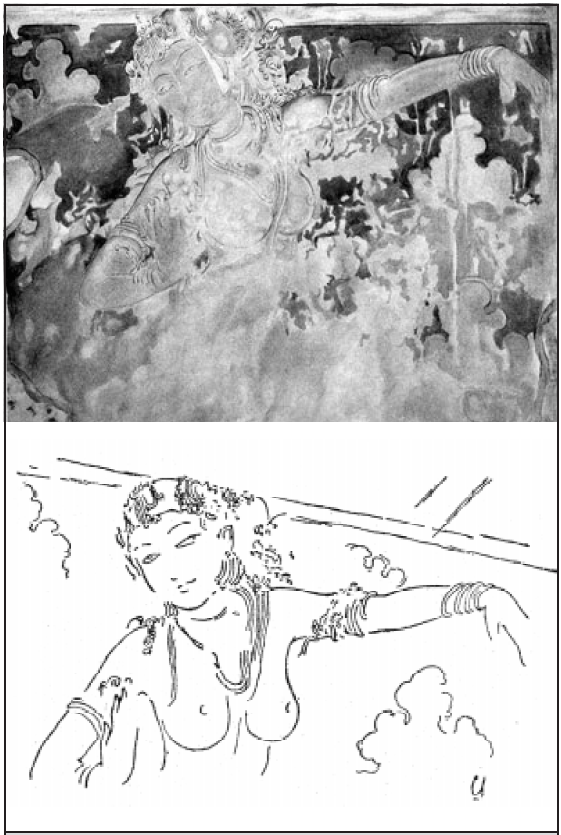
On the front face of the southern pillar is a beautiful picture of a dancer, her left arm stretched-out in lata-hasta pose, gracefully. She has her right arm bent at the elbow, in front of her bosom with its palm presenting pataaka. Her ears are adorned with patra-kundala (known as olai in Tamil), rings set with gems,and her arms decked with bracelets and bangles.

Dancer in the southern pillar

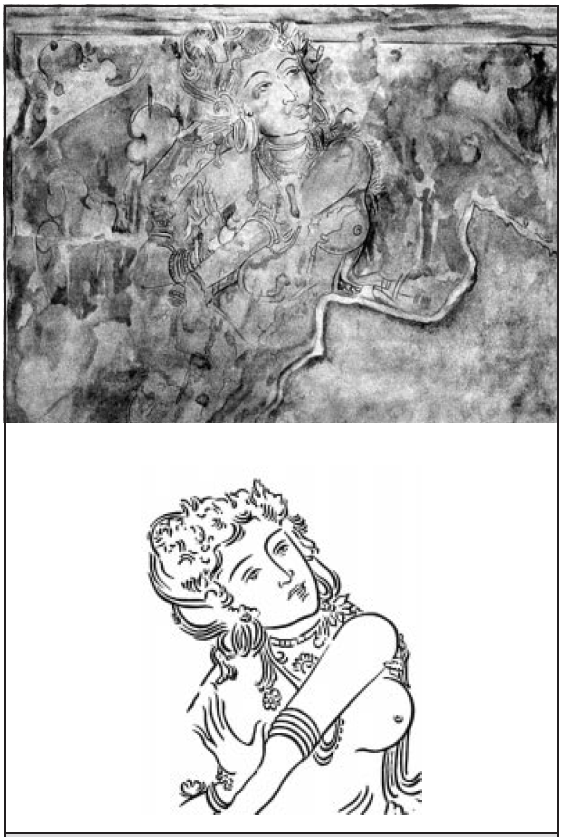
Even more graceful is the other dancer on the front face of the northern pillar. She has her left arm starched in lata-hasta pose, while her right arm is bent at the elbow, in front
of her bosom with its palm presenting pataaka. The headdress and the ornaments of this dancer are very distinct. The hair is decked with flower garlands.

Dancer in the northern pillar

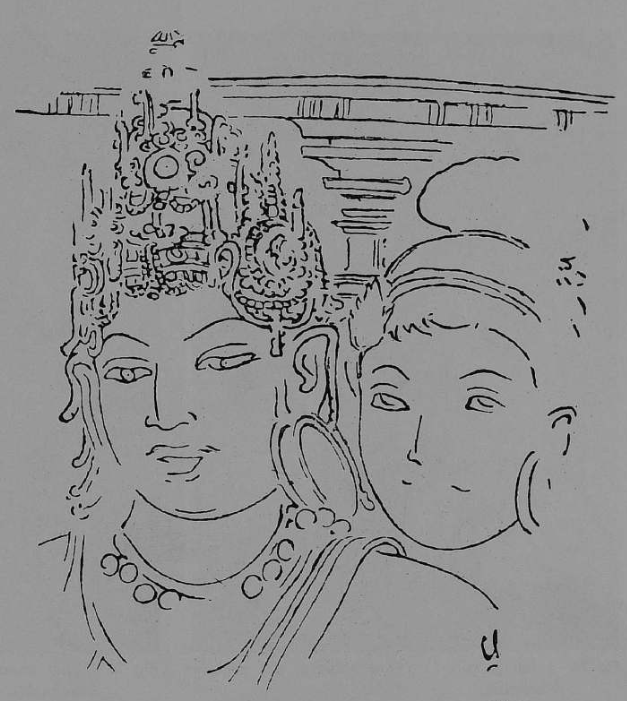
The painting on the other face of the southern pillar represents a man and a woman, possibly the builder, and his queen. The man has an elaborate kiritam (diadem on the head), a patra-kundala (rings set with gems) in the ear. There is also an umbrella raised over both. His demeanor and his diadem indicate his royal status.

The royal couple

We could not arrive at a clear decision of who these couple are. It is generally believed to be the Pandya king Srimaran Srivallabhan and his queen who renovated this temple and built extensions.

Researchers found that there are two layers of paintings, an earlier and a latter. Possibly there was earlier work done by Pallava painter, later it might be taken over by Pandyas.

C Sivaramamurthy in his South Indian Paintings, clearly mentions that they are Pandya paintings. Let me quote –

The figures, however, like the famous prince and princess with a monk before them, and the
two marvellous dancers, as well as the pool filled with flowers, fishes, ducks, a buffalo and elephant, are all Pandyan paintings of great elegance, revealing the craftsmanship of the painter.

We never regret our tiresome cycling to this place. Even then, the extent of damage to the paintings was disheartening. After the heavy quarrying nearby, how much our kids will inherit is a question mark. Prof S Swaminathan proposes a facility to preserve the same. Are we ready to lose the charm of the unique Jain cave temple with Pandya paintings? Or will there be change in our attitude to preserve it? The questions are hanging in the air.

If you happen to travel, do not forget to show this to your kids.

For more readings –

Saving Sittanavasal

Sittannavasal -a booklet by Prof S Swaminathan.

South Indian Paintings by C Sivaramamurthy

Going behind peahens, Sittannavasal, 12 Jul 2003 | Pandian Ramaiah.

This post is part of Blogchatter’s WRITE A PAGE A DAY 2025 campaign.

Kalari Murti of Kodumbalur

Kodumbalur (கொடும்பாளுர் / Koṭumpāḷūr / कोडुम्पाळूर्) is a hamlet near my birthplace. When something is so near and freely available, you won’t realize its value. This is a general global phenomenon. I am no exception.

It is historically important as it was the headquarters of the Irukkuvels, one of the chieftains of the Chola kingdom. In the popular novel Ponniyin Selvan, Vanathi, Princess of Kodumbalur, was a close associate of the powerful Chola princess Kundavai. She was in love with Arunmozhi Varman, also known as RajaRaja Chola.

According to the epic Cilappatikaram, the protagonists Kovalan and Kannaki crossed this place on their way from Uraiyur (modern-day Tiruchirapalli) – one of the Chola capitals – to Madurai, the Pandya capital. This epic names this place கொடும்பை நெடுங்குளக் கோட்டகம் (Koṭumpai Neṭuṅkuḷak Kōṭṭakam / कोडुम्पै नेडुंगुळक् कोट्टकम्).

Such a busy town is now just a village now. This place has three important archaeological sites:

  • The Muvar Kovil (Temple of Three),
  • The Aivar Kovil (Temple of Five),
  • The Mucukuntesvara Temple.

The Muvar Kovil temple enchants every viewer. It is older than the Thanjavur Brihadisvara Temple (or Big Temple).

Kodumbalur vimanam | 📸 M V Kiran

But the focus of this post is one of the icons we can see at Kodumbalur: the Kalari Murti idol of Shiva.

Kalari Murti, Kodumbalur | 📸 M V Kiran

The story goes like this: Shiva’s devotee Markandeya was supposed to die at the age of 16. Impressed by his deep devotion, Shiva wanted to help him by challenging Yama, the god of death. Shiva performed a ‘playful dance’ (களிநடனம்) on top of Yama, pushing him away and saving his devotee.

Markandeya episode, Raja Ravi Varma.

This sculpture at Kodumbalur is considered one of the finest examples of early Chola art and iconography. The representation of Shiva as Kalari Murti is in the first tier of the eastern niche of one of the remaining temples.

Kalari Murti is the first niche of the left photograph | 📸 (c) travel.bushavali.com
Kalari Murti, Kodumbalur, (c) https://puratattva.in/kodumbalur-glory-of-the-irukkuvels/

Look at the above picture. Shiva is shown in a dynamic, dancing posture, indicating a destructive attitude. However, killing Yama would stop deaths in the universe, destabilizing the equilibrium. Therefore, Shiva is careful not to push Yama to death. He is dancing on his back playfully. Note the smile on Shiva’s face and the horror on Yama’s face. This symbolizes Shiva’s victory over death.

The soft molding of his abdomen, thighs, and legs makes this sculpture unique. The compassion shown on Shiva’s face brings a smile to our faces too!

If you happen to travel to Tiruchi or Madurai, do not forget to visit this beautiful early chola temple. The same form of Shiva is common to see in other places too.

Kalantaka Shiva, Kailasanatha Temple, Kanchipuram. I found this photo on facebook.
Kalantaka Shiva, Gangai Konda Cholapuram, (c) the sculptor, photo (c) Rahul Naidu

For more reading-

This post is part of Blogchatter’s WRITE A PAGE A DAY 2025 campaign.