Bodhisattva, Gandhara

The Asian Civilisations Museum (ACM) in Singapore recently received Buddhist artifacts from Kolkata. I had been a visitor there. Upon entering the museum, visitors are immediately captivated by the striking Gandhara Bodhisattva head, its arresting composure sought attention even before they reach the special exhibition. With it’s intricate decorated ornaments, curly hair/mustache/beard. It does not look like conventional Buddhist artifacts.

As I stood before the stunning Gandhara Bodhisattva head, memories of my school days flooded my mind. In class 9, we had studied about Gandhara artistry, but without any background in artistry, it was hard for us to fully appreciate its significance at the time. However, life has a way of circling back. Recently I had a visitor from India, who specifically asked about this artifact. It was heartening to see people taking interest in understanding this piece of history and artistry.

From being just another topic in school to becoming a tangible connection with someone else’s curiosity decades later, it underscored the power of personal experiences and shared interests in deepening our understanding and connection with cultural artifacts.

This is likely a representation of Avalokiteśvara, the Bodhisattva of compassion. But we can not definitely confirm. The short description on roots website did not explain this too. I’ve written in details about Avalokiteśvara in another post of the same series. Hence I am not going to repeat it once again. But let’s focus on this artifact of ACM. This terracotta sculpture is believed to be 4th – 5th centuries AD, the peak period of Gandhara art. This art form is believed to be in practice since 1st Century BC to 7th Century AD.

The style began as an influence of Greco-Roman artistic traditions mixed with Indian art forms. Historians say the refined facial expression of this is influenced by early Gandharan sculpture styles.

Gandharan region, Western Pakistan – Eastern Afghanistan, was of central importance in the development of Mahayana Buddhism from 1st Century BC. It embraced the art forms of Hellenic (ancient and modern Greek), ancient Iran and China, made a fusion with Indian art forms, reflecting the cultural exchange along the silk roads.

Back then, Gandhara art was just another topic in my history textbook, a distant concept without much personal relevance, introduced horribly by my history teachers. Now, standing before the magnificent Gandhara Bodhisattva head, I’m in awe of the rich heritage it represents. Life is interesting, though stressful at times!

For further reading

This post is part of Blogchatter’s WRITE A PAGE A DAY 2025 campaign.

Horsemen pillars of Vijayanagara/Nayaka

Sri Varadharaja Perumal Temple in Kanchipuram is popular for its exquisite architectural features, including the 100 Pillared Hall. When I went there for the first time, the shrine was closed as the lord Varadharaja is taking his afternoon nap. Until the temple opens, I was roaming around this hall.

from Sri Varadharaja Perumal Temple | Pandian Ramaiah 17 Sep 2006

I found intricately carved pillars, which depict horses and mystical creatures or Yalis ridden by warriors. Sadly, the mandapam was closed. I could not enjoy all the creative skills of artistry skills. These pillars are not only aesthetically wonderful but also showcase the advanced craftsmanship of the Vijayanagara era.

The 100(0) pillared mandapam, Sri Varadaraja Perumal Temple, Kanchipuram | Pandian Ramaiah, 17 Sep 2006.

I understood that this 100 Pillared Hall is a significant part of the temple’s expansion during the Vijayanagara Empire’s reign. The carvings on the pillars include scenes from the depictions of Vishnu and his avatars. The nearby temple tank made my presence serene.

The Horse armour from Varadharaja Perumal Temple | Pandian Ramaiah, 17 Sep 2006

The horsemen pillars are typical style of Vijayanagara and Nayaka-s who are Vijayanagara’s chieftains. Typically such pillars elevate the temple’s status as a masterpiece of Vijayanagara architecture, reflecting the rich cultural and religious heritage of the region.

I wish to highlight two more places with pillars depicting horsemen –

  • Sri Ranganathaswamy Temple, Srirangam – The temple’s 1000 Pillared Hall features sculptures of rearing horses with riders exemplifying Vijayanagara artistry. The hall is a notable example of planned theatre-like structures, to gather devotees.
  • Shikakiriswara temple, Kudumiyamalai – I spoke about this temple in this series earlier. Similar to 100 pillard mandapam of Kanchipuram and 1000 pillared mandapam of Srirangam, there is a Anivetti-k-kal-mandapam contributed by Nayaka-s.

Let me quote from the documentation of Prof S Swaminathan and MV Kiran –

The portrayal here of figure of horsemen treading over the foot soldiers is of particular interest. One can see here weapons used respectively by the horseman and the foot soldiers and the method in which the foot soldiers defended themselves from the attacks of the horsemen.

Kudumiyamalai, SS, MVK

Horsemen pillar at Kudumiyamalai | Pandian Ramaiah, 23 ‎April ‎2007

All three temples share similarities in their architectural features: a hall with pillars adorned with riders on horse/mythical yali/other animals.

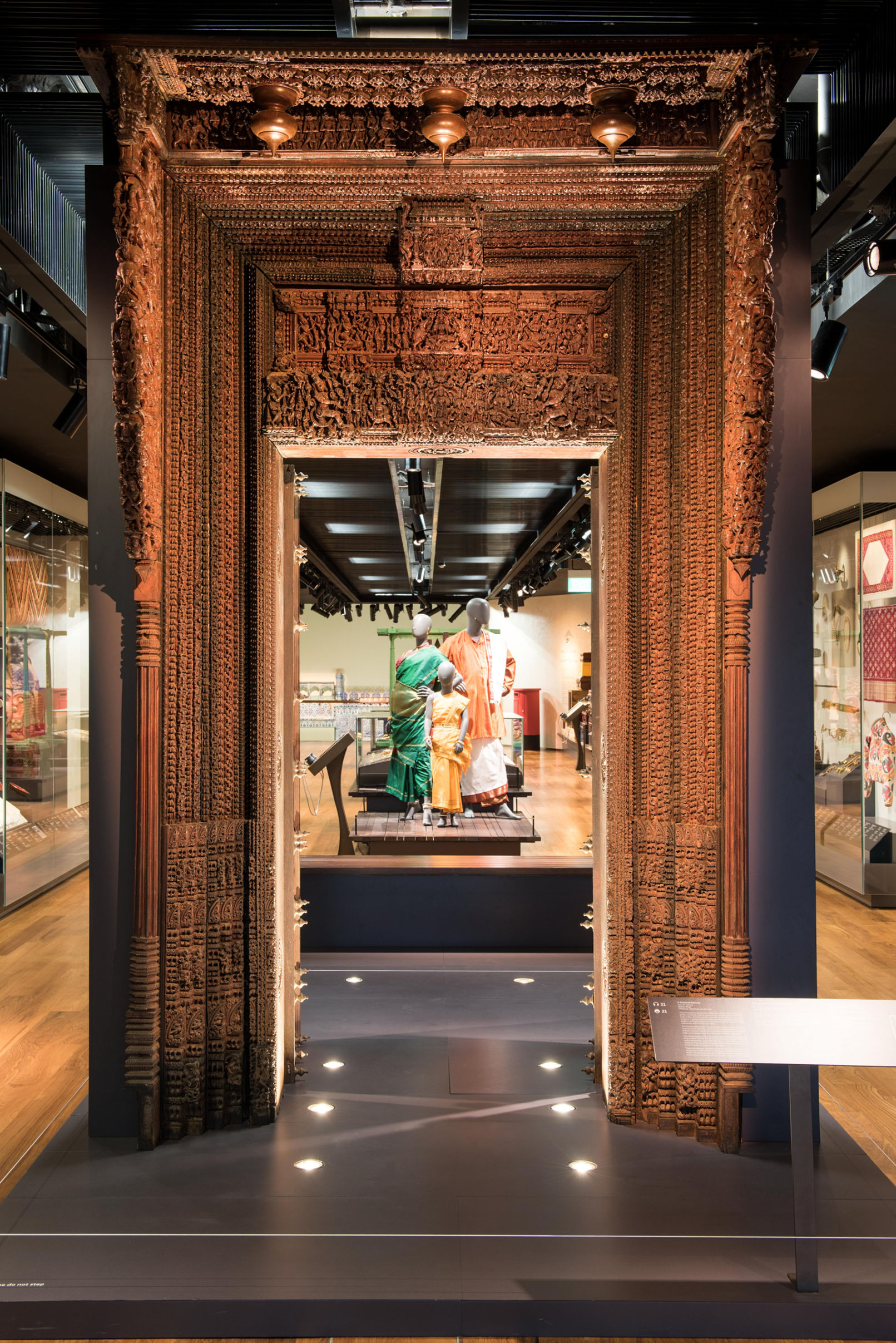
Additionally, I’d like to mention an artifact often highlighted during my museum tours: the Chettiar Doorway at the Indian Heritage Centre in Singapore.

Chettinad Door way, Indian Heritage Center, Singapore | Picture credit: indianheritage.gov.sg

This doorway is adorned with over 5000 carvings, including Ramayana, Vishnu riding on Garuda’s shoulders, Ganesha, Subramanya, Gajalakshmi and other motifs. On the side, we saw beautiful armours riding horses and Yali-s. It reflects the influence of Nayaka art on Chettinad architecture.

The door way, side view | Picture (c) arizonahandbook.com

Breathtaking, isn’t it?

While discussing South Indian temple architecture, it is essential to acknowledge the contributions of the Vijayanagara and Nayaka dynasties, particularly, Nayakas’ colossal sculptures. At first sight, it pins your mind with it majestic beauty. If you have the opportunity, visit these sites and share your experiences with me.

This post is part of Blogchatter’s WRITE A PAGE A DAY 2025 campaign.

Ratha Mandapam of Kunnandarkoil

Kiran and I traveled to Kunnandarkoil. Kiran had already read the documentation and was on his way to verify his readings on-site. As a web developer, I recklessly accompanied him. I went there without any expectations, as I had never traveled that route before.

When we entered into the temple complex, the Ratha Mandapam immediately grabbed our attention. It looked majestic despite its dilapidated condition.

The Chariot, Ratha Mandapam, June 2002 | M V Kiran

We rushed to see the rock cut shrine first, as it was evening and we might not be able to see the cave the dark. The cave temple was similar to the cave of Thirukokarnam. We saw similar mandapam supported by pillars, whose sirsa/heads were decorated with simple, folds of carvings.

When we came out of the complex, we walked past boys playing cricket toward the Ratha Mandapam.

This is a chariot-shaped mandapa with 90 pillars. Picture (c) puratattva.in

The chariot wheels of the Konark Sun Temple are famous, and I wrote about the Ratha Mandapam of Darasuram earlier. The one at Kunnandarkoil is relatively small. Yet, the wheels are elegantly carved, and the majestic facade is striking. It is attached to a mandapam with 101 pillars, but most of the mandapam is in a dilapidated condition, and it is not safe to walk inside. If it were well-maintained, the people of this place wouldn’t need a marriage hall.

Sometimes, artifacts from unexpected places are extraordinarily special and unforgettable.

For further reading –

This post is part of Blogchatter’s WRITE A PAGE A DAY 2025 campaign.