We talk a lot about ideal couple, ideal parent, ideal child. We often expect others to embody ideals that we ourselves struggle to achieve. But all of us are on the way of trying to be one. Our goal is like the lovely divine couple Siva and Parvati and their lovely kid Skanda. The parent with child seated in Sukhasana on a royal posture is shown by Somaskanda murti.
It may be sometime around 1920s or 1930s. Historian C. Sivaramamurti goes to Thanjavur to view the Chola paintings, discovered recently then. He makes a copy of it and wrote a paper to the quarterly magazine Triveni, He goes to Kanchipuram Sri Kailasanatha Temple.
For those who have not visited Kailasanatha temple, understand that it is one of the marvels of Pallava architecture. If Mamallapuram is their dream in stone, this is their dream in sand and plaster. The temple, adorned with detailed sculptures and vibrant Pallava paintings, must have resembled a colorful pavilion in its prime.
Sri Kailasanatha Temple, Kanchipuram | Pandian Ramaiah 13 March 2013
It has a main shrine for Siva, surrounded by pradakshina path way. The way is surrounded by outer walls with many small shrines, covered with Pallava paintings. They are one of the earliest paintings of Indian art history, along with Ajanta, Thanjavur, Sittannavasal and Panamalai.
The temples striking appearance captivates visitors, and upon entering, one feels transported into Pallava sphere of influence. In addition to the paintings, the temple is worth visiting for its beautifully carved Grantha inscriptions.
Grantha inscriptions/Pallava signatures| Pic Pandian Ramaiah 27 Feb 2007
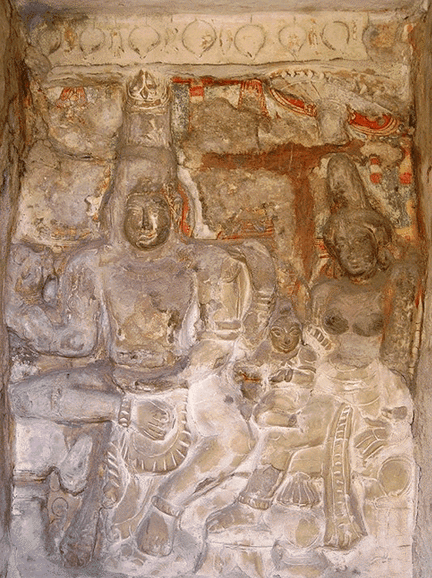
Mr Murti identified the Somaskanda panel for the first time in cell (or small shrine) no 41 at the Kailasanatha temple at Kanchipuram in the early 20th century. He mentioned that he copied the Somaskanda painting and identified it.
Somaskanda, 7th Century, Kanchipuram | C Sivaramamurti
He says the most of the painting got defaced due to natural cause and vandalism. When I went to see that now, it is even worse. But whatever exists, it shows the dynamic flow of lines and dye combinations that creates the figure of Siva- the father, Parvati – the mother and Skanda – the child. Other figures are also depicted, including what some believe to be Vishnu and the gana-s (attendants) of Kailash.
Somakanda line drawing, South Indian Paintings by C Sivaramamurti
It also has other figures, people say Vishnu, other gana-s of Kailash.
We can recognize the face of Siva. But most of Siva’s torso, the face of Parvati are lost. Baby Skanda is too damaged severely.
Let me quote from Mr Murti..
“It is a lovely theme of fond parents and a frolicsome child, of the ideal mates and the object of their love, of the philosophy of affection which, though lavished on the off-spring, increase a thousandfold.”
Somaskanda | Picture source unknown
Professor Jouveau Dubreuil, who had discovered the paintings earlier, was pleased with Sivaramamurti’s identification and came to Madras specifically to confirm its accuracy.
The preservation of Kanchipuram, Sittannavasal are important to save our heritage. But even now, the cells are open to public, the paintings are getting damaged every day due to vandalism. Ajanta is decently preserved, partially it is due to the way the cave is excavated. Natural decay occurs slowly there because the cave entrances are small. But caves like Sittannavasal and structural temples like Kailasanatha temple, are facing heavy challenges to survive.
In conclusion, the Somaskanda panel at Kanchipuram’s Kailasanatha temple offers a profound glimpse into Pallava artistry and the enduring ideals of family and divinity.
We, few boys of age between 11 and 13, traveled to Sittannavasal from Pudukkottai by our bicycles. I think it would be 1990 or 1991. We started with enthusiasm. By the time we came out of the town, the vast landscape and free air soothed our eyes and lungs. Soon we felt a sense of accomplishment, despite having only cycled a short distance!
Before crossing our tenth kilometer, we felt the ache in our legs. We were not sure, there was considerable distance on both sides. We carry no cash to buy any snacks. Then we took short break now and then. By the time the Sittanavasal hill came to our vision, we rejoiced despite losing our gallop.
With full force, we cycled further. The problem is, the entire route from Pudukkottai to Sittanavasal is a gentle uphill. So you can feel our pain. Yet, we decided to reach our target. On the way, another obstacle came in. Yes, It rained. In fact, it was a down pour. We found our shelter in nearby bus stop.
Sittannavasal hill, 12 July 2003 | M V Kiran
By the time rain subsided, we took a decent break. With streams of rainwater flowing alongside the road, we cycled and reached the place. It was so scenic because it was deserted due to rain and there were small streams flowing from the top of the hill, which we never imagined we could see.
We read about that place in our history. Unfortunately, for five years, from class 6 to 10, history was taught in a manner that did not engage me. As I crossed by forties, I won’t even consider them as teachers. I feel they did not effectively convey the importance and interest of history. Coming back, this place Sittannavasal is important for many reasons.
It has one of the earliest Tamil inscription, dating back to 3rd or 5th century BC.
It has the cave temple that is entirely dedicated to Jains (We have many caverns and beds. But Sittannavasal cave is in the form of a temple).
It has one of the early Pandya paintings.
Three of those paintings are the focus of today’s post
My understanding goes like this. Pandyas ruled the southern part of Tamilnadu from Madurai. Cholas ruled the eastern part of Tamilnadu from Uraiyur, Pazhayarai, Thanjavur, Gangai Konda Cholapuram (modern day Jayamkondam). There were clashes and marriage relationships between Pallavas and Pandyas.
Despite their rivalry, the Pandyas were clearly influenced by Pallava architectural styles. In addition, Pallava princesses who married Pandyas likely brought their artistic influences with them.
Kochadayan Ranadhira (7th Century AD) was known to be a popular king who defeated Ays of Thirnelveli-Tiruvanandapuram. He entered into a political marriage alliance with a Pallava princess. His son Maravarman Rajasimha was the one who attacked Pallava King Nandivarman Pallavamalla when their kingdom was in stress.
Maravarman Rajasimha’s son Nedunjadayan had a minister, Madura Kavi, who excavated Anamalai temple for vishnu. This suggests that Pallava artistic influence likely played a role in the development of the Pandyan cave temple architecture.
Entrance to Yoga Narasimhar temple, Anamalai, with the rock in the background (c) Rayappa Kasi
With this background, let’s come to Sittannavasal. It has multiple sites. But let’s talk about the Jain cave temple ‘Arivar Koil’. Outside the temple, there is an inscription belongs to 9th century. It states additions and renovations of the cave temple is done in early Pandya period.
The inscription is our focus. So let me go to the paintings. Let me quote, from Prof S Swaminathan and M V Kiran’s documentation –
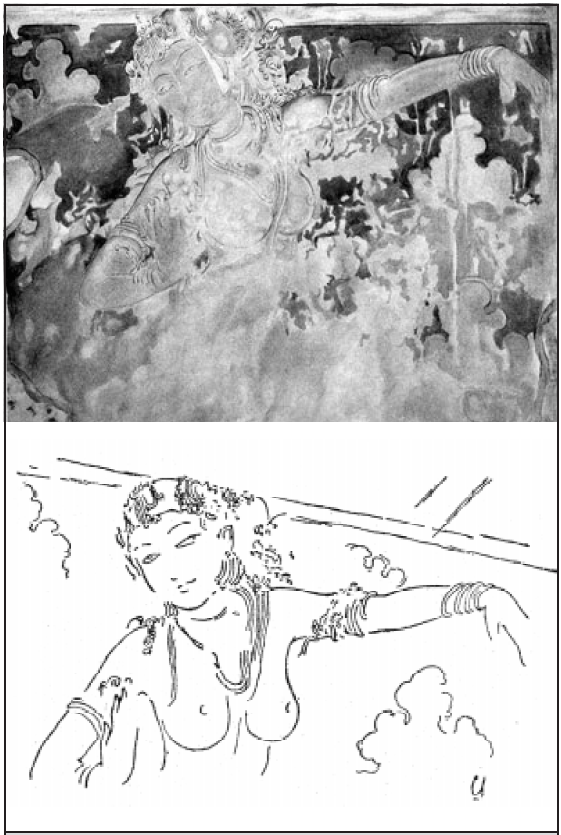
On the front face of the southern pillar is a beautiful picture of a dancer, her left arm stretched-out in lata-hasta pose, gracefully. She has her right arm bent at the elbow, in front of her bosom with its palm presenting pataaka. Her ears are adorned with patra-kundala (known as olai in Tamil), rings set with gems,and her arms decked with bracelets and bangles.
Dancer in the southern pillar
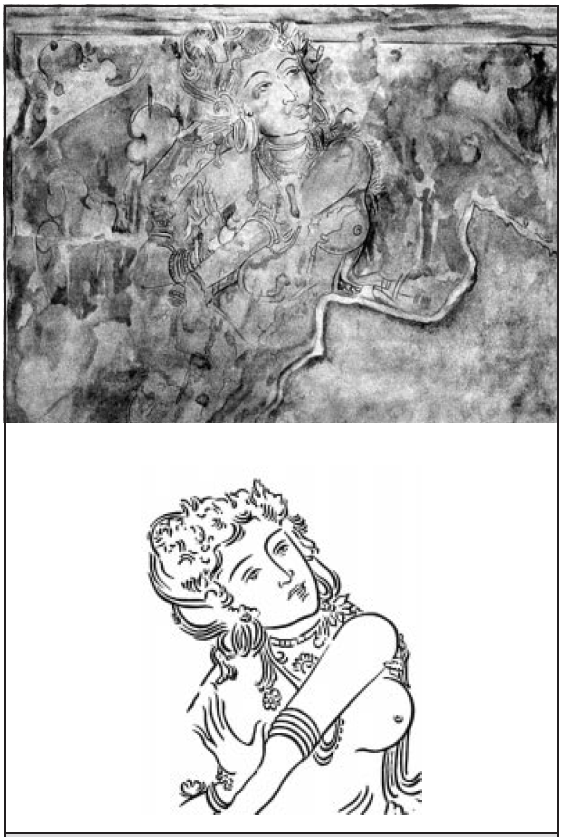
Even more graceful is the other dancer on the front face of the northern pillar. She has her left arm starched in lata-hasta pose, while her right arm is bent at the elbow, in front of her bosom with its palm presenting pataaka. The headdress and the ornaments of this dancer are very distinct. The hair is decked with flower garlands.
Dancer in the northern pillar
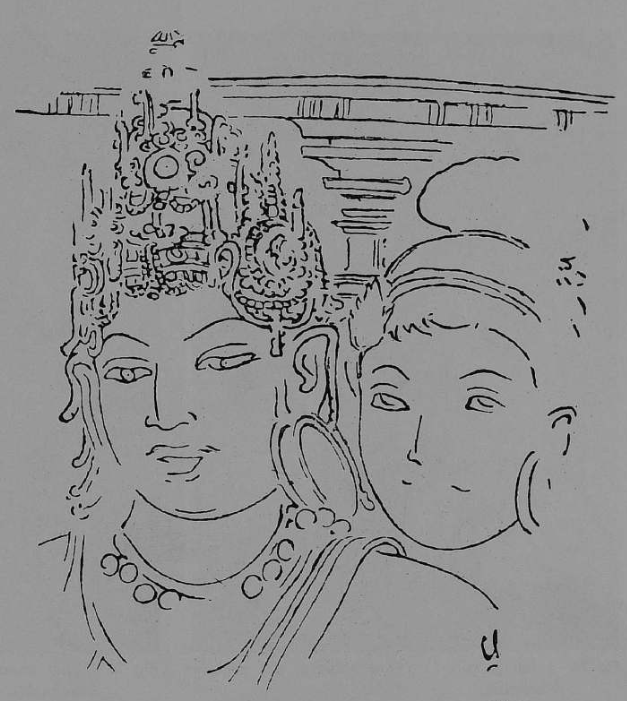
The painting on the other face of the southern pillar represents a man and a woman, possibly the builder, and his queen. The man has an elaborate kiritam (diadem on the head), a patra-kundala (rings set with gems) in the ear. There is also an umbrella raised over both. His demeanor and his diadem indicate his royal status.
The royal couple
We could not arrive at a clear decision of who these couple are. It is generally believed to be the Pandya king Srimaran Srivallabhan and his queen who renovated this temple and built extensions.
Researchers found that there are two layers of paintings, an earlier and a latter. Possibly there was earlier work done by Pallava painter, later it might be taken over by Pandyas.
C Sivaramamurthy in his South Indian Paintings, clearly mentions that they are Pandya paintings. Let me quote –
The figures, however, like the famous prince and princess with a monk before them, and the two marvellous dancers, as well as the pool filled with flowers, fishes, ducks, a buffalo and elephant, are all Pandyan paintings of great elegance, revealing the craftsmanship of the painter.
We never regret our tiresome cycling to this place. Even then, the extent of damage to the paintings was disheartening. After the heavy quarrying nearby, how much our kids will inherit is a question mark. Prof S Swaminathan proposes a facility to preserve the same. Are we ready to lose the charm of the unique Jain cave temple with Pandya paintings? Or will there be change in our attitude to preserve it? The questions are hanging in the air.
If you happen to travel, do not forget to show this to your kids.