
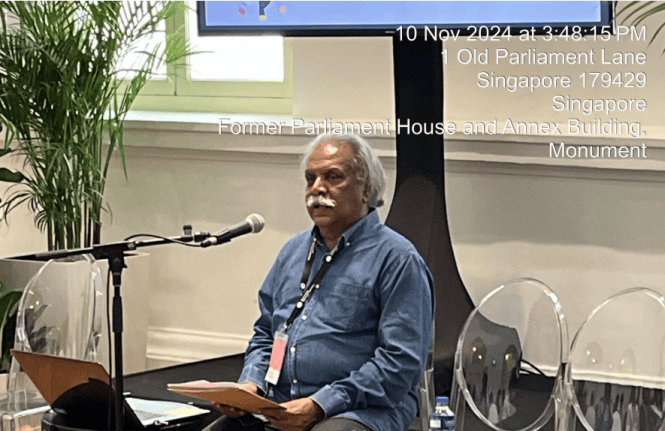
November is the month of the Writers Festival in Singapore, and this year’s theme is “In Our Nature.” Wildlife conservationist S. Theodore Baskaran was one of the invited speakers. His keynote address focused on the contribution of environmental literature, also known as green literature, to conservation efforts. The session was scheduled for November 9, 2024, in the Blue Room at the Arts House.
He fondly remembered the 1972 Stockholm Conference and mentioned that concerns about nature have increased worldwide since then. Many books have been written, and many conferences convened, focusing on nature, the environment, and the relationship between nature and humanity.
He started with Rachel Carson’s Silent Spring. He stated that the work changed the direction of history. Rachel was a biologist and an excellent writer. When she returned to her village, she found that there were no birds. It was spring, the reproductive season for birds, so she expected to hear their songs. However, they were missing. She discovered that pesticides were being used to destroy the worms. Since there were no worms, the birds, which feed on worms, stopped visiting. Thus, the spring became silent.

When discussing Tamil literature, he pointed out that those who write about the environment are volunteers, not biologists. He introduced prominent works of green literature of Tamil across different forms. This made his talk meaningful.
He started with M. Krishnan. He quoted his words of stark contrast between Indian and Western attitudes towards the environment and wild animals. He mentioned Po Appasamy. Fiction is unavoidable when discussing this context.
Fiction
While talking about fiction, he introduced Sa. Kanthasamy‘s Saayavanam novel. Saayavanam is one of the earliest examples of literature focusing on ecological concerns in India and addresses forest clearances and industrial development in Thanjavur, Tamil Nadu. This was written well before environmental vocabulary was formally established in Tamil.
He appreciated modern-day Tamil writers who use proper (or natural) words of forests when they write about village-based subjects. He explained that many such words are forgotten, using the example of the lion-tailed macaque. Those who literally translate this as ‘singa-vaal Kurangu‘ into Tamil do not know that a proper Tamil word exists. He points out that the word ‘solai mandhi‘ already exists, which is the correct term for the lion-tailed macaque because these monkeys used to live in the shola jungles. He also points out another term, ‘kaatu mandhi‘ (forest monkeys), for those that lived in the forests after the shola regions.
He mentioned two works of Perumal Murugan: Koolamathari and Poonachi. One of these novels discusses the dhole (செந்நாய் / wild dog), which existed in the Javvadhu Hills and Kalvarayan Hills but is now extinct. He appreciates Perumal Murugan for mentioning jungle cats and the strange behavior of humans who eat them, which is one of the reasons for their extinction.
He introduced writer and Sahitya Akademi award-winning author Cho Dharman‘s Koohai novel. Another award-winning writer, Joe De Cruz‘s Aazhi Sool Ulagu, was mentioned because it discusses life at sea and the lives of fishermen. He appreciates Saayathirai by Suprabharathi Manian for its exploration of the effects of dyeing unit waste from Tiruppur being discharged into rivers.
He recalled Jeyamohan‘s novels, Rubber and Kaadu, as their core themes revolve around life in the forest.

Kadikai Bernard’s Athu Oru Kadal Kaalam received mention due to its extensive coverage of seashore communities from Manappad to Pulicat Lake and their culture.
Articles
Articles written in various media contribute to the wellness of the environment. He mentioned the articles by writer Nakkeeran about rain forests and mangrove forests.
Publications
There are publications that have started to publish green literature in Tamil Nadu. He discussed the capabilities of digital cameras, which offer a variety of technical features for capturing birds in motion. He pointed out Ravindran Natarajan, who takes excellent wildlife pictures and offers them to publications.
Poetries
His quotes from poetry added a sugar-coated touch to his keynote address.
He quoted the poetry of Aasai Thambi‘s Kondalathi.
Mounan Yatrika was the next poet mentioned for his poetry collection Inikkum Pazham.
He introduced poet Satheesh Muthu Gopal for his knowledge about birds and his writing skills that immerse the reader in the world of birds.
Devadevan‘s poem Chittu Kuruvi also found its place in the talk.
Magazines
The role of magazines focusing on ecological conservation should be highlighted. Magazines like Kaadu, Uyir, and Poovulahin Nanbarkal were mentioned.
Modern trends
Modern-day field trips have helped the Tamil community gain better insights into dragonflies and butterflies.
After mentioning an interesting discussion in blogs or email groups about the correct Tamil word for “ape,” his talk ended with a poem by Kalapriya.
After the talk, a panel discussion explored his and audience’s interests further.
—
On November 10, 2024, I had a chance to attend a panel discussion titled “Literary Skylines: Narratives of Urbanisation” featuring Kelley Cheng, architect and founder of the Press Room in Singapore; Syarifah Nadhirah, a visual artist and creative director from Malaysia; and Theodore Baskaran moderated by Kennie Ting, Author and Museum Director from Singapore at the Asian Civilizations Museum. He showcased cityscapes over the past 4,000 years, starting from the Indus civilization. On the same day, there was a symposium on Nature and Tamil Literature by young writers from Singapore along with Theodore Baskaran.
After the scheduled events were over, it was a beautiful Sunday evening to have a cup of coffee and chat with writers Theodore Baskaran, Satheesh Muthu Gopal, and Sivanandam Neelakandan on the lawn of the Arts House. The discussion extended late into the evening and covered a variety of topics, including the environment, Tamil, and the influence of politics. Thus, the first weekend of the Singapore Writers Festival was densely populated with discussions, laughter, and autographs!

Of course, a big shopping too! Hope to meet my TBRChallenge 2025 🙂


Note: Errors, if any, in links are purely mine. I am open to correct if highlighted.
For further readings:
- சுற்றுச்சூழல் தொடர்பான தவறுகளின் மொத்த தாக்கமே பருவநிலை மாற்றம் – Tamil Murasu
- “கண்களைத் திறந்து பாருங்கள்” – சிங்கப்பூர் எழுத்தாளர் விழாவில் தியடோர் பாஸ்கரன் – Sivanandam Neelakandan
- சிங்கையில் ஒலித்த பசுமைக் குரல் – Writer Pa Sathees Muthu Gopal
