A2Z 2026 theme reveal: Singapore’s War Heritage

World is facing a difficult time. Decision made by world leaders often based on their own interests, affect ordinary people like us. I recently saw a news report that more than 3,00,000 people returned to India from the Middle East. What has happened to their jobs? Do they have children who are in school or college?

We aren’t even sure if we’ll receive our gas cylinders on time. Hotels are closing, leading to job losses gifting economic problems for countries around the world. Despite knowing the devastating effects of war, why does it happening again and again?

The ongoing war has made me think about World War 2 from Singapore’s perspective. We lost many humans – Chinese/Malays/Indians/British/Austalians/Japanese. I will be narrating the story, starting with the first place attacked, Kota Bahru in Malaysia, and ending at Changi Prison, where the prisoners of war were held.

I will split this into 26 posts in 6 sections.

Part 1: Pre-War & Context

  • A — Ancient Roots
  • B — British Fortress
  • C — Colonial Defense
  • D — December 1941

Part 2: Invasion & Battle

  • E — Entry into Malaya
  • F — Fall of Sarimbun
  • G — Gap in Defense

Part 3: The Battle for Pasir Panjang

  • H — Heroism of Malay Regiment
  • I — Infantry
  • J — Junction of Pasir Panjang
  • K — Killings at Alexandra
  • L — Lieutenant Adnan Saidi
  • M — Massacre at the Ridge

Part 4: Surrender

  • N — Negotiation at Ford Factory
  • O — Occupation Begins

Part 5: Changi & POW Life

  • P — Prisoners of War (POW)
  • Q — Quarters of Changi
  • R — Religious Solace (Changi Chapel)
  • S — Stanley Warren’s Murals
  • T — Treatment of POWs
  • U — Underground Resistance

Part 6: Liberation & Legacy

  • V — Victory & Liberation
  • W — War Memorials
  • X — Xperience of Civilians
  • Y — Yearning for Peace
  • Z — Zeal for Heritage

To be honest, I’m feeling a little stretched for time. I missed Blogchatter campaigns and almost missed this one too! But the community reminded me (which is why I like this community) and I thought I would give a try. I won’t be able to write as much this year, but I’ll focus on story telling with simple language and fewer words.

I wish all my fellow bloggers for a successful season!

I will be using AI to help with grammar and awkward sentences, but I will try to keep my tone as much as possible.

The posts will be released six days a week between April 1st and April 30th. I seek your support throughout April to make this release successful and memorable.

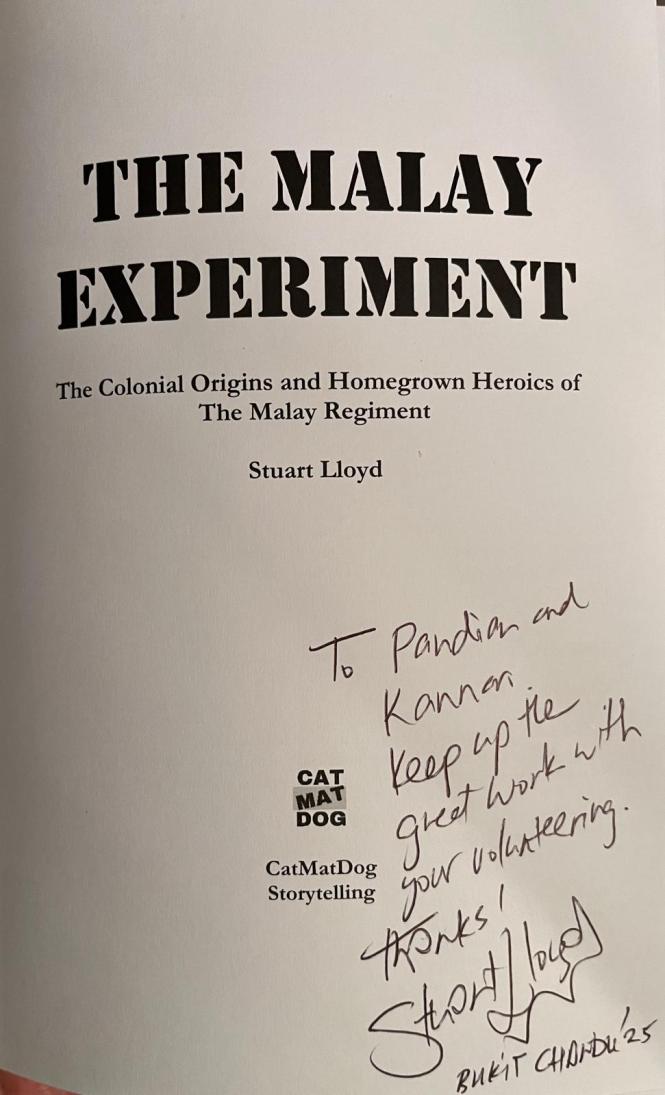
The Malay Experiment | Stuart Lloyd

It was never expected that the full thrust of 18 Division would be thrown against the Malay Regiment directly. 13,000 seasoned Japanese versus 1400 untested Malays.
– Chapter 6: The Battle of Pasir Panjang

Malaysia and Singapore offer a different perspective to foreigners like me. This is the land where WW-II was fought, as we say in Tamil raththamum sathaiyumaaga (ரத்தமும் சதையுமாக) – meaning “with blood and flesh”. My friends have taken me to the Kranji War Cemetery a couple of times. It is always stressful and depressing to realize what happened here in 1940s.

This book by Stuart Lloyd explains the valor bravely expressed by a novice military force – The Malay Regiment – during WW-II. In twelve chapters, this easy-to-read book, (under 100 pages), portrays a chronological note of their beginning, development, training, brutal war and its aftermath, recovery and finally their role in post-independence border clashes and world peacekeeping.

Recently Stuart spoke at Reflections at Bukit Chandu Museum, Singapore (located on the hill where the Battle of Pasir Panjang was fought, just before British Surrendered to Japanese). I bought this book a week ago. His effective storytelling kept us engaged at the museum and eventually pushed me to read the book during my morning commute. He vividly portrays figures like Major Bruce, Brigadier Raja Lope and Lt Adnan Saidi.

This book provides not only the swift action by the Japanese but also their unexpected approaches and failure of Allied forces. It provides convincing facts about the unchallenged airspace advantage enjoyed by the Japanese. Where might British resources might have been spent? Perhaps in Europe and the Middle East? Stuart highlights the superior war equipment, communication and strategy of Japanese. On the other hand, Allied forces lacked these resources – At one point, they even attacked their own forces due to poor communication.

For me, it was important to read Stuart’s documentation about how the Japanese convinced Indian soldiers to switch sides, by assuring them of Indian freedom, mentioning figures like Mohan Singh. (His relationship with Japanese was broken later miserably). While the complex politics of the Indian National Army is not the main scope of this book, the propaganda used to convince Indian forces makes me feel nervous. It feels as though Indian forces were just human resources pulled into different directions by world powers.

The post-war rejuvenation of Malay Regiment is documented in crisp language, covering conflicts all the way upto Malaysia-Indonesia and Malaysia – Phillipines clashes. The way Stuart stacks his historical storytelling – connecting the events on a timeline and providing background about officers – makes the book important. I wonder the amount of effort he put in to collect all these.

When I finish introducing this book, I find myself thinking about those soldiers who died at the Battle of Pasir Panjang or were executed later. None of them accepted the change to remove their uniforms to survive. For example, Lt Adnan Saidi left behind his wife and kids. His wife too died in late 1940s years due to illness, leaving the kids without father or mother. His brother too sacrificed his life to save the British throne.

The war devastated the family of every Malay solider. They might have faced hardship surviving the Japanese occupation due to their identity, and later faced financial crisis during the British reoccupation. The posthumous award were given, and identities established. Stuart doesn’t ask this explicitly, but the events make the reader think: does a symbolic honor compensate for their personal losses and material hardships. That is the life of a soldier!

Click here to borrow this book at NLB