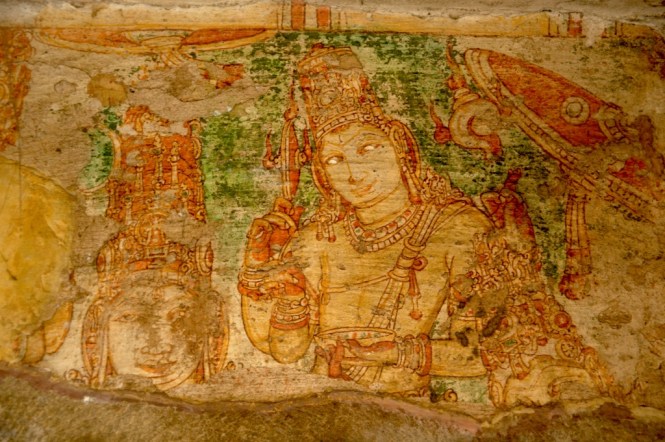
Padmapani mural of Ajanta captivated my boss. I could feel many times as I worked with him for my first three years. That might have pushed me to take the train and a car to Ajanta. We were searching for someone in a large complex. How would we feel if the person we’re searching for suddenly appeared before us? That’s how I felt, when I saw the popular Padmapani and Vajarapani murals in very first cave.
From left to right: Padmapani, Sanctum, Vajrapani | Pandian Ramaiah 16 Dec 2007
A Bodhisattva is a person who is on the way of attaining enlightenment to become Buddha. Compassion is his/her essence. Commitment to attain enlightenment to assist those who are in stress is his/her vow.
Avalokiteśvara, the lord who looks down, is a revered Bodhisattva in Mahayana Buddhism. Known as Padmapani, he embodies infinite compassion. He is depicted in various forms across the cultures. I have seen at least two of them. Most of the Indian forms shows avalokiteśvara as male. In Southeast Asia, Avalokiteśvara is often depicted as the female Bodhisattva Guanyin. I used to highlight this similarities when I do my museum tours. I understand that Tibetans and Mongolians have their own counterparts.
The eyes of Padmapani painting looks extremely calm and soothes us. With a lotus flower in hand represents purity and abundant compassion. He is ready to delay his own enlightenment, to help others like us.
His Mantra Om Mani Padme Hum, symbolizes his compassionate nature and it is widely chanted for protection from suffering.
Kannadasan wrote கருணை தேடி அலையும் உயிர்கள் உருகும் வார்த்தை அம்மா ‘Mother, the word that melts souls wandering in search of compassion’. Kirupananda Variyar said in one his his speeches, ‘As god can not take care of every home, he sent a mother on his behalf’. Avalokiteśvara embodies compassion in all its forms, offered unconditionally and without expectation, much like a mother’s love for her child.
Reading recommendation:
AJANTA CAVE PAINTINGS – the many-splendoured delights of Ajanta compiled by Subramanian Swaminathan
The upper berths of Indian railways are like attics without a window! He appreciated himself for his philosophy and lying with crossed legs in his ‘attic’ of Devagiri Express bound for Mumbai. Travels – especially traveling alone – were the moment of dhyana for him. He used to get dazzling ideas during such travels. But he will forget all of them when he gets down at his destination. Disturbing his contemplation, TTE knocked on his legs and asked for his ticket.
His chauffeur Easwar had dropped him at Aurangabad station after visiting a bustling attraction – Ajanta. He was so punctual since Saturday morning. He came at 8am sharp on Sunday morning, too, to take him to the promenade that day! The driving time to Ajanta was more than that of Ellora. Instead of any distractions, they went to Ajanta. The view point on the way to Ajanta was an important attraction, he did not visit.
Aurangabad: The journey to Ajanta begins, Aurangabad-Jalgaon-Indore Highway. Approximately 100 km from here.Aurangabad-Jalgaon-Indore Highway.Trail from hill to hill! They say Japan paid for that roadFrom the view point. (c) columbia.edu
If we look at the very old Indian paintings, we have no significant evidences. Paintings of Sigiriya of Sri Lanka, Kanchipuram of Chennai, Sittannavasal of Pudukkottai and Brihadeeswara temple of Thanjavur belong to 5th, 7th, 9th and 11th centuries AD. The paintings at Ajanta help as evidence of Indian painting from the 2nd century BC till the 6th and 7th centuries AD.
Painting at Kailasanatha temple, Kanchipuram – 7th century AD (c) blogvirasatehind.wordpress.comPainting at Brihadeeswara temple, Thanjavur – 11th century (c) Benoy K BehlPainting of Jain ascetic, Sittannavasal – 9th Century (c) Prof S SwaminathanPainting from Sigiriya, Sri Lanka – 5th century (c) lankapura.com
The discovery of Ajanta is an interesting tale. John Smith, Madras Presidency Officer, went out for a hunt in Ajanta hills. He might be an explorer like Jaggu. But Jaggu hates hunters, but that is not our topic of discussion today. John did not find a tiger. But he find a rock-cut-cave on a distance from a hilltop in the midst of the dense forest; there must have been the light of the Buddha – glowing on the banks of a Waghur river, flowing in a horse shoe shaped path – identified itself and asked him to bring to the attention of outer world. The art treasure was later nationalized and became a feast for our eyes and topic of research for our minds.
Jaggu reached Ajanta around 11:30. He needed to escape from the ‘compulsion selling’ of tourist shops from there. Easwar had warned about them earlier. He just kept quiet and passed through the shops. Still, there was one rogue who tried to pull him out to sell something.
No. It is not Pilgrimage to Sabarimala. ‘Explorimage’ to Ajanta
By the time he entered Ajanta, he felt as if he had done a time travel and reached the 10th century. The view was breathtaking.
Caves have been carved here during the time of the Satavahanas (2 BC) and the Vakatakas (AD 6, 7). All are Buddhist monasteries. Their side-walls, canopies or wherever you touch them were filled with impeccable paintings. Buddhist Jataka stories were painted as well. Are you interested in Jataka stories and archeology? Mark my words, you will not be able to visit Ajanta in one day.
Despite the morals of Jataka tales, many granular details, such as costumes, musical instruments, and birds, continue to amuse researchers even today. Analysts are amazed at the continued tradition since the Ajanta painting period till the contemporary period.
The first two caves themselves will show the most important paintings to fill your mind with immense pleasure. That was a place of humble Buddhist monks. Those caves, sculptures and paintings are where their souls are frozen, though they are deceased already.
Cave 1
Bodhisattva is any human being who is on the way to enlightenment or path towards ‘Buddha’. Padmapani is a Bodhisattva with compassion. Jaggu was familiar with this painting through books.
Padmapani, Cave 1
Similarly, Vajrapani – holder of thunderbolt – is a God of protection.
Padmapani, Cave 1 (Right side of Sanctum)Padmapani, Karuvarai, VajrapaniMurals, Cave 1Cave 1Cave 2Treasures at Cave 2Cave 2Miracle of Sravasti – Cave 2Cave 2: The sanctum and the muralCave 2: The floral designs. Still we use such type of decorative elements.Cave 6Cave 7
Large symmetrical caves could be seen here, like a tall palm tree, dating back to the 2nd century BC. One of these caves, number ten, was what was discovered by John during the colonial period.
The first-century Chaitya-shaped cave – Cave 9Cave 9Cave 9: There were sculptures depicting the daily life of humansCave No. 10 is probably the oldest of the Ajanta Caves. This majestic look identified itself to John during his hunting. This cave has another specialty. It has the oldest painting of India, that belongs to 2nd century BC.
It is awe-inspiring to see the paintings of the caves of 2nd century BC. Yes. Really. Those paintings have the most perfect measurements for face, makeup, jewelry sets, despite being very old!! Who’d drawn this? What’s his/her name? Was he/she short or tall? That was the land where so many intellectuals lived at those times!!
2nd century BC painting. Neat. Belonging to the Hinayana period The costumes found in those paintings, surprise us. These should be the most interesting paintings for girls.Cave 10Cave 10The cavesDying princess, cave 16Elephant story – Cave 17Indra flying in the clouds Cave 1The Waghur riverThe drinking Couple, Cave 17Cave 17: Decorated entrance to heaven 🙂Cave 17: A feast for the eyes. What kind of place was that? The wall and the canopy of enormous height were filled with painting – everywhere! Jataka tales glittered in paintings!The caves should be visited after a rainy season for a better view!
In addition to the paintings, beautiful sculptures could also be found there. How decorative the arches were! How perfect the elegance of the sculptures were!
Cave 19: This shrine belongs to the late Mahayana period. Chaitya type. The most beautiful and elegant sculptures were found in the cave.Cave 19: A feast for the eyesCave23: Tell me. Which is perfect? the design at the top or the one at the bottom? Cave 19: NagarajCave 23Cave 23Cave 23
When someone dies, his/her unresolved karma passes on to a new birth instantaneously. However, when a person attains nirvana, they are free from rebirth. When such a person dies, it is the end of his/her rebirth. He attains the mahaparinirvana, the eternal divinity.
This cave 26 is the result of your search; the rise of your soul.
Cave 26: This was the last chapter of the Ajanta trip. Exterior decoration and The sculptures will take your time here.A man stands on the right side, helping to infer the height of the caveThis shape is simulated to the sternum of the BuddhaCave 19hmm. so many caves! so many paintings!
Was there no one to disturb the Buddha?! Mara was there. He was known to be a king, who had the contrasting view of life to that of Buddha. Buddha pulled the people towards eternity. Mara liked to pull them towards worldly pleasures. Mara was drawn in cave 1. He has been sculpted in cave 26.
Buddha and Mara. The painting in the first cave was sculpted hereMara climbed on the elephant and came with his evil forces to attack the BuddhaMara climbed on the elephant and came with his evil forces to attack the BuddhaMara’s daughters: Despite the large relief, each of these small sculptures in it is very realistically carvedThe answer to why Jaggu could not be a Buddha was clear. This stone-shaped Mara daughter itself had captivated his mind! How could he practice penance elsewhere! What a dynamic posture it was!Mahaparinirvana: My leader was with us.. walked with us.. shared food with us.. told moral stories.. Performed miracles.. Defeated the evil that resisted. He solved the misery of poor people. Here is where he left me. He quits his job and falls asleep. Om mani padme hum.The final moment. Siddhartha, you came to uplift us, the poor. Let your compassion be with us – ever.
For Jaggu, who hails from Tamil Nadu – the land of small-rock-cut temples carved out of granite rock – Elephanta, Ellora and Ajanta are like swargapuri (heaven). If someone can go with some preparation, like gathering a quick knowledge of Buddhism & Jainism, Indian paintings and Jataka tales these places will be wonderful.
Tiresome early morning at Dadar station.
The Mahan Buddha born on this earth, left his kingly life, abandoned Rahula, and Yosodara, to demonstrate us…. the compassion! Let’s be compassionate with each other! Om Mani Padme Hum!
End of travelogue – Jaggu’s search for cave temples.
I’m participating in #BlogchatterA2Z 2022 with theme Yātum ūrē!