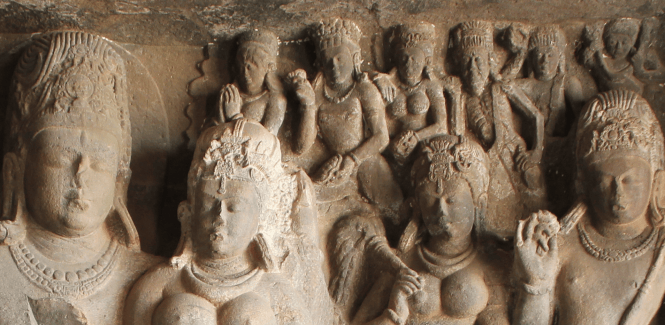
Yali frieze of Narttamalai

Kiran and I had a memorable early morning journey to Narttamalai (nārttāmalai/नार्त्तामलै) before two decades. I can’t quite recall how we traveled; I believe it was by car. As the sun began to paint the sky, we started our climb up Narttamalai hill.

Narttamalai, though a remote village along the Trichy-Pudukkottai highway, is a site of national importance. This entire village is a historical gem, though perhaps not as well-known as it deserves to be, even among locals.

Vijayalaya Cholisvaram | MV Kiran June 2003

The hill cradles six treasures

  • There are two rock-cut temples,
    • Pazhiyili Isvaram (பழியிலி ஈஸ்வரம்/paḻiyili īśvaram/पळियिलि ईश्वरम्) and
    • Samanar-kudagu (சமணர் குடகு/camaṇar kuṭaku/चमणर् कुडकु),
  • One magnificent structural temple called Vijayalaya Chozhisvaram (விஜயாலய சோழீஸ்வரம்/vijayālaya cōḻīśvaram/विजयालय चोळीश्वरम्), which is a marvellous piece of art, on the hill.
  • A famous living temple of Mariamman (மாரியம்மன்/māriyammaṉ/मारियम्मन्).
  • The Kadambar temple (கடம்பூர் கோயில்/kaṭampūr kōyil/कडम्पूर् कोयिल्) at the foot of a hill nearby is another beautiful temple.
  • The natural cavern of Aluruttimalai (ஆளுருட்டி மலை/āḷuruṭṭi malai/आळुरुट्टि मलै) contains polished stone beds and other Jaina vestiges.

Kiran, well-prepared with research, led the way. My main role, as I saw it, was to offer moral support.

As the rising sun showered the landscape in a warm and golden light, we carefully climbed the sloping, slick rock, eager to capture a beautiful photograph of Vijayalaya Cholisvaram. Later within the temple campus, we were struck by the richness of its cultural heritage.

24 Jun 2003 | Pandian Ramaiah

Vijayala Cholisvaram is a structural Siva temple, Opposite it, excavated into steep hillside, are two cave temples. One is Samanar Kudagu, the cave of Jains.

Samanar Kudagu Cave Temple | June, 2003

Today, let’s focus on the yali – also known as vyali or vyala or vyalaka – a recurring lion-like figure. The motif is often seen in Hindu and Buddhist temples and royal spaces. Samanar Kudagu is not an exception too.

The cave temple seems to have begun as a Jain site around 7th century, later becoming to shrine of vishnu. Mango trees and bushes create a serene atmosphere. A facade or mandapam stands before the cave, and it’s this facade that I want to highlight.

The facade’s base is adorned with procession of yalis. Sculpted to convey power and fierceness, these yalis often serve as brackets, or pillars supporting the structure. Simetimes they feature elephant trunks or bird wings.

Statue of Gajasimha Tower (Gaja yali) of Cham Da Nang Sculpture Museum (photo provided by nv)
Picture (c) archives.org.vn

We observed various types of yali-s. The simha yali has a lion’s head and body. The Gaja yali combines an elephant’s head with a lion’s body. The Makara yali features the body of a lion and the head of a crocodine. Similarly, the architecture boast a variety of yalis, such as Sarpa yali and Nara yali.

The yala frieze, Samanar Kudagu, Narttamalai | MV Kiran, June 2003

The plinthe of this facade features makara heads in the corners devouring humans in their mouth. These connect to frieze of elephants and Simha yalis. Though relatively small, they contribute to the basement’s beauty. Carved with dynamic energy, the playful nature of these yalis brought smiles to our faces. What a skill and imagination!
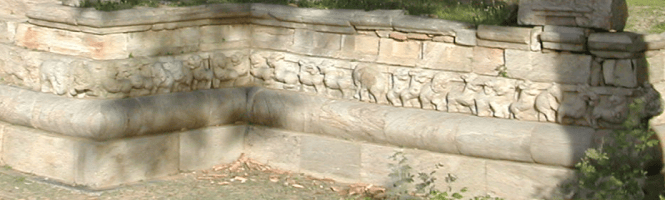
The yala frieze, Samanar Kudagu, Narttamalai | MV Kiran, June 2003

Scholars suggest several reasons for these depictions: protection, good luck and fertility among them. But beyond any symbolic meaning, they contribute an immense beauty that broadens our prospective as we enter these sacred spaces.

For more readings –

Singapore Stone

Long long ago so long ago nobody will know how long ago, there lived a man called Badang in a place called Saluang. I do not know where it is. It might be somewhere in Malaysia or Singapore. As a slave, he was working for a farm. His work made him tired and fatigued. He thought if he were stronger, he wouldn’t feel tired

While fishing secretly, he encountered a monster stealing his catch. Badang threatened the creature, who offered to grant him immense strength in exchange for letting it free. Badang agreed.

With his newfound power, Badang amazed everyone, including the King of Singapore. He demonstrated his strength by pushing a massive boat into the sea without anyone’s help. The King freed Badang and made him army commander. Badang then defeated a strong man from Kalinga of India in various contests of lifting a massive stone in present day Fort Canning Hill.

Image (c) roots.gov.sg

Kalinga was able to lift the stone only up to his knees. Badang not only lifted it, also threw it all the way until the mouth of Singapore river (present day Fullerton hotel area). He became a celebrated hero, serving the King and bringing peace to Singapore.

This is a mythological story. But a stone of 10 x 10 ft with inscriptions of several lines was left in the same place. No one was able to decipher it. But it became a challenge for the group of labourers. The colonial authorities decided to blow it up to make way for development.

Before doing so, a copy of the inscription was made. But the characters were defaced a lot due to weather. It is believed to be 13th or 14th century. Somebody believes that it may belong to 10th century.

A drawing of three fragments from a sandstone block that once stood at the Singapore River mouth. The bottom fragment is known as the Singapore Stone. Image (c) Wikipedia

Different experts provide different theory about the characters. Some say Kawi script, the old Javanese script with Sanskrit words.

Peter James Begbie was a Captain in the East India Company’s Madras Artillery worked from Malacca. He published the book The Malayan Peninsula in 1834. He guess the inscription sound similar to Tamil, but using obsolete words.

Australian researcher Dr Iain Sinclair identifies a fragment kesariva. He believes it may be the part of parakēcarivarmaṉ (परकेसरिवर्मन्), a typical title represents Chola Kings. As per his estimation, the stone may belongs to 10th century CE. If this is true, the Indian connection with Singapore goes back to the same timeline.

The damaged parts of the stone are kept in National Museum of Singapore. Some one told me that the one found in Badang Terrace of Fort Canning Hill is its replica. But I am unable to verify the fact.

Badang Terrace, Five Kings Walk at Fort Canning Hill
Picture (c) https://singaporeforless.blogspot.com/

Whatever it is is, Singapore Stone is one of the other artifacts that stand still to show the connection between India with Southeast Asia.

To read further –

This post is part of Blogchatter’s WRITE A PAGE A DAY 2025 campaign.

Somaskandha Pallava Painting, Kanchipuram

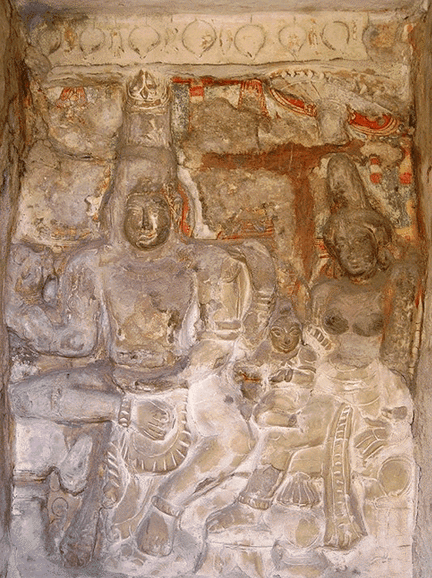
We talk a lot about ideal couple, ideal parent, ideal child. We often expect others to embody ideals that we ourselves struggle to achieve. But all of us are on the way of trying to be one. Our goal is like the lovely divine couple Siva and Parvati and their lovely kid Skanda. The parent with child seated in Sukhasana on a royal posture is shown by Somaskanda murti.

It may be sometime around 1920s or 1930s. Historian C. Sivaramamurti goes to Thanjavur to view the Chola paintings, discovered recently then. He makes a copy of it and wrote a paper to the quarterly magazine Triveni, He goes to Kanchipuram Sri Kailasanatha Temple.

For those who have not visited Kailasanatha temple, understand that it is one of the marvels of Pallava architecture. If Mamallapuram is their dream in stone, this is their dream in sand and plaster. The temple, adorned with detailed sculptures and vibrant Pallava paintings, must have resembled a colorful pavilion in its prime.

Sri Kailasanatha Temple, Kanchipuram | Pandian Ramaiah 13 March 2013

It has a main shrine for Siva, surrounded by pradakshina path way. The way is surrounded by outer walls with many small shrines, covered with Pallava paintings. They are one of the earliest paintings of Indian art history, along with Ajanta, Thanjavur, Sittannavasal and Panamalai.

The temples striking appearance captivates visitors, and upon entering, one feels transported into Pallava sphere of influence. In addition to the paintings, the temple is worth visiting for its beautifully carved Grantha inscriptions.

Grantha inscriptions/Pallava signatures| Pic Pandian Ramaiah 27 Feb 2007

Mr Murti identified the Somaskanda panel for the first time in cell (or small shrine) no 41 at the Kailasanatha temple at Kanchipuram in the early 20th century. He mentioned that he copied the Somaskanda painting and identified it.

Somaskanda, 7th Century, Kanchipuram | C Sivaramamurti

He says the most of the painting got defaced due to natural cause and vandalism. When I went to see that now, it is even worse. But whatever exists, it shows the dynamic flow of lines and dye combinations that creates the figure of Siva- the father, Parvati – the mother and Skanda – the child. Other figures are also depicted, including what some believe to be Vishnu and the gana-s (attendants) of Kailash.

Somakanda line drawing, South Indian Paintings by C Sivaramamurti

It also has other figures, people say Vishnu, other gana-s of Kailash.

We can recognize the face of Siva. But most of Siva’s torso, the face of Parvati are lost. Baby Skanda is too damaged severely.

Let me quote from Mr Murti..

“It is a lovely theme of fond parents and a frolicsome child, of the ideal mates and the object of their love, of the philosophy of affection which, though lavished on the off-spring, increase
a thousandfold.”

Somaskanda | Picture source unknown

Professor Jouveau Dubreuil, who had discovered the paintings earlier, was pleased with Sivaramamurti’s identification and came to Madras specifically to confirm its accuracy.

The preservation of Kanchipuram, Sittannavasal are important to save our heritage. But even now, the cells are open to public, the paintings are getting damaged every day due to vandalism. Ajanta is decently preserved, partially it is due to the way the cave is excavated. Natural decay occurs slowly there because the cave entrances are small. But caves like Sittannavasal and structural temples like Kailasanatha temple, are facing heavy challenges to survive.

In conclusion, the Somaskanda panel at Kanchipuram’s Kailasanatha temple offers a profound glimpse into Pallava artistry and the enduring ideals of family and divinity.

For further reading

  • South Indian paintings by C Sivaramamurti
  • Indian Painting Tradition by S Swaminathan

This post is part of Blogchatter’s WRITE A PAGE A DAY 2025 campaign.

Sadasiva of Elephanta and Cambodia

I have written about my day out to Elephanta earlier. I finished the panels of the main cave one by one. Finally I was standing before the striking colossal bas-relief of Trimurti Siva or Mahesa Murti Siva or Sadasiva.

Sadasiva or Trimurti Siva | Pandian Ramaiah, 1 Dec 2007

Sadasiva is considered as the highest form of Siva. People believe the concept originated from South Indian Shaiva Siddhanta. Sadasiva has five faces, that represents five holy tasks (panchakritya). Three faces are visible in Elephanta. The fourth and fifth is believed to be at the back.

Standing or sitting in front of this artifact is a different experience. You need to experience it.

The Portuguese, when they came to India, found a massive elephant structure here in the 18th century. As per Sachin KR Tiwari’s presentation, it looks to be they damaged and vandalized this cave and removed valuable inscriptions. I am thinking about similar complaints about a Dutch official who cut the head of the sculptures in Java. What we have now is what they left behind. What India is now is also a result of what they left behind.

Coming back, The hair of siva is elegantly carved with extensive details in jata-makuta (hair crown). The face of the Tatpurusha (the centre face) shows extreme peace.

The linga form, especially the mukha linga form represents Sadashiva. Now I understand why Indian heritage center in Singapore has kept the Mukha Linga infront of Sadasiva sculpture.

Sadasiva and Mukha Linga, Indian Heritage Center, Singapore|Photo (c)thesmartlocal.com

The Sadasiva you see in above is from Tamil Nadu. Yet, the one you see below is from Cambodia.

Bronze of Shiva as Sadashiva or Mahesha, late 12th – early 13th century, Cambodia. Collections of Asian Civilisations Museum. Image (c) roots.gov.sg

The face looks more south-east Asian one. Yet they absorbed the same concept and created this bronze with local art form. It shows the influence of Hinduism, particularly, Shaivism in the Khmer Empire during 11th or 12th centuries.

The world was highly connected, but the later decline of Indian influence in Southeast and East Asia is surprising.

This post is part of Blogchatter’s WRITE A PAGE A DAY 2025 campaign.

The elegant dancers of Sittannavasal

We, few boys of age between 11 and 13, traveled to Sittannavasal from Pudukkottai by our bicycles. I think it would be 1990 or 1991. We started with enthusiasm. By the time we came out of the town, the vast landscape and free air soothed our eyes and lungs. Soon we felt a sense of accomplishment, despite having only cycled a short distance!

Before crossing our tenth kilometer, we felt the ache in our legs. We were not sure, there was considerable distance on both sides. We carry no cash to buy any snacks. Then we took short break now and then. By the time the Sittanavasal hill came to our vision, we rejoiced despite losing our gallop.

With full force, we cycled further. The problem is, the entire route from Pudukkottai to Sittanavasal is a gentle uphill. So you can feel our pain. Yet, we decided to reach our target. On the way, another obstacle came in. Yes, It rained. In fact, it was a down pour. We found our shelter in nearby bus stop.

Sittannavasal hill, 12 July 2003 | M V Kiran

By the time rain subsided, we took a decent break. With streams of rainwater flowing alongside the road, we cycled and reached the place. It was so scenic because it was deserted due to rain and there were small streams flowing from the top of the hill, which we never imagined we could see.

We read about that place in our history. Unfortunately, for five years, from class 6 to 10, history was taught in a manner that did not engage me. As I crossed by forties, I won’t even consider them as teachers. I feel they did not effectively convey the importance and interest of history. Coming back, this place Sittannavasal is important for many reasons.

  1. It has one of the earliest Tamil inscription, dating back to 3rd or 5th century BC.
  2. It has the cave temple that is entirely dedicated to Jains (We have many caverns and beds. But Sittannavasal cave is in the form of a temple).
  3. It has one of the early Pandya paintings.

Three of those paintings are the focus of today’s post

My understanding goes like this. Pandyas ruled the southern part of Tamilnadu from Madurai. Cholas ruled the eastern part of Tamilnadu from Uraiyur, Pazhayarai, Thanjavur, Gangai Konda Cholapuram (modern day Jayamkondam). There were clashes and marriage relationships between Pallavas and Pandyas.

Despite their rivalry, the Pandyas were clearly influenced by Pallava architectural styles. In addition, Pallava princesses who married Pandyas likely brought their artistic influences with them.

Kochadayan Ranadhira (7th Century AD) was known to be a popular king who defeated Ays of Thirnelveli-Tiruvanandapuram. He entered into a political marriage alliance with a Pallava princess. His son Maravarman Rajasimha was the one who attacked Pallava King Nandivarman Pallavamalla when their kingdom was in stress.

Maravarman Rajasimha’s son Nedunjadayan had a minister, Madura Kavi, who excavated Anamalai temple for vishnu. This suggests that Pallava artistic influence likely played a role in the development of the Pandyan cave temple architecture.

Entrance to Yoga Narasimhar temple, Anamalai, with the rock in the background (c) Rayappa Kasi

With this background, let’s come to Sittannavasal. It has multiple sites. But let’s talk about the Jain cave temple ‘Arivar Koil’. Outside the temple, there is an inscription belongs to 9th century. It states additions and renovations of the cave temple is done in early Pandya period.

The inscription is our focus. So let me go to the paintings. Let me quote, from Prof S Swaminathan and M V Kiran’s documentation –

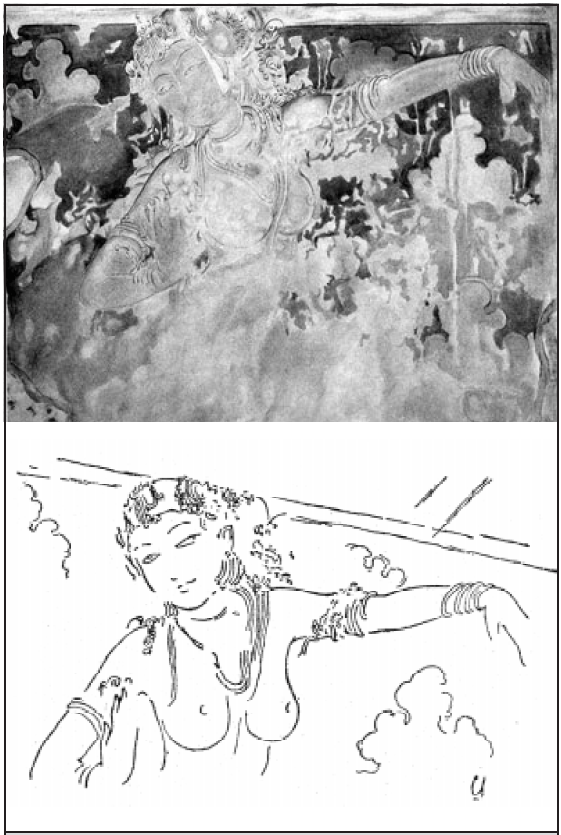
On the front face of the southern pillar is a beautiful picture of a dancer, her left arm stretched-out in lata-hasta pose, gracefully. She has her right arm bent at the elbow, in front of her bosom with its palm presenting pataaka. Her ears are adorned with patra-kundala (known as olai in Tamil), rings set with gems,and her arms decked with bracelets and bangles.

Dancer in the southern pillar

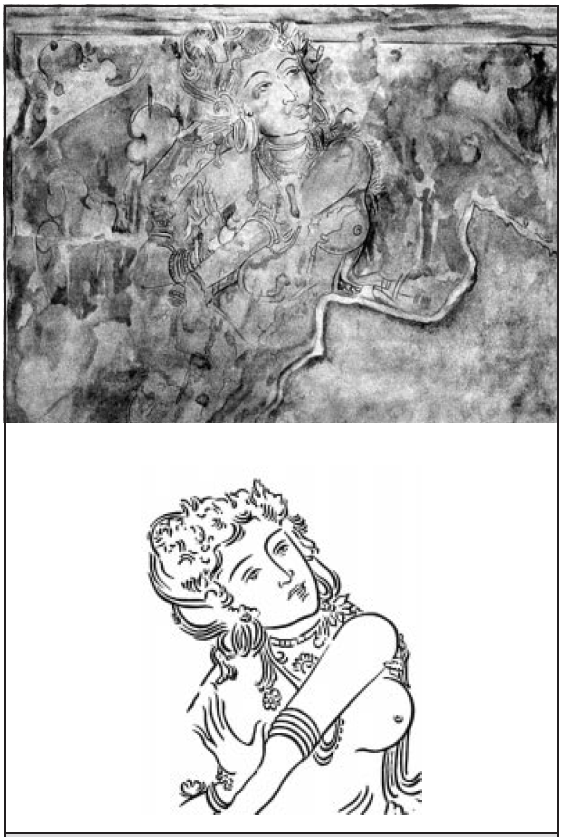
Even more graceful is the other dancer on the front face of the northern pillar. She has her left arm starched in lata-hasta pose, while her right arm is bent at the elbow, in front
of her bosom with its palm presenting pataaka. The headdress and the ornaments of this dancer are very distinct. The hair is decked with flower garlands.

Dancer in the northern pillar

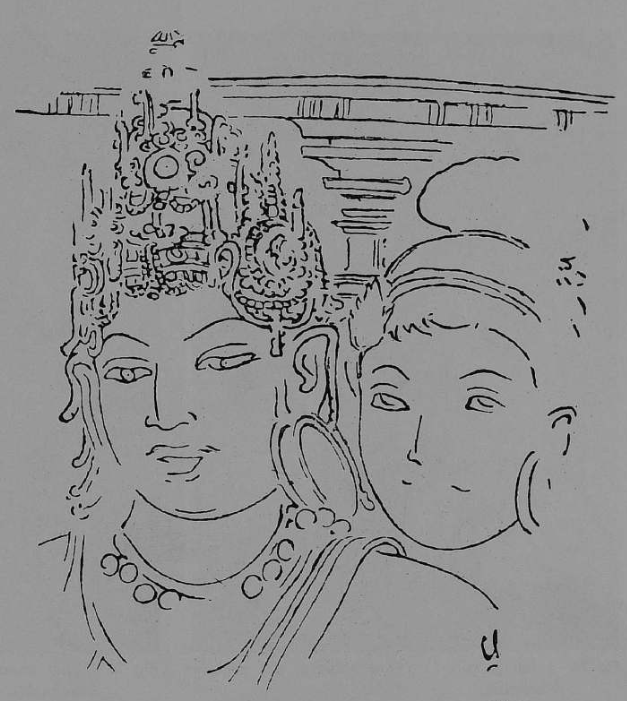
The painting on the other face of the southern pillar represents a man and a woman, possibly the builder, and his queen. The man has an elaborate kiritam (diadem on the head), a patra-kundala (rings set with gems) in the ear. There is also an umbrella raised over both. His demeanor and his diadem indicate his royal status.

The royal couple

We could not arrive at a clear decision of who these couple are. It is generally believed to be the Pandya king Srimaran Srivallabhan and his queen who renovated this temple and built extensions.

Researchers found that there are two layers of paintings, an earlier and a latter. Possibly there was earlier work done by Pallava painter, later it might be taken over by Pandyas.

C Sivaramamurthy in his South Indian Paintings, clearly mentions that they are Pandya paintings. Let me quote –

The figures, however, like the famous prince and princess with a monk before them, and the
two marvellous dancers, as well as the pool filled with flowers, fishes, ducks, a buffalo and elephant, are all Pandyan paintings of great elegance, revealing the craftsmanship of the painter.

We never regret our tiresome cycling to this place. Even then, the extent of damage to the paintings was disheartening. After the heavy quarrying nearby, how much our kids will inherit is a question mark. Prof S Swaminathan proposes a facility to preserve the same. Are we ready to lose the charm of the unique Jain cave temple with Pandya paintings? Or will there be change in our attitude to preserve it? The questions are hanging in the air.

If you happen to travel, do not forget to show this to your kids.

For more readings –

Saving Sittanavasal

Sittannavasal -a booklet by Prof S Swaminathan.

South Indian Paintings by C Sivaramamurthy

Going behind peahens, Sittannavasal, 12 Jul 2003 | Pandian Ramaiah.

This post is part of Blogchatter’s WRITE A PAGE A DAY 2025 campaign.

Ratha Mandapam of Kunnandarkoil

Kiran and I traveled to Kunnandarkoil. Kiran had already read the documentation and was on his way to verify his readings on-site. As a web developer, I recklessly accompanied him. I went there without any expectations, as I had never traveled that route before.

When we entered into the temple complex, the Ratha Mandapam immediately grabbed our attention. It looked majestic despite its dilapidated condition.

The Chariot, Ratha Mandapam, June 2002 | M V Kiran

We rushed to see the rock cut shrine first, as it was evening and we might not be able to see the cave the dark. The cave temple was similar to the cave of Thirukokarnam. We saw similar mandapam supported by pillars, whose sirsa/heads were decorated with simple, folds of carvings.

When we came out of the complex, we walked past boys playing cricket toward the Ratha Mandapam.

This is a chariot-shaped mandapa with 90 pillars. Picture (c) puratattva.in

The chariot wheels of the Konark Sun Temple are famous, and I wrote about the Ratha Mandapam of Darasuram earlier. The one at Kunnandarkoil is relatively small. Yet, the wheels are elegantly carved, and the majestic facade is striking. It is attached to a mandapam with 101 pillars, but most of the mandapam is in a dilapidated condition, and it is not safe to walk inside. If it were well-maintained, the people of this place wouldn’t need a marriage hall.

Sometimes, artifacts from unexpected places are extraordinarily special and unforgettable.

For further reading –

This post is part of Blogchatter’s WRITE A PAGE A DAY 2025 campaign.

A Tale of Two Lands: Rathi & Manmadan in Kudumiyamalai and Javanese Shadow Puppetry

Though just a few kilometers from my native place, I haven’t visited Kudumiyanmalai (Kuṭumiyāmalai / कुडुमियामलै) in a long time. It is a common failing, I think, we often overlook the value of the things close by and readily available.

Kudumiyamalai: A historical gem and a treasure of sculptures

Sikanatha temple, Kudumiyamalai | Pandian Ramaiah, 23 April 2007

Yet, Kudumiyamalai boasts a rick history, with Jain beds on its western side of the hillock believed to date back to 2nd century.

Similar to other natural caverns of Jains, the one here offers a breathtaking panoramic view of the surrounding landscape for several kilometers. Writer Jeyamohan believes that our minds will open upon seeing the wide vision of nature. The River Vellar and its banks are particularly picturesque from this vantage point.

One of the most memorable aspects of my village life during power cuts was the collective experience. We’d all emerge from our homes and instinctively glance towards the hilltop. If the light atop the hill remained dark, a sense of shared relaxation would settle in. At least, we were all in the same boat! It’s a little ironic that despite the decades that have passed since my birth, power cuts still occasionally disrupt life in my village.

On the eastern foothills lies a cave temple, dedicated to Lord Shiva. Near by, a structural temple, Sikakirisvara Temple, houses another Shiva shrine. The exact time of construction for this temple remains unknown. However M V Kiran, my ex-colleague who documented this place along with my ex-Boss, noted that most early Chola inscriptions are found in near by Melakkovil (another shine near by) and second prakaram. This suggests that the main shrine might have been remodeled during later periods. Nayaka too involved in development of this temple with beautifully sculpted pillars with intricate carvings.

Two of these sculptures, Rathi and Manmadan, are the focus of this post.

Rathi and Manmadan: A story of Love and Loss

Belief in Rathi and Manmadan, the Hindu god of love, extends back to Vedic period. The story of Kama (Manmadan)’s destruction in Shiva Purana is well-known. When Indra sought Manmadan’s help to awaken Lord Shiva from his medidation, Manmadan’s arrow of love angered Shiva.

Shiva opened his third eye and destroyed Manmadan. Though later revived, Manmadan was condemned to leave heaven and reside in the hears of all men in earth. Following her husband, Rathi too descended to earthly realm, dwelling within the heards of women.

Sculptures depicting Rathi and Manmadan are found throughout Tamil Nadu, but the one in Kudumiyamalai is particularly notable.

Rathi devi, Kudumiyamalai | Pandian Ramaiah, 23 April 2007
Kama / Manmada, Kudumiyamalai | Pandian Ramaiah, 23 April 2007

The damaged state of these sculptures is truly saddening. Imagine their beauty, if they were fully intact!

“What shall I do? Where can I go? What is it that the gods have done in making my husband a victim thus? They have called him here and destroyed him.”
Chapter 19 – Kama’s destruction by Siva

This lament of Rathi devi, upon death of Manmadan, echoes my own sorrow at the sight of these damaged sculptures.

Artist Silpy’s drawings offer a glimpse of their potential splendor.

Rathi of Kudumiyanmalai drawn by Artist Silpy
Manmadan in kudumiyanmalai, drawn by Artist Silpy

I am particularly fond of this Manmadan sculpture. He is depicted with a distinctly masculine physique and mustache, a feature that resembles Nayaka style.

The Javanese Connection: Wayang Kulit

I am fascrinated by the connection to Javanese culture, Wayang Kulit, a traditional shadow puppetry art form originating from Indonesia, especially Java and Bali, often draws themes from Indian epics and Purana-s. The story of Shiva and Manmadan is depicted in this puppet show – KAMAJAYA-KAMARATIH.

Google Translation of the post titled Filosofi Wayang Jawa: Kamajaya & Kamaratih, Lambang Kerukunan Pasangan (The Javanese Puppetry Philosophy: Kamajaya & Kamaratih, Symbols of Marital Harmony):

In Javanese puppetry, Batara Kamajaya and his wife, Batara Kamaratih are symbols of a harmonious couple. Both are handsome and beautiful and have the duty as the god of love in the puppet world. Known to be very harmonious, loving each other, and loyal to their partners. There is never a story of a dispute between the two.

It is said that one day, Batara Guru (Parameswara or Shiva) was meditating and suddenly heaven was shocked by an attack by a giant army sent by Prabu Nilarudraka which overwhelmed all the gods. The situation became increasingly critical, the gods then followed Batara Guru to wake him up from his hermitage. However, all efforts failed. Batara Guru remained steadfast in his meditation.

Batara Kamajaya then took the initiative to wake Batara Guru up using the Pancawisaya Arrow. If this arrow hits someone, it will create a feeling of love and arouse lust. The arrow was released and hit Batara Guru, immediately his meditation was cancelled and he woke up in a state of anger. From his third eye, a blue light appeared which immediately hit Batara Kamajaya and burned his body.

Knowing the death of Kamajaya, Batari Kamaratih asked to be killed by Batara Guru too so that she could follow her husband. Batara Guru, who was overcome with anger, then revived Batara Kamajaya using Tirta Amerta. However, because he had made a mistake, Batara Kamajaya was then sent to reside in the souls of men in the world. Meanwhile, Batari Kamaratih also came down and resided in the souls of every woman.

The two gods are tasked with uniting the souls of men and women into a pair of lovers or husband and wife who are equipped with love, affection, and harmonious relationships.

The story in Javanese puppet show resonates deeply. Batara Kamajaya and Batara Kamaratih embody a harmonious couple, fulfilling their duty as gods of love.

Batara Kamajaya, Java, 20th century, Asian Civilization Museum, Singapore

I am amazing to consider the interconnections of these cultures across vast distances. Kudumiyamalai in Tamil Nadu and Javanese shadow puppetry tradition – both reflecting the timeless story of Rathi and Manmadan.

For more reading –

This post is part of Blogchatter’s WRITE A PAGE A DAY 2025 campaign.

Ravana shaking Kailash, Ellora

Maharashtra is a treasure trove of archeological wonders. I had no plans to visit any of them but it happened all of a sudden. When can driver took a turn to car park, I spotted the Kailasanatha cave and urged him to stop the car. He shut me up and suggested me to start from the beginning of all caves.

Cave 14 is a remarkable specimen. One of its bas-reliefs is the focus of today’s post.

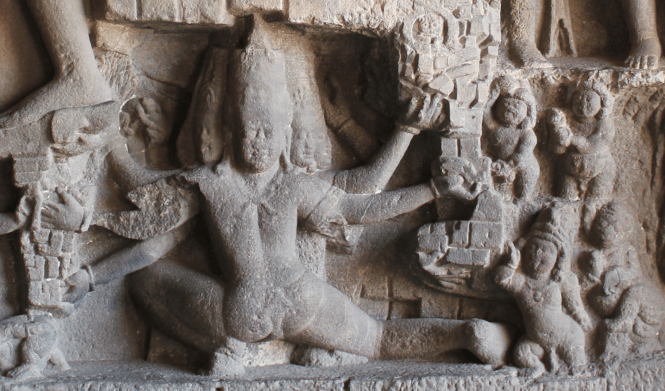
Ravananugrahamurti – Ravana shaking Mount Kailash.

The story goes like this. Kailash was not under the Chinese control as we see now. So Ravana did not need to wait for a visa in their Embassy. Ravana, one day Ravana reached Kailash to offer his prayers eagerly, like I stepped into cave 14. Shiva and Parvati were spending time together, because of which Ravana was asked to wait.

After waiting for long time, he lost his patience. Why would Shiva make a devoted follower and powerful ruler like Ravana wait so long? Out of impatience and so much confidence on his confidence, he tried to lift and shake mount Kailash. He wanted to grab Shiva’s attention, to remind him to come for darshan, the meeting.

His actions caused tremors in Mount Kailash. Everybody came to Siva Parvati in fear. Parvati too look confused, but Shiva knew Ravana’s intentions. As he liked Ravan, he wanted him to teach a lesson to kill his ego. With his thumb finger in his toe, he pressed the hill slightly. He doesn’t want to crush Ravana but it shot up the physical and mental stress for Ravana, he couldn’t hold the mountain any more.

Image from Madurai – photo (c) https://pratheep.com/ravana-at-mount-kailash

Given up and realized about his mistake, Ravana wanted to do something to pacify Shiva. He pulled his nerves in his thigh tightly and made them as strings. Treating his body as Veena and his nerves as its strings, he played an enjoyable rhythm.

This story is sculpted in life size bas-relief in cave 14, a Hindu cave temple at Ellora dating from the early 7th century AD. It features a large mandapa with massive decorated pillars.

It has a notable panel depicting Ravana shaking Mount Kailash. This relief sculpture is located on the south wall of the cave and is based on a mythological theme from the Hindu epic Ramayana.

Ravana and Mount Kailash, Pandian Ramaiah, 07 Dec 2007.
We may even have a treasure hunt to see how many panels depicts this story in Ellora.

When I saw the scale, the intricate details and dynamic composition, I opened my mouth in wonder. Because I never saw such bas-reliefs.

At the bottom of the panel, Ravana is depicted with ten heads and twenty arms, emphasizing his power. His multiple hands are carved in various positions to convince us about his effort to lift Mount Kailash.

Lord Shiva positioned at the top of the panel, Shiva is shown seated calmly on Mount Kailash. His jatamakuta (hair crown) is carved with detail to form a respectable crown. Not only Shiva, it is so beautiful to see the stylish hair adornment and jewelry of Parvati, her chowry bearer too.

Parvati, seated beside shiva, reclining to her husband. Somebody say her face shows alarm. Her face reaction tells me that, she too aware of what’s happening and curious to know what will eventually unfold with a knowing smile. Her vaddanam (ornamental belt/oddiyanam), mathapatti (ornament that decorates the border of the hair in forehead) and nethichutti (jewelry at the centre of the forehead) are carved with fine details..

The panel includes terrified maidservants and rishis rushing about. These figures would be comparatively smaller, but still richly detailed, with expressive gestures that add depth to the scene.

Last but not least, look the four dwarfs below, who are depicted mocking Ravana, adding a touch of humor to the scene. Their small stature and exaggerated expressions would contrast with the more serious main figures.

Sites like Ellora will make any visitor crazy. Because such places has enormous to offer. They carry piles of arts and cultural heritage knowledge and stand as a silent witness for our past and how different beliefs or way of life originated in India and find their ways of betterment. Like Andal sings in her Thiruppavai, எல்லே இளங்கிளியே! இன்னும் உறங்குதியோ!, these artifacts asks us to wake up and gather more knowledge. This life is like our mother, takes effort to carry us, and offer us wisdom.

Pandian Ramaiah, 15 Dec 2007.

I’ll meet you with another post with another artifact. Until then have a blessed day.

This post is part of Blogchatter’s WRITE A PAGE A DAY 2025 campaign.

Lingodbhava of Thirumayam

Have you been to Thirumayam? If you are a orthodox Vaishnavite, it is a revered divyadesam – one of the 108 holy shrines celebrateed by Alwars in their hymns. The Vishnu shrine here predates the famous Srirangam temple. The Ananta Sayani – Vishnu reclining on his serpent bed with Lakshmi beside him – is larger than that of the one at Srirangam.

Shaivaites also find significance in Thirumayam, home to a magnificent Siva temple. The consort of Lord Shiva here is beutifully named as Venuvaneswari. That means ‘Eswari of Venu Vanam‘ (bamboo forest). The temple is attached with an octagonal shaped uruni – the holy pond.

Satyagirisvara temple (Shiva temple), Pandian Ramaiah, 28 Feb 2010. There are two famous rock-cut shrines, one of Siva [shown here] and the other of Vishnu, adjacent to each other.

Historians will find Thirumayam brimming with centuries of historical facts. The cave temples are believed to date back to 7th century AD. From a chronology perspective, I need to highlight that work at Ellora caves might have started around this time. It features one of the Tamil Nadu’s largest inscriptions. The site witness the stories of colonial aggression too.

Thirumayam Fort, Pandian Ramaiah, 28 Feb 2010. Before reaching the town, one can see a fort atop a large hill. In past centuries, the fort was much larger than what now obtains; this is affirmed by the fact that the main entrance to the old fort lies about one kilometer south of the present-day fort. This extrance to the old fort still stands, it has a courtyard with pillared corridors and shrines of various deities. The sculptures on the pillars are truly beautiful. The Thirumayam fort, set in 40 acres, is of great historical importance. It was built by Sethupathi Vijaya Ragunatha Thevar, ruler of Ramanathapuram in AD 1687.

But I write this post to mention about one of the icons, that left a profound impression on me – Lingodbhava.

How ever this post focuses on a particular icon that deeply captivated me – the bas-relief of Lingodbhava.

Lingodbhava | (c) Arvind Venkataraman

It shows the supremacy of Lord Shiva. It begins with a dispute between Brahma and Vishnu over who is superior. To resolve this, Shiva manifested as a colossal pillar of fire, challenging them to find its beginning or end. Brahma transformed into a swan and flew upwards. Vishnu became a boar and dug downwards.

After a long search, Vishnu accepted defeat, recognizing Shiva’s greatness. In contrast, Brahma falsely claimed he found the top with the help of a tāḻampū – screw pine flower (or Ketaki flower in some version). Angered by this deceit, Shiva cursed Brahma to be un-worshipped, thazhampoo and Ketaki flower are banned from using it to adorn gods and declared that the Lingodbhava would symbolize his eternal presence.

Tamil revolutionary poet Bharati’s poem captures this.

Tamil: அடியும் முடியும் அறிய முடியான்
Diacritics: aḍiyum muḍiyum aṟiya muḍiyāṉ
Hindi: अडियुम् मुडियुम् अऱिय मुदियान्.
Meaning: The one whose start and end could not be found.

Usually Lingodbhava statue is found at the rear of Shiva sanctums. The one in Thirumayam, carved inside the 7th century cave temple, is truly inspiring. Rising from the floor to the ceiling, it is a colossal representation of the story. By the time I saw for the first time, it was breathtaking, unable to avert my eyes.

The entire cave temple was likely adorned with vibrant murals in the past. I can only wonder the splendor of the cave with its decorated walls and ceiling. Sadly, most of these murals are lost. mirroring the fate of similar paintings in Sittannavasal and Kanchipuram.

This Lingodbhava in Thirumayam is one of the earliest such artifacts in India.

Since that encounter, whenever I see Lingodbhava, it inevitably evokes the memory of the one in Thirumayam.

The realization of truth in life mirrors this philosophy. The more we dig, more we learn.

See you in another post. Thank you.

(c) Lingodbhava in featured image: Puratattva

Pandian Ramaiah, 28 Feb 2010. There is no connection between this picture and this post. It is the memory of the road and bus existed a decade ago, before taken over by National Highways.

This post is part of Blogchatter’s WRITE A PAGE A DAY 2025 campaign.

Kalari Murti of Kodumbalur

Kodumbalur (கொடும்பாளுர் / Koṭumpāḷūr / कोडुम्पाळूर्) is a hamlet near my birthplace. When something is so near and freely available, you won’t realize its value. This is a general global phenomenon. I am no exception.

It is historically important as it was the headquarters of the Irukkuvels, one of the chieftains of the Chola kingdom. In the popular novel Ponniyin Selvan, Vanathi, Princess of Kodumbalur, was a close associate of the powerful Chola princess Kundavai. She was in love with Arunmozhi Varman, also known as RajaRaja Chola.

According to the epic Cilappatikaram, the protagonists Kovalan and Kannaki crossed this place on their way from Uraiyur (modern-day Tiruchirapalli) – one of the Chola capitals – to Madurai, the Pandya capital. This epic names this place கொடும்பை நெடுங்குளக் கோட்டகம் (Koṭumpai Neṭuṅkuḷak Kōṭṭakam / कोडुम्पै नेडुंगुळक् कोट्टकम्).

Such a busy town is now just a village now. This place has three important archaeological sites:

  • The Muvar Kovil (Temple of Three),
  • The Aivar Kovil (Temple of Five),
  • The Mucukuntesvara Temple.

The Muvar Kovil temple enchants every viewer. It is older than the Thanjavur Brihadisvara Temple (or Big Temple).

Kodumbalur vimanam | 📸 M V Kiran

But the focus of this post is one of the icons we can see at Kodumbalur: the Kalari Murti idol of Shiva.

Kalari Murti, Kodumbalur | 📸 M V Kiran

The story goes like this: Shiva’s devotee Markandeya was supposed to die at the age of 16. Impressed by his deep devotion, Shiva wanted to help him by challenging Yama, the god of death. Shiva performed a ‘playful dance’ (களிநடனம்) on top of Yama, pushing him away and saving his devotee.

Markandeya episode, Raja Ravi Varma.

This sculpture at Kodumbalur is considered one of the finest examples of early Chola art and iconography. The representation of Shiva as Kalari Murti is in the first tier of the eastern niche of one of the remaining temples.

Kalari Murti is the first niche of the left photograph | 📸 (c) travel.bushavali.com
Kalari Murti, Kodumbalur, (c) https://puratattva.in/kodumbalur-glory-of-the-irukkuvels/

Look at the above picture. Shiva is shown in a dynamic, dancing posture, indicating a destructive attitude. However, killing Yama would stop deaths in the universe, destabilizing the equilibrium. Therefore, Shiva is careful not to push Yama to death. He is dancing on his back playfully. Note the smile on Shiva’s face and the horror on Yama’s face. This symbolizes Shiva’s victory over death.

The soft molding of his abdomen, thighs, and legs makes this sculpture unique. The compassion shown on Shiva’s face brings a smile to our faces too!

If you happen to travel to Tiruchi or Madurai, do not forget to visit this beautiful early chola temple. The same form of Shiva is common to see in other places too.

Kalantaka Shiva, Kailasanatha Temple, Kanchipuram. I found this photo on facebook.
Kalantaka Shiva, Gangai Konda Cholapuram, (c) the sculptor, photo (c) Rahul Naidu

For more reading-

This post is part of Blogchatter’s WRITE A PAGE A DAY 2025 campaign.