Haw said, “Sometimes, Hem, things change and they are never the same again. This looks like one of those times. That’s life! Life moves on. And so should we.”
Who Moved My Cheese p 45
“Who Moved My Cheese?” by Dr. Spencer Johnson is an intriguing fiction that portrays the different behaviors of people during change in an engaging manner. The 90-page story takes place in a maze and features two mice and two small humans, each possessing their own unique character. The book is written in a simple style, as if a grandmother were narrating to her grandchildren, but it is suitable for readers of all ages, including teenagers. It is a must-read for college students and busy professionals, and I often heard the title mentioned among MBA students during my college days. I recently read the book myself.
The story of three types of fish – the one which is smart and precautionary, the one that only considers danger when it arrives, and the one that never cares about danger – is often heard during our childhood. This is similar to the story told in “Who Moved My Cheese?” One of the key takeaways from the book is that change is inevitable and we must be prepared for it. How quickly we sense change and react to it determines our safety. The book illustrates the importance of adapting to change and how failure to do so can negatively impact our lives.
This book is inspiring because it depicts the character Haw’s ability to adapt to change. He tries to motivate his fellow human Hem by providing him with clues during his search. These clues serve as key messages for us to adapt to change as well. Embracing change quickly is not always easy, but consistent effort will lead to success. Any missteps along the way should be viewed as learning opportunities.
To conclude, “Who Moved My Cheese?” is a must-read for professionals and students who are looking to improve themselves. This inspiring book highlights the fast-paced nature of the changing world and provides insights on how to adapt to these changes. Each page is filled with positive and inspiring words written in a simple manner. By imagining how good you would be after the change, you can reduce the fear and keep moving forward. It is a visionary thought that I hope will also be helpful to you, my dear reader.
Whenever I leave my home, I often feel a sense of longing and say ‘veetukku…’ (to go back home). Adults would make fun of me and ask, ‘Why, are you in the forest?’ I would get more irritated when someone teased me like that.
Later, I started attending primary school. I missed my home and cried for the whole day. When my teacher asked why, I said ‘veetukku…’
During my college days, I wanted to present myself as a different person. As a law or arts student, I saw joining politics as my only option. Tamil politics operates like a multi-level-marketing scheme, with money flowing from the top tier to the bottom tier in a hierarchy. From the party leader to the low-level party cadres who put up flags and lights for meetings, everyone benefits when the “cash rain” falls. In return, they expect us to be more “visvasi-s” (trusting). That trust is important to receive money in the next cash flow. To prove my trust, I threw a stone at the glass window of a local opposition party leader. I was arrested and spent time in lockup. When I realized I needed to pay for my own bail, I felt a sense of longing and said ‘veetukku…’.
Despite that, I got the opportunity to move up the political ladder. I spent all my resources, including loans, donations, and threats. My goal was not to double, but to at least quintuple my investment. It was not as easy as you might think. Even after gaining power, I had to spend a lot to mute opponents, both within my own party and in the opposition. I needed to use money and power interchangeably. I knew I would receive the same treatment if I lost power. I bought lands, built rice mills, opened several petrol stations, and built a shopping complex in the center of the city. Most notably, I built a college. The college business helped to increase my prestige. Previous generations of politicians were bar owners, but people like me in the “neo political” era don’t have to live in that kind of environment. I pay educated people, and their parents respect me. When my previous generatation leaders became wine shop owners, I became ‘educationalist’. But the motive is the same! I was intoxicated by the widespread power I had, but deep down, I knew who I truly was. My mind lamented, ‘veetukku…’
It’s been some time. I’ve experienced ups and downs. I rose high on the political ladder in Tamil Nadu. My self-conscious did not remind me of who I am. As time passed, I grew older and my sons became powerful centers in my party. Even my grandsons are accorded great respect wherever they go. The power intoxicated everyone in my family. I felt I had achieved. I felt proud of my accumulated wealth, but it was never enough. I started a series of distilleries to produce liquor. The government gave up on education, and privates gave up the bars. I sold liquor barrels to the government. My liquor was sold on every street, in front of many places of worship, and at the doorstep of daily wage workers. I made every part of society taste my spirit. The government took the blame, and I was happily hiding behind it.
I felt something was wrong with my health before I reach the average life span of India. I felt fatigued. That was the day my cook prepared a pal nandu kozhambu (crab curry cooked with spices and coconut milk), and I couldn’t eat enough. My wife realized, and eventually, the physicians announced they couldn’t do anything to save me. Money poured inside my house from all my income sources, like the endless tides in Chennai Marina. Of course, the Chennai Marina is black due to sewage water, and my money has its own black shade too. But none of the currency notes could save me or relieve me from my pain. I was unconsciousness in the hospital ward for most of the time. Whenever I regained my consciousness, I could hear the heated arguments between my sons as they struggled over property and power sharing. It was the quietest period of my life. Nobody greeted me, nobody offered me a garland or towel, no press meets, no assembly talks. I was kept alive by a feeding tube. One evening, my wife came into the ward. She wanted to ask something. “Where did you keep the navaratna kasumala?” she asked. I said “Veetukku…” She couldn’t understand, so she leaned in closer to hear me. I repeated “Veetukku…”
The vehicle was en route to my home. Upon realizing what was about to happen, arrangements were made. I was back in my bedroom, surrounded by care. My elder son said, “Appa.. Appa.. Can you hear me? We’re home. Are you happy now? Where is the navaratna kasumala?” I lamented “Veetukku…”, but I couldn’t make it as an audible voice. I felt I was traveling through a black tunnel in search of light. I heard someone else lamenting far away, far below me. There seemed to be the end of the tunnel. There was a bright space that greeted me with pleasure. All my pain and worries, which had come with me so far, went away. Someone there asked me, “Veetuku..? You’re home?” I said, “Yes, finally.”
—
This blog post is a part of Blogchatter’s WRITE A PAGE A DAY campaign. This is a fiction. It does not represent anyone in real. If it reflects someone, know that it is purely accidental. Company is not responsible 😀
Ocean, Forest, Desert, Sky are symbolic representations of the behemoth called the cosmos. They are carnivorous creations of great power. When someone finds himself abandoned in a desert – where the massive dunes are being moved by dusty storms – he may lose his sense.
An adventure against those dunes without safety is insane. So this is my warning in the last post of #BlogChatterA2Z about any such adventures.
Desert safari is offered as a culture-coated adventure sport in Emirates. The smart drivers drive their SUV vehicles up and down, turning left and right, tilting here and there to abnormal inclinations relentlessly in the deserts of Dubai. With opened windows, half-bloated tires, these beetle like vehicles make the drivers the guardians of the lives of their guests.
Several incidents were reported about the fatal accidents in these desolated multitudes of sand dunes. Emergency services find it difficult to reach the location due to off-roading. So try on your own risk! Certainly do not risk your little ones by making them sit on your lap or shoulders or wearing unworthy seat-belts. Know what you are doing!
Your desert safari may have a shubh ratri!! Yes, Belly dancing.
Exotic belly dance in an oasis, after the sun hid himself behind the dunes, at an aura of yellow lights, is another attraction somebody should not avoid. There are tourists, who take the wise decision of skipping desert safari, but they assemble at belly dance camp. You may follow them, if you feel you are vulnerable.
Image (c) desertsafaridubaiImage (c) HabeebDeserted streets on a Friday morning (weekend)
I’m participating in #BlogchatterA2Z 2022 with theme Yātum ūrē!
“Philippines is taking away our jobs”. I have heard this many times in exotic Indian IT industry since 2007. Indian BPO companies have haunting stories. It may be their work pressure, office hours, and cultural issues. Above all, customers blasted Indian BPO agents for their Indian accent. Some of them used racist comments, too.
It was at the time, Philippines became a pet of Silicon Valley. Philippines’ sales managers became am assailant to challenge the Indian sales executives. Conventionally, they exported nurses and maids. If you take Singapore, more than 2 Lakh Filipinos stay here to contribute to Singapore’s healthcare and IT industry.
When I went there, I felt I was in OMR – the IT corridor- of Chennai. But I tried to pacify myself with many ‘too’-s.
“Ok.. Manila’s traffic is so congested like Indian cities, too.”
“They, do not respect traffic rules, too.”
“Hmm… same pollution too..”
Wah.. same hot weather too”.
But there are some key points behind their rise. We, Indians, need to learn these to compete with them.
Makati, the richest city of Philippines, is the heart of outsourcing industries. Despite the low cost of Indian call center agents, Makati won many BPO projects from the US. Over the period, the outsourcing industry has changed like – Indians for development and Filipinos for soft skills (Voice based/call centers). They started winning IT development projects too.
Certainly, Filipinos’ accent was better understood by Americans than that of Indians’. It is also noted that they have better infrastructure than Indians. Though Indians rulers boast themselves, symbols of misfortune – like power cuts, water lorries, poor public transportation, increased business cost (because of too much admin tasks such as buying diesel to run gen sets, finding contractors to run company bus services, finding reliable catering partners to fill the tummies of their employees, etc) – are inevitable. Indian entrepreneurs should overcome the perils of poor Indian infrastructure before focusing on business.
One of the important factors is, Filipino kids are aligned towards American English and culture. They start reading American literature in their schools itself. Indian kids are aligned towards British English. American culture did not reach Indian commoners; it was something followed by a small group of elites. So, it is a bit hard for Indians to catch up.
Still, Indian engineers strive to deliver their best. Kudos! Alas, Indian infrastructure should gratify them!
***
I’m participating in #BlogchatterA2Z 2022 with theme Yātum ūrē!
Why everybody rides a two-wheeler or car in Chennai? Why not we go by Bus? I thought like this once. I decided to go to the office by bus. On the same day, with a blanched face, I decided not to choose the bus once again. With horrific traffic, speedy water lorries (How long will the ‘prosperous’ Tamilnadu run water lorries?), above all, the bus drivers disregard the passengers by not stopping at the bus stops – It is one among the worst.
I’m participating in #BlogchatterA2Z 2022 with theme Yātum ūrē!
One day, the chief of Hong Kong’s Metro – Mass Transit Railway (MTR) – was traveling on London’s tube. The journey stuttered like listening to music from a decade old audio cassette. It runs for sometime, then stops, then goes again. The WIFI was intermittent; finally it stopped working. Finally, there was an announcement that said, there was a signal failure. Later Hong Kong’s MTR won the crossrail project for London, which connects East and West.
Image (c) SCMP
MTR was known for its efficiency. MTR chief – who leads a train service that runs the trains at 2 minute intervals; who leads a train service which provides uninterrupted WIFI to all its users – might have compared the efficiencies of both systems. Could you imagine? A rail comes in 2 minutes interval. When I missed the first train, the next train arrived immediately. For someone, who waits at Chennai’s local railway station for 20 minutes or 30 minutes, it was a stunning scene. It is something, world train services can not deliver even today. In addition, the number of interchanges reduce the travel time considerably.
One more sequin that dazzle MTR is its earnings. Train companies are making losses. But MTR is making huge profit. But not by running the trains alone. It has a real estate business as well. Malls are built on top of train stations. The shops pay for rental, too. In addition, before building the station MTR used to buy land around the station, to generate revenue. In addition to Hong Kong’s railway, they won a project to run London’s crossrails. They have operations in China, Australia too. They wanted to work on Kuala Lumpur – Singapore metro project too.
In addition to MTR, they have trams and buses too. Passengers used to pull the rople to wield the ‘ding ding‘ bell, which became an important part of Hong Kong’s culture.
One more notable thing – to avoid chaotic traffic like Chennai – Government encourages people to take public transportation and discourages owning private vehicles.
***
I’m participating in #BlogchatterA2Z 2022 with theme Yātum ūrē!
MacRitchie reservoir has plenty of nature trails of different distances and different difficulties. I had been there a couple of times to take the smaller trails. I had the courage to run my Decathlon Run 2021 there. One fine day Kannan and I went to the full stretch of 11Kms.
This attraction has a haunting tale of love behind the screens. A lady whose last name was renamed as Fann and a guy, whose last name was renamed as Lok, fell in love. Macritchie viewpoint was their meeting point. At that time the reservoir was not built. Fann’s father was a ProBritish business man. Lok was the leader of a local Communist clan. Obviously there comes a conflict.
Fann’s father arranged her marriage with another person, whose last name was renamed to Tai. Fann did not like it. But Tai loved her (One-side). At one point in time, Fann was identified as a dead body, near to the place, where she used to meet Lok.
Despite his refusal, Tai built a tomb for her. Everybody might be praising him for building a tomb, on the MacRitchie hill itself to value his one-sided love. Actually, there was a twist. After a few weeks of Fann’s death, Lok was killed in a riot. His tomb was built at the other side of the hill, on which Fann’s tomb was also built.
Later Fann’s family and Tai’s family were found to be guilty of murdering both. Seems to be Tai murdered Fann. Later, a plot was conspired to kill Lok in the riot, with the support of his Communist leader and built the tombs on opposite sides of the same hill, so that they would not join.
Fann’s soul realized about the deception. It is believed that she used to come out on the water surface during the night to roam around!
Don’t worry. She didn’t harm the trekkers. May be, the trekkers help her not to feel her loneliness. 🚶🚶♀️🚶🚶♀️🚶🚶♀️🚶🚶♀️ We had the cross-country, nature walk, and tree-top walk all on the same day! To feel and enjoy the ekantham (loneliness/tranquility), you should start your hiking early in the morning. Put on your walking shoes, take your walking sticks, and carry enough water. Be careful about the food items, as it may attract Hanumans 🙂
The tree-top walk may require some waiting time. If you go with kids, plan accordingly. Water stations are rare. There is one near the tree top walk. But it is almost the peak of the hill. You may not be able to relinquish your hike just because you are thirsty. You will be stuck.
Jersey is a small and autonomous island under the shadow of the UK. It is part of Channel Islands. But it is not part of United Kingdom. St Helier is the capital town.
This small water-locked country, has a close connection with India. Lal Bahadur Shastri wanted to transform a milk-deficient India into the world’s largest milk producer. National Daily Development Board was formed and Dr Verghese Kurien (Amul man) became its chairman. As the Jersey cows were adaptive to hot climates, they have been imported from Sweden and Germany. In Nepal, these cows are called drought animals!
It is a well-known financial hub. They use English as their main language. They have their own currency. At the same time, Pound Sterling is also allowed at 1:1 value. It has lovely beaches on all sides too! I went there on a sunny morning. After my commitments of the day were over, I used to walk around the streets of colonial buildings. That is how I crossed their Liberation Square.
France and Britain declared war on Germany in 1939, as it invaded Poland. They knew Germany was trying to reach them. German army was known for its valor and efficiency. After Poland, Germany wanted Western Europe. By 1940, France had surrendered. Followed by that, Channel Islands started vacating as they were prone to attack.
Despite Channel Islands being at its door steps, the UK remained indecisive. (But the irony is, they had a clear vision of splitting India and Pakistan 😉 ) Germany occupied the islands in 1940. German press orated their victory. It appeared to that world like ‘England was finished’. But it is not 100% false. The UK lost a place, where its flag was flown for eight centuries, without firing a shot. The UK was questioned for demilitarizing the islands.
1941 – UK radio asked the islanders to put up ‘V for Victory‘ sign boards. Some of the islanders joined in that movement, which angered Germans. It was not an organized protest. Individuals and small groups did it. German’s imposed curfew and censorship of press to safe guard their interest.
While Germans fortified the islands heavily, there started a scarcity of food. The West, who destroyed colonial India by their man-made-droughts, sent Red Cross ship to deliver food parcels.
A girl of Jersey, Edna Loftus Channing, was unhappy with the brutal ruling of Nazi forces. She was working as a launderer. She had no other choice except adapting herself with the new rule. She received an identity card, which is to be possessed by her at all times. She has been warned to adhere to German rules.
Their driving rules were changed. Time is adjusted to Berlin’s. German currency was hailed. The Germans looted Jersey’s garment shops to send back to their German girl friends. German soldiers wrote letters with Jersey’s British stamp, which contained the king’s face. Singing National anthem was restricted. Public entertainment were screened for Anti-German propaganda.
Edna was happy when the British Liberation Army came for rescue.
German’s influence declined after they lost in D-Day landings in 1944. Jersey took one more year to get itself liberated in 1945. The Royal Navy and British Army liberated the island. British flag returned to Jersey Island after 5 years. Islanders cheered it on with joy and gratitude. This is where Liberation Square was established on its 50th anniversary.
Edna, too, joined the gathering to welcome the British soldiers, who landed in St Helier and St Peter Port. Nazi Swastika flag was replaced by Union Jack. The islanders rejoiced and partied.
Few days after the liberation, she crossed a sentry post where she found a soldier with charming face. He smiled at her and said a ‘hello’. He was Silas Martin. He was one of the British troop. Edna and Martin fell in ‘love at first sight’. Both of their minds might be arrested by each other. Because Martin did not go back to his home country. He worked as a builder and and Edna worked in a guest house near by. Their endrance made them as a great couple. They married and lived together happily.
Edna died at 68. Martin died 6 weeks later.
***
2011-09-02
I’m participating in #BlogchatterA2Z 2022 with theme Yātum ūrē!
Liberation SquareCrowds welcome British troops on Jersey during the liberation of the Channel Islands. Picture (c) mirror.co.ukV for Victory – Winston Churchill. Picture (c) mirror.co.uk
Mr Jaggu missed his sister and nieces. They too missed a cranky-chatterbox like Jaggu. Jaggu should catch the first bus at 4am to go to her house, which was far away from his home. But he decided to take his Gladiator bike – his new toy! He thought he could start by 4am early in the morning and reach there around 7 or 7-30. Else during the peak summer, Tamil Nadu will roast him like the peeled potato of finger chips. He kept an alarm at 3am, safely getting up around 04:45. He has a strange habit. He will never blame himself for his own faults. He blamed his phone first as his mummy was just watching him. Then he blamed the low volume of the alarm. Finally, he blamed his mummy for switching off his alarm.
Furious mummy looked like Kannagi who argued with Pandya King. She started shouting to reveal the root cause
“You , donkey, sleeping like lazy buffalo. You snoozed the alarm twice and slept like an arrogant donkey. For every snoozed alarm, your dad and I used to wake up. But you never did, Kumbhakarna. Finally you blame me ah. I’ll kick you out of this house, irritating donkey.”
He was wondering, how many types of buffaloes and donkeys she knew. She was still shouting at him like Vishnu sahasranamam chanting, while spraying water mixed with cow dung at the entrance. In their custom, no one should leave the house before spraying. Buffaloes and donkeys seem to be the national animal of his house. Jaggu was wondering, what’s wrong with other animals like dinosaurs, elephants and horses? WTH she call him buffallo and donkey always. She should change her partiality attitude among those poor animals.
Hearing the ‘laksharchana’, Jaggu took a lovely shower and got ready in 30 minutes. He tried to take his bike outside. Mummy came there with another round of shouting.
“How many times I told you, donkey? Not to go out with empty stomach.”
“maa too early ma. I’ll take later.”
“Drink this neeraharam (rice-water, usually kept overnight) at least! When you go out of house, your stomach should be cool. As long as I am here, I’ll give it to you, foolish donkey. If you get married, your wife will not force you…”
“Ok Ok. do not shout ma. Your hubby may shout at me as well. Instead of shouting at me, search for a good girl for me to marry. righto?”
He put his bike on morning warm-up mode while drinking what she gave. He switched on the headlights, clicked the gear shaft to first position by 5-15. On the way he got some money from an ATM. The poor security man was still sleeping inside the A/C ATM room. Jaggu was wondering if he could insert a piece of straw into his nostrils.
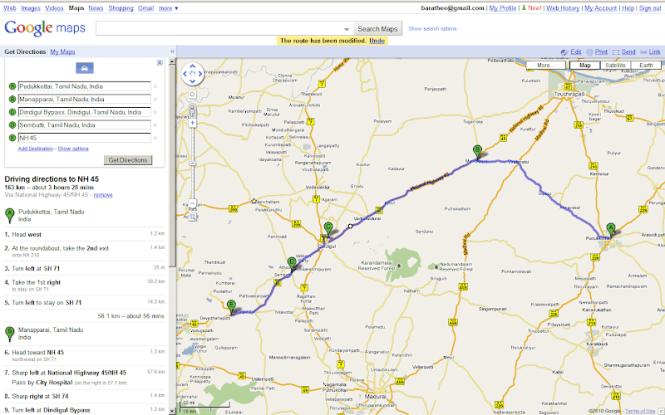
The route was very simple. Pudukkottai to Manapparai (state highway) – enjoy NH 45 till Dindigul – then take NH 210 till Oddanchatram and come back!
It rained the previous night, so the journey was very chill. The road was good and bad, like the human rights policy of western countries. Construction of bridges was in progress. He enjoyed a spectacular sunrise. Peacocks and snakes crossed his way.
He reached Manapparai at 7-00 (58 KMs @ 1 hr and 30 mins). Manapparai was famous for Murukku. But the quality of the Murukku sold at the bus stand was not so good now a days. It lost its taste. It’s too oily as well. He stopped there for nature’s call followed by a phone call.
After Manapparai, he joined NH-45. He needed to ride for the next 60 KMs. Four lane work was in progress. So there were many take-diversion plates. He kept on riding on his left for some time, then on the right side for some time. This patter was repeated multiple times. So keep-the-right is not a fault, when the road is under construction. Does it mean, we can break the rules if we have valid justification? His face was smiling inside his helmet.
The completed road was as smooth as Aavin butter. He could go up to 80kmph (his limit always!! ). There was no sun. The road was smooth. He was enjoying his ride while he opened his wind-shield now and then to get fresh air.
He reached Dindigul bypass – Palani junction at 08-15 AM. (Manapparai – Dindigul 69 KMs @ 1 hr and 15 mins). He should turn to the right on NH 210 to reach his destination. There was a twist in screenplay. The cool weather and the lovely wind made him so crazy. He wanted to ride for some more distance. He doesn’t want to end that chilled journey in another 20 KMs.
He called his sis.
“ka, I won’t join you for breakfast. But I’ll be there for lunch. Do not wait for me.”
“What da? Where are you now?”
“You too? do not start your ‘archanai‘ (blasting). I had enough from your mummy already. I want to ride in the hills. I’ll come soon.”
“Whattt? It is dangerous da, you know. I’ll complain to mummy.”
“Such an obedient daughter, you postpone your responsibility for few hours. I’ll be there soon hee hee.”
Dindigul – Batlagundu
He did not turn to the right as planned. He resumed straight on Dindigul – Madurai road all the way until Kodaikanal Road junction. He took the right to continue his lovely journey on NH 45 Extn. The road was not as smooth as that of earlier. The sun was raising slowly to become more and more horrible. He didn’t have enough petrol to ride on Kodai hills. He stopped at Sempatti to top up the fuel. The petrol staff was so funny, he was asking why Jaggu placed the number plate above the head lamp (Yamaha’s foolish (a) stylish design!)
Batlagundu – Pannaikadu
He continued exploring. Before he crossed Batlagundu, he was about to slip as he was following a mini-lorry. It is the rule. A bike rider should not follow a heavy vehicle at a close distance. They will leave pits and dents between their wheels. Bike riders won’t have time to react. Sometimes, they may apply sudden break as well. The rider may lose balance. After Batlagundu he reached the Ghat road junction. He took the right to go to Kodaikanal. Yes, he did not have a second thought.
After riding for some more distance in the plains, (The road looked like an avenue covered with shadows of tamarind trees on both sides), he touched the ghat road. His up-hilling started there in 4th gear. (Dindigul to Ghat road – 43 KMs @ 1 hr / 09:15am).
Batlagundu – Pannaikadu
The road was smooth. He saw very less numbers vehicles moving slowly, since the summer vacation was over already. He stopped here and there to take a few photographs. The sun was hot enough, but the mountain wind and the shadow beneath the trees subsided the temperature.
There are few other routes lead to Kodaikanal. But Batlagundu – Kodaikanal route is the safer one. In addition, it was the older one built by British. The hair pin pends are less.
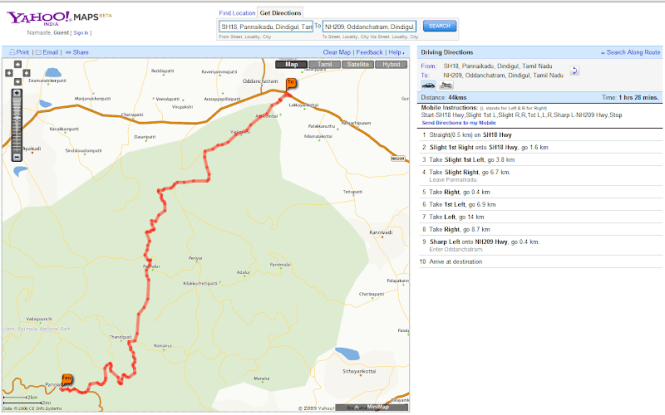
He was driving between 30 to 40 KMPH since he felt it was comfortable. He continued at 60kmph on the plains. There was a place called ‘Dam Dam Paarai’ (paarai – hill in Tamil!), where he got a charming view of the valley and an Eli-vaal (rat tail) falls. The water was gushing out slowly. He throttled again. He was very much eager to enter into ‘the road not taken’ – Pannaikaadu – Thaandikudi – Paachaloor – Oddanchatram
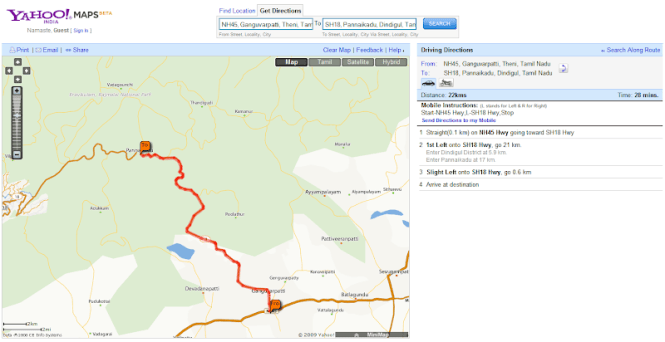
He reached the Pannaikadu tri-junction. Kodaikanal is just 20 KMs if you go straight. The ‘road not taken‘ was there on his right. He turned right on the deviated route. That road was hardly taken. Mostly it is used by public transports which connects the villages to different cities like Kodaikanal, Dindigul, and Oddanchatram. He stopped at Pannaikadu for a short break!
Pannaikadu to Thandikudi
You can see, the road was damaged considerably. Even the concrete at the end of the road was also worn out.
Pannaikadu to Thandikudi
Being hardly used, the greeneries were not spoiled there. The greenish bushes and trees decorated both sides of the road. Some of the places on the road seemed to never see sunlight due to those densely covered trees! The bushes with blooms on the side of the road formed a lively-flower-compound-wall. No body should miss it. But the road was bad. Sometimes he brought down the throttle below 20 kmph.
Pannaikadu to Thandikudi
After Pannaikadu, the next destination is Thandikudi. That stretch of the road was much better. He was all alone on that single road. He was the only rider exploring that hill. The horses, horse boys and other jeeps stopped at Pannaikadu. He liked that ekantham (loneliness)! But he didn’t know, the same ekantham would worry him at the later point of the trip!
He saw a view of the green and cloudy valley and dam on the way. (10-25 AM)
Pannaikadu to ThandikudiPannaikadu to ThandikudiPannaikadu to ThandikudiPannaikadu to ThandikudiPannaikadu to Thandikudi
He reached Thandikudi soon. He was very cautious about the roads and its branches. So he stopped when ever he got confused, to enquire the route correctly. He took a right turn there.
Next target was Thadiyan Kudisai via Mangalam Kombu. Another 10 KMs! The names of the villages were funny. There were lot of uphilling and downhilling with dozens and dozens of many U-turns. Some times he switched to second gear for steep uphilling. Wah.. It was enough in two places, he switched to 1st gear!! In the deep forest, the road divided itself into two. Nobody was there except a teashop, and its owner. The owner-lady looked like God Jakkamma to him.
“Akka, How to go to Pachalur?”
“You should continue to go straight. It will take you to Kuppamma-patti, KC Patti and Pachalur”
He got confused since what she told was different from his earlier enquiries.
“Thats ok akka, But people suggested me to go through Thadiyan Kudisai”
“This is Thadiyan Kudisai”
Then he realized that he had reached Thadiyan Kudisai already. So his next target was Pachalur. Thanking her, his leg started clicking the gear shaft. The downhill and uphill started again. The road was very bad due to rains. The way was dark due to shadows and very hiiiiiiighly grown trees.
On the way He understood from few locals that 1 liter of petrol was 70 rupees there..! (It was 52 in Delhi in 2010). He was interested to see the Churches in those villages. Interesting!
There was a twist at ‘Kuppamma patti’. The locals suggested to take a short cut which can skip KC Patti and lead straight to Pachalur, which may save around 5 KMs. The option to save 5 KMs in hills is simply superb. It is equivalent to 10 or 15 kilometers on the plains. But the shortcut was even steeper. His Glady was vrroooming much while downhilling at 2nd gear. Then again uphilling.. downhilling.. uphilling… oofff.. Finally, he reached Pachalur on time (12-00 noon).
His final target – Oddanchatram – was at 30 KMs from here. The road becomes smoother now, as that road is widely used by Transports. Mostly he was in downhill mode, which indicated that he was reaching the plains. A lot of U-turns reduced the elevation. Bamboo forests decorated the way!
He was flying like a bee as he reached the plains! Alas, he felt like the chicken inside the grill due to the hot sun.. Yes, elevation came down to 500 meters from 1600 and 1200! With a non stop ride surpassing Vadakadu village, he reached the destination with utmost pleasure at 01-00 Noon! (30 kms @ 1 hr)
His sister was scolding him non-stop like an RJ. After her turn was over, his mummy called him to take over.
“What do you think, donkey? Such an irresponsible buffalo. If something happened somewhere, what to do?”
6th Day of June 2010
***
I’m participating in #BlogchatterA2Z 2022 with theme Yātum ūrē!
The Tower of London is located on the bank of River Thames and it is near to the iconic Tower Bridge. The ancient construction was being used as royal residence, treasury of jewels of the Royal Family. I went there on a cloudy weekend break. Before reaching that place, I had a pleasant walk on the streets near the London Bridge. That’s the day I realized London Bridge and Tower Bridge are different!
Tower of London is where the Kohinoor diamond – which was looted from India (India’s version) and gifted by Punjab king (UK’s version) – was kept. Interestingly, it had also been used as a torture house, jail, and slaughterhouse.
The human rights of the selected prisoners – who went to the Tower through Traitor’s gate – were blown in the chilly breeze of Thames. The heads of those unfortunate souls lost contact with their bodies. Those disjointed heads were pierced with spikes and kept for public display as a ghastly warning to others.
Anne Boleyn, drawing by Hans Holbein the Younger, c. 1534–35; in the British Museum, London. Image (c) britannica.com
Anne Boleyn was born in 1507. She was the wife of King Hendry VIII. She was the mother of Queen Elizabeth – I. Before he married Anne, he ditched his first wife Catherine. She desired to marry Lord Henry Percy. But the King prevented her marriage diplomatically, as he himself loved her. I compare this with the influence of Tamil actor M.G. Ramachandran on Tamil actress Jayalalitha. More than his wish for a male heir, his desire for Anne drove him to break his marriage relationship with Catherine.
Henry and Anne married secretly. She gave birth to a female child. Soon, the king lost interest in Anne, too. He started hunting for other white girls. Still, she gave birth to a male child in January 1536. Just after 5 months, Henry sent her to this Tower of London on a charge of adultery. A new-mom, pacha-pulla-kari in Tamil, will be nourished and taken care of very well in India. She will get better nourishment from her mother, utmost love from all relatives. Despite being a queen, Anne did not enjoy these human rights. On the other hand, she was facing the slaughter house, at the age of 29, while her breasts were still producing milk for her 4 month-old baby boy. A girl was married and murdered after getting a male heir!
After two weeks, Henry married Jane!
I’m participating in #BlogchatterA2Z 2022 with theme Yātum ūrē!
The upper berths of Indian railways are like attics without a window! He appreciated himself for his philosophy and lying with crossed legs in his ‘attic’ of Devagiri Express bound for Mumbai. Travels – especially traveling alone – were the moment of dhyana for him. He used to get dazzling ideas during such travels. But he will forget all of them when he gets down at his destination. Disturbing his contemplation, TTE knocked on his legs and asked for his ticket.
His chauffeur Easwar had dropped him at Aurangabad station after visiting a bustling attraction – Ajanta. He was so punctual since Saturday morning. He came at 8am sharp on Sunday morning, too, to take him to the promenade that day! The driving time to Ajanta was more than that of Ellora. Instead of any distractions, they went to Ajanta. The view point on the way to Ajanta was an important attraction, he did not visit.
Aurangabad: The journey to Ajanta begins, Aurangabad-Jalgaon-Indore Highway. Approximately 100 km from here.Aurangabad-Jalgaon-Indore Highway.Trail from hill to hill! They say Japan paid for that roadFrom the view point. (c) columbia.edu
If we look at the very old Indian paintings, we have no significant evidences. Paintings of Sigiriya of Sri Lanka, Kanchipuram of Chennai, Sittannavasal of Pudukkottai and Brihadeeswara temple of Thanjavur belong to 5th, 7th, 9th and 11th centuries AD. The paintings at Ajanta help as evidence of Indian painting from the 2nd century BC till the 6th and 7th centuries AD.
Painting at Kailasanatha temple, Kanchipuram – 7th century AD (c) blogvirasatehind.wordpress.comPainting at Brihadeeswara temple, Thanjavur – 11th century (c) Benoy K BehlPainting of Jain ascetic, Sittannavasal – 9th Century (c) Prof S SwaminathanPainting from Sigiriya, Sri Lanka – 5th century (c) lankapura.com
The discovery of Ajanta is an interesting tale. John Smith, Madras Presidency Officer, went out for a hunt in Ajanta hills. He might be an explorer like Jaggu. But Jaggu hates hunters, but that is not our topic of discussion today. John did not find a tiger. But he find a rock-cut-cave on a distance from a hilltop in the midst of the dense forest; there must have been the light of the Buddha – glowing on the banks of a Waghur river, flowing in a horse shoe shaped path – identified itself and asked him to bring to the attention of outer world. The art treasure was later nationalized and became a feast for our eyes and topic of research for our minds.
Jaggu reached Ajanta around 11:30. He needed to escape from the ‘compulsion selling’ of tourist shops from there. Easwar had warned about them earlier. He just kept quiet and passed through the shops. Still, there was one rogue who tried to pull him out to sell something.
No. It is not Pilgrimage to Sabarimala. ‘Explorimage’ to Ajanta
By the time he entered Ajanta, he felt as if he had done a time travel and reached the 10th century. The view was breathtaking.
Caves have been carved here during the time of the Satavahanas (2 BC) and the Vakatakas (AD 6, 7). All are Buddhist monasteries. Their side-walls, canopies or wherever you touch them were filled with impeccable paintings. Buddhist Jataka stories were painted as well. Are you interested in Jataka stories and archeology? Mark my words, you will not be able to visit Ajanta in one day.
Despite the morals of Jataka tales, many granular details, such as costumes, musical instruments, and birds, continue to amuse researchers even today. Analysts are amazed at the continued tradition since the Ajanta painting period till the contemporary period.
The first two caves themselves will show the most important paintings to fill your mind with immense pleasure. That was a place of humble Buddhist monks. Those caves, sculptures and paintings are where their souls are frozen, though they are deceased already.
Cave 1
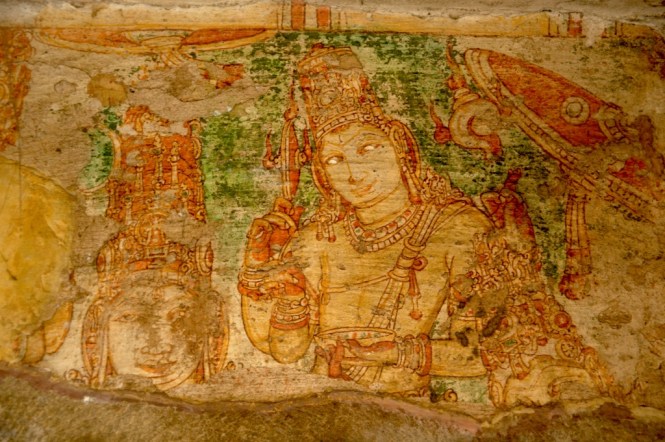
Bodhisattva is any human being who is on the way to enlightenment or path towards ‘Buddha’. Padmapani is a Bodhisattva with compassion. Jaggu was familiar with this painting through books.
Padmapani, Cave 1
Similarly, Vajrapani – holder of thunderbolt – is a God of protection.
Padmapani, Cave 1 (Right side of Sanctum)Padmapani, Karuvarai, VajrapaniMurals, Cave 1Cave 1Cave 2Treasures at Cave 2Cave 2Miracle of Sravasti – Cave 2Cave 2: The sanctum and the muralCave 2: The floral designs. Still we use such type of decorative elements.Cave 6Cave 7
Large symmetrical caves could be seen here, like a tall palm tree, dating back to the 2nd century BC. One of these caves, number ten, was what was discovered by John during the colonial period.
The first-century Chaitya-shaped cave – Cave 9Cave 9Cave 9: There were sculptures depicting the daily life of humansCave No. 10 is probably the oldest of the Ajanta Caves. This majestic look identified itself to John during his hunting. This cave has another specialty. It has the oldest painting of India, that belongs to 2nd century BC.
It is awe-inspiring to see the paintings of the caves of 2nd century BC. Yes. Really. Those paintings have the most perfect measurements for face, makeup, jewelry sets, despite being very old!! Who’d drawn this? What’s his/her name? Was he/she short or tall? That was the land where so many intellectuals lived at those times!!
2nd century BC painting. Neat. Belonging to the Hinayana period The costumes found in those paintings, surprise us. These should be the most interesting paintings for girls.Cave 10Cave 10The cavesDying princess, cave 16Elephant story – Cave 17Indra flying in the clouds Cave 1The Waghur riverThe drinking Couple, Cave 17Cave 17: Decorated entrance to heaven 🙂Cave 17: A feast for the eyes. What kind of place was that? The wall and the canopy of enormous height were filled with painting – everywhere! Jataka tales glittered in paintings!The caves should be visited after a rainy season for a better view!
In addition to the paintings, beautiful sculptures could also be found there. How decorative the arches were! How perfect the elegance of the sculptures were!
Cave 19: This shrine belongs to the late Mahayana period. Chaitya type. The most beautiful and elegant sculptures were found in the cave.Cave 19: A feast for the eyesCave23: Tell me. Which is perfect? the design at the top or the one at the bottom? Cave 19: NagarajCave 23Cave 23Cave 23
When someone dies, his/her unresolved karma passes on to a new birth instantaneously. However, when a person attains nirvana, they are free from rebirth. When such a person dies, it is the end of his/her rebirth. He attains the mahaparinirvana, the eternal divinity.
This cave 26 is the result of your search; the rise of your soul.
Cave 26: This was the last chapter of the Ajanta trip. Exterior decoration and The sculptures will take your time here.A man stands on the right side, helping to infer the height of the caveThis shape is simulated to the sternum of the BuddhaCave 19hmm. so many caves! so many paintings!
Was there no one to disturb the Buddha?! Mara was there. He was known to be a king, who had the contrasting view of life to that of Buddha. Buddha pulled the people towards eternity. Mara liked to pull them towards worldly pleasures. Mara was drawn in cave 1. He has been sculpted in cave 26.
Buddha and Mara. The painting in the first cave was sculpted hereMara climbed on the elephant and came with his evil forces to attack the BuddhaMara climbed on the elephant and came with his evil forces to attack the BuddhaMara’s daughters: Despite the large relief, each of these small sculptures in it is very realistically carvedThe answer to why Jaggu could not be a Buddha was clear. This stone-shaped Mara daughter itself had captivated his mind! How could he practice penance elsewhere! What a dynamic posture it was!Mahaparinirvana: My leader was with us.. walked with us.. shared food with us.. told moral stories.. Performed miracles.. Defeated the evil that resisted. He solved the misery of poor people. Here is where he left me. He quits his job and falls asleep. Om mani padme hum.The final moment. Siddhartha, you came to uplift us, the poor. Let your compassion be with us – ever.
For Jaggu, who hails from Tamil Nadu – the land of small-rock-cut temples carved out of granite rock – Elephanta, Ellora and Ajanta are like swargapuri (heaven). If someone can go with some preparation, like gathering a quick knowledge of Buddhism & Jainism, Indian paintings and Jataka tales these places will be wonderful.
Tiresome early morning at Dadar station.
The Mahan Buddha born on this earth, left his kingly life, abandoned Rahula, and Yosodara, to demonstrate us…. the compassion! Let’s be compassionate with each other! Om Mani Padme Hum!
End of travelogue – Jaggu’s search for cave temples.
I’m participating in #BlogchatterA2Z 2022 with theme Yātum ūrē!