Barus Tamil Inscription

When I traced the path of Islam to southeast asia, I came across the Tamil inscription of Barus in Indonesia. This inscription mentions about marakkala-nayan, which is maraikayar today, a term used to note the South Indian muslim traders. But when I went behind the inscription, it offers much more than Tamil Muslim connection.

This inscription was found in in 1873 in the village of Lobu Tua (Loboe Toewa), near Barus (Baros), North-western Sumatra province of Indonesia. It is dated back to Saka year 1010 and 1088 CE. This archaeological discovery was reported in Madras epigraphy report of 1891-92 by E Hultzsch, an English Epigraphist based in India. Y. Subbarayalu, an eminent historian and epigraphist says, this text falls within the reign of Kulottunga Chola I of Tamil Nadu.

Barus inscription. Picture source: facebook

The text:

Let me quote –

1 svasti śrī cakarai
1 ஸ்வஸ்தி ஸ்ரீ சக ரை
2 āṇṭu ayirattu[p pa]-
2 ஆண்டு ஆயிரத்து[ப் ப]
3 ttu cellāni[n]-
3 த்து செல்லானி[ன்]
4 ra mācit tingal
4 ற மாசித் திங்கள்
5 vārōcāna mātan-
5 வாரோசான மாதன்-
6 kari vallavat tēci u-
6 கரி வல்லவத் தேசி உ-
7 yyak konta paţ-
7 ய்யக் கொண்ட பட்-
8 ṭinattu vēļāpurattu
8 டிணத்து வேளாபுரத்து
9 kūţi niranta tē[cit ticai]
9 கூடி நிரந்த தே[சித் திசை]
10 viļangu ticai āyira-
10 விளங்கு திசை ஆயிர-
11 ttaiññürruvarō-
11 த்தைஞ்ஞூற்றுவரோ-
12 m nammakanār nakara sēnāpa-
12 ம் நம்மாகனார் நகர சேனாப-
13 ti nattuceţţi
13 தி நாட்டுசெட்டி
14 yārkkum patineņpūmi
14 யார்க்கும் பதினெண்பூமி
15 tēci apparkku mā[ve]t-
15 தேசி அப்பர்க்கு மா[வே]ட்-
16 tukaļukkum nā vaittuk
16 டுகளுக்கும் நா வைத்துக்
17 kututta paricāvatu marak[ka]
17 கொடுத்த பரிசாவது மரக்க[க]
18 la… …
18 ல … …
19 la marakkala nāyanun kēvi-
19 ல மரக்கல நாயனுங் கேவி-
20 kaļum kastū[ri] vilai mu[tala]kappa[ta]
20 களும் கஸ்தூ[ரி] விலை மு[தல]க்கப்ப[ட]
21 ańcu tun[tā]yam ponnum ku[tu]
21 அஞ்சு துண்[டா]யம் பொன்னும் கு[டு]
22 ttup pāvāţai ērakkațavatākavum
22 த்து பாவாடை ஏறக்கடவதாகவும்
23 ippaţikku [i]kkal eluti nāţţi
23 இப்படிக்கு [இ]க்கால் எழுதி நாட்டி
24 k kututtom patineņpūmi tēcit ticai viļa
24 க் கொடுத்தோம் பதினெண்பூமி தேசித் திசை விள
25 ńku ticai āyirattainnūrruvarōm a
25 ங்கு திசை ஆயிரத்தைஞ்ஞூற்றுவரோம் அ
26 ramaraverka aramēy tuṇai.
26 றமறவர்க்க அறமே துணை.

Interpretation

ஸ்வஸ்தி ஸ்ரீ சாகரை ஆண்டு ஆயிரத்து[ப் ப] த்து செல்லானி[ன்]ற மாசித் திங்கள் வாரோசான மாதங்கரி வல்லவத் தேசி உய்யக் கொண்ட பட்டினத்து வேளாபுரத்து கூடி நிரந்த தே[சித் திசை] விளங்கு திசை ஆயிரத்தைஞ்ஞூற்றுவரோம் நம்மாகனார் நகர சேனாபதி நட்டுசெட்டியார்க்கும் பதினெண்பூமி தேசி அப்பர்க்கு மா[வே]ட்டுகளுக்கும் நா வைத்துக் கொடுத்த பரிசாவது மரக்க[க]ல … …ல மரக்கல நாயனுங் கேவிகளும் கஸ்தூ[ரி] விலை மு[தல]க்கப்ப[ட] அஞ்சு துண்[டா]யம் பொன்னும் கு[டு]த்து பாவாடை ஏறக்கடவதாகவும் இப்படிக்கு [இ]க்கால் எழுதி நாட்டிக் கொடுத்தோம் பதினெண்பூமி தேசித் திசை விளங்கு திசை ஆயிரத்தைஞ்ஞூற்றுவரோம் அறமறவர்க்க அறமே துணை. (Text converted from English to Tamil by Gemini AI and proof read by me!)

In the Saka year 1010 current, month Masi, we, the Five Hundred of the Thousand Directions, having met at the Vēlāpuram in Vārōsu (Barus), also called Mātańkari vallavat tēci uyyak konta pattinam (literally “the pattinam (commercial town) for the welfare of the merchant body blessed by Mātańkari, that is, Durga”), decided to grant as follows to ‘our sons’, the nagara-sēnāpati Nattu-cettiyar, to Patinen-būmi-dēsi-appar, and to the māvettu-s (elephant-trainers?): [On each of the] ships’ [cargoes?], the ship’s captain (marakkala nāyan) and crew (kēvi) will pay the fee añju-tundāyam in gold, pegged to the price of kasturi (musk), and [then only] may ‘step on the cloth spread’ (that is, enter the settlement to trade). Thus we, the Five Hundred of the Thousand Directions, known in every direction in all the Eighteen Lands, had the stone inscribed and planted. Do not forget charity; charity alone will help you.

Barus beach, Indonesia | Picture source: Wikipedia

Noboru Karashima of Tokyo University mentioned in his paper INDIAN COMMERCIAL ACTIVITIES IN ANCIENT AND MEDIEVAL SOUTHEAST ASIA published in the Plenary Session Papers of Wold Tamil Conference 1995 – P5 mentions that,

K.A. Nilakanta Sastri discussed the problem of the ainnurruvar (five hundred , I wonder why it was stated in inscription as āyirattainnūr which mean one thousand and five hundred) mentioned in the inscription by examining several South Indian inscriptions referring to it. As he pointed out for the first time in his article, ainnurruvar is another merchant guild that flourished in South India from the tenth to the sixteenth centuries. This big corporate body of merchants that originated in Aihole in Karnataka in the eighth century or so seems to have extended its activities afterwards to Tamil Nadu and Andhra Pradesh, incorporating many other merchant bodies under its banner. It also seems to have kept some groups of soldiers for protection of their commercial activities.

We observe interesting points –

āyirattaiññürruvar: This is the merchant guild or big corporate body of merchants that originated in Aihole in Karnataka in the eighth century. They are also known as Ayyāvoḷe guild. Kanakalatha Mukund, in her book The trading world of the Tamil merchant: evolution of merchant capitalism in the Coromandel says that they had a presence in Kodumbalur which is near to my native.

Nagara-sēnāpati: This is a title that likely refers to a high-ranking military or administrative official within a city or urban center (nagara).

Nāṭṭu-ceṭṭiyār: “Ceṭṭiyār” is a term used to denote a member of the Chetti community, which is traditionally associated with trade and commerce in South India.

Marakkala-nayan: seems to relate to the term marakkayar used to denote the seafaring
Muslim merchants of the Tamil Nadu and Kerala coasts in the later period.

Matankari vallava-dési-uyyakkonda-pattinam: One who is loved by Mataṅkari. vallav means ‘beloved of’ in Sanskrit. This phrase can also be read as beloved of Mataṅkari. Since Matankari in Sanskrit is a form of Durga and the Ayyāvoḷe guild considered themselves as sons of Parameshwari (Subbarayulu Pg.41) it seems appropriate to simplify the translation as beloved of Parameswari.prasasti

Saka calendar: Saka calendar is the traditional Indian calendar system based on lunar months. It consists of 12 months, each with 29 or 30 days. It is used to calculate the dates of Hindu festivals and ceremonies. In Indonesia, particularly Bali and Java, the saka calendar was in practice for centuries. It was in use until 17th centuries. It is believed that Sultan Agung replaced it with Javanese calendar. It is still in practice by Indonesian Hindus in Bali and Java. I read an interesting note in Majapahit: Intrigue, Betrayal and War in Indoesia’s Greatest Empire by Herald Van Der Linde. It goes like this.

Historical Significance

This inscription highlights:

  1. The organized nature of Indian merchant guilds like āyirattaiññürruvar.
  2. Barus’s importance as a thriving port city as Vēļāpuram in medieval Sumatra.
  3. The integration of trade, religion, and governance in regulating commerce.
  4. The influence of Tamil merchants in Southeast Asia during this period.

It serves as a testament to the inter-connectedness of south and southeast Asia through maritime trade and cultural exchanges.

If I had a chance to visit this part of land, I need to visit National Museum at Jakarta to look at this artifact.

For further reading –

  • Ancient and Medieval Tamil and Sanskrit Inscriptions Relating to the Southeast Asia and China, Noboru Karashima and Y Subbarayalu
  • INDIAN COMMERCIAL ACTIVITIES IN ANCIENT AND MEDIEVAL SOUTHEAST ASIA, Noboru Karashima, Tokyo University
  • Maritime History of the Coramandel Muslims, A Socio-Historical Study on the tamil Muslims 1750 – 1900, Raja Mohamad
  • The திசை ஆயித்தைந்நூற்றுவர் – The five hundred (merchants) of a thousand directions, 4prasasti.wordpress.com
  • Lobu Tua Inscription, Wikipedia
  • Five Hundred Lords of Ayyavolu, Wikipedia

This post is part of Blogchatter’s WRITE A PAGE A DAY 2025 campaign.
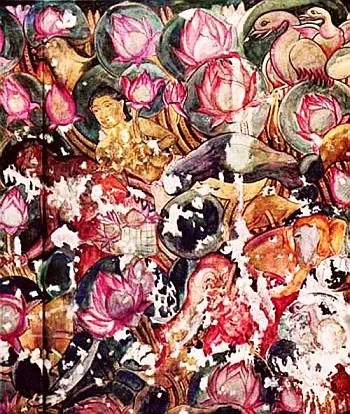
Samava Sarana, Sittannavasal

I wrote about our exploration of Sittannavasal by bicycle earlier. Later during 2000s I had a chance to understand the meaning of the paintings, as elaborated by scholars.

The Samava-sarana theme is a central figure of the Sittannavasal cave paintings. It is dated back to 7th century AD. This beautiful mural depicts a scene from Jain cosmology belief, a delightful Jain heaven containing a hall called Samava Sarana.

Picture source: pudukkottai.org

Samava-sarana or Samo-sharana means refuge-to-all. It is a preaching hall of the Tirtankara-s, stated to have more than 20,000 stairs in it. It is believed that the Samava-sarana seems to have replaced the Jain stupa as an object of worship.

Key aspect of the Samava-sarana painting at Sittannavasal includes the following –

  • The lotus tank (Khatika-bhumi) where the bhavya-s (jain faith followers attained the heaven) gather to hear the preaching of Tirtankara.
  • Bhavya-s collecting lotus flowers, carrying baskets
  • Animal motives makes the painting interesting. We see fishes, birds, bulls/buffaloes and elephants.

The face of the bhavya‘s looks neat, with arranged hair and pendant ear lobes.

Picture source: Karwaan Heritage

Similar motives can be found in other Jain worshiping places. But Sittannavasal paintings are considered as one of the earliest examples of Jain frescoes in South India.

Further reading:

This post is part of Blogchatter’s WRITE A PAGE A DAY 2025 campaign.

Bodhisattva, Gandhara

The Asian Civilisations Museum (ACM) in Singapore recently received Buddhist artifacts from Kolkata. I had been a visitor there. Upon entering the museum, visitors are immediately captivated by the striking Gandhara Bodhisattva head, its arresting composure sought attention even before they reach the special exhibition. With it’s intricate decorated ornaments, curly hair/mustache/beard. It does not look like conventional Buddhist artifacts.

As I stood before the stunning Gandhara Bodhisattva head, memories of my school days flooded my mind. In class 9, we had studied about Gandhara artistry, but without any background in artistry, it was hard for us to fully appreciate its significance at the time. However, life has a way of circling back. Recently I had a visitor from India, who specifically asked about this artifact. It was heartening to see people taking interest in understanding this piece of history and artistry.

From being just another topic in school to becoming a tangible connection with someone else’s curiosity decades later, it underscored the power of personal experiences and shared interests in deepening our understanding and connection with cultural artifacts.

This is likely a representation of Avalokiteśvara, the Bodhisattva of compassion. But we can not definitely confirm. The short description on roots website did not explain this too. I’ve written in details about Avalokiteśvara in another post of the same series. Hence I am not going to repeat it once again. But let’s focus on this artifact of ACM. This terracotta sculpture is believed to be 4th – 5th centuries AD, the peak period of Gandhara art. This art form is believed to be in practice since 1st Century BC to 7th Century AD.

The style began as an influence of Greco-Roman artistic traditions mixed with Indian art forms. Historians say the refined facial expression of this is influenced by early Gandharan sculpture styles.

Gandharan region, Western Pakistan – Eastern Afghanistan, was of central importance in the development of Mahayana Buddhism from 1st Century BC. It embraced the art forms of Hellenic (ancient and modern Greek), ancient Iran and China, made a fusion with Indian art forms, reflecting the cultural exchange along the silk roads.

Back then, Gandhara art was just another topic in my history textbook, a distant concept without much personal relevance, introduced horribly by my history teachers. Now, standing before the magnificent Gandhara Bodhisattva head, I’m in awe of the rich heritage it represents. Life is interesting, though stressful at times!

For further reading

This post is part of Blogchatter’s WRITE A PAGE A DAY 2025 campaign.

Veerabhadra, Madurai

Madurai‘s bustling street, or ‘kasakasa‘ as we call them in Tamil, were my frequent haunt during my under-graduate years. I’d navigate the crowded Town hall road, hunting for electronic parts for my often-unsuccessful projects. The city’s energy was intoxicating, allowing me to venture there after classes and return home late in the night. Evenings often found me at Periyar bus stand, happily munching onion bajji-s that filled my belly with utmost happiness!

Sri Meenakshi Temple, (mīnākṣī/मीनाक्षी) a stone’s throw from Town Hall Road, became my sanctuary. My reverence for the queen of Madurai grew with each visit, continuing even after I started working, with frequent trips between July and October 2002.

Madurai | Pandian Ramaiah, Oct 2002

Armed with newfound passion for photography and digital camera, I set out to verify my readings about the temple in person. Sadly many of those captured moments have been lost over time.

The temple stands as testament to magnificent sculpture, with Nayaka dynasty’s contributions during 16th and 17th centuries, being particularly impressive. In the mukha-mandapa of the Sri Sundareswara shrine (śrī sundarēśvarā/श्री सुन्दरेश्वरा), The Agni veerabhadra (agni vīrabhadrā/अग्नि वीरभद्रा) and Agora Veerabhadra sculptures captivate visitors.

Agora Veerabhadra, Madurai | Picture (c) Giridhar

Veerabhadra, born from Shiva’s wrath, is a formidable figure Hindu purana-s. The sculpture’s imposing presence is really scary with its four arms on each side wielding various weapons, including a bow in his right hand and left hand taking an arrow from quiver at his back. Notably a long sword – instrument of Daksha’s demise – is in one of his left hands.

As per iconography, Daksha should be depicted with the head of a goat nearby with his hands in a worshiping position. This representation symbolizes his resurrection and humility after Shiva restored him.

Agora Veerabhadra | Picture source: Unknown.

Additionally Bhadrakali, who was also created from Shiva’s anger along with Veerabhadra should be beside him. I don’t recall seeing them. I’ll have to check next time to be sure.

One concerning practice I observed was people throwing butter balls at the sculpture. This ritual, of unclear origin, mars the sculpture’s beauty and combined with inadequate maintenance, is a worrying sight.

The story of Daksha resonates even today, reminding us of the consequences of unchallenged ego. His transformation, symbolized by the goat’s head, represents the potential self-recovery and ensure we are on the way to enlightenment.

This post is part of Blogchatter’s WRITE A PAGE A DAY 2025 campaign.

Laboring women, Darasuram

I had an opportunity of attending a temple tour of Sri Airavatesvara Temple (Airāvatīśvara, ऐरावतीश्वर) at Darasuram (Dārāsūram, दारासुरम) by one of the best historian Mr Kudavayil Balasubramaniam. That was my first time visiting this temple. I had been there alone few times to explore. Yet, I need to read and understand about this temple in detail.

Airavateshwarar Temple, Darasuram | Picture: Pandian Ramaiah 27 Dec 2011

This a marvel in south Indian temple architecture. Built by RajaRaja Chola II and later renovated by Kulothunga III as per the inscriptions in this temple.

This marvelous temple is a gallery of fine carvings of Periyapuranam (Periyapurāṇam, पेरियपुराणम्), stories about 64 Saivite devotees. In addition it has micro carvings, small sculptures, ornamental pillars. It makes any visitors mad and forcing them to come back to this temple again and again.

One of the small sculptures in the rear prakaram (pathway) of the temple is the focus of today’s discussion. The panel is of half foot or even lesser. This unique carving shows a pregnant woman giving birth, assisted by two other women, while one other woman is watching near by (probably waiting to hold baby).

Laboring woman, Darasuram | Picture: Pandian Ramaiah 27 Dec 2011

This carving is notable for its detailed portrayal of child birth and the support provided by women during delivery at that time. Giving birth in standing position is widely practiced in many parts of the world. The techniques may vary. When I search for similar sculptures, there a few within in Tamil Nadu itself. But this is one of the best in aesthetically.

People there says, these sculptures are worshiped by conceived ladies for better laboring. In addition to spiritual symbolism, it stands still as a documentation of ancient delivery (which was practiced until recently), the skillful artistry of Chola kingdom.

This post is part of Blogchatter’s WRITE A PAGE A DAY 2025 campaign.

Bodhisattva Manjushri, Central Java

Java had several small villages. During earlier periods, Indians traders believed the cities in Indonesian archipelago were made of Silver and Gold. This piece of world is called in swarnabhoomi in Sanskrit in India. So when the monsoon starts, they board on ships to reach the islands. They realize what they believed was not fact, yet they do their trade – mainly spices, precious metals, aromatics – and go back to India with several travel baggage.

Those who want more valuable spices stayed back to continue their exploration. They were accompanied by Brahmins who shared stories of the Hindu trinity and Buddhist enlightenment in various villages. Over time, these group of villages developed into power centers, eventually giving rise to the kingdoms of Srivijaya and Sailendra.

Candi Plaosan | Picture : Wikipedia

Sailendra-s controlled central Java where as Srivijaya-s dominated Sumatra. Both of them had trade and cultural relationship. Sailendras formed a powerful Buddhist kingdom. Its rulers were known for their patronage of Buddhism and the construction of numerous temples including Buddhist temple complex at Borobudur and Hindu temples at Prambanan.

The bodhisattva Manjushri, Candi Plaosan | Picture researchgate.net

One of the sculptures – belongs to Sailendra period, from their capital Central Java – is the focus of today’s post – The Bodhisattva Manjushri. He is a significant figure in Mahayana Buddhism. He is one of the four great Bodhisattva-s in Chinese Buddhism – Avalokiteshvara (Compassion), Manjushri (Wisdom), Samantabhadra (conduct) and Maitreya (future enlightenment).

The specific sculptor of this piece remains unknown. It is likely attributed to the Sailendra rulers who were prominent patrons of Buddhist art and architecture during the 9th century. The presence of Manjusri statues in Central Java such as Candi Sewu, suggests a strong reverence.

The sculpture embodies the cultural and religious influences that spread gradually through the interactions of Indian traders, sailors, and monks, who brought Hindu and Buddhist ideas to the region, blending these with local Javanese elements.

This post is part of Blogchatter’s WRITE A PAGE A DAY 2025 campaign.

Carnelian beads of Padang

The term “Padang” means “field” in Malay, similar to “medan” in India, which were also part of early British urban planning. The Padang was designated for public use during the early British occupation of Singapore. It has been depicted in several 19th-century artworks. Notably, it was also a site where Netaji Subhas Chandra Bose addressed a gathering during WWII, highlighting its role in broader historical narratives.

Parts of the Padang are leased to social and athletic clubs, including the Singapore Cricket Club (SCC). An excavation at the SCC site in 2003 revealed that human activities significantly impacted the soil and vegetation of the Padang as early as the 14th century. Artifacts like Chinese porcelain and stoneware, Chinese coins were collected during this excavation. But our focus is on discovery of Carnelian beads from this site.

Carnelian bead found at SCC excavation| Image (c) epress.nus.edu.sg

While talking about Carnelian beads, we need to go back in history. The Indus Valley Civilization was renowned for its sophisticated craftsmanship, including the production of carnelian beads. The Indus craftsmen developed advanced techniques for drilling and decorating carnelian beads. Carnelian beads were extensively traded across the ancient world, reaching as far as Mesopotamia, the Arabian Peninsula, and even Greece. The production and trade of carnelian beads not only reflect the technological prowess of the Indus craftsmen but also highlight the civilization’s strategic position in ancient trade networks. These beads were often used as symbols of status and wealth.

The carnelian beads found at Keeladi, a significant archaeological site in Tamil Nadu, India, are part of the extensive discoveries that highlight the region’s rich cultural and historical significance. Carnelian beads have been found in various forms and quantities at Keeladi. For instance, two barrel-shaped beads were discovered in an urn, one of which was etched with a wavy pattern and lines5. Additionally, a cluster of 74 carnelian beads was found underneath an offering pot at the Keeladi-Kondagai burial site.

The two carnelian beads that were found in Konthagai. | Photo Credit: The Hindu

Coming back to our Singapore Cricket Club story, Four beads of red carnelian were found during the excavation. They are not perfectly spherical; they are rather irregular in shape. They measure approximately 2 cm in diameter. Prof John Miksic mentions that these were the first carnelian beads found in Singapore. It is highly probable that these were imported from India although an origin of Myanmar can not be completely discounted.

Beads found in SCC excavation site | Image c: epress.nus.edu.sg

One of these beads are displayed at Indian Heritage Center, Singapore. If you happen to visit Singapore, you may visit to realize the connection between Indian land and southeast Asia in the past.

This post is part of Blogchatter’s WRITE A PAGE A DAY 2025 campaign.

Victoria Arch – A historical ignorance of Pudukkottai

I lived in and around this town. This has many historical buildings, fit to be museums, but encroached by Government agencies. These buildings, once offices of autocratic kings, became the abode of democracy. If you cross this town, you may visit the collector office, district courts and colleges. You will know how badly are they maintained. This place, once directly connected to British rule, has seen its historical charm fade under democracy.

One of them was the ornamental archway built in 1897 by King of Pudukkottai princely state to commemore the Diamond Jubilee of Queen Victoria as a token of his respect for a queen. East Main Stree is the high street (even now!) in Pudukkottai. He built the arch at the beginning of the high street.

Diamon Jubilee arch, Pudukkottai | Pandian Ramaiah, 16 July 2006

It was notable for its beauty. Thanjavur has such a arch too. Aesthetically, this arch was more appealing. It featured a unique image of Queen Victoria with black hair, her face resting on her left arm. Ironically, when the arch was built, the Queen had lost her husband and had retreated into an isolated life, often wearing mourning dresses. She stopped attending much public meetings. In addition, she never visited India. People used to say, she looks like an Indian queen than British!

The close-up | Pandian Ramaiah 16 July 2006

It provided a good look to the landscape, despite some political statues were erected later, as the entrance of high street.

Until recent days, the arch was standing with its glory. When I get my first camera, I went here to take my first few photographs. The town was under direct influence of British, due to which it was managed by no-nonsense people.

Dewan Seshaya Shastry improved the balance sheet of the state and planned the city with squared streets and roads with excellent water management with multiple ponds.

B.C. Holdsworth, another administrator, built a dam in Kadayakkudi. Present day Gandhi park was originally named after him. As per Indian antique records, a clock tower was declared open in 1933 by him. Swaminatha Pillai was the architect who designed the tower. The actual execution of the structure was entrusted to a contractor named M.K. Mahamadhaneef.

Holdsworth park during colonial times, renamed to Gandhi park | Pandian Ramaiah 16 July 2007

Unfortunately, these structures were poorly maintained over time. Political and cinema posters were stuck on the arch, and the park became uninviting due to poor maintenance. Recently there was some improvement in the maintenance of Park.

But a devastating destruction of legacy happened on Nov 14, 2009.

Erasing the legacy. Picture (c) The Hindu, 14 Nov 2009

as a vehicle rammed into the arch. Despite the arch did not lose its shape and fit to be conserved in other places, the district management demolished it into pieces. The legacy stood majestically for 112 years, vanished leaving a void that reflecting such minds.

You can never object to the justifications given by the management. But historians raised their concerns. Despite being led by highly qualified individuals, the management seemed to lack the historical awareness needed to preserve these remnants in a museum for future generation.

Similar demolition happened in Thanjavur as well. Though the people were different, common denominator is the historical ignorance of democracy and its bureaucracy.

After all, that is the town, had my history teacher, received Government salary, taught me that Ghajini Mohamed came, saw the pulchritude of the sculptures, felt it is fit for his bedroom and smuggled away! Despite this series talks about cultural traces, we need to talk about our own ignorance too.

For further reading –

This post is part of Blogchatter’s WRITE A PAGE A DAY 2025 campaign.

Mahishasura Mardini of India and Southeast Asia

Before the advent of cave temples, gods took shelters in structures made of brick, bamboo, or similar materials. These structures were vulnerable to time and eventually vanished.

To overcome this, excavation of cave temples started.

Mandagapattu is recognized as one of the earliest cave temples in Tamil Nadu, built by Pallava king Mahendravarman I in the early 7th century. Mahishasura Mardini cave of Mamallapuram was also mentioned often when we discussed about similar early structure. It is dated back to late 7th century during the reign of Pallava Narasimha Varman.

Mahishasura Mardini Cave, Mamallapuram

Mahishasura Mardini, Mamallapuram

Upon visiting, I stood in awe of the life-sized bas-relief of Mahishasura Mardini, considered one of the finest examples of Pallava art. The bas-relief depicts Goddess Durga fiercely battling with eight arms, wielding a sword, bow, and arrow, as she forces Mahishasura into retreat.

The bas-relief also depicts her attendants, including female warriors and gana-s (dwarfs) in action. Notably, one servant is shown holding an umbrella over the goddess’s head.

Vietnam: Po Nagar Temple

Mahishasura Mardini, Po Nagar Temple | Picture (c) Linda De Volder

Mahishasura mardini is widely depicted in southeast Asia as well. We talked about 7th century caves. Around the same time or later, we have a sample from Vietnam – Po Nagar Temple.

The goddess of this temple is believed to be worshiped for agricultural prosperity. She is linked with Bhagavati. But there is a doorway which represents goddess Durga with four hands, dancing on top of a buffallo, holding a chakra, lotus and trident. The face and crown resembles Chamba artistry. Yet it has the same concept.

Indonesia: Prambanan Temple

In Indonesia, Mahishasura Mardini is depicted in the 9th-century Prambanan Temple complex, showcasing the influence of Hindu mythology on Javanese art.

Durga Mahishasuramardini aka Loro Jonggrang, Prambanan, Central Java, Indonesia.
Picture (c) rarebooksocietyofindia.org

Cambodia: Sambor Prei Kuk

Sambor Prei Kuk is an important archaeological site having over 100 brick temples from the pre-Angkorian period, primarily dedicated to Hindu deities. The site is renowned for its early Khmer architecture and art.

Durga Mahishasuramardini, Sambor Prei Kuk, Khmer, 1st half of the 7th century
National Museum of Cambodia | Picture (c) art-and-archaeology.com

Durga story is perceived as the triumph of good over evil. There are several Mahisha-s roam around freely in Tamil Nadu right now. Just as Mahishasura threatened harmony, modern societal issues like drug abuse disrupt our communities, and we hope for a similar triumph of good over evil.

This post is part of Blogchatter’s WRITE A PAGE A DAY 2025 campaign.

Avalokiteśvara / Padmapani of Ajanta

Padmapani mural of Ajanta captivated my boss. I could feel many times as I worked with him for my first three years. That might have pushed me to take the train and a car to Ajanta. We were searching for someone in a large complex. How would we feel if the person we’re searching for suddenly appeared before us? That’s how I felt, when I saw the popular Padmapani and Vajarapani murals in very first cave.

From left to right: Padmapani, Sanctum, Vajrapani | Pandian Ramaiah 16 Dec 2007

A Bodhisattva is a person who is on the way of attaining enlightenment to become Buddha. Compassion is his/her essence. Commitment to attain enlightenment to assist those who are in stress is his/her vow.

Avalokiteśvara, the lord who looks down, is a revered Bodhisattva in Mahayana Buddhism. Known as Padmapani, he embodies infinite compassion. He is depicted in various forms across the cultures. I have seen at least two of them. Most of the Indian forms shows avalokiteśvara as male. In Southeast Asia, Avalokiteśvara is often depicted as the female Bodhisattva Guanyin. I used to highlight this similarities when I do my museum tours. I understand that Tibetans and Mongolians have their own counterparts.

Bodhisattva Cintamanicakra Avalokiteśvara a.k.a Guānyīn, Tooth relic temple, Singapore | Picture (c) buddhatoothrelictemple.org.sg

The eyes of Padmapani painting looks extremely calm and soothes us. With a lotus flower in hand represents purity and abundant compassion. He is ready to delay his own enlightenment, to help others like us.

Bodhisattva Padmapani, Picture (c) www.indian-heritage.org

His Mantra Om Mani Padme Hum, symbolizes his compassionate nature and it is widely chanted for protection from suffering.

Kannadasan wrote கருணை தேடி அலையும் உயிர்கள் உருகும் வார்த்தை அம்மா ‘Mother, the word that melts souls wandering in search of compassion’. Kirupananda Variyar said in one his his speeches, ‘As god can not take care of every home, he sent a mother on his behalf’. Avalokiteśvara embodies compassion in all its forms, offered unconditionally and without expectation, much like a mother’s love for her child.

Reading recommendation:

This post is part of Blogchatter’s WRITE A PAGE A DAY 2025 campaign.