Fall of Sarimbun

Singapore’s War Heritage

Part 2: Invasion & Battle

Recap: This series sets the stage for the Battle of Singapore by detailing the British colonial strategy of building a strong naval base, falsely believing it impenetrable, and underestimating the speed and innovative tactics of the Japanese forces who ultimately invaded via land and air in December 1941. The British defenses quickly crumbled, leading to a rapid retreat and the fall of Malaya.

6/26: Fall of Sarimbun

February 8, 1942, 10:30 PM – Japanese forces crossed the Johor Strait and landed, attacking Sarimbun Beach on the northwestern shore of Singapore. They used collapsible (foldable) boats to cross the strait. Approximately 13,000 Japanese personnel landed in Singapore as the first wave.

[googlemaps https://www.google.com/maps/embed?pb=!1m18!1m12!1m3!1d80406.17570133097!2d103.67649954373698!3d1.385683513236459!2m3!1f0!2f0!3f0!3m2!1i1024!2i768!4f13.1!3m3!1m2!1s0x31da0d0030fc1f9d%3A0x2bfa7b3a40fc280f!2sSarimbun%20Beach%20Landing!5e0!3m2!1sen!2ssg!4v1775345878575!5m2!1sen!2ssg&w=600&h=450]

Japanese commander Yamashita employed a deception tactic, leading the British to believe he would attack the northeastern side of Singapore (near Pulau Ubin island).

Northeast Singapore was home to the island’s first zoo, Punggol Zoo, run by a Singapore Indian real estate owner William Lawrence Soma Basapa. One of its visitors was scientist Albert Einstein, who was in Singapore in 1922 to raise funds for the Hebrew University. When the British anticipated a Japanese attack from the northeast, they ordered Basapa to relocate his animals and birds within 24 hours.

Unable to comply with the short notice, the British took matters into their own hands, shooting and killing all the animals and reptiles and releasing the birds. Basapa, heartbroken, passed away in 1943. I haven’t been able to verify if this occurred during Yamashita’s deception, only that it happened in 1942, though the exact month and date of the zoo’s clearance remain unknown to me at the time of writing this. Regardless, when Allied forces took the Japanese bait, the main attack occurred at the unexpected Sarimbun Beach – a moment of complete surprise.

Sarimbun was defended by the 22nd Australian Brigade, but they were outnumbered by the Japanese. Insufficient searchlights hampered their efforts to defend their lines.

The capture of Sarimbun Beach gave the Japanese a foothold on Singapore Island. They advanced south and captured Tengah Airfield, effectively crippling Singapore’s air defense.

This successful capture of Sarimbun Beach marked the beginning of the Japanese invasion of Singapore, culminating in the British surrender just seven days later.

Picture (c) littledayout.com

This post is a part of BlogchatterA2Z Challenge 2026 http://www.theblogchatter.com/

This 26-post series for the 2026 A2Z challenge explores Singapore’s WWII heritage, from the initial invasion to the liberation of Changi Prison. Using concise storytelling, I try to connect historical lessons of sacrifice and the need for peace all around the world.

Punggol Zoo

Entry into Malaya

Singapore’s War Heritage

Part 2: Invasion & Battle

Top post on Blogchatter

Recap: This series establishes the context for the Battle of Singapore by highlighting the British strategy of building a seemingly impenetrable fortress, particularly a naval base, believing a sea-based attack was the primary threat. However, this security was built on flawed assumptions – a weak northern defense and reliance on a distant main fleet – and was quickly shattered by the coordinated Japanese attacks on December 8th, 1941, beginning with Kota Bharu and escalating to the sinking of the Prince of Wales and Repulse.

5/26: Entry into Malaya

British rulers in Singapore failed to anticipate the speed and air superiority of the Japanese forces. War observers claim that the British felt superior to the Japanese and were unaware of the true capability of the Mitsubishi Zero long-range aircraft.

Mitsubishi Zero fighter.(c) warfarehistorynetwork.com

They believed that their older Brewster Buffalo aircraft were sufficient to counter the Japanese threat. Consequently, it was easier for the Japanese to achieve air superiority over Malaya and Singapore. The loss of air cover resulted in many casualties among British troops.

Brewster F2A Buffalo (c) Wikipedia

When troops move in trucks, the enemy can identify them by their noise. If bridges are bombed, movement becomes difficult. Therefore, the Japanese used bicycles. Hard to believe, right? Yes, expect the unexpected. When bridges were bombed, they simply carried their bicycles on their shoulders. They moved at an unimaginable speed over land, nearly 20 km/day. They covered 600 miles in just 55 days through Malaya.

Timeline

(Thanks: National Archives of Singapore)

December 8, 1941 – 12.25 am
The Japanese 18th Division lands at Kota Bahru

December 8, 1941 – 1.55 am
The Japanese bomb Pearl Harbour

December 8, 1941
The Japanese land in Singora and Patani (in Southern Thailand) and Kota Bahru (in
Northern Malaya) and begin offensive southwards.
The first air raid on Singapore occurs on the morning of December 8 (Chinatown and Raffles
Square) and air attacks to neutralise Tengah and Seletar air bases (these become
inoperable by January 1942)

December 10, 1941
Japanese troops sink Britain’s two main warships – the Prince of Wales and Repulse off the
cost of Kuantan

December 30, 1941
Martial law proclaimed in Singapore, which made stipulated offences triable by marital courts
and empowered military authorities to requisition land, vehicles and property

January 8, 1942
Japanese troops penetrate the outer lines of defence at Kuala Lumpur, Malaya.

January 15, 1942
Muar is captured by the Japanese. Lt-Gen Percival orders remaining 30,000 British troops in
Malaya to retreat to Singapore

January 17, 1942
The British blow up the causeway linking Malaya and Singapore to stop the Japanese from
entering

January 30 & 31, 1942
British troops completely withdraw from Malaya into Singapore. In just 55 days, the Malay
Peninsula was lost. The siege of Singapore begins

The British were unable to establish a defensive line. The Japanese often arrived before the British had completed setting up their defenses, attacking them from the rear. As the situation became unmanageable, British forces continued to retreat from north to south. It’s important to note that Singapore is located at the deep south.

Food and fuel are vital in wartime. The Japanese did not bring enough with them. The retreating British soldiers forgot to destroy their own food and fuel reserves. The Japanese captured these supplies, using British food and fuel to attack the British. That tactic backfired them later part of WWII, particularly in the battle of Imphal during battle against the British in India.

The British expected a conventional war, but the Japanese employed innovative tactics. While the British saw the jungle as an obstacle, the Japanese used it to their advantage. These differences led to the fall of Malaya in just 55 days.

This post is a part of BlogchatterA2Z Challenge 2026 http://www.theblogchatter.com/

This 26-post series for the 2026 A2Z challenge explores Singapore’s WWII heritage, from the initial invasion to the liberation of Changi Prison. Using concise storytelling, I try to connect historical lessons of sacrifice and the need for peace all around the world.

December 1941

Singapore’s War Heritage

Part 2: Invasion & Battle

Recap: This series details the historical context of Singapore as a British fortress – marketed as an “impregnable” naval base – and chronicles the rapid unraveling of that security with the coordinated Japanese attacks in December 1941 that initiated the battle for Singapore and reshaped the Pacific theater of World War II.

4/26: December 1941

Everyone believed they were safe until December 8, 1941, at 00:25 hours Malayan time. The next three days changed the fate of the Asia Pacific.

Invasion of Kota Bharu, Northern Malaya: 

Date: December 8, 1941 12:25 AM (Malayan time)

One hour before the Pearl Harbour attack, Japanese forces began their assault on Kota Bahru, a northern Malayan city. This is when World War II officially began in Southeast Asia.

[googlemaps https://www.google.com/maps/embed?pb=!1m18!1m12!1m3!1d100760.47687356672!2d102.19700887667001!3d6.104384426741569!2m3!1f0!2f0!3f0!3m2!1i1024!2i768!4f13.1!3m3!1m2!1s0x31b6afc90d8e7035%3A0xbdac945bdc42561b!2sWar%20Museum%20%E2%80%94%20Kerapu%20Bank!5e0!3m2!1sen!2ssg!4v1775259872410!5m2!1sen!2ssg&w=600&h=450]

Attack on Pearl Harbor, Hawaii

Date: December 7, 1941 7:48 AM (Hawaii time) (December 8 2:18 AM Singapore time)

The Japanese Air Force attacked the American Naval Base at Pearl Harbor in Hawaii. Citing this as a reason, America entered World War II officially.

First Air Raid on Singapore 

Date: December 8, 1941 4:15 AM (Singapore time)

While people were asleep, Japan bombed Raffles Place and Seletar, killing 61 and injuring 133. Electricity was still functioning well without any blackouts, which inadvertently aided the Japanese – the city’s lights themselves guided them.

Sinking of HMS Prince of Wales & Repulse

Date: December 10, 1941 12:33 PM (Ship sunken time)

HMS Prince of Wales and HMS Repulse, two massive warships considered the pride of Force Z, were bombed by Japanese planes near Kuantan, the capital of Pahang, a state on the eastern coast.

[googlemaps https://www.google.com/maps/embed?pb=!1m18!1m12!1m3!1d254784.3600486141!2d102.95246286670492!3d3.8088634320337937!2m3!1f0!2f0!3f0!3m2!1i1024!2i768!4f13.1!3m3!1m2!1s0x31c8b9f8e826e005%3A0xa44c16aafb214f62!2sKuantan%2C%20Pahang%2C%20Malaysia!5e0!3m2!1sen!2ssg!4v1775260037232!5m2!1sen!2ssg&w=600&h=450]

The destruction of these ‘unsinkable’ ships shattered the morale of the British Navy and broke the image of the ‘undefeatable navy’. The “Main Fleet to Singapore” plan explained earlier became an impossible idea.

The ships memorial at Alrewas. Picture (c) Wikipedia

Simultaneously, Japanese troops landed at Kota Bharu, beginning their land invasion.

[googlemaps https://www.google.com/maps/embed?pb=!1m18!1m12!1m3!1d3966.616797558494!2d102.30031779678951!3d6.182014200000005!2m3!1f0!2f0!3f0!3m2!1i1024!2i768!4f13.1!3m3!1m2!1s0x31b6b180b95ed53d%3A0x876654be66c100af!2sLaman%20Pendaratan%20Jepun%20dan%20Perang%20Dunia%20Ke-2!5e0!3m2!1sen!2ssg!4v1775260185252!5m2!1sen!2ssg&w=600&h=450]

This post is a part of BlogchatterA2Z Challenge 2026 http://www.theblogchatter.com/

This 26-post series for the 2026 A2Z challenge explores Singapore’s WWII heritage, from the initial invasion to the liberation of Changi Prison. Using concise storytelling, I try to connect historical lessons of sacrifice and the need for peace all around the world.

Colonial Defense

Singapore’s War Heritage

Part 1: Pre-War & Context

Recap: This series begins by drawing a parallel between modern conflicts and the historical context of Singapore, highlighting how military bases can become targets and inviting conflict. It then details how the British developed Singapore into a heavily fortified naval base – dubbed the “Gibraltar of the East” – believing its geography and defenses would protect it from attack, primarily from the sea, despite vulnerabilities on its northern jungle border..

3/26: Colonial Defense

Security was believed to be strong. As the Malayan jungle was located to the north of Singapore, it was believed that it would serve as a natural defense, much like the rock of Gibraltar. So, the defense was weakest in the north.

The defense of Singapore included British, Australian, Indian, Malay Regiment, and the Singapore Volunteer Corps.

On a side note – when Stamford Raffles landed in Singapore in 1819, a group of Bengal regiment soldiers also arrived. They safeguarded colonial offices and residences and were among the earliest Indian migrants to Singapore. Later, Punjabi-s joined them as military personnel, police officers, and private security guards.

Plaque on the plinth of the statue of Sir Stamford Raffles at Raffles’ Landing Site by the Singapore River. Picture: www.historic-uk.com

This post is a part of BlogchatterA2Z Challenge 2026 http://www.theblogchatter.com/

This 26-post series for the 2026 A2Z challenge explores Singapore’s WWII heritage, from the initial invasion to the liberation of Changi Prison. Using concise storytelling, I try to connect historical lessons of sacrifice and the need for peace all around the world.

For more reading:

Sepoys – Singapore Infopedia, Periasamy, Makeswary

British Fortress

Singapore’s War Heritage

Part 1: Pre-War & Context

Recap: The military bases often act as targets that invite conflict rather than solely providing security. The British fortified Singapore against seaward threats after 1819, relying on dense Malayan jungles to protect the island from a land-based attack.

2/26: British Fortress

Singapore was marketed as the “Gibraltar of the East“—an invincible fortress with a strong naval base.  I heard they wanted to build a naval base in Singapore in the 1920s, and they created an impression – among the public and bureaucrats – to secure enough funding for it. The real Gibraltar is a rocky terrain, whereas Singapore is a coastline with jungles, wetlands, and swamps.

Heavy 15-inch coastal guns were installed at Changi (east) and Buona Vista, facing south towards the sea. They were originally called “monster guns” when tested in England in 1934, before being shipped to Singapore.  The media amplified this, reinforcing the narrative of a strong naval base.

The British relied on the “Main Fleet to Singapore” plan, which assumed a naval attack. Because Singapore is an island, the thinking was that any attack would come from the sea. Despite building the Sembawang naval base, they didn’t maintain a permanent naval force there.

On the side note, considerable amount of people worked at Sembawang Naval Base were Indians. Sembawang is called as Kochu Keralam (or Little Kerala) because of the large community of Malayali workers lived there. From the 1940s to the 1960s – it housed more than 4,000 Malayali families.

The assumption was that if a country like Japan attacked Singapore, the main fleets stationed in London or Europe would sail to Singapore to neutralize the threat.

But as we say, we plan, and He plans something else.

An aerial view of the Singapore Naval Base in June 1953 from RAAF Avro Lincoln bombers. Picture : Wikipedia/awm.gov.au

This post is a part of BlogchatterA2Z Challenge 2026 http://www.theblogchatter.com/

This 26-post series for the 2026 A2Z challenge explores Singapore’s WWII heritage, from the initial invasion to the liberation of Changi Prison. Using concise storytelling, I try to connect historical lessons of sacrifice and the need for peace all around the world.

For more reading:

https://winstonchurchill.org/publications/finest-hour/finest-hour-169/churchill-and-the-fall-of-singapore/

https://www.nas.gov.sg/archivesonline/data/pdfdoc/MINDEF_20020215001/MINDEF_20020215003_1.pdf

V.K Santhosh Kumar, Tabla Jun 23, 2025, Malayalees were close-knit and vocal

Ancient Roots

Singapore’s War Heritage

Part 1: Pre-War & Context

1/26: Ancient Roots:

This 26-post series for the 2026 A2Z challenge explores Singapore’s WWII heritage, from the initial invasion to the liberation of Changi Prison. Using concise storytelling, I try to connect historical lessons of sacrifice and the need for peace all around the world.

I am starting this year’s A2Z series at a time when unprecedented things are happening in the world. America and Israel jointly attacked Iran, despite Iran publicly announcing their intent to retaliate against US military bases in the Middle East. Not only did they announce it, they acted upon their words.

Military bases – how dangerous are they? Middle Eastern states, even those not participating in the conflict openly, have been hit by missiles and drones, and their economies have stalled.

Wait, wait. If this A2Z series is about the Battle of Singapore, why are we talking about America’s war on Iran? Because military bases invite wars!

With that context in mind, let’s go back to 1819, when Thomas Stamford Raffles took control of Singapore after purchasing it from local rulers. He believed Malaya would be the better location to establish British settlements and influence trade. Following this event, the British implemented their typical city planning, laws, government, and military forces in Singapore. This included naval and air bases as well.

Thomas Stamford Raffles by George Francis Joseph, oil on canvas, 1817 : Picture Credit: Wikipedia

Malaya and Singapore were covered in deep jungles. So the British thought it would be difficult for enemies to attack from land, and if there was a threat, it would likely come from the sea. Hence, most of their cannons were positioned to face the ocean, for safeguarding purposes.

The military bases themselves could also be targets. Therefore, they secured those locations too.

How effective were these defenses? We shall see later in this series.

This post is a part of BlogchatterA2Z Challenge 2026 http://www.theblogchatter.com/

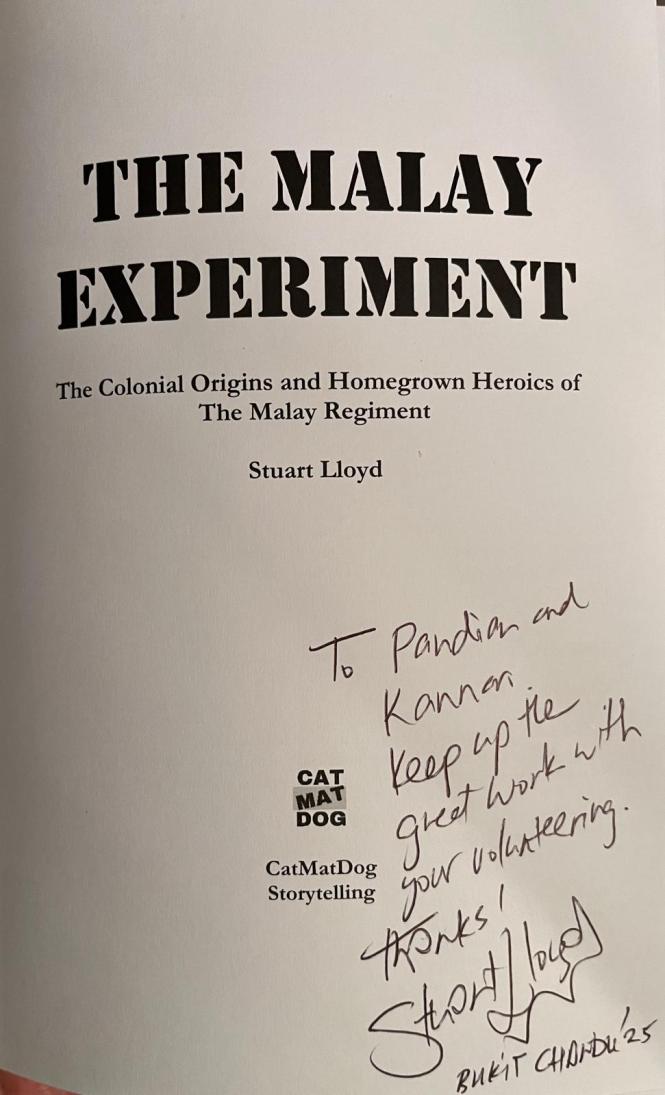
The Malay Experiment | Stuart Lloyd

It was never expected that the full thrust of 18 Division would be thrown against the Malay Regiment directly. 13,000 seasoned Japanese versus 1400 untested Malays.
– Chapter 6: The Battle of Pasir Panjang

Malaysia and Singapore offer a different perspective to foreigners like me. This is the land where WW-II was fought, as we say in Tamil raththamum sathaiyumaaga (ரத்தமும் சதையுமாக) – meaning “with blood and flesh”. My friends have taken me to the Kranji War Cemetery a couple of times. It is always stressful and depressing to realize what happened here in 1940s.

This book by Stuart Lloyd explains the valor bravely expressed by a novice military force – The Malay Regiment – during WW-II. In twelve chapters, this easy-to-read book, (under 100 pages), portrays a chronological note of their beginning, development, training, brutal war and its aftermath, recovery and finally their role in post-independence border clashes and world peacekeeping.

Recently Stuart spoke at Reflections at Bukit Chandu Museum, Singapore (located on the hill where the Battle of Pasir Panjang was fought, just before British Surrendered to Japanese). I bought this book a week ago. His effective storytelling kept us engaged at the museum and eventually pushed me to read the book during my morning commute. He vividly portrays figures like Major Bruce, Brigadier Raja Lope and Lt Adnan Saidi.

This book provides not only the swift action by the Japanese but also their unexpected approaches and failure of Allied forces. It provides convincing facts about the unchallenged airspace advantage enjoyed by the Japanese. Where might British resources might have been spent? Perhaps in Europe and the Middle East? Stuart highlights the superior war equipment, communication and strategy of Japanese. On the other hand, Allied forces lacked these resources – At one point, they even attacked their own forces due to poor communication.

For me, it was important to read Stuart’s documentation about how the Japanese convinced Indian soldiers to switch sides, by assuring them of Indian freedom, mentioning figures like Mohan Singh. (His relationship with Japanese was broken later miserably). While the complex politics of the Indian National Army is not the main scope of this book, the propaganda used to convince Indian forces makes me feel nervous. It feels as though Indian forces were just human resources pulled into different directions by world powers.

The post-war rejuvenation of Malay Regiment is documented in crisp language, covering conflicts all the way upto Malaysia-Indonesia and Malaysia – Phillipines clashes. The way Stuart stacks his historical storytelling – connecting the events on a timeline and providing background about officers – makes the book important. I wonder the amount of effort he put in to collect all these.

When I finish introducing this book, I find myself thinking about those soldiers who died at the Battle of Pasir Panjang or were executed later. None of them accepted the change to remove their uniforms to survive. For example, Lt Adnan Saidi left behind his wife and kids. His wife too died in late 1940s years due to illness, leaving the kids without father or mother. His brother too sacrificed his life to save the British throne.

The war devastated the family of every Malay solider. They might have faced hardship surviving the Japanese occupation due to their identity, and later faced financial crisis during the British reoccupation. The posthumous award were given, and identities established. Stuart doesn’t ask this explicitly, but the events make the reader think: does a symbolic honor compensate for their personal losses and material hardships. That is the life of a soldier!

Click here to borrow this book at NLB

Remembering Professor John Miksic: Singapore’s Pioneering Archaeologist & Historian (1946–2025)

Despite living in Singapore for more than a decade, I only came to know about Prof John Miksic last year. During my docent training, I discovered his work through materials, books, and online articles that became invaluable references for my heritage tours.

Prof Miksic was an important personality in Singapore’s archaeological and historical landscape. In the context of Singapore’s Indian heritage, his excavations illuminated the deep connections between this piece of land and India, as well as broader South Asian civilizations.

Under his leadership in 1984, Singapore conducted its first formal archaeological excavation at Bukit Larangan (Fort Canning Hill). The findings unearthed artifacts that pushed Singapore’s documented history back by several centuries, revealing a thriving 14th-century port city. His publication Singapore and the Silk Road of the Sea, 1300-1800 and his articles remain an essential reference for historians today.

Pic: Straits Times

I was discussing the carnelian beads and broken bangles from his excavations during my heritage tour today. After the tour ended, my fellow volunteer messaged me the news of his passing. Not only today, but for generations to come, Singapore will continue to benefit from his ground-breaking discoveries.

Rest in Peace, Professor Miksic. Your legacy lives on in every artifact displayed, every story told, and every Singaporean who now understands that their history stretches far beyond 1819.

Devapaladeva’s copper plate, Nalanda

While preparing for museum tours, I learned that kings from both India and Southeast Asia made donations to religious institutions of each other. I researched more and came to know about a valuable artifact – The Devapaladeva’s copperplate inscription.

Hiranand Shastri, the Indian historian and epigraphist, mentioned that he found this copper plate during his exploration of Nalanda University in 1921 in Monastery B (Wiki says Monastery 1). Despite the campus was destroyed heavily, this was not affected much. He looks to be happy to find this copper plate intact. With the help of Archaeological chemist, he was able to read the characters.

He is fascinated by this discovery, as it talks about kings of other countries, which made this copper palate of International value.

Devapaladeva inscription | Picture source: Reddit

Devapaladeva, a king of the Pala dynasty, issued this copper plate inscription granting permission to build a monastery at the request of the King of Suvarṇadvīpa, conveyed through a messenger. It also talks about the purpose of the offering in detail.

Suwarnadvipa or Suvarṇadvīpa is the island – south and central Sumatra in particular.

The southeast Asian Srivijayan king is mentioned as King Balaputradeva. His lineage and his relatives were also mentioned.

His mother was Tārā, daughter of King Dharmasetu of the lunar race. She was the consort of mighty king who was the son of YavaBhumi (yava is Java – remember the famous Yavanarani novel from Sandilyan!). The name of the father of Palaputradeva is not given at all but the name of the grandfather is said to have been something like Śrī-vira-vairi-mathana meaning the illustrious destroyer of heroic foes.

He strongly wrote that the Yavabhumi and the Suvarṇadvīpa are evidently identical with the Yavadvīpa and the Suvarṇadvīpa islands spoken of in Sanskrit works like the Ramayana or the Kathāsaritsāgara and are unquestionably the modern Java and Sumatra.

The Kathāsaritsāgara is a famous 11th-century collection of Indian legends and folk tales as retold in Sanskrit by the Shaivite Somadeva from Kashmir.

Hirananda Shastri, referencing various sources, concludes that Yavadvipa refers to Java proper, while Suvarṇadvīpa corresponds to Sumatra.

With other artifacts, he mentions that Srivijaya ruled Java and Sumatra from 7 to 10th century.

The historical evidence suggests that cultural and economic connections between India and Southeast Asian countries were more extensive in the past than in recent centuries. The decline of these relationships after the 14th century CE marks a notable shift in regional dynamics. This change in international relations and India’s global influence over time presents an interesting area for further historical research and analysis.

This post is part of Blogchatter’s WRITE A PAGE A DAY 2025 campaign.

Javanese golden armlet, Singapore

Recently I joined an nparks tour of Fort Canning Hill. During my Singapore Heritage training last year, I learned about the jewelry excavated from this site, formerly known as Bukit Larangan.

In the British colonial period, construction of a reservoir began in 1927 and finished in 1929 atop the hill, an area now closed to the public. In 1928, workers made a significant archaeological discovery: a treasure of 11 gold objects, including an exquisite Javanese-style gold armlet.

Picture source: wikipedia

This 14th-century armlet features the face of a kala (kirti-mukha or yali), a demon face from Hindu mythology. This motif, common feature on Javanese temples, was believed to offer protection. Please see my post on this motive to know more. The armlet’s intricate design includes skillfully crafted chains and clasps allowing for easy wear and removal.

The discovery suggests that Singapore (then Temasek) might be connected with 14th century Java, possibly belonging to royalty from the Kingdom of Singapura. While talking about Temasek and Javanese, I need to mention about Gaja Mada’s vow for a nusantara which annex Temasek, to show how connected these islands were.

Descriptive picture to show armlets | Generated by Gemini AI

This armlet is displayed at National Museum of Singapore. I blame myself for not visiting it yet!

This is a compelling evidence of medieval cultural exchanges between India and southeast Asia, show casing extensive trade networks that facilitated religious and artistic influences across the region.

For further reading:

This post is part of Blogchatter’s WRITE A PAGE A DAY 2025 campaign.