Recap: This series begins by drawing a parallel between modern conflicts and the historical context of Singapore, highlighting how military bases can become targets and inviting conflict. It then details how the British developed Singapore into a heavily fortified naval base – dubbed the “Gibraltar of the East” – believing its geography and defenses would protect it from attack, primarily from the sea, despite vulnerabilities on its northern jungle border..
3/26: Colonial Defense
Security was believed to be strong. As the Malayan jungle was located to the north of Singapore, it was believed that it would serve as a natural defense, much like the rock of Gibraltar. So, the defense was weakest in the north.
The defense of Singapore included British, Australian, Indian, Malay Regiment, and the Singapore Volunteer Corps.
On a side note – when Stamford Raffles landed in Singapore in 1819, a group of Bengal regiment soldiers also arrived. They safeguarded colonial offices and residences and were among the earliest Indian migrants to Singapore. Later, Punjabi-s joined them as military personnel, police officers, and private security guards.
Plaque on the plinth of the statue of Sir Stamford Raffles at Raffles’ Landing Site by the Singapore River. Picture: www.historic-uk.com
This 26-post series for the 2026 A2Z challenge explores Singapore’s WWII heritage, from the initial invasion to the liberation of Changi Prison. Using concise storytelling, I try to connect historical lessons of sacrifice and the need for peace all around the world.
Recap: The military bases often act as targets that invite conflict rather than solely providing security. The British fortified Singapore against seaward threats after 1819, relying on dense Malayan jungles to protect the island from a land-based attack.
2/26: British Fortress
Singapore was marketed as the “Gibraltar of the East“—an invincible fortress with a strong naval base. I heard they wanted to build a naval base in Singapore in the 1920s, and they created an impression – among the public and bureaucrats – to secure enough funding for it. The real Gibraltar is a rocky terrain, whereas Singapore is a coastline with jungles, wetlands, and swamps.
Heavy 15-inch coastal guns were installed at Changi (east) and Buona Vista, facing south towards the sea. They were originally called “monster guns” when tested in England in 1934, before being shipped to Singapore. The media amplified this, reinforcing the narrative of a strong naval base.
The British relied on the “Main Fleet to Singapore” plan, which assumed a naval attack. Because Singapore is an island, the thinking was that any attack would come from the sea. Despite building the Sembawang naval base, they didn’t maintain a permanent naval force there.
On the side note, considerable amount of people worked at Sembawang Naval Base were Indians. Sembawang is called as Kochu Keralam (or Little Kerala) because of the large community of Malayali workers lived there. From the 1940s to the 1960s – it housed more than 4,000 Malayali families.
The assumption was that if a country like Japan attacked Singapore, the main fleets stationed in London or Europe would sail to Singapore to neutralize the threat.
But as we say, we plan, and He plans something else.
An aerial view of the Singapore Naval Base in June 1953 from RAAFAvro Lincoln bombers. Picture : Wikipedia/awm.gov.au
This 26-post series for the 2026 A2Z challenge explores Singapore’s WWII heritage, from the initial invasion to the liberation of Changi Prison. Using concise storytelling, I try to connect historical lessons of sacrifice and the need for peace all around the world.
This 26-post series for the 2026 A2Z challenge explores Singapore’s WWII heritage, from the initial invasion to the liberation of Changi Prison. Using concise storytelling, I try to connect historical lessons of sacrifice and the need for peace all around the world.
I am starting this year’s A2Z series at a time when unprecedented things are happening in the world. America and Israel jointly attacked Iran, despite Iran publicly announcing their intent to retaliate against US military bases in the Middle East. Not only did they announce it, they acted upon their words.
Military bases – how dangerous are they? Middle Eastern states, even those not participating in the conflict openly, have been hit by missiles and drones, and their economies have stalled.
Wait, wait. If this A2Z series is about the Battle of Singapore, why are we talking about America’s war on Iran? Because military bases invite wars!
With that context in mind, let’s go back to 1819, when Thomas Stamford Raffles took control of Singapore after purchasing it from local rulers. He believed Malaya would be the better location to establish British settlements and influence trade. Following this event, the British implemented their typical city planning, laws, government, and military forces in Singapore. This included naval and air bases as well.
Thomas Stamford Raffles by George Francis Joseph, oil on canvas, 1817 : Picture Credit: Wikipedia
Malaya and Singapore were covered in deep jungles. So the British thought it would be difficult for enemies to attack from land, and if there was a threat, it would likely come from the sea. Hence, most of their cannons were positioned to face the ocean, for safeguarding purposes.
The military bases themselves could also be targets. Therefore, they secured those locations too.
How effective were these defenses? We shall see later in this series.
World is facing a difficult time. Decision made by world leaders often based on their own interests, affect ordinary people like us. I recently saw a news report that more than 3,00,000 people returned to India from the Middle East. What has happened to their jobs? Do they have children who are in school or college?
We aren’t even sure if we’ll receive our gas cylinders on time. Hotels are closing, leading to job losses gifting economic problems for countries around the world. Despite knowing the devastating effects of war, why does it happening again and again?
The ongoing war has made me think about World War 2 from Singapore’s perspective. We lost many humans – Chinese/Malays/Indians/British/Austalians/Japanese. I will be narrating the story, starting with the first place attacked, Kota Bahru in Malaysia, and ending at Changi Prison, where the prisoners of war were held.
I will split this into 26 posts in 6 sections.
Part 1: Pre-War & Context
A — Ancient Roots
B — British Fortress
C — Colonial Defense
D — December 1941
Part 2: Invasion & Battle
E — Entry into Malaya
F — Fall of Sarimbun
G — Gap in Defense
Part 3: The Battle for Pasir Panjang
H — Heroism of Malay Regiment
I — Infantry
J — Junction of Pasir Panjang
K — Killings at Alexandra
L — Lieutenant Adnan Saidi
M — Massacre at the Ridge
Part 4: Surrender
N — Negotiation at Ford Factory
O — Occupation Begins
Part 5: Changi & POW Life
P — Prisoners of War (POW)
Q — Quarters of Changi
R — Religious Solace (Changi Chapel)
S — Stanley Warren’s Murals
T — Treatment of POWs
U — Underground Resistance
Part 6: Liberation & Legacy
V — Victory & Liberation
W — War Memorials
X — Xperience of Civilians
Y — Yearning for Peace
Z — Zeal for Heritage
To be honest, I’m feeling a little stretched for time. I missed Blogchatter campaigns and almost missed this one too! But the community reminded me (which is why I like this community) and I thought I would give a try. I won’t be able to write as much this year, but I’ll focus on story telling with simple language and fewer words.
I wish all my fellow bloggers for a successful season!
I will be using AI to help with grammar and awkward sentences, but I will try to keep my tone as much as possible.
The posts will be released six days a week between April 1st and April 30th. I seek your support throughout April to make this release successful and memorable.
It was never expected that the full thrust of 18 Division would be thrown against the Malay Regiment directly. 13,000 seasoned Japanese versus 1400 untested Malays. – Chapter 6: The Battle of Pasir Panjang
Malaysia and Singapore offer a different perspective to foreigners like me. This is the land where WW-II was fought, as we say in Tamil raththamum sathaiyumaaga (ரத்தமும் சதையுமாக) – meaning “with blood and flesh”. My friends have taken me to the Kranji War Cemetery a couple of times. It is always stressful and depressing to realize what happened here in 1940s.
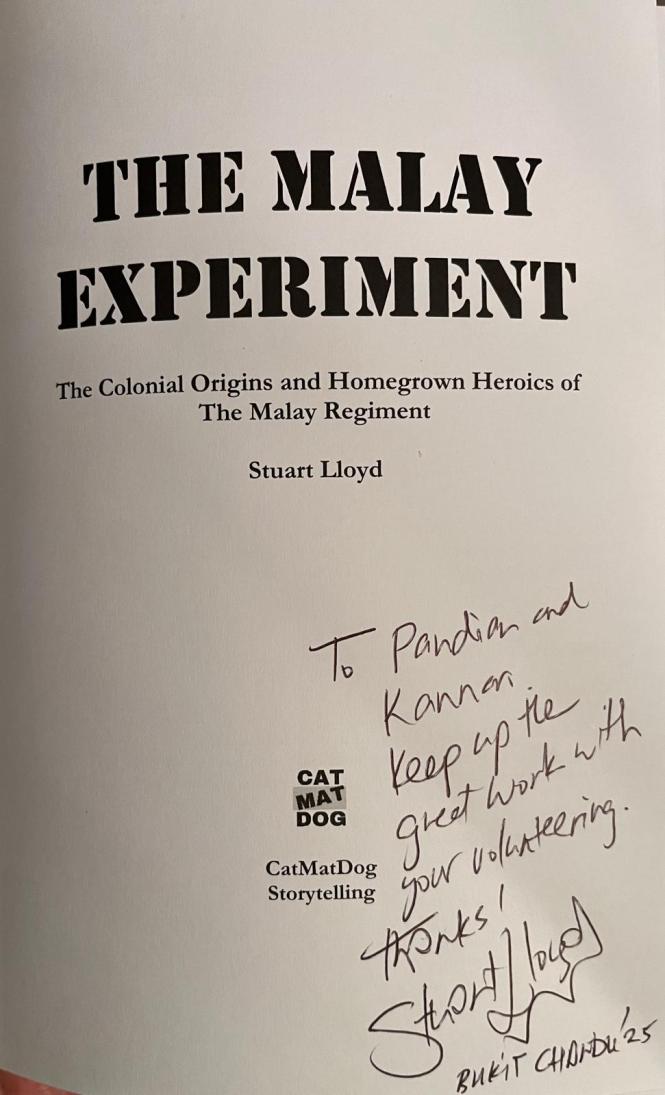
This book by Stuart Lloyd explains the valor bravely expressed by a novice military force – The Malay Regiment – during WW-II. In twelve chapters, this easy-to-read book, (under 100 pages), portrays a chronological note of their beginning, development, training, brutal war and its aftermath, recovery and finally their role in post-independence border clashes and world peacekeeping.
Recently Stuart spoke at Reflections at Bukit Chandu Museum, Singapore (located on the hill where the Battle of Pasir Panjang was fought, just before British Surrendered to Japanese). I bought this book a week ago. His effective storytelling kept us engaged at the museum and eventually pushed me to read the book during my morning commute. He vividly portrays figures like Major Bruce, Brigadier Raja Lope and Lt Adnan Saidi.
This book provides not only the swift action by the Japanese but also their unexpected approaches and failure of Allied forces. It provides convincing facts about the unchallenged airspace advantage enjoyed by the Japanese. Where might British resources might have been spent? Perhaps in Europe and the Middle East? Stuart highlights the superior war equipment, communication and strategy of Japanese. On the other hand, Allied forces lacked these resources – At one point, they even attacked their own forces due to poor communication.
For me, it was important to read Stuart’s documentation about how the Japanese convinced Indian soldiers to switch sides, by assuring them of Indian freedom, mentioning figures like Mohan Singh. (His relationship with Japanese was broken later miserably). While the complex politics of the Indian National Army is not the main scope of this book, the propaganda used to convince Indian forces makes me feel nervous. It feels as though Indian forces were just human resources pulled into different directions by world powers.
The post-war rejuvenation of Malay Regiment is documented in crisp language, covering conflicts all the way upto Malaysia-Indonesia and Malaysia – Phillipines clashes. The way Stuart stacks his historical storytelling – connecting the events on a timeline and providing background about officers – makes the book important. I wonder the amount of effort he put in to collect all these.
When I finish introducing this book, I find myself thinking about those soldiers who died at the Battle of Pasir Panjang or were executed later. None of them accepted the change to remove their uniforms to survive. For example, Lt Adnan Saidi left behind his wife and kids. His wife too died in late 1940s years due to illness, leaving the kids without father or mother. His brother too sacrificed his life to save the British throne.
The war devastated the family of every Malay solider. They might have faced hardship surviving the Japanese occupation due to their identity, and later faced financial crisis during the British reoccupation. The posthumous award were given, and identities established. Stuart doesn’t ask this explicitly, but the events make the reader think: does a symbolic honor compensate for their personal losses and material hardships. That is the life of a soldier!
Recently I joined an nparks tour of Fort Canning Hill. During my Singapore Heritage training last year, I learned about the jewelry excavated from this site, formerly known as Bukit Larangan.
In the British colonial period, construction of a reservoir began in 1927 and finished in 1929 atop the hill, an area now closed to the public. In 1928, workers made a significant archaeological discovery: a treasure of 11 gold objects, including an exquisite Javanese-style gold armlet.
Picture source: wikipedia
This 14th-century armlet features the face of a kala (kirti-mukha or yali), a demon face from Hindu mythology. This motif, common feature on Javanese temples, was believed to offer protection. Please see my post on this motive to know more. The armlet’s intricate design includes skillfully crafted chains and clasps allowing for easy wear and removal.
The discovery suggests that Singapore (then Temasek) might be connected with 14th century Java, possibly belonging to royalty from the Kingdom of Singapura. While talking about Temasek and Javanese, I need to mention about Gaja Mada’s vow for a nusantara which annex Temasek, to show how connected these islands were.
Descriptive picture to show armlets | Generated by Gemini AI
This armlet is displayed at National Museum of Singapore. I blame myself for not visiting it yet!
This is a compelling evidence of medieval cultural exchanges between India and southeast Asia, show casing extensive trade networks that facilitated religious and artistic influences across the region.
I have written about my day out to Elephanta earlier. I finished the panels of the main cave one by one. Finally I was standing before the striking colossal bas-relief of Trimurti Siva or Mahesa Murti Siva or Sadasiva.
Sadasiva or Trimurti Siva | Pandian Ramaiah, 1 Dec 2007
Sadasiva is considered as the highest form of Siva. People believe the concept originated from South Indian Shaiva Siddhanta. Sadasiva has five faces, that represents five holy tasks (panchakritya). Three faces are visible in Elephanta. The fourth and fifth is believed to be at the back.
Standing or sitting in front of this artifact is a different experience. You need to experience it.
The Portuguese, when they came to India, found a massive elephant structure here in the 18th century. As per Sachin KR Tiwari’s presentation, it looks to be they damaged and vandalized this cave and removed valuable inscriptions. I am thinking about similar complaints about a Dutch official who cut the head of the sculptures in Java. What we have now is what they left behind. What India is now is also a result of what they left behind.
Coming back, The hair of siva is elegantly carved with extensive details in jata-makuta (hair crown). The face of the Tatpurusha (the centre face) shows extreme peace.
The linga form, especially the mukha linga form represents Sadashiva. Now I understand why Indian heritage center in Singapore has kept the Mukha Linga infront of Sadasiva sculpture.
Sadasiva and Mukha Linga, Indian Heritage Center, Singapore|Photo (c)thesmartlocal.com
The Sadasiva you see in above is from Tamil Nadu. Yet, the one you see below is from Cambodia.
Bronze of Shiva as Sadashiva or Mahesha, late 12th – early 13th century, Cambodia. Collections of Asian Civilisations Museum. Image (c) roots.gov.sg
The face looks more south-east Asian one. Yet they absorbed the same concept and created this bronze with local art form. It shows the influence of Hinduism, particularly, Shaivism in the Khmer Empire during 11th or 12th centuries.
The world was highly connected, but the later decline of Indian influence in Southeast and East Asia is surprising.
Chettiyar-s are well-known businesspeople from South India. These traders originated from Tamil Nadu and traveled across the Bay of Bengal to expand their trading network in places like Malaysia, Singapore, and Myanmar.
Back then, there were no modern luxuries like four-hour flights. Instead, most Tamil people made the journey by sea, which took about 12 to 13 days from the cities of Chennai or Nagapattinam. It was a long and difficult journey, but they were determined to spread their business and make a living.
Nowadays, people travel to Chennai/Trichy on Friday night and return to work on Monday. A few centuries ago, they may have traveled only once every several years.
These traders are from the Tamil speaking community, following Shaiva Siddantha in Hinduism. They – who came here on business purposes – married local girls – Malay first, followed by Chinese, Indonesians and others – to became a family men.
It is not about a connection between man and woman. It is a mixture of two families from different cultures and ethnic races. These marriages between Indian traders and local women formed the community ‘Chetty Melaka’ or ‘Chitty Melaka’.
These men and women believed they were getting married, but through their marriages, they brought together different cultures and ethnic races. In their linguistic showcase, there is a beautiful rainbow of Tamil, Malay, Chinese, and other languages.
If you visit Singapore, do not forget Indian Heritage Centre to know about those interesting periods.
MacRitchie reservoir has plenty of nature trails of different distances and different difficulties. I had been there a couple of times to take the smaller trails. I had the courage to run my Decathlon Run 2021 there. One fine day Kannan and I went to the full stretch of 11Kms.
This attraction has a haunting tale of love behind the screens. A lady whose last name was renamed as Fann and a guy, whose last name was renamed as Lok, fell in love. Macritchie viewpoint was their meeting point. At that time the reservoir was not built. Fann’s father was a ProBritish business man. Lok was the leader of a local Communist clan. Obviously there comes a conflict.
Fann’s father arranged her marriage with another person, whose last name was renamed to Tai. Fann did not like it. But Tai loved her (One-side). At one point in time, Fann was identified as a dead body, near to the place, where she used to meet Lok.
Despite his refusal, Tai built a tomb for her. Everybody might be praising him for building a tomb, on the MacRitchie hill itself to value his one-sided love. Actually, there was a twist. After a few weeks of Fann’s death, Lok was killed in a riot. His tomb was built at the other side of the hill, on which Fann’s tomb was also built.
Later Fann’s family and Tai’s family were found to be guilty of murdering both. Seems to be Tai murdered Fann. Later, a plot was conspired to kill Lok in the riot, with the support of his Communist leader and built the tombs on opposite sides of the same hill, so that they would not join.
Fann’s soul realized about the deception. It is believed that she used to come out on the water surface during the night to roam around!
Don’t worry. She didn’t harm the trekkers. May be, the trekkers help her not to feel her loneliness. 🚶🚶♀️🚶🚶♀️🚶🚶♀️🚶🚶♀️ We had the cross-country, nature walk, and tree-top walk all on the same day! To feel and enjoy the ekantham (loneliness/tranquility), you should start your hiking early in the morning. Put on your walking shoes, take your walking sticks, and carry enough water. Be careful about the food items, as it may attract Hanumans 🙂
The tree-top walk may require some waiting time. If you go with kids, plan accordingly. Water stations are rare. There is one near the tree top walk. But it is almost the peak of the hill. You may not be able to relinquish your hike just because you are thirsty. You will be stuck.