Lingodbhava of Thirumayam

Have you been to Thirumayam? If you are a orthodox Vaishnavite, it is a revered divyadesam – one of the 108 holy shrines celebrateed by Alwars in their hymns. The Vishnu shrine here predates the famous Srirangam temple. The Ananta Sayani – Vishnu reclining on his serpent bed with Lakshmi beside him – is larger than that of the one at Srirangam.

Shaivaites also find significance in Thirumayam, home to a magnificent Siva temple. The consort of Lord Shiva here is beutifully named as Venuvaneswari. That means ‘Eswari of Venu Vanam‘ (bamboo forest). The temple is attached with an octagonal shaped uruni – the holy pond.

Satyagirisvara temple (Shiva temple), Pandian Ramaiah, 28 Feb 2010. There are two famous rock-cut shrines, one of Siva [shown here] and the other of Vishnu, adjacent to each other.

Historians will find Thirumayam brimming with centuries of historical facts. The cave temples are believed to date back to 7th century AD. From a chronology perspective, I need to highlight that work at Ellora caves might have started around this time. It features one of the Tamil Nadu’s largest inscriptions. The site witness the stories of colonial aggression too.

Thirumayam Fort, Pandian Ramaiah, 28 Feb 2010. Before reaching the town, one can see a fort atop a large hill. In past centuries, the fort was much larger than what now obtains; this is affirmed by the fact that the main entrance to the old fort lies about one kilometer south of the present-day fort. This extrance to the old fort still stands, it has a courtyard with pillared corridors and shrines of various deities. The sculptures on the pillars are truly beautiful. The Thirumayam fort, set in 40 acres, is of great historical importance. It was built by Sethupathi Vijaya Ragunatha Thevar, ruler of Ramanathapuram in AD 1687.

But I write this post to mention about one of the icons, that left a profound impression on me – Lingodbhava.

How ever this post focuses on a particular icon that deeply captivated me – the bas-relief of Lingodbhava.

Lingodbhava | (c) Arvind Venkataraman

It shows the supremacy of Lord Shiva. It begins with a dispute between Brahma and Vishnu over who is superior. To resolve this, Shiva manifested as a colossal pillar of fire, challenging them to find its beginning or end. Brahma transformed into a swan and flew upwards. Vishnu became a boar and dug downwards.

After a long search, Vishnu accepted defeat, recognizing Shiva’s greatness. In contrast, Brahma falsely claimed he found the top with the help of a tāḻampū – screw pine flower (or Ketaki flower in some version). Angered by this deceit, Shiva cursed Brahma to be un-worshipped, thazhampoo and Ketaki flower are banned from using it to adorn gods and declared that the Lingodbhava would symbolize his eternal presence.

Tamil revolutionary poet Bharati’s poem captures this.

Tamil: அடியும் முடியும் அறிய முடியான்
Diacritics: aḍiyum muḍiyum aṟiya muḍiyāṉ
Hindi: अडियुम् मुडियुम् अऱिय मुदियान्.
Meaning: The one whose start and end could not be found.

Usually Lingodbhava statue is found at the rear of Shiva sanctums. The one in Thirumayam, carved inside the 7th century cave temple, is truly inspiring. Rising from the floor to the ceiling, it is a colossal representation of the story. By the time I saw for the first time, it was breathtaking, unable to avert my eyes.

The entire cave temple was likely adorned with vibrant murals in the past. I can only wonder the splendor of the cave with its decorated walls and ceiling. Sadly, most of these murals are lost. mirroring the fate of similar paintings in Sittannavasal and Kanchipuram.

This Lingodbhava in Thirumayam is one of the earliest such artifacts in India.

Since that encounter, whenever I see Lingodbhava, it inevitably evokes the memory of the one in Thirumayam.

The realization of truth in life mirrors this philosophy. The more we dig, more we learn.

See you in another post. Thank you.

(c) Lingodbhava in featured image: Puratattva

Pandian Ramaiah, 28 Feb 2010. There is no connection between this picture and this post. It is the memory of the road and bus existed a decade ago, before taken over by National Highways.

This post is part of Blogchatter’s WRITE A PAGE A DAY 2025 campaign.

Kalari Murti of Kodumbalur

Kodumbalur (கொடும்பாளுர் / Koṭumpāḷūr / कोडुम्पाळूर्) is a hamlet near my birthplace. When something is so near and freely available, you won’t realize its value. This is a general global phenomenon. I am no exception.

It is historically important as it was the headquarters of the Irukkuvels, one of the chieftains of the Chola kingdom. In the popular novel Ponniyin Selvan, Vanathi, Princess of Kodumbalur, was a close associate of the powerful Chola princess Kundavai. She was in love with Arunmozhi Varman, also known as RajaRaja Chola.

According to the epic Cilappatikaram, the protagonists Kovalan and Kannaki crossed this place on their way from Uraiyur (modern-day Tiruchirapalli) – one of the Chola capitals – to Madurai, the Pandya capital. This epic names this place கொடும்பை நெடுங்குளக் கோட்டகம் (Koṭumpai Neṭuṅkuḷak Kōṭṭakam / कोडुम्पै नेडुंगुळक् कोट्टकम्).

Such a busy town is now just a village now. This place has three important archaeological sites:

  • The Muvar Kovil (Temple of Three),
  • The Aivar Kovil (Temple of Five),
  • The Mucukuntesvara Temple.

The Muvar Kovil temple enchants every viewer. It is older than the Thanjavur Brihadisvara Temple (or Big Temple).

Kodumbalur vimanam | 📸 M V Kiran

But the focus of this post is one of the icons we can see at Kodumbalur: the Kalari Murti idol of Shiva.

Kalari Murti, Kodumbalur | 📸 M V Kiran

The story goes like this: Shiva’s devotee Markandeya was supposed to die at the age of 16. Impressed by his deep devotion, Shiva wanted to help him by challenging Yama, the god of death. Shiva performed a ‘playful dance’ (களிநடனம்) on top of Yama, pushing him away and saving his devotee.

Markandeya episode, Raja Ravi Varma.

This sculpture at Kodumbalur is considered one of the finest examples of early Chola art and iconography. The representation of Shiva as Kalari Murti is in the first tier of the eastern niche of one of the remaining temples.

Kalari Murti is the first niche of the left photograph | 📸 (c) travel.bushavali.com
Kalari Murti, Kodumbalur, (c) https://puratattva.in/kodumbalur-glory-of-the-irukkuvels/

Look at the above picture. Shiva is shown in a dynamic, dancing posture, indicating a destructive attitude. However, killing Yama would stop deaths in the universe, destabilizing the equilibrium. Therefore, Shiva is careful not to push Yama to death. He is dancing on his back playfully. Note the smile on Shiva’s face and the horror on Yama’s face. This symbolizes Shiva’s victory over death.

The soft molding of his abdomen, thighs, and legs makes this sculpture unique. The compassion shown on Shiva’s face brings a smile to our faces too!

If you happen to travel to Tiruchi or Madurai, do not forget to visit this beautiful early chola temple. The same form of Shiva is common to see in other places too.

Kalantaka Shiva, Kailasanatha Temple, Kanchipuram. I found this photo on facebook.
Kalantaka Shiva, Gangai Konda Cholapuram, (c) the sculptor, photo (c) Rahul Naidu

For more reading-

This post is part of Blogchatter’s WRITE A PAGE A DAY 2025 campaign.

Prajnaparamita of Java

I wrote about an elegant Nataraja bronze from South India in my previous post. Let’s talk about another artifact from Eastern Java today.

The discovery

By 1818, during the era of European colonization that gripped Southeast Asia, Java was under Dutch colonial rule. There was growing interest in Europe in the archaeological and cultural heritage of their colonies. Officers like Stamford Raffles and Willem Stutterheim made journeys through Java and documented their findings.

Much before Stamford Raffles (why I mention him is because he is a venerated British colonial administrator of the Straits Settlements!), D. Monnereau, a Dutch East Indies official, was likely on an official trip or exploratory mission in the Malang area of Eastern Java.

Within the ruins of Cungkup Putri near the Singhasari temple, he identified (or perhaps looted?) the treasure called Prajnaparamita statue.

Buddhist Goddess and her Javanese connection

Prajnaparamita is considered the Goddess of the Perfection of Wisdom in Mahayana Buddhism. She is worshipped as the mother of all Buddhas. Some say this sculpture is a depiction of the first queen of Singhasari—Ken Dedes (also called Dyah Ayu Sri Maharatu Mahadewi or Nareswari). Ken Dedes herself has a captivating story behind her, but that is not the focus of this post. I will write about it another day.

Based on my readings, this is the Buddhist Goddess Prajnaparamita, but it might have been sculpted with resemblances to Ken Dedes. A few suggest this sculpture might have been erected where Ken Dedes was buried. Others write that it may depict Queen Gayatri, wife of the first king of Majapahit. However, this idea is not widely said due to the place it was found.

(c) the sculptor and wikipedia

Javanese art

This Buddhist mother Goddess was sitting in padmasana, on a padma peetam on top of a minimally decorated square platform. Her face is striking us, with a serene expression with downcast gaze. Her hair is arranged into an decorated crown (jata-makuta).

She is adorned with rich jewelry with beautifully carved necklaces, ear rings that matches with her face. A string of pearl wraps gracefully around her body. A lotus creeper with flower is intertwined in her left arm, holding Prajnaparamita sutra.

We need to talk about the fine-carved details of her Batik Sarong which was skillfully rendered. It provides a look of a sensuous drape of real cloth, depicting the goddess as a queen.

This 126 cm tall statue was made from pale rose volcanic andesite stone and is believed to date back to the 13th century. It is one of the finest sculptures representing Hindu-Buddhist Javanese art forms.

Why don’t you meet her in Google Arts and Culture.

Dutch took it

Later, this treasure was shipped to the Netherlands and displayed at the Rijksmuseum voor Volkenkunde in Leiden.

The Netherlands, which exerted enormous effort to maintain its colonial rule in Indonesia, later faced protests from Indonesia and international pressure. In 1978, they returned this sculpture to Indonesia as a “gift.” 🙂 This act improved relations between Indonesia and the Netherlands.

Of course, this Javanese mother taught her Javanese children to forgive their colonial rulers.

Reading recommendation –

This post is part of Blogchatter’s WRITE A PAGE A DAY 2025 campaign.

Nataraja of Thiruvarangulam (Delhi Museum)

Bronze sculpting is one of the unique skillsets of ancient India. The Dancing Girl bronze from the Harappan civilization is believed to be at least 3,500–4,000 years old.

Over time, this art form reached its peak during the Chola period. Chola bronzes are so exquisite that they have attracted smuggling networks. You may read Idol Thief by Vijay Kumar for more on this topic, but it is not the focus of this post.

One afternoon, my first boss called my colleague and me for a discussion. Thiruvarangulam, a place on the outskirts of Pudukkottai Town in Tamil Nadu, was also part of the discussion. This place is home to a beautiful Shiva temple dedicated to Sri Haratirthesvara. In Tamil, it is called Thiru Aran Kula Nathar.

The main shrine dates back to the 12th century. Around that time, the Chola dynasty had already conquered parts of northern Sumatra, the Khmer Empire was prominent in Angkor, the Srivijaya Empire was ruling the Malay Peninsula (though its dominance was declining), and the Majapahit Kingdom had not yet been established.

My boss mentioned that the temple once housed a stunning bronze statue of Nataraja, the dancing Shiva. This statue is now prominently displayed in the Delhi Museum. He marveled at it, saying it is one of the best Nataraja bronzes ever sculpted—perhaps the second best.

(c) Wikipedia

Nataraja performs his cosmic dance on the dwarf Muyalaka, who is positioned on a padma peetam (lotus pedestal). Nataraja has four hands, two on each side. In his upper right hand, he holds a damaru (udukkai); his lower right hand displays the abhaya mudra (gesture of fearlessness); his upper left hand holds fire; and his lower left hand is in a dancing pose. His legs are elegantly positioned in a dancing stance. The entire balance of the Nataraja bronze rests on his hands and the dancing Muyalaka.

I have yet to visit the museum and see this masterpiece in person. One day, I will go.

Reading recommendation –

This post is part of Blogchatter’s WRITE A PAGE A DAY 2025 campaign.

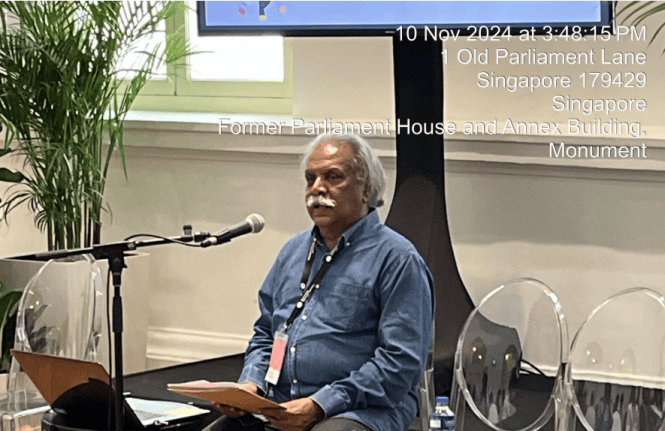
Wildlife conservationist S. Theodore Baskaran at Singapore Writers Festival 2024

November is the month of the Writers Festival in Singapore, and this year’s theme is “In Our Nature.” Wildlife conservationist S. Theodore Baskaran was one of the invited speakers. His keynote address focused on the contribution of environmental literature, also known as green literature, to conservation efforts. The session was scheduled for November 9, 2024, in the Blue Room at the Arts House.

He fondly remembered the 1972 Stockholm Conference and mentioned that concerns about nature have increased worldwide since then. Many books have been written, and many conferences convened, focusing on nature, the environment, and the relationship between nature and humanity.

He started with Rachel Carson’s Silent Spring. He stated that the work changed the direction of history. Rachel was a biologist and an excellent writer. When she returned to her village, she found that there were no birds. It was spring, the reproductive season for birds, so she expected to hear their songs. However, they were missing. She discovered that pesticides were being used to destroy the worms. Since there were no worms, the birds, which feed on worms, stopped visiting. Thus, the spring became silent.

When discussing Tamil literature, he pointed out that those who write about the environment are volunteers, not biologists. He introduced prominent works of green literature of Tamil across different forms. This made his talk meaningful.

He started with M. Krishnan. He quoted his words of stark contrast between Indian and Western attitudes towards the environment and wild animals. He mentioned Po Appasamy. Fiction is unavoidable when discussing this context.

Fiction

While talking about fiction, he introduced Sa. Kanthasamy‘s Saayavanam novel. Saayavanam is one of the earliest examples of literature focusing on ecological concerns in India and addresses forest clearances and industrial development in Thanjavur, Tamil Nadu. This was written well before environmental vocabulary was formally established in Tamil.

He appreciated modern-day Tamil writers who use proper (or natural) words of forests when they write about village-based subjects. He explained that many such words are forgotten, using the example of the lion-tailed macaque. Those who literally translate this as ‘singa-vaal Kurangu‘ into Tamil do not know that a proper Tamil word exists. He points out that the word ‘solai mandhi‘ already exists, which is the correct term for the lion-tailed macaque because these monkeys used to live in the shola jungles. He also points out another term, ‘kaatu mandhi‘ (forest monkeys), for those that lived in the forests after the shola regions.

He mentioned two works of Perumal Murugan: Koolamathari and Poonachi. One of these novels discusses the dhole (செந்நாய் / wild dog), which existed in the Javvadhu Hills and Kalvarayan Hills but is now extinct. He appreciates Perumal Murugan for mentioning jungle cats and the strange behavior of humans who eat them, which is one of the reasons for their extinction.

He introduced writer and Sahitya Akademi award-winning author Cho Dharman‘s Koohai novel. Another award-winning writer, Joe De Cruz‘s Aazhi Sool Ulagu, was mentioned because it discusses life at sea and the lives of fishermen. He appreciates Saayathirai by Suprabharathi Manian for its exploration of the effects of dyeing unit waste from Tiruppur being discharged into rivers.

He recalled Jeyamohan‘s novels, Rubber and Kaadu, as their core themes revolve around life in the forest.

Kadikai Bernard’s Athu Oru Kadal Kaalam received mention due to its extensive coverage of seashore communities from Manappad to Pulicat Lake and their culture.

Articles

Articles written in various media contribute to the wellness of the environment. He mentioned the articles by writer Nakkeeran about rain forests and mangrove forests.

Publications

There are publications that have started to publish green literature in Tamil Nadu. He discussed the capabilities of digital cameras, which offer a variety of technical features for capturing birds in motion. He pointed out Ravindran Natarajan, who takes excellent wildlife pictures and offers them to publications.

Poetries

His quotes from poetry added a sugar-coated touch to his keynote address.

He quoted the poetry of Aasai Thambi‘s Kondalathi.

Mounan Yatrika was the next poet mentioned for his poetry collection Inikkum Pazham.

He introduced poet Satheesh Muthu Gopal for his knowledge about birds and his writing skills that immerse the reader in the world of birds.

Devadevan‘s poem Chittu Kuruvi also found its place in the talk.

Magazines

The role of magazines focusing on ecological conservation should be highlighted. Magazines like Kaadu, Uyir, and Poovulahin Nanbarkal were mentioned.

Modern trends

Modern-day field trips have helped the Tamil community gain better insights into dragonflies and butterflies.

After mentioning an interesting discussion in blogs or email groups about the correct Tamil word for “ape,” his talk ended with a poem by Kalapriya.

After the talk, a panel discussion explored his and audience’s interests further.

On November 10, 2024, I had a chance to attend a panel discussion titled “Literary Skylines: Narratives of Urbanisation” featuring Kelley Cheng, architect and founder of the Press Room in Singapore; Syarifah Nadhirah, a visual artist and creative director from Malaysia; and Theodore Baskaran moderated by Kennie Ting, Author and Museum Director from Singapore at the Asian Civilizations Museum. He showcased cityscapes over the past 4,000 years, starting from the Indus civilization. On the same day, there was a symposium on Nature and Tamil Literature by young writers from Singapore along with Theodore Baskaran.

After the scheduled events were over, it was a beautiful Sunday evening to have a cup of coffee and chat with writers Theodore Baskaran, Satheesh Muthu Gopal, and Sivanandam Neelakandan on the lawn of the Arts House. The discussion extended late into the evening and covered a variety of topics, including the environment, Tamil, and the influence of politics. Thus, the first weekend of the Singapore Writers Festival was densely populated with discussions, laughter, and autographs!

Of course, a big shopping too! Hope to meet my TBRChallenge 2025 🙂

Note: Errors, if any, in links are purely mine. I am open to correct if highlighted.

For further readings:

The Parsis of Singapore | Suna Kanga & Subina Khaneja

The book tells us about the Parsi people, who they are, and how they came to live in India, migration of few of them to Singapore. It shares stories about famous Parsis in Singapore and describes different Parsi families living in Singapore and Malaysia.

The book shows how the adopted to Indian culture but still keep up their own tradition.

One of the panels in Zoroastrian museum highlighted this – “In numbers Parsis are beneath contempt, but in contribution, beyond compare!” – M.K. Gandhi. Similarly, within the small society of Singapore, tiny population of Parsis has interesting stories to tell us. Framroz and Pheonix aerated water factory story is something which most of them would be aware. I need to write about it one day.

This coffee-table book explains Parsi culture, how they are involved in the journey of Singapore, and their delicious food in detail.

My first boss used to say, every village will have a story to tell us. Similarly every family has a story to tell either their family or to the society. But the time and money involved in documenting such tales is enormous. From that perspective, the author’s work is commendable.

Written by Suna Kanga and Sabina Khaneja.


Related links:

Labour of love started by late wife comes to life as book on local Parsi community launched

To Buy: Kinokuniya | from author/publisher

To Rent: NLB | MBPJlibrary

Nimitham / நிமித்தம் by S. Ramakrishnan

Is there anything worse in this world than being rejected and neglected?

Plot

This Tamil novel tells the story of Devaraj, a man who faces challenges because he can’t hear well. Life throws many obstacles his way: sometimes it’s his own insecurities, sometimes it’s bad luck, and sometimes it’s just the way things turn out. A rude teacher at school forces him to quit, and a trip to a sign language school exposes him to the darker side of people. Everywhere he goes, he seems to return home empty-handed or feeling guilty. Back at home, he faces the disappointment of his angry father and frustrated mother. But his friend Ramasubbu stays by his side, encouraging him and helping him find a new path. The story follows Devaraj until he’s 47, leaving the reader wondering if he’ll ever find his place in the world and settle down with a wife.

Compelling Narrative

The interesting thing about this book isn’t just the story, but how it portrays different characters. Each chapter focuses on a different person, or even a few people! “Sumitra” by Kalpatta Narayanan narrates the story in similar approach too. So what makes this style of storytelling so engaging? It’s because we get to see human relationship, behaviour unfold through these characters, some of whom are listed here.

  • Devaraj’s mother
  • Ramasubbu, Devaraj’s childhood friend
  • Devaraj’s father
  • Razak sir, Devaraj’s rude teacher at school
  • Kanthi akka
  • Sreenivasan, the communist leader during emergency period
  • Daniel, The supervisor of the Sign school
  • Naomy, Maid of the Sign school
  • Rajamani, A Gandhian and the proprietor of Gandhi Vilas hotel
  • Man Udaiyar, Devaraj’s Grandfather at Timmalapuram
  • Vairavan Chettiar, Timmalapuram and his 2nd wife BhuvanSri from Penang
  • Sudharsanam sir and teacher
  • Thambaiyah from Vandipettai
  • Veppankulam Reddiar
  • Sangunni Pandaram
  • Perumal Nayakar and Manga
  • Gopal ayyar, owner of Gopalar Canteen at Vandipettai
  • Kesava Reddy, commission broker at Vandipettai
  • Joseph, printer training batch mate at Tuticorin
  • Grace Ammal, oldie at Sangu Thurai, native of above said Joseph.
  • Savari Muthu, the rationalist
  • Joslyn, Devraj’s first lover
  • The Sri Lankan refugees
  • The unnamed lady at Madurai town bus
  • Saveetha, coworker at Khadi shop at Ooty
  • Dr Balaiya, Mrs Balaiya, son Prabu, maid Subbamma
  • Pulenthiran, the passerby during new year
  • Valli Aachi and Meena Aachi from Chettinad
  • Guna, the assistant boy at Kaashi
  • Hemavathy, the spirit at Kaashi
  • Sadhu Siddhalingam
  • Devaraj’s brother and sister-in-law
  • Chakarapani, the scammer at Meenatchi Chit fund
  • Sivasu, the late married man

It feels almost like reading a collection of blog posts, each one revealing a different perspective on the story.

Emotional Depth

Many of us get discouraged when we keep failing. We try our best, but come home empty-handed or feeling ashamed. Ideally, eventually one of those attempts pays off, and things take off. But what if that breakthrough never comes? The constant disappointment can drain your energy and make it hard to keep trying. It’s like being trapped in a cycle of negativity, and it’s tough to break free. Very few stays energized and continue their hunt. Nimitham delves into profound such human emotions.

I liked all the chapters, to name a few, –

  1. There’s a particularly interesting chapter titled “கனவுகளும் வளர்கின்றன / Kaṉavukaḷum vaḷarkiṉṟaṉa” (which literally translates to “Dreams Grow”). It dives into Devaraj’s nightmare. It brings out a gambler who gambles against himself. This reminded me of a similar concept in “Venmurasu” by Jeyamohan, where characters like Draupadi or Yudhisthira gamble against themselves. I’ve even tried it myself, but it never seems to work out! Gambling against yourself requires a unique skillset. But it is a strong metaphor. It fits into the narrative of Devaraj’s life gambling against himself. It’s a very thought-provoking chapter!
  2. There’s another great chapter called “The World of Vandipettai” (வண்டிப்பேட்டை எனும் உலகம் / Vaṇṭippēṭṭai eṉum ulakam), which focuses on the bustling Vandipettai cotton market. It introduces us to a bunch of fascinating characters, like ‘well maintainer’ Thambaiya, ‘Penang’ BhuvanSri, ‘Efficient housewife’ Manga, ‘Gopallar canteen’ Gopal Ayyar, and ‘Commission Broker’ Kesava Reddy. The author makes a great point: every place has its own story, whether it’s the village you grew up in, the temple you visit, or even the tree where you used to play. And when someone tells the story of a place, it leaves a lasting impression on you. This chapter does exactly that – it captures the rise and fall of the Vandipettai market, along with the stories of the people who made it what it was. It’s a truly captivating read.
  3. The novel explores Devaraj’s relationships with women throughout his life. We see this theme play out in Naomi, Joslyn, Vanarani and RangaNayagi – relationships filled with hope, and a brief encounter with an unnamed lady in Madurai. The stark contrast between experiences with Naomi and the Madurai lady leaves a lasting impression on the reader. It’s interesting to see how Devaraj, despite facing limitations in his life, might subconsciously expect certain qualities from his partners. However, it’s important to remember that limitations shouldn’t dictate expectations. Just because someone faces challenges doesn’t mean they can’t have desires, and general human nature plays a role. This point is tragically mirrored by a real-world incident: a worker, enraged by a woman refusing service due to his race, ended up taking her life. This horrifying event reminds us that limitations shouldn’t justify prejudice.

Conclusion

What truly elevates Nimittam is its exploration of human relationships. The way the story unfolds through different characters, allows us to experience a rich tapestry of connection, rejection, and hope. Overall, it’s a deeply satisfying read that leaves a lasting impression.

Democratizing Democracy: Why “Everything is Politics” in India

We stained our finger; our public walls are postered. The excitement is building for India’s upcoming democratic milestone on June 4th!

Indian democracy is a vibrant, messy, and sometimes frustrating thing. We celebrate its triumphs – peaceful transitions of power, a robust free press – but also grapple with its shortcomings – corruption, dynastic politics, and inefficient public services.

This post fits right into the spirit of “Everything is Politics” because democracy isn’t just about voting every few years. It’s about holding our leaders accountable, demanding better from our systems, and constantly striving to improve.

The Power is politics

Democracy empowers the common man. Recall the famous Tamil song by Vaali, written for legendary TN actor-turned-politician MG Ramachandran. The song quotes the words of another TN politician, Annadurai, who declared: ‘In a democracy, we are all kings.’?

It’s this collective power that keeps the system in check. We all knew that. But that collective power is being manipulated or entertained by several factors, such as unsustainable appeasement schemes, media management, diverting the attention, politicizing the criticisms.

The power of the voters is undeniable. In Tamil Nadu, for instance, we witnessed a powerful display of this force in 1996. Voters decisively ousted the then-ruling AIADMK party, led by J. Jayalalithaa, after a period of perceived corruption and authoritarian rule. This decision sent a clear message that no leader is invincible, and the power ultimately lies with the people. However, the story doesn’t end there.

Ironically, in the 2006 elections, voters brought the AIADMK party back to power under Jayalalithaa again. I need to mention that the DMK rule was after Jayalalitha-I disaster was mostly a better one. Even it was appreciated by DMK critics like Cho Ramasamy.

While this might seem contradictory, it highlights the complexity of democracy. Voters may choose to give a leader another chance, hoping for improvement, or perhaps there’s a lack of strong alternatives. Sometimes they just want a change for no reason! This cycle in democratic politics emphasizes the ongoing responsibility of the electorate to be discerning and engaged.

Democratic Dynasties are politics

While strolling through Tissamaharama, a town in southern Sri Lanka, I noticed a curious sight. Daily calendars in shops, large and small, featured the face of a prominent Sri Lankan politician. This wasn’t just any politician; he belonged to a powerful ‘democratic dynasty’ that had dominated the region for years. My visit predated the country’s recent economic collapse.

Back then, the world watched with growing concern as this leader’s influence seemed to tighten. Locals, however, expressed a sense of pride, boasting about his “majority” status in the area. It left me questioning their definition of pride. Ironically, it was the very people who later took matters into their own hands, ousting this same family from power.

The fate of the shop owners with their political calendars remains unknown. Sri Lanka is gearing up for presidential elections, and it wouldn’t surprise me if this very dynasty attempted a comeback.

These ‘democratic dynasties’ understand the power of those commoners. So, they politicize them by offering appeasement schemes, media management (we call that as free media in India!) at the cost of growth of the society.

These exemplify the unpredictable potent, yet manipulated, power of the common people.

Dynastic politics, where power runs in families, weakens this power dynamic. It can create a sense of entitlement among leaders and stifle competition. But here’s the political angle: Indian ‘democratic dynasties’ often use sophisticated and biased internal elections to maintain control and label themselves as democrats. It’s up to us, the voters, to demand more transparency and hold them accountable.

Democratic Disappointment is politics

Can we, as Indians, have an honest conversation about how well our democracy holds leaders accountable? Should our love for India (nationalism) or our political beliefs (democrat) stop us from having this discussion?

China in a curious way despite not having a democracy in the political sense has a very high sense of accountability on the part of his leaders that isn’t so for all authoritarian regimes, but it is so for China, and they have created a culture of accountability….

One of the Southeast Asian Leader, said in an interview in 45th St. Gallen Symposium.

Does our democracy make sure leaders are answerable for their actions? Can we achieve this in the future?

Shouldn’t a democracy provide basic things like a steady electricity supply all the time? I get free electricity of 100 units in TN, but it keeps going off! My friend says some people need the free power more, but I need reliable power too! Is this democracy okay if it cuts off power when I need it most? – assume the power goes off while I grind chutney in my busy mornings. He says the state is responsible, not the central government, but isn’t that all part of democracy?

The electors should not allow the Indian democracy to make all sorts of fake promises, which it don’t follow through. We should refute democracy that allows lies to form a government.

Poor public services are politics

Many people talk about this issue – a major weakness of Indian democracy. It seems like there are two sides to our democracy. Every five years, it comes to us with promises and seems friendly, almost like a beggar asking for your vote. But for the next five years, it can feel distant and unhelpful.

A patriotic citizen has choices like government sponsored schools, hospital or clinic, electricity, water, or gas. These services either do not change or deteriorated in last three decades years.

Maybe it’s a common way of thinking in India that we deserve low-quality services. Not only in politics, but also in every task we work. I admit, I’m guilty of it too! The sad part is, sometimes we even think offering bad service is a favor. But who will tell us that in a democracy, it’s our duty to expect – at least – decent services, not the worst?

Our democracy takes a big chunk of our income through taxes, yet we often have to make our own arrangements for things like education, healthcare, and even basic utilities. All it seems to offer in return is the freedom to speak our minds. Is this really enough for us to keep protecting this system?

If you challenge them, you’ll see the power of democracy in action. They might yell, insult you, or even try to label you based on religion, caste or political views. It happens in both center and states.

Beyond Criticism, Towards Progress

Let’s not shy away from criticizing our democracy. But let’s also acknowledge its achievements. We’ve had peaceful transitions of power for decades, a feat many nations haven’t achieved.

Here’s the political reality: India’s global partnerships depend on a stable and accountable democracy, though India’s stability is not in agenda of west democratic interests. Criticism isn’t about weakening India; it’s about making it stronger.

Conclusion: Democratizing Democracy

“Everything is Politics” because a functioning democracy requires constant participation. We need to hold leaders accountable, demand better public services, and actively engage in the political process. This isn’t about being blind democrats or nationalists; it’s about striving for a better, more responsive democracy that truly serves the people.

We deserve a better society, and our society deserves a better version of us.

This post is a part of ‘Everything is Politics Blog Hop’ hosted by Manali Desai and Sukaina Majeed.

Zape of Spice, Zing of Love | Whispers on the Train 26

Recap: Jyoti, the cheerful food vendor, always brightened Jayanthan’s day at the Poongudi train stop. But their love hit a wall. Her brother wouldn’t approve, and Jayanthan even struggling for a better job in the city. Just as hope faded, Jyoti’s brother, without her consent, set her wedding with someone else. This made Jayanthan to fight for his love, ultimately succeeding with the support of well-wishers.…

Part 3: Final whistle

Chapter 26/26: Zape of Spice, Zing of Love

Mrs. Mangalam caught Thangamma’s hands and conversed with her privately for a long time inside the house before taking leave.

As she reached the doorway, Thangamma noticed Karuna slipping out of the compound. “Where are you off to?” she called after him. But Karuna was already muttering under his breath, “The post office. I need to call the other groom’s family. They shouldn’t come here and make things even more embarrassing.” He rushed off without waiting for a reply. Thangamma offered a silent nod, a secret smile playing on her lips as she met Mrs. Mangalam’s gaze.

“Men,” Ahmed chuckled, his voice dripping with a mock seriousness “are like cobras before marriage, all hiss and threat. But after? Just spineless worms, wouldn’t you agree, Jyoti?” Just as Jyoti’s eyebrow twitched, Ahmed, sensing her disapproval, swiftly changed tack. “Well,” he boomed, nudging Rajan playfully, “In this chaos, Rajan’s love life can’t be left to chance, can it?” Ahmed said with a nudge, when the gang settled on the raised verandah. “Time for us find him the perfect partner!”

Rajan shot him a mock glare. “Shut up, Ahmed. Give the Jayanthan and Jyoti some breathing space.”

Mrs. Mangalam, ever the pragmatist, chuckled. “Don’t worry, Rajan. Someone else will replace Jyoti to feed the passengers. And who knows, they might even be suitable bride material for you.”

Jyoti, who had just joined Mrs. Mangalam, added with a laugh, “Ya, there are so many other train stations too. Rajan anna has plenty of choice.”

Rajan swatted playfully at Ahmed’s arm. “Everything’s because of you, you walking stomach! Can’t keep your mouth shut and your belly satisfied at the same time, can you? But seriously, Jyoti, you’re a lifesaver. We can’t have another train journey without your delicious food.”

As we continued our banter, a familiar rumble echoed in the distance. The morning-passenger-train, adorned with vibrant colors, chugged past, its horn blaring a joyous melody. Jyoti and I exchanged a knowing smile, the sound a reminder of our unconventional beginnings and the journey we had just begun.

The train, a symbol of both separation and connection, roared away, leaving behind a trail of laughter and the promise of a future filled with love, resilience, and perhaps even a few spice-infused adventures along the way.

The End

I’m participating in #BlogchatterA2Z 2024

Yardstick of Courage | Whispers on the Train 25

Recap: Jyoti, the cheerful food vendor, always brightened Jayanthan’s day at the Poongudi train stop. But their love hit a wall. Her brother wouldn’t approve, and Jayanthan even struggling for a better job in the city. Just as hope faded, Jyoti’s brother, without her consent, set her wedding with someone else. This made Jayanthan fight for their love…

Part 3: Final whistle

Chapter 25/26: Yardstick of courage

The commotion drew the grandmother, her steps measured as she approached. Her eyes scanned me, then settled on Mrs. Mangalam. “His mother?” she inquired, her voice laced with curiosity. Her thandatti earring, flowed gracefully behind her.

Mrs. Mangalam stepped forward, a glint in her eye. “Me? We all wear different hats in life, don’t we? Let me wear this one too. Not just for him, but for both of them.”

The old woman’s brow furrowed in confusion. “If you accept, her real mother will come,” Mrs Mangalam declared.

Keerthivasan, seizing the opportunity, came in, later introduced himself as a lawyer, explained her the situation calmly, his voice a soothing balm on the tense atmosphere.

Karuna, his face stormy with stubborn defiance, bellowed, “What are you doing here? We were having a discussion!”

The old woman, her voice weak but laced with surprising firmness, cut through the tension. “This is their choice, sir,” she addressed Keerthivasan, her gaze politely but firmly bypassing Karuna’s outburst. “If the girl agrees, no one can stop her. He clearly being unfair and rude, that’s his nature” she added, her voice a faint challenge directed at Karuna. “Are we truly going to threaten a grown woman? That will only push her away.”

Her gaze landed on Thangamma with a weak but determined nod. “Bring her out, let her have her say.” A bony finger, surprisingly steady despite her age, pointed towards me. “This nonsense ends now. If she refuses,” her voice dropped to a weak but icy tone, “you leave immediately. Otherwise, I’m afraid I’ll have to make Karuna fulfill his obligations.”

My heart hammered a frantic rhythm against my ribs. Would she dare? Would she defy the expectations, fear for her brother, the societal pressures, to choose love?

As Thangamma ushered Jyoti forward, a hush fell over the small gathering. Footsteps. My breath hitched. Jyoti appeared in the doorway, eyes lowered, her hand resting on the jamb.

The parrot swooped overhead, landing on the thatched roof with a clatter of wings.

Tears welled up in my eyes. Here she was, the one I’d searched for tirelessly on Poongudi’s streets and deserted train platforms, my heart heavy, my thoughts a jumbled mess. This was the face I longed to see when loneliness gnawed at me in my bachelor room back home.

My pillows and blankets held the silent tears I cried for Jyoti. Nightmares mocked my every weakness, especially my inability to keep my promise of offering her a helping hand before she drowned.

Her downcast eyes mirrored the Padmapani of Ajanta, its usual compassion replaced by worry. But there were no tears. Her once flushed cheeks sported a dark rash that framed her sorrowful eyes. The toll, this separation had taken on her, was evident. Love, how ruthlessly it could steal everything! Uncontrollable tears welled up, blurring my vision. While I wiped them discreetly, I heard it.

“I love him,” she whispered, her voice trembling but resolute. “I can’t live without him.”

The tension shattered. The world around us dissolved into a burst of emotions, as vibrant and varied as the shades of a Kandangi saree. Relief washed over me like a tidal wave, leaving me weak and breathless. A collective sigh of relief escaped the handful of observers, drowning out Jyoti’s brother’s protests. The old woman smiled, a silent nod of approval.

Suddenly, Karuna lunged forward, his face contorted in rage. “No!” he roared, reaching for Jyoti. But before he could touch her, Thangamma intervened, her voice booming with authority. “Step back, please. This is their choice, and they’ve spoken.”

Karuna’s defiance sputtered out. The witnesses roared their approval, their voices echoing Thangamma’s unwavering stance. My boss, Mrs. Mangalam, squeezed my shoulder, her pride evident. Mr. Keerthivasan tried to calm Karuna further, but his posture was noticeably relaxed. Jyoti, standing tall beside Thangamma, finally allowed a hopeful smile to grace her lips.

Thangamma stood firm, her expression unreadable yet her presence radiating power. A few steps away, Mrs. Mangalam’s gaze met hers, a grateful smile softening the corners of her lips. It was a silent exchange, speaking volumes of unspoken thanks and unspoken admiration. These two strong women dominated the scene. Their silent language, a shared understanding, made me recall Jyoti’s earlier hope for the two guardian angels, the Kannimars. Could Jyoti have been the one pulling the strings all along, like a puppeteer controlling us? The thought struck me with a jolt.

As Jyoti met my gaze, finally, a soul-deep love washed over me, threatening to engulf us entirely. Her determined eyes, locked onto mine, which was glistening with tears. The invisible distance between us seemed to shrink with each silent beat of our hearts, as if our souls reached out to caress each other in the open air.

A single tear, not of fear this time but of overflowing happiness, welled up in Jyoti’s lower eyelid. It didn’t trace a path down her cheek, but instead, plopped silently onto the doorsteps.

Just then, the parrot squawked, “Ayo it is so blushing for me yeh!” It took flight, soaring diagonally against the rising sun. Its screech, “Kreeyeh.. Kreeyeh..,” echoed repeatedly across the summer sky.

(To be continued)

I’m participating in #BlogchatterA2Z 2024