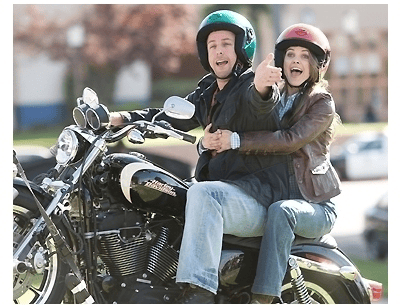
Bedtime Stories is a 2008 an interesting comedy film. It was the first appearance of Adam Sandler in a family oriented story.
Martin Bronson runs a hotel called Sunny Vista Motel. After 25 years in business, the hotel is liquidated to Nottingham Group of Hotels chairman Barry Nottingham due to financial challenges.
Skeeter is Martin’s son. Nottingham promises to ask him to take care of business later. Skeeter continues as a repairman at the hotel.
Unexpectedly, Nottingham later appoints her daughter’s boyfriend, Kendall Duncan, as the next manager. Skeeter got disappointed and resume to his work under stress.
Skeeter’s older sister Wendy works at a school. With the school closing, she has to travel to Arizona for a job interview. She asks Skeeter and her friend Jill Hastings – who works at the school – to babysit her children Bobby and Patrick for a week.
For a week, Jill takes care of the children during the day and Skeeter at night.
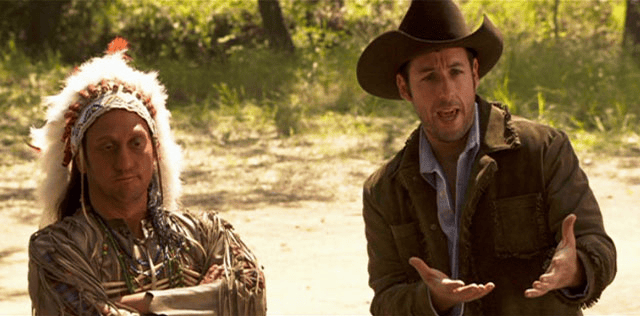
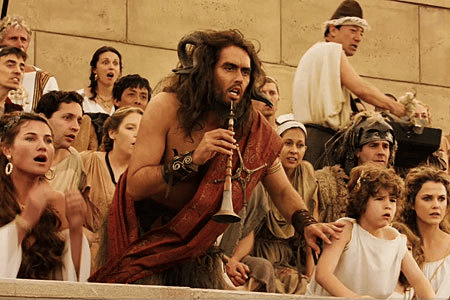
It is that one week that makes this film a magical treat! Skeeter tells stories to lull children to sleep. In it, he acts as the protagonist and tells a story every day with his own life as the plot. The story of a Greek king one day. Cowboy story for another day. Children also pour in their ideas to the stories.
Interestingly, the same story becomes real on the very next day in Skeeter’s life. From there, watch the twists and turns, whether it ends happily or sadly on screen.
A movie for kids! But the screenplay is designed to appeal to adults as well. The visuals, sets and their costumes that match the story made the movie enjoyable for me.
—
This translated post is part of Blogchatter’s WRITE A PAGE A DAY 2023 campaign
Joy is a divorced mother of two children who works as a clerk in an airline company. Despite being surrounded by a complicated household, with her ex-husband Tony living in the basement and her triple-divorced father Rudy as an ‘extra luggage’, Joy never gave up on her dreams. With the encouragement of her grandmother Mimi and her childhood friend Jackie, Joy designed a modern floor mop and tried to manufacture and market it.
Things didn’t go as planned when Joy was informed about a similar automatic mop that was patented by a Hong Kong scientist, Uttar, and she was asked to pay a $50,000 deposit. In an attempt to make her dream a reality, Joy sought help from Neil Walker, an executive at a trading company, QVC. After a few failed attempts, Joy was able to make her invention a success.
The movie follows Joy’s journey as she navigates through a world filled with betrayal and fraud, and eventually finds success. The scenes where Joy struggles to make her invention a success and her disappointment when her company was forced to shut down, shows how determined she was to make her dreams a reality.
“I know how to invent. I don’t know the business. But I am cleaning my house daily. I did this. I know, my mop is better than any other, give me a chance” – The scene in which Joy Neal struggle to get a success – notable!
The scene in which the patent attorney, Trudy and her father, the fraudulent patent agent work together to force her company to shut down – the way she tear up all her designs with extreme disappointment – stressful!
During the 1900s, you could do some shopping at T.Nagar, Chennai followed by dinner before taking a single ticket to Sri Lanka. There was a boat mail service operated from Madras, which could be reused as a ferry ticket at Dhanushkodi, to reach Thalai Mannar in Sri Lanka.
The train started from Chennai and passed through Chengalpattu, Villupuram, Cuddalore, Kumbakonam, Thanjavur, Tiruchirappalli, Pudukkottai, Manamadurai, Ramanadhapuram to reach Rameswaram and Dhanushkodi. In British times, this was called the boat mail. The railway line was called the main line. A chord line connecting Tiruchirappalli and Villupuram at a short distance was not built then.
Dhanushkodi was the emigration/immigration point. There were a couple of health centers, RC church, a railway station, police station and customs office etc. It was inhabited by traders and fishermen. Following 20 to 25 hours of travel, you will get off the train before getting on steam boats to take you to Sri Lanka, which is 35 kilometers away.
Many of us will remember the tsunami of 26th Dec 2004. Before 40 years, there was another unfortunate incident. The sea was extremely rough due to the devastating cyclone. Passenger train 653 – running between Pamban and Dhanushkodi – was on the track waiting for a signal to reach Dhanushkodi station. The station is already under water due to harsh tides. Train staff were standing on top of a water tank and looking at the passenger train helplessly.
The locomotive pilot had no other choice but to proceed. It was then that another massive wave hit the passenger train, which swallowed the whole train with 6 bogies. The train was completely submerged, except for a glimpse of the locomotive stretching above the water for a few inches.
Dhanushkodi was completely swept by the cyclone. India did not try to recreate the town. It has not yet been inhabited. The boat mail was running between Chennai and Rameswaram now. As a result of the Tamil-Sinhala war in the 1980s, the ferry service was halted. The water connection between eastern Tamil Nadu and Tamil land in Sri Lanka was cut off.
Those who stay in Rameswaram, if they want to travel to northern Sri Lanka now (which is located 35 kilometers away geographically), they should come to Chennai first by train for 12 hours; they need to take a flight to Colombo; they need to travel by bus back to Mannar.
Somebody wants to promote Ram Setu, while others want to destroy it. These are purely political. Let’s not get into it. But let’s look at it from a global perspective. Can two countries that are geographically and culturally close not be connected by land or water?
China has opened its borders to its nearby islands Hong Kong and Macau, following the Covid-19 pandemic. Irrespective of political tensions, Taiwan and mainland China are culturally and commercially connected.
Singapore gained independence from the British and was connected to Malaysia for a few years. Later it became an independent country. Both countries have high connectivity on all fronts.
I wrote about Jersey in the past V for Victory – war & love in Jersey.
Eurostar trains run at high speeds through the tunnel connecting France and London.
Because connectivity between any two countries gives immense benefit to both.
Improved trade: Customs can be setup on both ends. Goods can be transported efficiently. The more efficient the movement of goods, the greater the benefits for society as a whole. Universities on both sides can accept students from each other. Cricket grounds can be increased. Mannar on the Sri Lankan side and Madurai on the Indian side will see improved trade opportunities.
Exchange of cultural ideas: India and the world have not succeeded in getting enough rights for ethnic Tamils in Sri Lanka. They had had enough of corruption and bloodshed already. Tamils inhabit the northern part of Sri Lanka, which is relatively poor. Land and water connectivity will bring them out of poverty. As well as that, brides and grooms need each other on both sides!
A boost in tourism: Indian tourists are among the highest in Sri Lanka. Sri Lankans visit Chennai and Trichy in large numbers. A land/water connection will reduce travel costs. It would improve connectivity. There was a time where Sri Lankan Tamils used to come to Ramnad to watch a movie and go back.
Security: Smuggling and human trafficking are disguised in the name of fishing. It is underplayed by politics. A land bridge and waterway would improve security and reduce illegal activities.
A land bridge is not meant to be easy financially. That too in an ecologically unstable region like Dhanushkodi. There have been talks about a tunnel between the two countries. It requires substantial funding from international players. Both sides show a lack of interest. Do Indian foreign officials have an interest in this? Are the Sinhalese opposed to this? We do not know. This will benefit the country for centuries to come, so it should happen.
It was the path built by Hanuman Sena for Rama. I hope someone realizes it someday.
Idumban was exhausted. He was carrying a kavadi, which had two mountains on either side, causing his shoulders to ache as if they were being twisted. Agathiyar was repeatedly messaging him on WhatsApp with the message, “Are you there?” but only receiving single gray ticks instead of the expected blue double clicks.
A few days prior, Agathiyar had tasked Idumban with transporting the two mountains, named Sivagiri and Shaktigiri, from Mount Kailash to Pothigai Hills (also known as Courtallam hills in the Western Ghats) via Air India Cargo.
However, due to the heavy rain in Chennai, all flights and lorries had been cancelled. Idumban was forced to embark on the journey on foot. He pondered the yearly struggles faced by Indian cities, with heavy rainfall during the rainy season and water shortages in the summer.
As Idumban continued his journey, carrying the heavy weight of the two mountains, he became confused and lost his way near Dindigul town after Trichy. At that moment, a young man on an Enfield bike came across the weary Idumban.
The young man said, “What’s up, seems like you’re extremely tired. Why don’t you take a break here?” and gestured to Avinankudi. Idumban agreed and decided to rest. However, unbeknownst to Idumban, the young man on the motorcycle activated a mobile jammer, cutting off all communication between Idumban and Agathiyar.
As Agathiyar was unable to reach Idumban through WhatsApp, Idumban was able to take a peaceful nap at Avinankudi without any interruptions.
After waking up and washing his face in Saravana Poikai lake, Idumban searched for the young man and his motorcycle, but to no avail. Eventually, all the messages that were jammed earlier finally downloaded onto Idumban’s mobile.
Idumban exclaimed, “Oh my god, what have I done?” and tried to lift the mountain, but was unable to do so. If he had help from Air India cargo or a National Permit truck, it would have been easier, but he was all alone. He wondered what a challenge this was.
While struggling, he noticed a boy sitting on one of the mountains in the kavadi, wearing a kaupinam (kovanam/a man forelap). Idumban thought, “Could this boy be the reason for the increased weight of the kavadi? Is he playing a prank on me? No, he’s just a small boy. But what if he’s causing this problem?”
Idumban then ordered the boy, “Get down from the hill, brother. I need to lift my kavadi.”
The boy mocked Idumban, saying, “You’re ordering me around? You claim to be able to lift mountains, but you can’t even lift it with a small boy like me?”
Already irritated by Agathiyar’s scoldings, Idumban had no patience left. He tried to grab the boy in an attempt to discipline him. However, Idumban was defeated in the fight.
The boy then asked, “I won. What will you do for me?” revealing himself to be the baby god Murugan in disguise.
Idumban responded, “Oh, the god with the sphere, were you the one challenging me?”
With great delight, Idumban then began to sing the kavadi sindhu.
Idumban received a blessing from Murugan. He requested that the devotees of Murugan sing Kavadi Sindhu poems and carry kavadis during their procession to the home of their beloved deity. Murugan agreed immediately.
Idumban went on, “Oh you who instructed your own father! I was carrying the kavadi to Avinankudi. You have blessed me. Please bless your devotees who come here with kavadis as well.”
Murugan happily accepted. And thus, Kavadi and Kavadi Sindhu were born!
“Sorry sir, there has been a change of plan in your project. The mountains will be here, not in Pothigai,” Murugan sent a message to Agathiyar on WhatsApp. He shared their location, which was in Palani. Murugan lived on one hill and Idumban lived on the nearby hill happily until they were taken under the control of the HR&CE department later 😀
—
Translated to English and rewritten as part of Blogchatter’s WRITE A PAGE A DAY 2023 campaign, on the day of Thaipusam festival.
Murugan is revered as the supreme deity above the Trimurti-s and Deva-s in both dream and consciousness. Pamban Adikalar was a devotee who worshipped such a deity in both dream and waking life. He was a follower of Shuddh-advaita and was the Guru of Tamil scholars Thiru Vi. Kalyanasundaranar (Thiru ViKa) and S Sachinandam Pillai. He was a leading sage among other Gurus and was knowledgeable in the ashtama-sidhdhis. Despite his mastery of supernatural powers, he controlled them as they were obstacles to attain moksha.
I will provide a portion of his history here. He was born as a result of the devotion and penance of Saththappa Pillai and Sengamalathammai in Pamban in the Shaiva Velala tradition in 1850. He was named Appavu.
Pamban Adigal had a deep devotion to Lord Murugan from a young age. He regularly recited the six-letter “Sa-ra-va-na-bha-va” mantra, also known as the Sadakkara mantra in Tamil, and received the blessings of Lord Murugan as a result.
With Arunagiri Nathar as his inspiration, Pamban Adigal made a promise to write one poem dedicated to Lord Muruga for every ten poems he wrote. He sought the blessings of the deity and became fluent in classical Tamil language. He began writing poems about his beloved deity, Lord Muruga. Despite leading a household life for some time, he longed for a life of asceticism within.
Let’s know about an incident that happened in 1891. One day, Pamban Adigalar said to his friend Angamuthu Pillai, “I will go to Palani tomorrow”.
His friend asked, “When will you return?”
“I won’t return” Adigalar replied.
His friend asserted, “You started immediately without a word. is it an order from Murugan?”
Adikalar agreed, “Yes”.
In the evening, as Pamban Adigalar was meditating on the terrace, a towering figure appeared before him. The figure was grinding its teeth in anger and pointing its index finger at Adigalar. It shouted at him, “Dey, Did you lied as an order from God? I don’t think I ordered you. Why did you lied?”.
Pambal Swamigal was shaking with fear upon seeing that figure. He was sweating profusely and could not utter a word. Instead, he silently prayed in his mind. ‘Oh my lord, the ocean of kindness! I did not lie to earn a land or wealth. I lied in considering the anma-laabam (benefit of my soul). Kindly forgive me’.
Almighty asked, “Do you want to get the anma-laabam by lieing? Can’t I offer it to you?”. In addition, it ordered, “You should not come to Palani until I order you. tell me you won’t!”
Adigal’s tongue twisted, “I won’t come until I get an order”.
The massive figure vanished.
Adigal rose to his feet and fell to the ground to pay homage to his deity. From then on, he never told a lie, even jokingly, out of fear of incurring divine retribution.
Adigal implored Murugan to call him to Palani, but the deity declined. Adigal visited and venerated all sacred sites except Palani, and was punished for a minor falsehood.
After embracing the ascetic lifestyle, he boarded a boat and crossed the Pamban River. With hands folded in reverence, he silently paid homage to his birthplace. “Oh my mother land, I will not come to this soil with this body”.
He venerated various sacred shrines and was known by the monastic name Kumara Guru Dasar.
In the Tamil month of Panguni (March-April) 1894, he was residing in a village called Pirappanvalasai, where he was attended to by a disciple named Udayanayagam Pillai.
Pamban Swami had a strong desire to see and worship Murugan with his own eyes. He made a firm resolve that he would survive only if he were granted the vision of Kandavel, otherwise, he would not.
Kumara Gurudasa Swamigal (also known as Pamban Adigal) visited a cemetery with his disciple UdayaNayagam Pillai. They erected a pavilion, under which Gurudasa asked his disciple to dig a pit that could accommodate a person. He instructed UdayaNayagam to surround the pit with thorns as a fence.
He said, “UdayaNayagam, I will sit inside the pit and start my penance towards Murugan. I will come back if I happened to see Murugan. Or else, I’ll die and disappear. You keep a small scoop of food without salt in every afternoon. If I did not take it, you don’t have to feed me later. Never ever forget Murugan” and blessed him.
Gurudasa descended into the pit, clasped his hands and placed them on his head. He prayed by uttering “Kumara Guru!” and faced the north direction while sitting inside.
UdayaNayagam Pillai was heartbroken at the sight and, out of fear of disobeying his guru, worshiped him before returning home.
Adigalar concentrated and delved deep into meditation. He battled with his monkey mind for five days while eating saltless food. During this time, a snake appeared and six or seven ghosts of both male and female genders tried to distract him by dancing at night. Despite these disturbances, Adigalar continued to pray with the sadakara mantra, and the ghosts were unable to touch him before eventually disappearing.
A muni with a tall, pure white form approached and entered the pit to lift Adigalar out. The muni used a oak stick as a yoga tandam to beat it, and the stick disappeared into smoke along with the muni. Adigalar loudly recited the sadakara mantra, causing the king of ghosts to retreat a mile to the south before disappearing.
Adigalar prayed and cried towards baby god, “oh my lord, Shanmugha, the ocean of grace, the treasure of mercy, what a challenge I’m facing. Why do I suffering this much? I wanted to see your divine form. I abandoned my relatives, parents, wife and children. I forget all obscenities. Oh the husband of Valli! I am your servant. I forget everything and got down into the pit in graveyard and started this penance to see you. why do you refuse to possess me?”
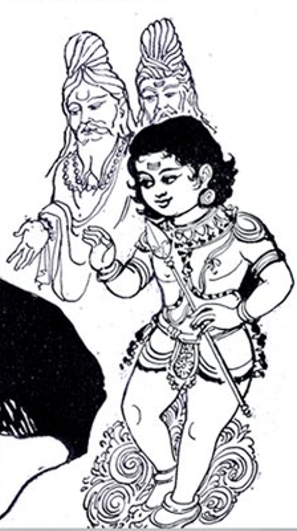
On the seventh day, a male infant appeared and bestowed blessings upon Adigalar. The baby was accompanied by two rishi-s with matted hair on either side. The rishi-s told the baby, “Oh thy baby god, he is in penance towards you”.
The baby, named Velan (meaning “the one with the sphere”), beckoned Adigalar towards him and blessed him. Adigalar rose to his feet and prayed to Velan. The divine being whispered something into Adigalar’s ear and blessed him. Murugan and the rishis disappeared like a thunderstorm towards the west.
Adigalar sat in meditation, following the divine preaching. He remained still, like a tree trunk, and became an embodiment of Saint Arunagiri Nathar’s poetry.
Oh, king of the sphere, who pierced the Grauncha hill! Oh, one with a chest adorned with a garland of Kadamba flowers! I sought solitude to contemplate and focus my mind on you. I have lost myself, this body is but a mere shell.
Kandhar AlangkAram by Thiru Arunagirinathar – 19 sonna kirounja
Adigalar was so absorbed in his devotion that he lost track of time, spending 28 days in contemplation before descending into the pit. After 35 days, there was a loud, thunderous sound and the land and sky appeared to shake.
A brilliant light appeared and a divine voice spoke from the sky. “Ekadasa Rudra-s were coming. You get up!”
Adigalar said, “I will not get up for anybody’s order except Kandavel”
There was another voice “It is the order of Murugan, Get up!”
Upon hearing the divine voice, Adigalar rose to his feet and offered a salute by placing his hands on his head. He then bid farewell after saying “I cant leave this place where I was blessed. I am afraid to refuse the order of my father-like God. Hence I leave”. Moon was shining in west direction.
Adigalar sat on the shaded verandah of UdayaNayagam Pillai’s house. Once dawn broke, UdayaNayagam and other disciples gathered around him. Adigalar asked for a Panchangam (Hindu calendar) to determine the date. He realized that he had been in meditation for 35 days.
Adigalar recorded these events in his poetry.
Adigalar worshipped his deity in both his dreams and waking state and rejoiced repeatedly.
Adigalar had the practice of eating a small lunch devoid of salt, tamarind, chili, mustard, oil, and sugar. He lived an ascetic life, embodying the qualities of a rishi.
On December 27, 1923, Adigalar was involved in a vehicle accident that resulted in a fracture of one of his legs. The British doctors who treated him advised that the leg should be amputated, given his age and habit of avoiding salt and spices. However, on the next day of the new moon, Adigalar prayed to Murugan and requested to be saved.
During his prayer, he saw a vision of a blue peacock dancing in the sky with its feathers spread, and another peacock dancing below. He was amazed and worshipped this sight from his hospital bed.
Adigalar then saw a vision of two small spheres scratching his fractured leg, and suddenly, the leg joined back together. The next day, when the British doctor came to check on him, he saw a child in the bed, but the child disappeared as he approached.
Miraculously, Adigalar was able to walk again, and he attributed this to the intervention of Murugan.
Adigalar composed 6,666 poems in classical Tamil and also wrote prose.
On May 30th, 1929, his soul reached the divine steps of Lord Murugan on the day of Sashti Thithi.
His memorial temple is located in Tiruvanmiyur, Chennai and is considered a place of supreme peace, where enmities are said to be removed upon worship.
Thirumuruga Kirupananda Variyar wrote this article in Kalki Magazine. This is a unofficial translation by me. I am not sure about copyright of this article. If it violates copyright, I’ll take it down.//embedr.flickr.com/assets/client-code.js
Today is Thaipusam day. This is a special post to celebrate the same. It is an ancient Tamil festival celebrated by the Tamil community around the world, including in Tamil Nadu, Sri Lanka, Mauritius, Malaysia, and Singapore. It is not associated with Tamil politics.
Translated to English as part of Blogchatter’s WRITE A PAGE A DAY 2023 campaign.
A significant portion of modern medical resources and funding is directed towards prolonging human life, as reported in an article. As we live in an age of transplant surgeries, reading this novel is sure to provide an exceptional reading experience. I highly recommend it, as it is one of the finest novels I have read to date.
Arogya Niketan (translated to Tamil as ஆரோக்ய நிகேதனம்) – Tarashankar Pandyopadhyaya Translation – T.N. Kumaraswamy Publisher – Sahitya Akademi, First Edition 1972, Second Edition 2015 To reserve in NLB – Ārōkkiya – nikētan̲am To read Writer Jayamohan Introduction Buy in Bengali, Tamil
Ten days ago, I visited the Ang Mo Kio Library and saw a Tamil translation of this novel on the new arrivals display. I borrowed it. The story set in a village in Bengal that has an Ayurvedic center. The main character, Jeevan Thattar, is the center’s doctor who learned the ways of Ayurvedic medicine from his father and practices it with the belief that death is inevitable and his medicine is meant to fight diseases, not death.
Dr. Pradyod, a young allopathic doctor working at the government hospital in the same village, disagrees with Jeevan’s approach and often criticizes him. Despite their differences, both doctors come together to treat patients, with Jeevan correcting cases that Pradyod missed and vice versa. The novel showcases their growing friction as a result of the generation gap.
Jeevan Thattar is depicted as a wise and experienced doctor, who dropped out of allopathic studies due to his love for Manjari. Despite facing setbacks in his life, his passion for medicine never faded, and he always remains curious about new advancements in the field. Despite being criticized by some patients for predicting their death, Jeevan continues to practice medicine, even if it means treating just one patient at an odd time.
Pradyod, on the other hand, is depicted as a vibrant and ambitious young doctor who is determined to prove Jeevan wrong. However, as he gains more experience, he realizes the importance of Jeevan’s approach and the two doctors come together to treat patients.
Athar Bau, Jeevan’s wife, is portrayed as an unhappy woman who scolds Jeevan for his predictions of death and for selling all their property in vain. Despite her scoldings, she is not cruel, and her anger stems from the fact that Jeevan is seen as a curse by the villagers.
The protagonist, Jeevan, is depicted as a man who is always curious about death and its form. He desires to understand death and is always eager to learn about new advancements in medicine. Despite his age, he remains a curious child who is fascinated by germs shown in microscope and the effectiveness of new drugs.
The novel touches upon various aspects of death, including untimely deaths and how different people cope with it. The heartwarming scene is when Jeevan feasts Abaya, despite realizing that her husband is going to die. This scene highlights Jeevan’s compassion for his patients and his role as a doctor beyond just treating illnesses.
It is difficult to express in words the situation where Jeevan Masai takes his naadi (pulse) and confronts his final day. The writer’s ability to capture this difficulty evokes a strong emotional response from the reader. Masai is torn between his desire to go to the banks of the Ganges and his concern for Athar Bau, who he sees as vulnerable and helpless. This part of the novel left me spellbound, and my eyes filled with tears as Athar Bau spoke at the end.
The novel highlights the human emotion and the longing for recognition of an old-fashioned physician. It presents the dilemma of living life on one’s own terms versus trying to control it according to one’s preferences.
The author, Tarasankar, was a highly acclaimed Indian novelist who wrote 65 novels during his career. He received numerous awards, including the Rabindra Puraskar, Sahitya Akademi Award, Jnanpith Award, Padma Shri and Padma Bhushan.
The translation into Tamil by Mr. Kumaraswamy is fluent and accurate, but the book contains several typographical errors.
—
This post was originally Written on 26 Sep 2015. Translated to English as part of Blogchatter’s WRITE A PAGE A DAY 2023 campaign.
Nothing compares to a relaxed drive on the highways of Tamil Nadu, despite their notorious reputation for poor road design and undisciplined drivers. My fingers tap rhythmically on the steering wheel as I enjoy Illayaraja music on Kodaikanal FM. As I travel from Bangalore to Kodaikanal, I switch between my favorite radio stations across the route. When I reach the districts of Karur and Dindigul, I switch to this station, which brings back memories of my hometown, or rather, my childhood jungle.
It has been a tiring drive since the afternoon, with my calf muscle begging for a break. Although a hot water massage may be necessary for relief, the excitement of returning to my hometown in the hills overrides any discomfort. My mother is pleased with the rainfall this year, hoping for a successful harvest season. Potatoes are a common crop in the area, but she favors rice, which is not typical for the Kurinji – the hilly terrain of Sangam Tamil Landscape. She works with nature to cultivate a flat surface for farming in one of the villages of Kodaikanal.
It is not about the immense nature wealth and season that binds to be to that soil. It is my surrounding. The life is not colourful and tasteful without appuchi-s, aachi-s, maman-s and machan-s, the bhoomiputra-s! After migrating to Bangalore, I am slowly disconnecting from this root. My rational mind believes, while my emotions disagree with it. My emotions are like Hem in Who Moved My Cheese – resist to change! I took the Dindigul route as it is dark already. After deviating from Sempatti, I was on the ghat roads towards my heaven on the peak!
It’s not just the wealth of nature and seasons that ties me to that land, but it’s my community. Life isn’t as colorful or enjoyable without appuchi-s, aachi-s, maman-s and machan-s, the bhoomiputra-s! After moving to Bangalore, I’ve gradually started to lose touch with my roots. My logical mind understands this, but my emotions are like Hem in “Who Moved My Cheese,” and they resist to change.
I took the Dindigul route because it was already dark. After deviating from Sempatti, I was on the winding mountain roads, heading towards my paradise on the peak! My headlight was too weak for the dense forests covering the single godforsaken road that crosscut into the jungle. I just crossed pandimuni temple. I would be able to reach my destination in thirty minutes. For a long time, I have not seen any humans after entering into ghat road. This darkness is making me to feel uncomfortable.
As I approached Chettiyar Thottam, considered by locals as the gateway to our cluster of villages, I spotted a mesmerizing display of fireflies. I slowly brought my vehicle to a stop and turned off the engine, in awe of the sight before me. The farm fields were ablaze with countless flickering yellow lights, a scene more beautiful than anything I had ever seen on Instagram. It was as if a flock of flamingos were flying across the horizon. The world truly holds many wonders beyond what we see on social media.
I restarted the engine and drove down the road carefully, trying not to interrupt my thoughts. As I turned left, my headlights illuminated a skinny man wearing a dirty lungi and vest. I was momentarily startled, as I didn’t expect anyone to be there. But then I recognized him as Chakarai Mama, who used to work in Chettiyar Thottam. I pulled over near him, and he was engrossed in his phone. Slowly, he lifted his gaze to acknowledge me as I stopped nearby.
“Who?.. ” he asked..
“Its me, mama. Kumaran”
“Hey.. Mapla. Kumara.. When you came here”. He coughed to clear his throat before speaking, as his voice was hoarse.
“Just on my way, mama. That’s ok. What are you doing at this time here?”
“Evening shift for electricity. I came to switch on the motor.”
His eyes went back to his cell phone multiple times before he responded me.
“What’s this mama? fireflies.. huh? So many of them”
“Yes, mapla. winter season is over la. I used to see a few. But it is too many, this year.. hah.”
“It is so rare, mama. I never saw like this”
“Indeed.. hah. But they are super hunters, mapla. See how glamourous they are. But they can snails too.”
“Really ah.”
“What did you think then? They have a poisonous sting. It can paralyze snails, earth worms, even some beetles within minutes. Just consume like a sarakku!”
He murmured. Yet, he couldn’t resist to look into his mobile.
“What’s there in that phone, mama? Girl friend ah..”
“Rummy, mapla. You know what? We can play in phone. “
“Oh.. Mama, you didn’t leave this habit ah.. So many times I told you.”
“Its so easy mapla.. can earn money, buy land, tractor, power tiller.. anything.. I can even call Devi, back”
“Just stop it mama. You never won in rummy, even when playing with your friends with cards. You started playing in online. ah.. Just shut up and don’t lose any more money, hear it?”
“Mapla.. just one time la. Do you have a sum of 5000? Can do Google Pay? I’ll give back in the morning. Sure thing”
He was in a possessed state.
“This is nonsense. This is what I have. Take it. Finish it and come tomorrow morning. Don’t forget to switch off the motor.”. I handed him a bottle of KingFisher beer, then lifted my own glass and restarted the engine.
“Mapla. Mapla… Hey…” Chakarai mama was pleading. I gestured with an X sign and pressed down on the accelerator pedal.
It was 9:15 PM when I arrived at home. My mother was already prepared with hot Idiyappam and coconut milk. I eagerly dug in, savoring the flavor of the soaked rice strings. While I ate, I engaged in conversation to pass the time.
“I met Chakarai mama on the way. He still drinks, doesn’t he?”
I kept the fact that I gave him a beer bottle to myself and didn’t mention it to them.
“What? Chakarai? Where?” My father’s gaze shifted from my mother to me as he put down his spoon and stopped eating. My mother’s eyebrows furrowed in surprise, while I raised my eyebrows in confusion.
“Why? near Chettiyar thottam, on the road side bridge, near the motor room”
“Eswara. Who asked you drive at odd timing and stop at strange places?” She took the vibhuti-bowl and applied in my forehead.
“What? What happened”
“HE died two days ago. “
“What???”
“He committed suicide..”
“Sh**”. I spell bound and I felt like I was being pushed down on the downhill.
“Is it..?”
“Yes, he was unwavering and addicted to seetu (cards). This addiction ultimately led to his downfall, you know. He lost everything, including his wife, who left him, and his land, which he sold to fund his addiction. In the end, he took his own life by consuming pesticide and locking himself in the motor room. It appears that his soul has not found peace yet.”
I couldn’t eat any more.
“Addiction is like light. People like him are its preys.” My father said.
Haw said, “Sometimes, Hem, things change and they are never the same again. This looks like one of those times. That’s life! Life moves on. And so should we.”
Who Moved My Cheese p 45
“Who Moved My Cheese?” by Dr. Spencer Johnson is an intriguing fiction that portrays the different behaviors of people during change in an engaging manner. The 90-page story takes place in a maze and features two mice and two small humans, each possessing their own unique character. The book is written in a simple style, as if a grandmother were narrating to her grandchildren, but it is suitable for readers of all ages, including teenagers. It is a must-read for college students and busy professionals, and I often heard the title mentioned among MBA students during my college days. I recently read the book myself.
The story of three types of fish – the one which is smart and precautionary, the one that only considers danger when it arrives, and the one that never cares about danger – is often heard during our childhood. This is similar to the story told in “Who Moved My Cheese?” One of the key takeaways from the book is that change is inevitable and we must be prepared for it. How quickly we sense change and react to it determines our safety. The book illustrates the importance of adapting to change and how failure to do so can negatively impact our lives.
This book is inspiring because it depicts the character Haw’s ability to adapt to change. He tries to motivate his fellow human Hem by providing him with clues during his search. These clues serve as key messages for us to adapt to change as well. Embracing change quickly is not always easy, but consistent effort will lead to success. Any missteps along the way should be viewed as learning opportunities.
To conclude, “Who Moved My Cheese?” is a must-read for professionals and students who are looking to improve themselves. This inspiring book highlights the fast-paced nature of the changing world and provides insights on how to adapt to these changes. Each page is filled with positive and inspiring words written in a simple manner. By imagining how good you would be after the change, you can reduce the fear and keep moving forward. It is a visionary thought that I hope will also be helpful to you, my dear reader.
Whenever I leave my home, I often feel a sense of longing and say ‘veetukku…’ (to go back home). Adults would make fun of me and ask, ‘Why, are you in the forest?’ I would get more irritated when someone teased me like that.
Later, I started attending primary school. I missed my home and cried for the whole day. When my teacher asked why, I said ‘veetukku…’
During my college days, I wanted to present myself as a different person. As a law or arts student, I saw joining politics as my only option. Tamil politics operates like a multi-level-marketing scheme, with money flowing from the top tier to the bottom tier in a hierarchy. From the party leader to the low-level party cadres who put up flags and lights for meetings, everyone benefits when the “cash rain” falls. In return, they expect us to be more “visvasi-s” (trusting). That trust is important to receive money in the next cash flow. To prove my trust, I threw a stone at the glass window of a local opposition party leader. I was arrested and spent time in lockup. When I realized I needed to pay for my own bail, I felt a sense of longing and said ‘veetukku…’.
Despite that, I got the opportunity to move up the political ladder. I spent all my resources, including loans, donations, and threats. My goal was not to double, but to at least quintuple my investment. It was not as easy as you might think. Even after gaining power, I had to spend a lot to mute opponents, both within my own party and in the opposition. I needed to use money and power interchangeably. I knew I would receive the same treatment if I lost power. I bought lands, built rice mills, opened several petrol stations, and built a shopping complex in the center of the city. Most notably, I built a college. The college business helped to increase my prestige. Previous generations of politicians were bar owners, but people like me in the “neo political” era don’t have to live in that kind of environment. I pay educated people, and their parents respect me. When my previous generatation leaders became wine shop owners, I became ‘educationalist’. But the motive is the same! I was intoxicated by the widespread power I had, but deep down, I knew who I truly was. My mind lamented, ‘veetukku…’
It’s been some time. I’ve experienced ups and downs. I rose high on the political ladder in Tamil Nadu. My self-conscious did not remind me of who I am. As time passed, I grew older and my sons became powerful centers in my party. Even my grandsons are accorded great respect wherever they go. The power intoxicated everyone in my family. I felt I had achieved. I felt proud of my accumulated wealth, but it was never enough. I started a series of distilleries to produce liquor. The government gave up on education, and privates gave up the bars. I sold liquor barrels to the government. My liquor was sold on every street, in front of many places of worship, and at the doorstep of daily wage workers. I made every part of society taste my spirit. The government took the blame, and I was happily hiding behind it.
I felt something was wrong with my health before I reach the average life span of India. I felt fatigued. That was the day my cook prepared a pal nandu kozhambu (crab curry cooked with spices and coconut milk), and I couldn’t eat enough. My wife realized, and eventually, the physicians announced they couldn’t do anything to save me. Money poured inside my house from all my income sources, like the endless tides in Chennai Marina. Of course, the Chennai Marina is black due to sewage water, and my money has its own black shade too. But none of the currency notes could save me or relieve me from my pain. I was unconsciousness in the hospital ward for most of the time. Whenever I regained my consciousness, I could hear the heated arguments between my sons as they struggled over property and power sharing. It was the quietest period of my life. Nobody greeted me, nobody offered me a garland or towel, no press meets, no assembly talks. I was kept alive by a feeding tube. One evening, my wife came into the ward. She wanted to ask something. “Where did you keep the navaratna kasumala?” she asked. I said “Veetukku…” She couldn’t understand, so she leaned in closer to hear me. I repeated “Veetukku…”
The vehicle was en route to my home. Upon realizing what was about to happen, arrangements were made. I was back in my bedroom, surrounded by care. My elder son said, “Appa.. Appa.. Can you hear me? We’re home. Are you happy now? Where is the navaratna kasumala?” I lamented “Veetukku…”, but I couldn’t make it as an audible voice. I felt I was traveling through a black tunnel in search of light. I heard someone else lamenting far away, far below me. There seemed to be the end of the tunnel. There was a bright space that greeted me with pleasure. All my pain and worries, which had come with me so far, went away. Someone there asked me, “Veetuku..? You’re home?” I said, “Yes, finally.”
—
This blog post is a part of Blogchatter’s WRITE A PAGE A DAY campaign. This is a fiction. It does not represent anyone in real. If it reflects someone, know that it is purely accidental. Company is not responsible 😀
Everybody needs information. After the dot-com discovery, there is a massive inflow of information in the world. Every stakeholder wants to meddle and control this flow. They do not hesitate to sugar-coat, malign or even spread rumours. Fake news wave flows across all tiers of the society.
I know someone in a village, who killed and cooked all his pet chickens. Because somebody told him that world will be no more in 2000. After media is run for profit by private players, journolists starts targeted bullying to bring down their opponents. Governments wants to control the press as much as they can. If not, it tries to adjust the flow of news using its moles inside. On this background, I would like to write about a book, I borrowed recently from library as part of #TBRChallenge by Blogchatter.
The pouring of news in dailies/TVs/social media are all poured by different parties based on their own interest. When it is in aligned with our view, we believe it is true. In addition, we starts sharing with our circle without verifying.
Fact-verifying is another jiggery-pokery. It can’t be 100% right always. On the other side, fact-checking all news is not practically not possible at all.
In this case, making juveniles aware of the news process, news consumption becomes important. That is what this book tries to do. ‘Coping with Fake news and Disinformation’ written by Devlin Smith.
This book has 6 chapters. A Free Press Making the news Faking the news Finding the truth Information overload Consuming the news.
It starts approaching the false news behaviour from the historical background. The book ends where it tries to create awareness of how to consume the news. Author tries to target the teens to create media awareness. So the book is pleasingly stitched with bigger fonts, colourful typesetting and interesting pictures. I liked the chapter that describes the fake news that provocated America and Spain to burst into a war.
I think this book will be of interest of socially-aware teens.
To write about the author, Devlin Smith, writes across different genres for the past 2 decades. She studies English with Journalism as specialization.
Name of the book: Coping with fake news and disinformation Author: Devlin Smith Publisher: New York : Rosen Publishing,2020. Genre: Juvenile Literature – Media literacy. Fake news. ISBN: 9781725341203 NLB | Amazon
I’m participating in the #TBRChallenge by Blogchatter. With this, I wrap up this challenge as well as 2022. See you in 2023.
dwaraka
Stay informed with curated content and the latest headlines, all delivered straight to your inbox. Subscribe now to stay ahead and never miss a beat!