Have you been to Thirumayam? If you are a orthodox Vaishnavite, it is a revered divyadesam – one of the 108 holy shrines celebrateed by Alwars in their hymns. The Vishnu shrine here predates the famous Srirangam temple. The Ananta Sayani – Vishnu reclining on his serpent bed with Lakshmi beside him – is larger than that of the one at Srirangam.
Shaivaites also find significance in Thirumayam, home to a magnificent Siva temple. The consort of Lord Shiva here is beutifully named as Venuvaneswari. That means ‘Eswari of Venu Vanam‘ (bamboo forest). The temple is attached with an octagonal shaped uruni – the holy pond.
Satyagirisvara temple (Shiva temple), Pandian Ramaiah, 28 Feb 2010. There are two famous rock-cut shrines, one of Siva [shown here] and the other of Vishnu, adjacent to each other.
Historians will find Thirumayam brimming with centuries of historical facts. The cave temples are believed to date back to 7th century AD. From a chronology perspective, I need to highlight that work at Ellora caves might have started around this time. It features one of the Tamil Nadu’s largest inscriptions. The site witness the stories of colonial aggression too.
Thirumayam Fort, Pandian Ramaiah, 28 Feb 2010. Before reaching the town, one can see a fort atop a large hill. In past centuries, the fort was much larger than what now obtains; this is affirmed by the fact that the main entrance to the old fort lies about one kilometer south of the present-day fort. This extrance to the old fort still stands, it has a courtyard with pillared corridors and shrines of various deities. The sculptures on the pillars are truly beautiful. The Thirumayam fort, set in 40 acres, is of great historical importance. It was built by Sethupathi Vijaya Ragunatha Thevar, ruler of Ramanathapuram in AD 1687.
But I write this post to mention about one of the icons, that left a profound impression on me – Lingodbhava.
How ever this post focuses on a particular icon that deeply captivated me – the bas-relief of Lingodbhava.
It shows the supremacy of Lord Shiva. It begins with a dispute between Brahma and Vishnu over who is superior. To resolve this, Shiva manifested as a colossal pillar of fire, challenging them to find its beginning or end. Brahma transformed into a swan and flew upwards. Vishnu became a boar and dug downwards.
After a long search, Vishnu accepted defeat, recognizing Shiva’s greatness. In contrast, Brahma falsely claimed he found the top with the help of a tāḻampū – screw pine flower (or Ketaki flower in some version). Angered by this deceit, Shiva cursed Brahma to be un-worshipped, thazhampoo and Ketaki flower are banned from using it to adorn gods and declared that the Lingodbhava would symbolize his eternal presence.
Tamil revolutionary poet Bharati’s poem captures this.
Tamil: அடியும் முடியும் அறிய முடியான் Diacritics: aḍiyum muḍiyum aṟiya muḍiyāṉ Hindi: अडियुम् मुडियुम् अऱिय मुदियान्. Meaning: The one whose start and end could not be found.
Usually Lingodbhava statue is found at the rear of Shiva sanctums. The one in Thirumayam, carved inside the 7th century cave temple, is truly inspiring. Rising from the floor to the ceiling, it is a colossal representation of the story. By the time I saw for the first time, it was breathtaking, unable to avert my eyes.
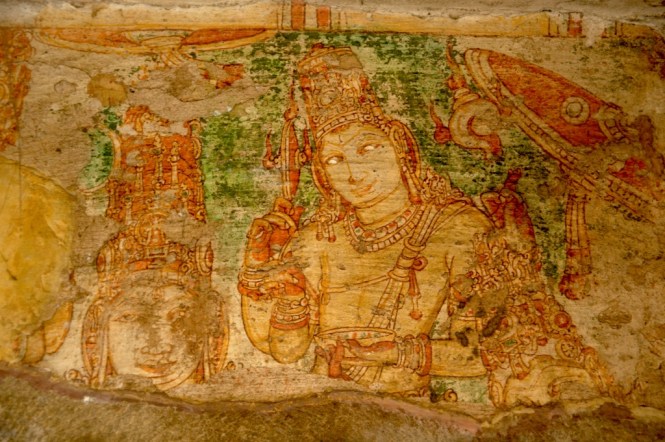
The entire cave temple was likely adorned with vibrant murals in the past. I can only wonder the splendor of the cave with its decorated walls and ceiling. Sadly, most of these murals are lost. mirroring the fate of similar paintings in Sittannavasal and Kanchipuram.
This Lingodbhava in Thirumayam is one of the earliest such artifacts in India.
Since that encounter, whenever I see Lingodbhava, it inevitably evokes the memory of the one in Thirumayam.
The realization of truth in life mirrors this philosophy. The more we dig, more we learn.
Pandian Ramaiah, 28 Feb 2010. There is no connection between this picture and this post. It is the memory of the road and bus existed a decade ago, before taken over by National Highways.
Kodumbalur (கொடும்பாளுர் / Koṭumpāḷūr / कोडुम्पाळूर्) is a hamlet near my birthplace. When something is so near and freely available, you won’t realize its value. This is a general global phenomenon. I am no exception.
It is historically important as it was the headquarters of the Irukkuvels, one of the chieftains of the Chola kingdom. In the popular novel Ponniyin Selvan, Vanathi, Princess of Kodumbalur, was a close associate of the powerful Chola princess Kundavai. She was in love with Arunmozhi Varman, also known as RajaRaja Chola.
According to the epic Cilappatikaram, the protagonists Kovalan and Kannaki crossed this place on their way from Uraiyur (modern-day Tiruchirapalli) – one of the Chola capitals – to Madurai, the Pandya capital. This epic names this place கொடும்பை நெடுங்குளக் கோட்டகம் (Koṭumpai Neṭuṅkuḷak Kōṭṭakam / कोडुम्पै नेडुंगुळक् कोट्टकम्).
Such a busy town is now just a village now. This place has three important archaeological sites:
The Muvar Kovil (Temple of Three),
The Aivar Kovil (Temple of Five),
The Mucukuntesvara Temple.
The Muvar Kovil temple enchants every viewer. It is older than the Thanjavur Brihadisvara Temple (or Big Temple).
Kodumbalur vimanam | 📸 M V Kiran
But the focus of this post is one of the icons we can see at Kodumbalur: the Kalari Murti idol of Shiva.
Kalari Murti, Kodumbalur | 📸 M V Kiran
The story goes like this: Shiva’s devotee Markandeya was supposed to die at the age of 16. Impressed by his deep devotion, Shiva wanted to help him by challenging Yama, the god of death. Shiva performed a ‘playful dance’ (களிநடனம்) on top of Yama, pushing him away and saving his devotee.
Markandeya episode, Raja Ravi Varma.
This sculpture at Kodumbalur is considered one of the finest examples of early Chola art and iconography. The representation of Shiva as Kalari Murti is in the first tier of the eastern niche of one of the remaining temples.
Look at the above picture. Shiva is shown in a dynamic, dancing posture, indicating a destructive attitude. However, killing Yama would stop deaths in the universe, destabilizing the equilibrium. Therefore, Shiva is careful not to push Yama to death. He is dancing on his back playfully. Note the smile on Shiva’s face and the horror on Yama’s face. This symbolizes Shiva’s victory over death.
The soft molding of his abdomen, thighs, and legs makes this sculpture unique. The compassion shown on Shiva’s face brings a smile to our faces too!
If you happen to travel to Tiruchi or Madurai, do not forget to visit this beautiful early chola temple. The same form of Shiva is common to see in other places too.
Kalantaka Shiva, Kailasanatha Temple, Kanchipuram. I found this photo on facebook. Kalantaka Shiva, Gangai Konda Cholapuram, (c) the sculptor, photo (c) Rahul Naidu
Bronze sculpting is one of the unique skillsets of ancient India. The Dancing Girl bronze from the Harappan civilization is believed to be at least 3,500–4,000 years old.
Over time, this art form reached its peak during the Chola period. Chola bronzes are so exquisite that they have attracted smuggling networks. You may read Idol Thief by Vijay Kumar for more on this topic, but it is not the focus of this post.
One afternoon, my first boss called my colleague and me for a discussion. Thiruvarangulam, a place on the outskirts of Pudukkottai Town in Tamil Nadu, was also part of the discussion. This place is home to a beautiful Shiva temple dedicated to Sri Haratirthesvara. In Tamil, it is called Thiru Aran Kula Nathar.
The main shrine dates back to the 12th century. Around that time, the Chola dynasty had already conquered parts of northern Sumatra, the Khmer Empire was prominent in Angkor, the Srivijaya Empire was ruling the Malay Peninsula (though its dominance was declining), and the Majapahit Kingdom had not yet been established.
My boss mentioned that the temple once housed a stunning bronze statue of Nataraja, the dancing Shiva. This statue is now prominently displayed in the Delhi Museum. He marveled at it, saying it is one of the best Nataraja bronzes ever sculpted—perhaps the second best.
(c) Wikipedia
Nataraja performs his cosmic dance on the dwarf Muyalaka, who is positioned on a padma peetam (lotus pedestal). Nataraja has four hands, two on each side. In his upper right hand, he holds a damaru (udukkai); his lower right hand displays the abhaya mudra (gesture of fearlessness); his upper left hand holds fire; and his lower left hand is in a dancing pose. His legs are elegantly positioned in a dancing stance. The entire balance of the Nataraja bronze rests on his hands and the dancing Muyalaka.
I have yet to visit the museum and see this masterpiece in person. One day, I will go.
Chettiyar-s are well-known businesspeople from South India. These traders originated from Tamil Nadu and traveled across the Bay of Bengal to expand their trading network in places like Malaysia, Singapore, and Myanmar.
Back then, there were no modern luxuries like four-hour flights. Instead, most Tamil people made the journey by sea, which took about 12 to 13 days from the cities of Chennai or Nagapattinam. It was a long and difficult journey, but they were determined to spread their business and make a living.
Nowadays, people travel to Chennai/Trichy on Friday night and return to work on Monday. A few centuries ago, they may have traveled only once every several years.
These traders are from the Tamil speaking community, following Shaiva Siddantha in Hinduism. They – who came here on business purposes – married local girls – Malay first, followed by Chinese, Indonesians and others – to became a family men.
It is not about a connection between man and woman. It is a mixture of two families from different cultures and ethnic races. These marriages between Indian traders and local women formed the community ‘Chetty Melaka’ or ‘Chitty Melaka’.
These men and women believed they were getting married, but through their marriages, they brought together different cultures and ethnic races. In their linguistic showcase, there is a beautiful rainbow of Tamil, Malay, Chinese, and other languages.
If you visit Singapore, do not forget Indian Heritage Centre to know about those interesting periods.
Pray for it, let it be bestowed, Wish for it, let it rain down like a snow. Take a stand for what is right, and pure, And the nectar of grace shall surely pour.
Water is a gift, a grace so divine, Transforming barren land to liquid fine. Out of its kindness, it softens stone, Turning harsh earth to liquid all its own.
-unofficial translation of a part from Jeyamohan’s novel Kratham.
These are the descriptions about Varuna, the God of rain, by Jeyamohan. Getting wet in rains is a blessing. This a story of getting wet in summer rain.
We went for an interesting trip to saw 4 monuments.
Dilapidated Shiva temple, Pulvayal
Shikanatha Shiva temple, Kudumiyanmalai
Muvar Koil, Kodumbalur
Aivar Koil, Kodumbalur
Our first hop is Pulvayal. The temple is on the right side of Pudukkottai – to Manapparai road.
You can find he temple right behind a school there. The half of the temple is damaged already. It is so pathetic to see the temples like this. There is a beautiful Shiva temple surrounded by parivara temples. Despite not being an worshipped temple, there were traces of viscous of lamp-oil. I am interested to see who that obedient devotee is.
From there, Kudumiyanmalai is not far. Due to summer, all the ponds on the way were either dried or close to dry already. A life size statue of Kangeyar welcomed us inside the temple. The 1000 pillared hall is renovated from its dangerous condition 20 years ago. The temple is at the foot of a massive rock.
Relieves of Nayanmar-s (c) pudukkottai.org
The rock has a fold on it, where 64 nayanmar bas relieves were carved. Annai and Ammai was seating on a bull at the centre.
Kodumbalur is close to 1 hour travel from Kudumiyanmalai. Kodumbalur has 3 archeological sites Muvar Koil, Aivar Koil and Muchukundevara koil. We visited two of them that day.
We started with Muvar Koil.
Muvar temple
Sanjay was reading the ASI board there which said ‘It was built by Boothi Vikrama Kesari, who is a chieftain of Sundara Chola.’
It was just a one liner. But it brought the timeline in our mind. Muvar temple is earlier than the famous Thanjavur Brihadisvara temple. People used to say these may be trials before the construction of Thanjavur temple.
The most beautiful one is Muvar koil, the temple-of-three! But we can see two temples only now. One is demolished. We saw the basements only. The garden was beautiful. Due to rains, it was so pleasant to visit that time. Sun took a short break, to allow us to visit the temple.
Rain water harvesting in Muvar Koil complexRain water harvestingWay to Aivar koil after renovations
Aivar koil is a just a collection the basements of five temples. If it existed, it could be the most massive and beautiful temple complex in Kodumbalur. It is heart breaking to see the temple basement. What those invaders got by destroying art forms? treasure right.
Aivar Temple Complex in Rainy clouds. Must have been a massive structure. Cleanly destroyed and buried
There is a saying in Tamil for those who steal the properties of Siva temple, Sivan soththu kula naasam – ‘Shiva’s property is the destruction of clan’. Despite the condition of those invading countries even in 21st century, still the theft continues.
Pulvayal and Kudumiyanmalai were as pleasant as they were forty years ago.
It is a pleasant surprise to see the latest Kodumbalur monuments after the developments performed by Archeological Survey of India. They have an lushy lawn. There is a path made of stone slabs. Publications of ASI were also available. Entry fee is ₹15 per person.
Another interesting fact is, Kodumbalur was a capital of Irukkuvel-s. It is mere a village now. When Kodumbalur flourished, there is no Chennai. See the way time travels!
—
This post is part of Blogchatter’s WRITE A PAGE A DAY 2023 campaign.
Jersey is a small and autonomous island under the shadow of the UK. It is part of Channel Islands. But it is not part of United Kingdom. St Helier is the capital town.
This small water-locked country, has a close connection with India. Lal Bahadur Shastri wanted to transform a milk-deficient India into the world’s largest milk producer. National Daily Development Board was formed and Dr Verghese Kurien (Amul man) became its chairman. As the Jersey cows were adaptive to hot climates, they have been imported from Sweden and Germany. In Nepal, these cows are called drought animals!
It is a well-known financial hub. They use English as their main language. They have their own currency. At the same time, Pound Sterling is also allowed at 1:1 value. It has lovely beaches on all sides too! I went there on a sunny morning. After my commitments of the day were over, I used to walk around the streets of colonial buildings. That is how I crossed their Liberation Square.
France and Britain declared war on Germany in 1939, as it invaded Poland. They knew Germany was trying to reach them. German army was known for its valor and efficiency. After Poland, Germany wanted Western Europe. By 1940, France had surrendered. Followed by that, Channel Islands started vacating as they were prone to attack.
Despite Channel Islands being at its door steps, the UK remained indecisive. (But the irony is, they had a clear vision of splitting India and Pakistan 😉 ) Germany occupied the islands in 1940. German press orated their victory. It appeared to that world like ‘England was finished’. But it is not 100% false. The UK lost a place, where its flag was flown for eight centuries, without firing a shot. The UK was questioned for demilitarizing the islands.
1941 – UK radio asked the islanders to put up ‘V for Victory‘ sign boards. Some of the islanders joined in that movement, which angered Germans. It was not an organized protest. Individuals and small groups did it. German’s imposed curfew and censorship of press to safe guard their interest.
While Germans fortified the islands heavily, there started a scarcity of food. The West, who destroyed colonial India by their man-made-droughts, sent Red Cross ship to deliver food parcels.
A girl of Jersey, Edna Loftus Channing, was unhappy with the brutal ruling of Nazi forces. She was working as a launderer. She had no other choice except adapting herself with the new rule. She received an identity card, which is to be possessed by her at all times. She has been warned to adhere to German rules.
Their driving rules were changed. Time is adjusted to Berlin’s. German currency was hailed. The Germans looted Jersey’s garment shops to send back to their German girl friends. German soldiers wrote letters with Jersey’s British stamp, which contained the king’s face. Singing National anthem was restricted. Public entertainment were screened for Anti-German propaganda.
Edna was happy when the British Liberation Army came for rescue.
German’s influence declined after they lost in D-Day landings in 1944. Jersey took one more year to get itself liberated in 1945. The Royal Navy and British Army liberated the island. British flag returned to Jersey Island after 5 years. Islanders cheered it on with joy and gratitude. This is where Liberation Square was established on its 50th anniversary.
Edna, too, joined the gathering to welcome the British soldiers, who landed in St Helier and St Peter Port. Nazi Swastika flag was replaced by Union Jack. The islanders rejoiced and partied.
Few days after the liberation, she crossed a sentry post where she found a soldier with charming face. He smiled at her and said a ‘hello’. He was Silas Martin. He was one of the British troop. Edna and Martin fell in ‘love at first sight’. Both of their minds might be arrested by each other. Because Martin did not go back to his home country. He worked as a builder and and Edna worked in a guest house near by. Their endrance made them as a great couple. They married and lived together happily.
Edna died at 68. Martin died 6 weeks later.
***
2011-09-02
I’m participating in #BlogchatterA2Z 2022 with theme Yātum ūrē!
Liberation SquareCrowds welcome British troops on Jersey during the liberation of the Channel Islands. Picture (c) mirror.co.ukV for Victory – Winston Churchill. Picture (c) mirror.co.uk
The Tower of London is located on the bank of River Thames and it is near to the iconic Tower Bridge. The ancient construction was being used as royal residence, treasury of jewels of the Royal Family. I went there on a cloudy weekend break. Before reaching that place, I had a pleasant walk on the streets near the London Bridge. That’s the day I realized London Bridge and Tower Bridge are different!
Tower of London is where the Kohinoor diamond – which was looted from India (India’s version) and gifted by Punjab king (UK’s version) – was kept. Interestingly, it had also been used as a torture house, jail, and slaughterhouse.
The human rights of the selected prisoners – who went to the Tower through Traitor’s gate – were blown in the chilly breeze of Thames. The heads of those unfortunate souls lost contact with their bodies. Those disjointed heads were pierced with spikes and kept for public display as a ghastly warning to others.
Anne Boleyn, drawing by Hans Holbein the Younger, c. 1534–35; in the British Museum, London. Image (c) britannica.com
Anne Boleyn was born in 1507. She was the wife of King Hendry VIII. She was the mother of Queen Elizabeth – I. Before he married Anne, he ditched his first wife Catherine. She desired to marry Lord Henry Percy. But the King prevented her marriage diplomatically, as he himself loved her. I compare this with the influence of Tamil actor M.G. Ramachandran on Tamil actress Jayalalitha. More than his wish for a male heir, his desire for Anne drove him to break his marriage relationship with Catherine.
Henry and Anne married secretly. She gave birth to a female child. Soon, the king lost interest in Anne, too. He started hunting for other white girls. Still, she gave birth to a male child in January 1536. Just after 5 months, Henry sent her to this Tower of London on a charge of adultery. A new-mom, pacha-pulla-kari in Tamil, will be nourished and taken care of very well in India. She will get better nourishment from her mother, utmost love from all relatives. Despite being a queen, Anne did not enjoy these human rights. On the other hand, she was facing the slaughter house, at the age of 29, while her breasts were still producing milk for her 4 month-old baby boy. A girl was married and murdered after getting a male heir!
After two weeks, Henry married Jane!
I’m participating in #BlogchatterA2Z 2022 with theme Yātum ūrē!
The upper berths of Indian railways are like attics without a window! He appreciated himself for his philosophy and lying with crossed legs in his ‘attic’ of Devagiri Express bound for Mumbai. Travels – especially traveling alone – were the moment of dhyana for him. He used to get dazzling ideas during such travels. But he will forget all of them when he gets down at his destination. Disturbing his contemplation, TTE knocked on his legs and asked for his ticket.
His chauffeur Easwar had dropped him at Aurangabad station after visiting a bustling attraction – Ajanta. He was so punctual since Saturday morning. He came at 8am sharp on Sunday morning, too, to take him to the promenade that day! The driving time to Ajanta was more than that of Ellora. Instead of any distractions, they went to Ajanta. The view point on the way to Ajanta was an important attraction, he did not visit.
Aurangabad: The journey to Ajanta begins, Aurangabad-Jalgaon-Indore Highway. Approximately 100 km from here.Aurangabad-Jalgaon-Indore Highway.Trail from hill to hill! They say Japan paid for that roadFrom the view point. (c) columbia.edu
If we look at the very old Indian paintings, we have no significant evidences. Paintings of Sigiriya of Sri Lanka, Kanchipuram of Chennai, Sittannavasal of Pudukkottai and Brihadeeswara temple of Thanjavur belong to 5th, 7th, 9th and 11th centuries AD. The paintings at Ajanta help as evidence of Indian painting from the 2nd century BC till the 6th and 7th centuries AD.
Painting at Kailasanatha temple, Kanchipuram – 7th century AD (c) blogvirasatehind.wordpress.comPainting at Brihadeeswara temple, Thanjavur – 11th century (c) Benoy K BehlPainting of Jain ascetic, Sittannavasal – 9th Century (c) Prof S SwaminathanPainting from Sigiriya, Sri Lanka – 5th century (c) lankapura.com
The discovery of Ajanta is an interesting tale. John Smith, Madras Presidency Officer, went out for a hunt in Ajanta hills. He might be an explorer like Jaggu. But Jaggu hates hunters, but that is not our topic of discussion today. John did not find a tiger. But he find a rock-cut-cave on a distance from a hilltop in the midst of the dense forest; there must have been the light of the Buddha – glowing on the banks of a Waghur river, flowing in a horse shoe shaped path – identified itself and asked him to bring to the attention of outer world. The art treasure was later nationalized and became a feast for our eyes and topic of research for our minds.
Jaggu reached Ajanta around 11:30. He needed to escape from the ‘compulsion selling’ of tourist shops from there. Easwar had warned about them earlier. He just kept quiet and passed through the shops. Still, there was one rogue who tried to pull him out to sell something.
No. It is not Pilgrimage to Sabarimala. ‘Explorimage’ to Ajanta
By the time he entered Ajanta, he felt as if he had done a time travel and reached the 10th century. The view was breathtaking.
Caves have been carved here during the time of the Satavahanas (2 BC) and the Vakatakas (AD 6, 7). All are Buddhist monasteries. Their side-walls, canopies or wherever you touch them were filled with impeccable paintings. Buddhist Jataka stories were painted as well. Are you interested in Jataka stories and archeology? Mark my words, you will not be able to visit Ajanta in one day.
Despite the morals of Jataka tales, many granular details, such as costumes, musical instruments, and birds, continue to amuse researchers even today. Analysts are amazed at the continued tradition since the Ajanta painting period till the contemporary period.
The first two caves themselves will show the most important paintings to fill your mind with immense pleasure. That was a place of humble Buddhist monks. Those caves, sculptures and paintings are where their souls are frozen, though they are deceased already.
Cave 1
Bodhisattva is any human being who is on the way to enlightenment or path towards ‘Buddha’. Padmapani is a Bodhisattva with compassion. Jaggu was familiar with this painting through books.
Padmapani, Cave 1
Similarly, Vajrapani – holder of thunderbolt – is a God of protection.
Padmapani, Cave 1 (Right side of Sanctum)Padmapani, Karuvarai, VajrapaniMurals, Cave 1Cave 1Cave 2Treasures at Cave 2Cave 2Miracle of Sravasti – Cave 2Cave 2: The sanctum and the muralCave 2: The floral designs. Still we use such type of decorative elements.Cave 6Cave 7
Large symmetrical caves could be seen here, like a tall palm tree, dating back to the 2nd century BC. One of these caves, number ten, was what was discovered by John during the colonial period.
The first-century Chaitya-shaped cave – Cave 9Cave 9Cave 9: There were sculptures depicting the daily life of humansCave No. 10 is probably the oldest of the Ajanta Caves. This majestic look identified itself to John during his hunting. This cave has another specialty. It has the oldest painting of India, that belongs to 2nd century BC.
It is awe-inspiring to see the paintings of the caves of 2nd century BC. Yes. Really. Those paintings have the most perfect measurements for face, makeup, jewelry sets, despite being very old!! Who’d drawn this? What’s his/her name? Was he/she short or tall? That was the land where so many intellectuals lived at those times!!
2nd century BC painting. Neat. Belonging to the Hinayana period The costumes found in those paintings, surprise us. These should be the most interesting paintings for girls.Cave 10Cave 10The cavesDying princess, cave 16Elephant story – Cave 17Indra flying in the clouds Cave 1The Waghur riverThe drinking Couple, Cave 17Cave 17: Decorated entrance to heaven 🙂Cave 17: A feast for the eyes. What kind of place was that? The wall and the canopy of enormous height were filled with painting – everywhere! Jataka tales glittered in paintings!The caves should be visited after a rainy season for a better view!
In addition to the paintings, beautiful sculptures could also be found there. How decorative the arches were! How perfect the elegance of the sculptures were!
Cave 19: This shrine belongs to the late Mahayana period. Chaitya type. The most beautiful and elegant sculptures were found in the cave.Cave 19: A feast for the eyesCave23: Tell me. Which is perfect? the design at the top or the one at the bottom? Cave 19: NagarajCave 23Cave 23Cave 23
When someone dies, his/her unresolved karma passes on to a new birth instantaneously. However, when a person attains nirvana, they are free from rebirth. When such a person dies, it is the end of his/her rebirth. He attains the mahaparinirvana, the eternal divinity.
This cave 26 is the result of your search; the rise of your soul.
Cave 26: This was the last chapter of the Ajanta trip. Exterior decoration and The sculptures will take your time here.A man stands on the right side, helping to infer the height of the caveThis shape is simulated to the sternum of the BuddhaCave 19hmm. so many caves! so many paintings!
Was there no one to disturb the Buddha?! Mara was there. He was known to be a king, who had the contrasting view of life to that of Buddha. Buddha pulled the people towards eternity. Mara liked to pull them towards worldly pleasures. Mara was drawn in cave 1. He has been sculpted in cave 26.
Buddha and Mara. The painting in the first cave was sculpted hereMara climbed on the elephant and came with his evil forces to attack the BuddhaMara climbed on the elephant and came with his evil forces to attack the BuddhaMara’s daughters: Despite the large relief, each of these small sculptures in it is very realistically carvedThe answer to why Jaggu could not be a Buddha was clear. This stone-shaped Mara daughter itself had captivated his mind! How could he practice penance elsewhere! What a dynamic posture it was!Mahaparinirvana: My leader was with us.. walked with us.. shared food with us.. told moral stories.. Performed miracles.. Defeated the evil that resisted. He solved the misery of poor people. Here is where he left me. He quits his job and falls asleep. Om mani padme hum.The final moment. Siddhartha, you came to uplift us, the poor. Let your compassion be with us – ever.
For Jaggu, who hails from Tamil Nadu – the land of small-rock-cut temples carved out of granite rock – Elephanta, Ellora and Ajanta are like swargapuri (heaven). If someone can go with some preparation, like gathering a quick knowledge of Buddhism & Jainism, Indian paintings and Jataka tales these places will be wonderful.
Tiresome early morning at Dadar station.
The Mahan Buddha born on this earth, left his kingly life, abandoned Rahula, and Yosodara, to demonstrate us…. the compassion! Let’s be compassionate with each other! Om Mani Padme Hum!
End of travelogue – Jaggu’s search for cave temples.
I’m participating in #BlogchatterA2Z 2022 with theme Yātum ūrē!
Jaggu was anxiously waiting at one of the platforms of Dadar station. He looked like a lost child at a temple festival. He was waiting for Devagiri Express bound for Secunderabad.
It was a tiresome day at his iron scrap company. By the time he left the godown, it was almost 7pm. His train was scheduled for 9pm. He rushed to Borivali to take dresses for 2 days and rushed to Dadar station like a 108 ambulance.
Boss of his very first company was a master in Ajanta and Ellora. Jaggu called him a couple of weeks back to get his suggestion to visit those places.
“What a kollan (scrap iron seller) is going to do in an artistic place? Are you going to dig any iron mine there?”
“Ayo sir. No. Just to enrich my..”
“Enrich what?”
Our hero Jaggu removed all his ornamental romanticisms in his words and put it in black & white.
“No sir. I have a weekend. I’d like to visit Ajanta and Ellora”
He suggested reaching Jalgaon first. It is easier to reach Ajanta from there. It was not convincing for Jaggu. It was true. Ajanta is nearer to Jalgaon. But Ellora is far away, more than 200 KMs. Travel time will ruin his plan. Mumbai to Jalgaon; Jalgaon to Ajanta; Ajanta to Ellora; Ellora to Aurangabad; Aurangabad to Mumbai. Jaggu decided it wouldn’t work out. He finalized one option finally
Mumbai – Aurangabad (1 night trip by train – onward)
Jaggu found good reviews about the travels on Wiki Travel site. He dialed them from the dusty and rusty phone of his iron scrap company. Pankaj picked up the phone on the other end. Jaggu spoke to him few simple sentences.
“I will come to Aurangabad after one week. Hindi and Marathi letters are like Karasev and Seenisev (sweet sev) for me. I can not speak both of them. I like to visit Ajanta and Ellora. I need someone who can pick me from railway station on Saturday morning, take me to those places, and drop me the same railway station by Sunday night. Could you help me?”
Pankaj was so confident, “You just come over. Don’t worry”.
Jaggu asked for one more assistance, “Could you book a hotel room as well, please?”.
“No problem”.
A reliable business man like Pankaj are the Gems of Indian tourism. If Jaggu was the president of India, he would make him a tourism minister. Jaggu’s colleage said that the travel agent may get a commission for booking the room, etc etc. So what? He work for Jaggu, right? As long as he helps his guests to have a memorable journey, nothing wrong with giving him minister post! No. Not to get more commission; but to establish trusted tourism environment. It’s rare to see such sincere guys in India – or at least in Jaggu’s native place.
The next step was to book the tickets in Devagiri Express, all within 15 minutes! The search for caves would be sweet like a jilebi only if there was no travel problem!
All was well, except that Dadar station, where Jaggu was waiting for his train then. There were plenty of platforms like Chennai Central. There was a parade of night trains. They came and stopped on the platforms with a screeching sound one after another. At no time, they left the platform with a paaang horn. In between, they wait for 1 or 2 minutes to board the passengers. Miserably some of the trains do not have name boards at all. Jaggu enquired here and there, and finally he was waiting on that platform. Despite being a nationalistic, he was blaming himself.
‘Indians do wonders; sometimes blunders too.’
Was it that difficult to keep the name boards and arrival and departure screens? Indian railway should learn to serve its guest like Pankaj!
The train arrived late by 10 minutes. The crowd of passengers started running back and forth on the platforms like the warriors running in war fields in Baahubali movie. Jaggu saw all passengers start running back and forth furiously, like the Kaalakeya-s of Baahubali movie. He, too, ran across the mob to find his S8 coach.
Representational picture (c) Wikipedia
Jaggu was sitting in his aisle seat. There was a white lady sitting in the opposite seat with an North (or east) Indian guy, who looked younger than her. With an oily face and a kadukkan (ear ring) he looked weird. It was like Pakoda Kathar (a comedian in old Tamil movies) and Padmini (Leading heroine in old Tamil movies) acting in the lead roles. Whatever. It is up to an individual.
There was an elite-bald-gentleman sitting besides Jaggu. He took out baby cucumbers, a knife and a plastic plate. While he started cutting the cucumbers, he tried to socialize with the white lady. Bored Jaggu eavesdropped into their conversation.
“Haaai”
“Haai”
“Are you a tourist here?”
“Ya. I’m a traveler” *smiles*
“Interesting.. Which country are you from?”
“Belgium”
“Oh you travel alone? That’s great. European ladies are usually bold in nature..” (The discussion was not annoyed by the tuk tuk sound of cutting the cucumber in plastic plate).
“Na Na.. He is my companion.” Her fingers pointed at the kadukkan guy with the oily face. Kadukkan guy smiled at the elite for the sake of doing it.
“Oh.. Wonderful. “. (To the kadukkan guy) “How do you know her?”
“…”
(To the European) “How do you know him? You need to be careful while traveling alone”. Jaggu understood the elite man got suspicious.
“He is my Facebook friend”
Jaggu felt he should jump out of the train immediately.
The elite-balded-head took out a bottle and glass. A transparent liquid with a savor smell was poured into the glass with bup bup sound.”
“You want to have some wine?”
“No Thank You. I have mine”.
Jaggu stood up to push his bag on his upper birth. Like an angry monkey, he jumped to his birth at no time. He could not tolerate the discussion any more as he was so jealous of the kadukkan and elite. Still the discussion was going on, like the one between Indian and Chinese armies.
“Why don’t you have some salads”
The kadukkan boy was still looking out side the window on the opposite side.
“No. Thank you. I don’t like cucumbers”
She might be bored as well. She too got up and came up to the opposite upper birth. She smiled at Jaggu and thanked him, as he helped her to switch on the fan. Before she completed her odomos coating, Jaggu went to a deep Zzz mode with a light snoring.
While he was asleep, he woke up on hearing the noise of stone pelting on the train. Aurangabad was marked as a district of concerns due to naxalism.
There are two unsolvable problems in India – one is diabetes; the other one is stone-pelting!
As promised, Pankaj’s driver was waiting with a name plate early in that cold morning. It was written as JAGGU, Mumbai. Jaggu got goosebumps. He became a Mumbaikar in just 3 weeks :-). A nice room was reserved for him in a nice hotel as well.
At Aurangabad station
The punctual driver Easwar told Jaggu, “You take a nap first. We may leave at 8 a.m. Hotel breakfast may not be suitable for you. I will take you to another South Indian restaurant for breakfast”.
Jaggu slept for two hours. He still felt the jolting of the train compartment. He went to the reception at 7:50. Easwar came on time, as promised. There was a hotel nearby. Easwar preferred to have Kesari after Jaggu compelled him to give him company. On his recommendation, Jaggu ordered for dosa. Actually, it was not that good. Jaggu should have ordered local food.
They started after breakfast. Easwar liked Aurangabad very much. He kept on praising his town. Jaggu was not amused as it was like Trichy or Madurai in Tamilnadu. They came out of the city and joined the beautiful highway in 15 minutes.
The attractions started from Khuldabad. They visited Aurangzeb’s tomb. It was a wrong choice to have a tomb as the first stop; that too belongs to a tyrant. Jaggu asked Easwar to avoid the local attraction as he wanted to spend time at Ellora.
The high way was like any other Tamil Nadu highway (of 2007). It had pits like the dents of Moon. There were mountains, ridges, and bushes all over. Jaggu was wondering, if there were a bunch of mountains, it would be surprising only if Ellora had not been constructed!
Daulatabad was another town on the way. It had a fort with artillery. It became the capital of Mohammed bin Tughluq. Later that place was abandoned due to water scarcity. Devagiri was its old name. Changing Devagiri into Daulatabad is secular and renaming it back to Devagiri is communal in India!
Jaggu avoided that port, as his time did not allow him. The road contained different entrances; they might have been the entrances to the old fort. The ghat road starts immediately after Daulatabad. Ridges of fort walls were seen even on the hills.
Daulatabad FortChamber of guards?!The ghat road beginsSecurity chamber?Travel through dry land on a breezy morningGrishneshwar Jyotirlinga Temple, sometimes referred to as the Ghrneshwar or Ghushmeshwar Temple, is one of the shrines dedicated to Lord Shiva that is referenced in the Shiva Purana. It was on their way.
This place was not in Jaggu’s plan. Still, he respected his driver’s choice as he insisted “How come you come to our place and refuse to see this?” :-). That was one of the 12 Jyotirlinga Lingam temples. It is located in the village of Verul, very close to Ellora.
Siva Siva!
They went down and down like a cobra moves among piles of straws to reach Ellora at 11am.
Elluru village
Upon entering, Jaggu saw the Kailasanatha cave and screamed in joy. But Easwar did not stop the car.
“Hey, Stop Stop. where are you going?” Jaggu shouted. Easwar got worried if he would jump out of the window.
“Wait. Look the way I suggest you” Easwar replied with a determination. He stopped the car in one place. Jaggu will look at the nearby caves and return. Both of them will drive to the next cave. Thus he was able to see all the caves in 4 hops.
A total of 34 caves. Hindu caves, Buddhist caves and Jain caves. It is a treasure trove of art.
It will become a book, if the caves are explained one after the other. Readers can enjoy the pictures below.
The journey begins, directly to the last cave 32. This is called Indra-sabhaThe kodi-maram or dhwaja sthambham (flag pole) had grown tall. Taller than you and Jaggu.The stone elephant – opposite to the flagpole.Caves carved like bird cages, beside the dhwaja sthambham
What made me so excited was the grandeur of it! Floors and canopies in the cave. Very fine sculptures. And, its size! WOWW!! Massive!
TerraceDecorated entrance.34th Cave, Jain Acharya and his disciplesWhat a cave, not at all. It is a palace with multiple attics!Cave 33 – Indrani (There was a connecting path between the caves. Jaggu played hide and seek)The majestic pillar, in which the wavy ornaments and small and large reliefs are sculpted elegantly. I do not know what to say, adornment for stone, adornment for God Himself?Possible to do in a stone? Yes!Is it to support the roof or to soak us in dreams?Cave 33 – Indra Sabha.Is this an unfinished art work?? Even so, it looks like appeared and dissolved in the stoneThe reminiscences of paintingThe reminiscences of paintingAcharya-sCave 33 – Indra Sabha. (50 pictures over already, but still we did not finish 2 caves). Multi story caves is something we can not see in Tamil Nadu.கண்களுக்கு விருந்தாகCave 33 – Indra SabhaCave 33 – Indra SabhaCave 34Cave 33 – Indra SabhaThis cave appeared as Jaggu roamed around leisurely.. What a strange place! What a treasure! Eyes were given just to view this, dear readers; just to view this!Cave 29. Lord Siva was boiling with anger. It is of the height of two men. You may see the face only if you stand on Jaggu’s shoulder!Cave 26 – Ravana and Mount Kailash. This sculpture can be put up as a treasure hunting competition. You can find it so many places across the Ellora caves.Cave 26 – Siva Parvati weddingCave 26 – The kailayaHmm.. seems there is a path here.Wow. there are some caves on the other side..Later, he ran to the other side and came back. The path is a bit difficult. Make sure you do not fall off the cliff. This is where the waterfall is located during the rainy season. It may pour for six or seven months. Jaggu is not lucky to view that.The same place during rainy season. Picture (c) tripotoCave 27 – Balarama, Sri Krishna, Seshasai VishnuCave 27 – VarahaCave 27 – The hall with all the sculptures seen above, starts from Mahishasura MardiniCave 26Cave 26Cave 26, 27Cave 25 – Sanctum, (Bass relief of Sun god in the canopy),23, 24A, 24BKannika-s / Kannimar-s / Saptamatrika-sCave 21 – EntranceCave 21Cave 21Cave 21 – Ganga standing on a crocodile. This sculpture glistened in the afternoon sunlight.Cave 21 Cave 21 – Ganga and other women standing in a lotus flower to welcome the devotees. This is the most beautifully carved cave in Ellora.கைலாயம்Cave 21 – Ananda thandavaCave 21 – Is it a rock or clay? They rendered the hair style like a beautiful drawingCave 21Cave 21Cave 17ACave 17ACave 17ACave 17A – it may look like an mediocre. But it is a heaven of sculpturesCave 12. Rows and columns of caves -3 storiesCave 12. Rows and columns of caves -3 storiesCave 10 – The only cave in Buddhist Chaitya structureCave 10. The ornated cave is said to be dedicated to the divine engineer Vishwakarma. What has he got to do with Buddhism? Mahayana is inclusive. It says ok-lah!Cave 10Cave 14Cave 14Cave 1: The origin. The first cave. It is said that the cave was probably built for lodging and then started to be used by Buddhist monks. 6th century AD
To this day, Kailasa Temple is the reminiscent of the Ellora caves. Why? Because of its beauty? But everything there was beautiful! Its structure made the difference. It did not belong to West Indian architecture. The temple belongs to South Indian architecture. The big temple was carved out of a single rock, from top to bottom. Not from bottom to top! Remember the monoliths of Mahabalipuram.
The Kailasa Temple is a fine example of South Indian-Rashtrakuta temple architecture. Rashtrakuta King Krishna-I – ruled in the 7th century – extended his rule until Karnataka. It is said to have been built in the form of the Virupaksha Temple at Pattadakal.
The awful work of rock carving. South Indians may feel at home, on alien soil. As if in a trance, you may be wandering in and out of that temple. It may be one of your enchanting moments, in which you burst into endless soliloquy.
On the way back
Did those caves get carved into the rock, or were they sculpted in our minds? Jaggu’s mind was overwhelmed with Ellora. This is our address, our identity, our ancestral home. Jaggu’s desire was that everyone should go at least once in their life time. Perumal thirumozhi renders a beautiful line ‘கோனேரி வாழும் குருகாய்ப் பிறப்பேனே’, that expresses the poet’s eagerness to rebirth as a stork in Venkata hill (Tirupati). Jaggu wondered, what if Ellora rejuvenate itself with all the monks of Hinduism, Jainism and Buddhism pursuing their duties. If that happens, he wanted to rebirth as a rat, that can steal the ghee of the lamps of these cave temples and eat it secretly 🙂
***
I’m participating in #BlogchatterA2Z 2022 with theme Yātum ūrē!
Only those who give to the poor are good. The doors of paradise will open to those who satisfy their hunger.
-Manimekalai (Tamil-Buddhist Novel), Seethalai Sathanar, 6th c AD.
Day 3 : 6 Jun 2019
Rangamani woke up before Thangamani. He took a bath and opened the balcony door. The cold breeze caressed him. He went out, stood facing the lake, and stared at the mountain which showed its silhouette in the morning darkness. Mountains are the abode of Kandan, the Tamil God. Mountains are where Siva and Parvati are roaming on their Bulls. Mountains are Gods. They gift us loneliness. They gift us renunciation. After renunciation, there are no delivery dates, no promise, no stress, of course, no money too!!
Kandy woke up early in the morning. As the darkness is slowly being replaced by fresh day light. Buses hewed the morning crowd. Children in school uniforms were walking down from the near-by green hillock. Buses and private vehicles were waiting until those kids crossed the road. This is something you could not see at Chennai’s zebra crossing.
That windy morning made his heart rhythm in sync with the food steps of those kids. He thought of himself as the contemporary Aristotle, Leo Tolstoy, or Adi Shankara. They might not have their morning tea like him. Out of hunger, they might have come up with such meaningful philosophical thoughts. Elder kid Junga put in an appearance before he went to take his bath. He might be baffled to see his dad in a strange posture. Rangamani realized that Junga was looking above his head. Was there any golden ring or what? He looked above. There was no golden ring, but lot of mosquitos flying in a ring shape! He got some audience for his ideologies, at last!
Slowly, Thangamani came out of the room, with another bonny attire, to offer them the morning tea. “Ayo pei (ghost)!!!”, screamed Rangamani and Junga at same time at her over-makeup. Thangamani gave a grimace of anger. “You destructive dogs..” She murmured to herself and went inside to adjust her make-up. Bunga was still enjoying his elongated sleep.
Kandy lake
The lodge they stayed in used to offer buffet breakfast for its guests. As they went within months of the Easter Sunday bombings, the tourism industry was in shambles. Their restaurant merely had one or two staff. They knocked up a pack of fresh pancakes and cakes. The cut fruits were not fresh, though. Being starved the previous day, poor Rangamani’s family didn’t waste a grain!
They checked out already. Let’s follow them!
Their travel plan had the following:
Look around the Buddha temple called Dalada Maligawa.
Worship at Hindu shrine which is inside the Dalada Maligawa.
Start their trip to Nuwara Eliya.
Sri Dalada Maligawa or the Temple of the Sacred Tooth Relic
They parked the car on the bank of the lake and walked towards the temple. Tushara said he would not get a parking space usually. The Easter Bombing had deluged the commoners with losses. This place should have been added to their travel plan as it is an iconic building and UNESCO site. Junga and Bunga were walking excitedly. The way to the temple was colourful with lots of florists. Birds like flamingos were resting on the bank. Some of them were swimming in the water. The pleasant weather made Rangamani recall his trip to Kodaikanal lake.
Tushara bought them their entry tickets. They got a discount of SAARC countries. Another Qatari traveler joined them. They arranged a guide – a so-called UNESCO site-certified guide – to explain to them the historical background of this site.
Kandy temple of tooth campus
There were checkpoints outside the temple. Bunga excitedly passed the checkpoint and did hi-fi to the soldier standing nearby.
Kandy – Temple of tooth campus
All the Buddhist monks in Sri Lanka worship in that temple. Babies born in Sri Lanka are brought there within a year of birth. The temple was full of newly born babies, neomamas, and their caretakers.
Rangamani’s family went to attend the morning ceremony. The temple looks auspicious with the vyali-s, dragons, tusks of elephants. They waited for a long time. Rangamani lost his patience at the ceremonial prelude. He started gazing at all the veiled brass vessels one by one. He thought he may get an annadhanam (food offering) and appeased his mind. Alas, he did not get anything till the end!
Kandy – Temple of tooth campus
The tooth relic of the Buddha is kept in a golden castle there. They keep the ark open for public display once a year. The sacred tooth relic of the Buddha was in Kalinga after the death of the Buddha. At the behest of King Gugasiva of Kalinga, his daughter Princess Hemamali and her husband Dantha smuggled it to Sri Lanka. This happened in the fourth century BC.
They have a statue for them as well. It is located in a garden outside the temple. Ranga’s family walked around and viewed those statues and read the legend underneath.
A lot of people came for the morning ceremony slowly in long queues due to security checks. Check after the bomb blast is useless. It is a customary action. But all governments follow that to shut the mouths of critics. Some of the babies in their mamma’s laps were crying. Some of them were still sleeping in this noisy environment. They may recharge themselves for their turns later!
It is their turn to worship at the sanctum of tooth relics. Rangamani and Junga were squeezed like our Indian women screw their wet cloths before drying it. They lost Thangamani and Bunga in the crowd. Ranga found it very hard to keep Junga in his hands in that huge crowd. Somehow Rangamani and Junga came out. Thangamani came out already and was waiting for her hubby.
She was in another arresting apparel today. Rangamani wore a t-shirt, which was bought on Amazon for 100 rupees. They visited the manuscripts room before visiting the meditation hall. While Thangamani looked at the religious manuscripts and texts placed over there, Ranga was looking outside to find the origin of the aroma of food.
Political importance of Kandy temple
Thangamani asked if the guide could take them to the Kataragama Temple on the same campus. The Qatari and the UNESCO guide went away. Tushara was kind enough to accept and he himself guided them to the temple.
Tushara and Junga
Katragama devalaya was like a hut. It was a fusion of Buddhism and Hinduism. The Buddha was in the ananda sayana (sleeping) pose in the sanctum while Vishnu and Brahma stood outside in worshipping pose. That would be a little confusing!
Kataragama devalaya – Kandy – Temple of tooth
Things to Note
Entry Fee: <$10 per head
It is recommended to wear white/lite-coloured shirts and tops. Dark shirts/tops may hurt the local devotees.