British Fortress

Singapore’s War Heritage

Part 1: Pre-War & Context

Recap: The military bases often act as targets that invite conflict rather than solely providing security. The British fortified Singapore against seaward threats after 1819, relying on dense Malayan jungles to protect the island from a land-based attack.

2/26: British Fortress

Singapore was marketed as the “Gibraltar of the East“—an invincible fortress with a strong naval base.  I heard they wanted to build a naval base in Singapore in the 1920s, and they created an impression – among the public and bureaucrats – to secure enough funding for it. The real Gibraltar is a rocky terrain, whereas Singapore is a coastline with jungles, wetlands, and swamps.

Heavy 15-inch coastal guns were installed at Changi (east) and Buona Vista, facing south towards the sea. They were originally called “monster guns” when tested in England in 1934, before being shipped to Singapore.  The media amplified this, reinforcing the narrative of a strong naval base.

The British relied on the “Main Fleet to Singapore” plan, which assumed a naval attack. Because Singapore is an island, the thinking was that any attack would come from the sea. Despite building the Sembawang naval base, they didn’t maintain a permanent naval force there.

On the side note, considerable amount of people worked at Sembawang Naval Base were Indians. Sembawang is called as Kochu Keralam (or Little Kerala) because of the large community of Malayali workers lived there. From the 1940s to the 1960s – it housed more than 4,000 Malayali families.

The assumption was that if a country like Japan attacked Singapore, the main fleets stationed in London or Europe would sail to Singapore to neutralize the threat.

But as we say, we plan, and He plans something else.

An aerial view of the Singapore Naval Base in June 1953 from RAAF Avro Lincoln bombers. Picture : Wikipedia/awm.gov.au

This post is a part of BlogchatterA2Z Challenge 2026 http://www.theblogchatter.com/

This 26-post series for the 2026 A2Z challenge explores Singapore’s WWII heritage, from the initial invasion to the liberation of Changi Prison. Using concise storytelling, I try to connect historical lessons of sacrifice and the need for peace all around the world.

For more reading:

https://winstonchurchill.org/publications/finest-hour/finest-hour-169/churchill-and-the-fall-of-singapore/

https://www.nas.gov.sg/archivesonline/data/pdfdoc/MINDEF_20020215001/MINDEF_20020215003_1.pdf

V.K Santhosh Kumar, Tabla Jun 23, 2025, Malayalees were close-knit and vocal

Ancient Roots

Singapore’s War Heritage

Part 1: Pre-War & Context

1/26: Ancient Roots:

This 26-post series for the 2026 A2Z challenge explores Singapore’s WWII heritage, from the initial invasion to the liberation of Changi Prison. Using concise storytelling, I try to connect historical lessons of sacrifice and the need for peace all around the world.

I am starting this year’s A2Z series at a time when unprecedented things are happening in the world. America and Israel jointly attacked Iran, despite Iran publicly announcing their intent to retaliate against US military bases in the Middle East. Not only did they announce it, they acted upon their words.

Military bases – how dangerous are they? Middle Eastern states, even those not participating in the conflict openly, have been hit by missiles and drones, and their economies have stalled.

Wait, wait. If this A2Z series is about the Battle of Singapore, why are we talking about America’s war on Iran? Because military bases invite wars!

With that context in mind, let’s go back to 1819, when Thomas Stamford Raffles took control of Singapore after purchasing it from local rulers. He believed Malaya would be the better location to establish British settlements and influence trade. Following this event, the British implemented their typical city planning, laws, government, and military forces in Singapore. This included naval and air bases as well.

Thomas Stamford Raffles by George Francis Joseph, oil on canvas, 1817 : Picture Credit: Wikipedia

Malaya and Singapore were covered in deep jungles. So the British thought it would be difficult for enemies to attack from land, and if there was a threat, it would likely come from the sea. Hence, most of their cannons were positioned to face the ocean, for safeguarding purposes.

The military bases themselves could also be targets. Therefore, they secured those locations too.

How effective were these defenses? We shall see later in this series.

This post is a part of BlogchatterA2Z Challenge 2026 http://www.theblogchatter.com/

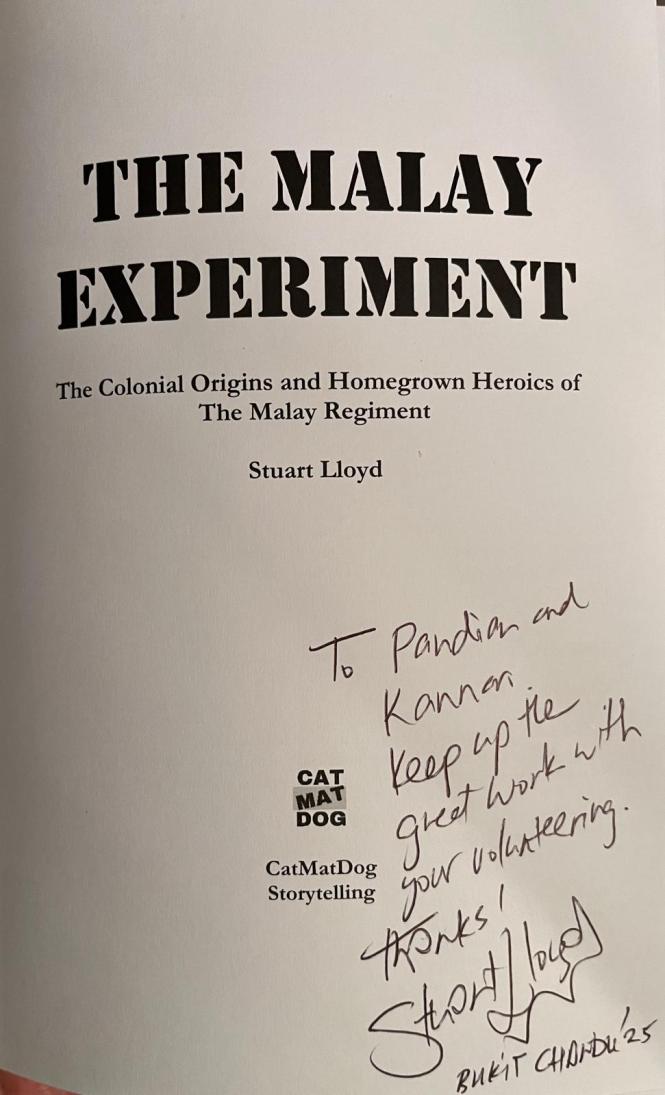
The Malay Experiment | Stuart Lloyd

It was never expected that the full thrust of 18 Division would be thrown against the Malay Regiment directly. 13,000 seasoned Japanese versus 1400 untested Malays.
– Chapter 6: The Battle of Pasir Panjang

Malaysia and Singapore offer a different perspective to foreigners like me. This is the land where WW-II was fought, as we say in Tamil raththamum sathaiyumaaga (ரத்தமும் சதையுமாக) – meaning “with blood and flesh”. My friends have taken me to the Kranji War Cemetery a couple of times. It is always stressful and depressing to realize what happened here in 1940s.

This book by Stuart Lloyd explains the valor bravely expressed by a novice military force – The Malay Regiment – during WW-II. In twelve chapters, this easy-to-read book, (under 100 pages), portrays a chronological note of their beginning, development, training, brutal war and its aftermath, recovery and finally their role in post-independence border clashes and world peacekeeping.

Recently Stuart spoke at Reflections at Bukit Chandu Museum, Singapore (located on the hill where the Battle of Pasir Panjang was fought, just before British Surrendered to Japanese). I bought this book a week ago. His effective storytelling kept us engaged at the museum and eventually pushed me to read the book during my morning commute. He vividly portrays figures like Major Bruce, Brigadier Raja Lope and Lt Adnan Saidi.

This book provides not only the swift action by the Japanese but also their unexpected approaches and failure of Allied forces. It provides convincing facts about the unchallenged airspace advantage enjoyed by the Japanese. Where might British resources might have been spent? Perhaps in Europe and the Middle East? Stuart highlights the superior war equipment, communication and strategy of Japanese. On the other hand, Allied forces lacked these resources – At one point, they even attacked their own forces due to poor communication.

For me, it was important to read Stuart’s documentation about how the Japanese convinced Indian soldiers to switch sides, by assuring them of Indian freedom, mentioning figures like Mohan Singh. (His relationship with Japanese was broken later miserably). While the complex politics of the Indian National Army is not the main scope of this book, the propaganda used to convince Indian forces makes me feel nervous. It feels as though Indian forces were just human resources pulled into different directions by world powers.

The post-war rejuvenation of Malay Regiment is documented in crisp language, covering conflicts all the way upto Malaysia-Indonesia and Malaysia – Phillipines clashes. The way Stuart stacks his historical storytelling – connecting the events on a timeline and providing background about officers – makes the book important. I wonder the amount of effort he put in to collect all these.

When I finish introducing this book, I find myself thinking about those soldiers who died at the Battle of Pasir Panjang or were executed later. None of them accepted the change to remove their uniforms to survive. For example, Lt Adnan Saidi left behind his wife and kids. His wife too died in late 1940s years due to illness, leaving the kids without father or mother. His brother too sacrificed his life to save the British throne.

The war devastated the family of every Malay solider. They might have faced hardship surviving the Japanese occupation due to their identity, and later faced financial crisis during the British reoccupation. The posthumous award were given, and identities established. Stuart doesn’t ask this explicitly, but the events make the reader think: does a symbolic honor compensate for their personal losses and material hardships. That is the life of a soldier!

Click here to borrow this book at NLB