Carnelian beads of Padang

The term “Padang” means “field” in Malay, similar to “medan” in India, which were also part of early British urban planning. The Padang was designated for public use during the early British occupation of Singapore. It has been depicted in several 19th-century artworks. Notably, it was also a site where Netaji Subhas Chandra Bose addressed a gathering during WWII, highlighting its role in broader historical narratives.

Parts of the Padang are leased to social and athletic clubs, including the Singapore Cricket Club (SCC). An excavation at the SCC site in 2003 revealed that human activities significantly impacted the soil and vegetation of the Padang as early as the 14th century. Artifacts like Chinese porcelain and stoneware, Chinese coins were collected during this excavation. But our focus is on discovery of Carnelian beads from this site.

Carnelian bead found at SCC excavation| Image (c) epress.nus.edu.sg

While talking about Carnelian beads, we need to go back in history. The Indus Valley Civilization was renowned for its sophisticated craftsmanship, including the production of carnelian beads. The Indus craftsmen developed advanced techniques for drilling and decorating carnelian beads. Carnelian beads were extensively traded across the ancient world, reaching as far as Mesopotamia, the Arabian Peninsula, and even Greece. The production and trade of carnelian beads not only reflect the technological prowess of the Indus craftsmen but also highlight the civilization’s strategic position in ancient trade networks. These beads were often used as symbols of status and wealth.

The carnelian beads found at Keeladi, a significant archaeological site in Tamil Nadu, India, are part of the extensive discoveries that highlight the region’s rich cultural and historical significance. Carnelian beads have been found in various forms and quantities at Keeladi. For instance, two barrel-shaped beads were discovered in an urn, one of which was etched with a wavy pattern and lines5. Additionally, a cluster of 74 carnelian beads was found underneath an offering pot at the Keeladi-Kondagai burial site.

The two carnelian beads that were found in Konthagai. | Photo Credit: The Hindu

Coming back to our Singapore Cricket Club story, Four beads of red carnelian were found during the excavation. They are not perfectly spherical; they are rather irregular in shape. They measure approximately 2 cm in diameter. Prof John Miksic mentions that these were the first carnelian beads found in Singapore. It is highly probable that these were imported from India although an origin of Myanmar can not be completely discounted.

Beads found in SCC excavation site | Image c: epress.nus.edu.sg

One of these beads are displayed at Indian Heritage Center, Singapore. If you happen to visit Singapore, you may visit to realize the connection between Indian land and southeast Asia in the past.

This post is part of Blogchatter’s WRITE A PAGE A DAY 2025 campaign.

Victoria Arch – A historical ignorance of Pudukkottai

I lived in and around this town. This has many historical buildings, fit to be museums, but encroached by Government agencies. These buildings, once offices of autocratic kings, became the abode of democracy. If you cross this town, you may visit the collector office, district courts and colleges. You will know how badly are they maintained. This place, once directly connected to British rule, has seen its historical charm fade under democracy.

One of them was the ornamental archway built in 1897 by King of Pudukkottai princely state to commemore the Diamond Jubilee of Queen Victoria as a token of his respect for a queen. East Main Stree is the high street (even now!) in Pudukkottai. He built the arch at the beginning of the high street.

Diamon Jubilee arch, Pudukkottai | Pandian Ramaiah, 16 July 2006

It was notable for its beauty. Thanjavur has such a arch too. Aesthetically, this arch was more appealing. It featured a unique image of Queen Victoria with black hair, her face resting on her left arm. Ironically, when the arch was built, the Queen had lost her husband and had retreated into an isolated life, often wearing mourning dresses. She stopped attending much public meetings. In addition, she never visited India. People used to say, she looks like an Indian queen than British!

The close-up | Pandian Ramaiah 16 July 2006

It provided a good look to the landscape, despite some political statues were erected later, as the entrance of high street.

Until recent days, the arch was standing with its glory. When I get my first camera, I went here to take my first few photographs. The town was under direct influence of British, due to which it was managed by no-nonsense people.

Dewan Seshaya Shastry improved the balance sheet of the state and planned the city with squared streets and roads with excellent water management with multiple ponds.

B.C. Holdsworth, another administrator, built a dam in Kadayakkudi. Present day Gandhi park was originally named after him. As per Indian antique records, a clock tower was declared open in 1933 by him. Swaminatha Pillai was the architect who designed the tower. The actual execution of the structure was entrusted to a contractor named M.K. Mahamadhaneef.

Holdsworth park during colonial times, renamed to Gandhi park | Pandian Ramaiah 16 July 2007

Unfortunately, these structures were poorly maintained over time. Political and cinema posters were stuck on the arch, and the park became uninviting due to poor maintenance. Recently there was some improvement in the maintenance of Park.

But a devastating destruction of legacy happened on Nov 14, 2009.

Erasing the legacy. Picture (c) The Hindu, 14 Nov 2009

as a vehicle rammed into the arch. Despite the arch did not lose its shape and fit to be conserved in other places, the district management demolished it into pieces. The legacy stood majestically for 112 years, vanished leaving a void that reflecting such minds.

You can never object to the justifications given by the management. But historians raised their concerns. Despite being led by highly qualified individuals, the management seemed to lack the historical awareness needed to preserve these remnants in a museum for future generation.

Similar demolition happened in Thanjavur as well. Though the people were different, common denominator is the historical ignorance of democracy and its bureaucracy.

After all, that is the town, had my history teacher, received Government salary, taught me that Ghajini Mohamed came, saw the pulchritude of the sculptures, felt it is fit for his bedroom and smuggled away! Despite this series talks about cultural traces, we need to talk about our own ignorance too.

For further reading –

This post is part of Blogchatter’s WRITE A PAGE A DAY 2025 campaign.

Mahishasura Mardini of India and Southeast Asia

Before the advent of cave temples, gods took shelters in structures made of brick, bamboo, or similar materials. These structures were vulnerable to time and eventually vanished.

To overcome this, excavation of cave temples started.

Mandagapattu is recognized as one of the earliest cave temples in Tamil Nadu, built by Pallava king Mahendravarman I in the early 7th century. Mahishasura Mardini cave of Mamallapuram was also mentioned often when we discussed about similar early structure. It is dated back to late 7th century during the reign of Pallava Narasimha Varman.

Mahishasura Mardini Cave, Mamallapuram

Mahishasura Mardini, Mamallapuram

Upon visiting, I stood in awe of the life-sized bas-relief of Mahishasura Mardini, considered one of the finest examples of Pallava art. The bas-relief depicts Goddess Durga fiercely battling with eight arms, wielding a sword, bow, and arrow, as she forces Mahishasura into retreat.

The bas-relief also depicts her attendants, including female warriors and gana-s (dwarfs) in action. Notably, one servant is shown holding an umbrella over the goddess’s head.

Vietnam: Po Nagar Temple

Mahishasura Mardini, Po Nagar Temple | Picture (c) Linda De Volder

Mahishasura mardini is widely depicted in southeast Asia as well. We talked about 7th century caves. Around the same time or later, we have a sample from Vietnam – Po Nagar Temple.

The goddess of this temple is believed to be worshiped for agricultural prosperity. She is linked with Bhagavati. But there is a doorway which represents goddess Durga with four hands, dancing on top of a buffallo, holding a chakra, lotus and trident. The face and crown resembles Chamba artistry. Yet it has the same concept.

Indonesia: Prambanan Temple

In Indonesia, Mahishasura Mardini is depicted in the 9th-century Prambanan Temple complex, showcasing the influence of Hindu mythology on Javanese art.

Durga Mahishasuramardini aka Loro Jonggrang, Prambanan, Central Java, Indonesia.
Picture (c) rarebooksocietyofindia.org

Cambodia: Sambor Prei Kuk

Sambor Prei Kuk is an important archaeological site having over 100 brick temples from the pre-Angkorian period, primarily dedicated to Hindu deities. The site is renowned for its early Khmer architecture and art.

Durga Mahishasuramardini, Sambor Prei Kuk, Khmer, 1st half of the 7th century
National Museum of Cambodia | Picture (c) art-and-archaeology.com

Durga story is perceived as the triumph of good over evil. There are several Mahisha-s roam around freely in Tamil Nadu right now. Just as Mahishasura threatened harmony, modern societal issues like drug abuse disrupt our communities, and we hope for a similar triumph of good over evil.

This post is part of Blogchatter’s WRITE A PAGE A DAY 2025 campaign.

Avalokiteśvara / Padmapani of Ajanta

Padmapani mural of Ajanta captivated my boss. I could feel many times as I worked with him for my first three years. That might have pushed me to take the train and a car to Ajanta. We were searching for someone in a large complex. How would we feel if the person we’re searching for suddenly appeared before us? That’s how I felt, when I saw the popular Padmapani and Vajarapani murals in very first cave.

From left to right: Padmapani, Sanctum, Vajrapani | Pandian Ramaiah 16 Dec 2007

A Bodhisattva is a person who is on the way of attaining enlightenment to become Buddha. Compassion is his/her essence. Commitment to attain enlightenment to assist those who are in stress is his/her vow.

Avalokiteśvara, the lord who looks down, is a revered Bodhisattva in Mahayana Buddhism. Known as Padmapani, he embodies infinite compassion. He is depicted in various forms across the cultures. I have seen at least two of them. Most of the Indian forms shows avalokiteśvara as male. In Southeast Asia, Avalokiteśvara is often depicted as the female Bodhisattva Guanyin. I used to highlight this similarities when I do my museum tours. I understand that Tibetans and Mongolians have their own counterparts.

Bodhisattva Cintamanicakra Avalokiteśvara a.k.a Guānyīn, Tooth relic temple, Singapore | Picture (c) buddhatoothrelictemple.org.sg

The eyes of Padmapani painting looks extremely calm and soothes us. With a lotus flower in hand represents purity and abundant compassion. He is ready to delay his own enlightenment, to help others like us.

Bodhisattva Padmapani, Picture (c) www.indian-heritage.org

His Mantra Om Mani Padme Hum, symbolizes his compassionate nature and it is widely chanted for protection from suffering.

Kannadasan wrote கருணை தேடி அலையும் உயிர்கள் உருகும் வார்த்தை அம்மா ‘Mother, the word that melts souls wandering in search of compassion’. Kirupananda Variyar said in one his his speeches, ‘As god can not take care of every home, he sent a mother on his behalf’. Avalokiteśvara embodies compassion in all its forms, offered unconditionally and without expectation, much like a mother’s love for her child.

Reading recommendation:

This post is part of Blogchatter’s WRITE A PAGE A DAY 2025 campaign.

Horsemen pillars of Vijayanagara/Nayaka

Sri Varadharaja Perumal Temple in Kanchipuram is popular for its exquisite architectural features, including the 100 Pillared Hall. When I went there for the first time, the shrine was closed as the lord Varadharaja is taking his afternoon nap. Until the temple opens, I was roaming around this hall.

from Sri Varadharaja Perumal Temple | Pandian Ramaiah 17 Sep 2006

I found intricately carved pillars, which depict horses and mystical creatures or Yalis ridden by warriors. Sadly, the mandapam was closed. I could not enjoy all the creative skills of artistry skills. These pillars are not only aesthetically wonderful but also showcase the advanced craftsmanship of the Vijayanagara era.

The 100(0) pillared mandapam, Sri Varadaraja Perumal Temple, Kanchipuram | Pandian Ramaiah, 17 Sep 2006.

I understood that this 100 Pillared Hall is a significant part of the temple’s expansion during the Vijayanagara Empire’s reign. The carvings on the pillars include scenes from the depictions of Vishnu and his avatars. The nearby temple tank made my presence serene.

The Horse armour from Varadharaja Perumal Temple | Pandian Ramaiah, 17 Sep 2006

The horsemen pillars are typical style of Vijayanagara and Nayaka-s who are Vijayanagara’s chieftains. Typically such pillars elevate the temple’s status as a masterpiece of Vijayanagara architecture, reflecting the rich cultural and religious heritage of the region.

I wish to highlight two more places with pillars depicting horsemen –

  • Sri Ranganathaswamy Temple, Srirangam – The temple’s 1000 Pillared Hall features sculptures of rearing horses with riders exemplifying Vijayanagara artistry. The hall is a notable example of planned theatre-like structures, to gather devotees.
  • Shikakiriswara temple, Kudumiyamalai – I spoke about this temple in this series earlier. Similar to 100 pillard mandapam of Kanchipuram and 1000 pillared mandapam of Srirangam, there is a Anivetti-k-kal-mandapam contributed by Nayaka-s.

Let me quote from the documentation of Prof S Swaminathan and MV Kiran –

The portrayal here of figure of horsemen treading over the foot soldiers is of particular interest. One can see here weapons used respectively by the horseman and the foot soldiers and the method in which the foot soldiers defended themselves from the attacks of the horsemen.

Kudumiyamalai, SS, MVK

Horsemen pillar at Kudumiyamalai | Pandian Ramaiah, 23 ‎April ‎2007

All three temples share similarities in their architectural features: a hall with pillars adorned with riders on horse/mythical yali/other animals.

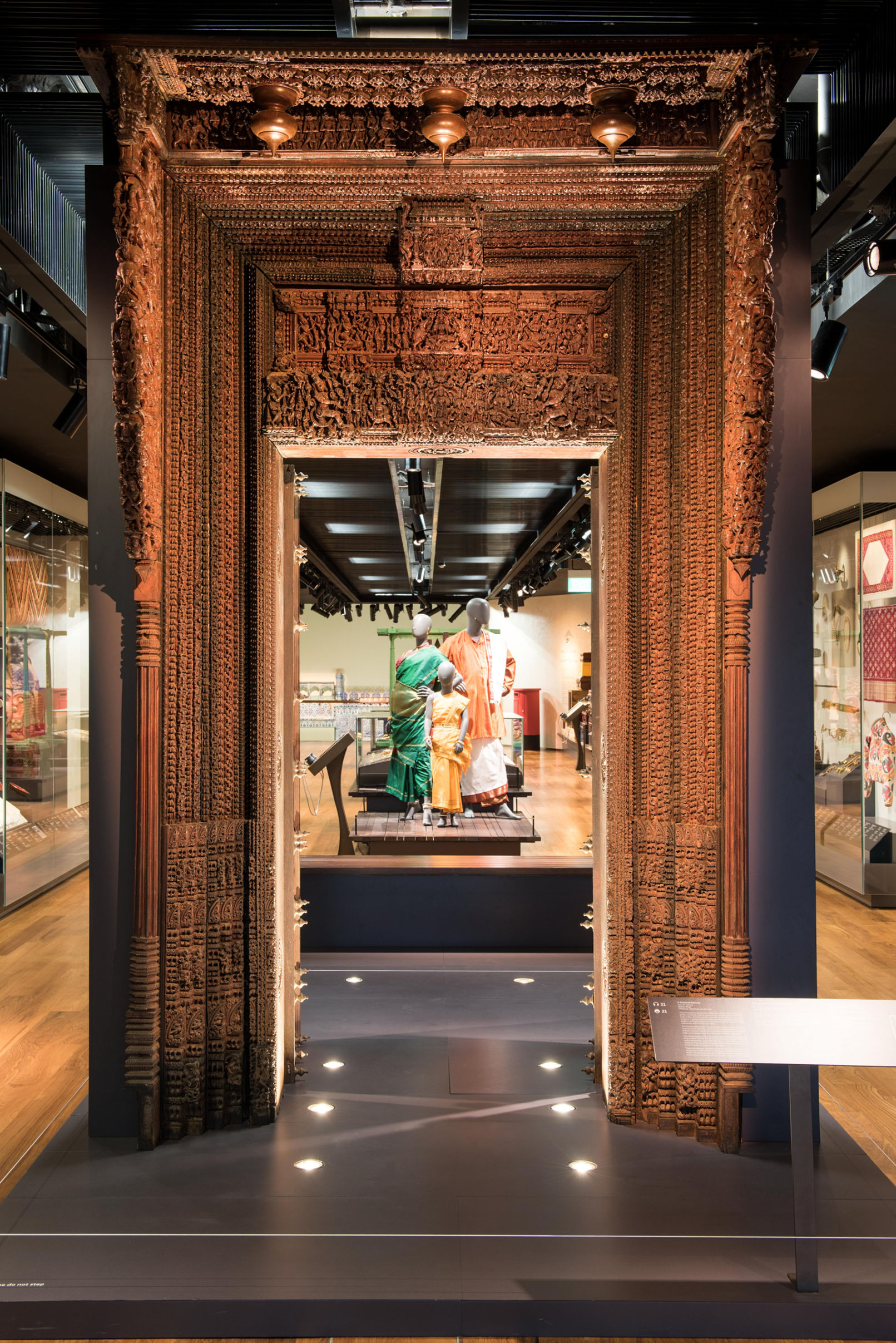
Additionally, I’d like to mention an artifact often highlighted during my museum tours: the Chettiar Doorway at the Indian Heritage Centre in Singapore.

Chettinad Door way, Indian Heritage Center, Singapore | Picture credit: indianheritage.gov.sg

This doorway is adorned with over 5000 carvings, including Ramayana, Vishnu riding on Garuda’s shoulders, Ganesha, Subramanya, Gajalakshmi and other motifs. On the side, we saw beautiful armours riding horses and Yali-s. It reflects the influence of Nayaka art on Chettinad architecture.

The door way, side view | Picture (c) arizonahandbook.com

Breathtaking, isn’t it?

While discussing South Indian temple architecture, it is essential to acknowledge the contributions of the Vijayanagara and Nayaka dynasties, particularly, Nayakas’ colossal sculptures. At first sight, it pins your mind with it majestic beauty. If you have the opportunity, visit these sites and share your experiences with me.

This post is part of Blogchatter’s WRITE A PAGE A DAY 2025 campaign.

Rosetta Stone of Egypt

When Google maps were not used, I was searching for the bus routes to reach British Museum from Croydon in the UK where I was staying for a short while. The purpose of my trip was not related to history, but I thought like having traveled so far, why can’t I visit the locations I was eager to explore. More importantly the Rosetta Stone.

Picture: Pandian Ramaiah, 27 Feb 2011

If you ask me why I am so curious to understand my fascination, let’s go back to 2000. During my work on an exhibition about the evolution of scripts, my team and I delved into various writing systems. We had been talking about the Indic scripts and others across the world. If I was surprised to realize only a few scripts that started several millenniums ago and still in practice.

Indic and Chinese scrips are of the kind. However, this post focuses on something else. One of the interesting fact in this exercise is to document the deciphering the scripts – ie, origin or Cuneiform, Hieroglyphs, Mesoamerican scripts etc.

We are discussing about Egypt and its Rosetta stone. It contains same message was carved in the stone in more than one script forms.

Following our discussions, I worked on creating a compelling exhibition panel. I was so obsessed with Rosetta Stone and I paid special interest to come out with a better version of panel.

Cleopatra written in Hieroglyphs | Story of scripts PPT

This stone was found in Egypt, but why do we need to talk about the British Museum? Because it is displayed over there. This story is similar to many others where artifacts are taken from their countries of origin and moved to Western museums—a practice that is not new.

Picture: Pandian Ramaiah, 27 Feb 2011

There has been ongoing debate between Egypt and the UK, with Egypt requesting the return of the artifact. But I understood that UK thinks that it is good to be displayed in British Museum because, it attracts global audience, so it provided Egypt a replica of the same!

But politics is not the focus of this post, the artifact is.

In 1799, This stone was discovered in a fort in Rosetta, Egypt. It contained same message in three script forms – Egyptian hieroglyphic, then extinct, Egyptian demotic script and Greek of 4th to 1st centuries BCE. Demotic and Greek were known to researchers. So, both helped them to decipher Hieroglyphics.

I read about the stone and captivated it. The visit to the museum that day, was mainly focused on scripts and Indian arts. They had a original and a replica. Standing before the Rosetta Stone, memories of discussions with my Boss from years ago flooded back.

Discussion with fellow museum visitor | Pandian Ramaiah, 27 Feb 20011

To read further –

Slides on Story of scripts – Prof S Swaminathan –

https://www.powershow.com/view/2ab6f2-MDMyN/Story_of_scripts_Part_3_Egyptian_Hieroglyphs_powerpoint_ppt_presentation

This post is part of Blogchatter’s WRITE A PAGE A DAY 2025 campaign.

Yali frieze of Narttamalai

Kiran and I had a memorable early morning journey to Narttamalai (nārttāmalai/नार्त्तामलै) before two decades. I can’t quite recall how we traveled; I believe it was by car. As the sun began to paint the sky, we started our climb up Narttamalai hill.

Narttamalai, though a remote village along the Trichy-Pudukkottai highway, is a site of national importance. This entire village is a historical gem, though perhaps not as well-known as it deserves to be, even among locals.

Vijayalaya Cholisvaram | MV Kiran June 2003

The hill cradles six treasures

  • There are two rock-cut temples,
    • Pazhiyili Isvaram (பழியிலி ஈஸ்வரம்/paḻiyili īśvaram/पळियिलि ईश्वरम्) and
    • Samanar-kudagu (சமணர் குடகு/camaṇar kuṭaku/चमणर् कुडकु),
  • One magnificent structural temple called Vijayalaya Chozhisvaram (விஜயாலய சோழீஸ்வரம்/vijayālaya cōḻīśvaram/विजयालय चोळीश्वरम्), which is a marvellous piece of art, on the hill.
  • A famous living temple of Mariamman (மாரியம்மன்/māriyammaṉ/मारियम्मन्).
  • The Kadambar temple (கடம்பூர் கோயில்/kaṭampūr kōyil/कडम्पूर् कोयिल्) at the foot of a hill nearby is another beautiful temple.
  • The natural cavern of Aluruttimalai (ஆளுருட்டி மலை/āḷuruṭṭi malai/आळुरुट्टि मलै) contains polished stone beds and other Jaina vestiges.

Kiran, well-prepared with research, led the way. My main role, as I saw it, was to offer moral support.

As the rising sun showered the landscape in a warm and golden light, we carefully climbed the sloping, slick rock, eager to capture a beautiful photograph of Vijayalaya Cholisvaram. Later within the temple campus, we were struck by the richness of its cultural heritage.

24 Jun 2003 | Pandian Ramaiah

Vijayala Cholisvaram is a structural Siva temple, Opposite it, excavated into steep hillside, are two cave temples. One is Samanar Kudagu, the cave of Jains.

Samanar Kudagu Cave Temple | June, 2003

Today, let’s focus on the yali – also known as vyali or vyala or vyalaka – a recurring lion-like figure. The motif is often seen in Hindu and Buddhist temples and royal spaces. Samanar Kudagu is not an exception too.

The cave temple seems to have begun as a Jain site around 7th century, later becoming to shrine of vishnu. Mango trees and bushes create a serene atmosphere. A facade or mandapam stands before the cave, and it’s this facade that I want to highlight.

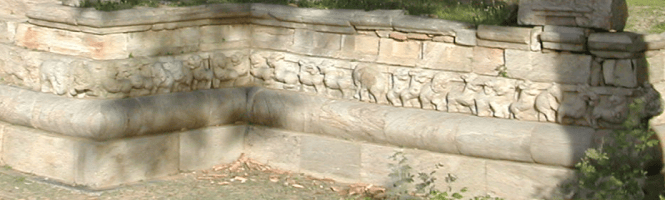
The facade’s base is adorned with procession of yalis. Sculpted to convey power and fierceness, these yalis often serve as brackets, or pillars supporting the structure. Simetimes they feature elephant trunks or bird wings.

Statue of Gajasimha Tower (Gaja yali) of Cham Da Nang Sculpture Museum (photo provided by nv)
Picture (c) archives.org.vn

We observed various types of yali-s. The simha yali has a lion’s head and body. The Gaja yali combines an elephant’s head with a lion’s body. The Makara yali features the body of a lion and the head of a crocodine. Similarly, the architecture boast a variety of yalis, such as Sarpa yali and Nara yali.

The yala frieze, Samanar Kudagu, Narttamalai | MV Kiran, June 2003

The plinthe of this facade features makara heads in the corners devouring humans in their mouth. These connect to frieze of elephants and Simha yalis. Though relatively small, they contribute to the basement’s beauty. Carved with dynamic energy, the playful nature of these yalis brought smiles to our faces. What a skill and imagination!

The yala frieze, Samanar Kudagu, Narttamalai | MV Kiran, June 2003

Scholars suggest several reasons for these depictions: protection, good luck and fertility among them. But beyond any symbolic meaning, they contribute an immense beauty that broadens our prospective as we enter these sacred spaces.

For more readings –

Singapore Stone

Long long ago so long ago nobody will know how long ago, there lived a man called Badang in a place called Saluang. I do not know where it is. It might be somewhere in Malaysia or Singapore. As a slave, he was working for a farm. His work made him tired and fatigued. He thought if he were stronger, he wouldn’t feel tired

While fishing secretly, he encountered a monster stealing his catch. Badang threatened the creature, who offered to grant him immense strength in exchange for letting it free. Badang agreed.

With his newfound power, Badang amazed everyone, including the King of Singapore. He demonstrated his strength by pushing a massive boat into the sea without anyone’s help. The King freed Badang and made him army commander. Badang then defeated a strong man from Kalinga of India in various contests of lifting a massive stone in present day Fort Canning Hill.

Image (c) roots.gov.sg

Kalinga was able to lift the stone only up to his knees. Badang not only lifted it, also threw it all the way until the mouth of Singapore river (present day Fullerton hotel area). He became a celebrated hero, serving the King and bringing peace to Singapore.

This is a mythological story. But a stone of 10 x 10 ft with inscriptions of several lines was left in the same place. No one was able to decipher it. But it became a challenge for the group of labourers. The colonial authorities decided to blow it up to make way for development.

Before doing so, a copy of the inscription was made. But the characters were defaced a lot due to weather. It is believed to be 13th or 14th century. Somebody believes that it may belong to 10th century.

A drawing of three fragments from a sandstone block that once stood at the Singapore River mouth. The bottom fragment is known as the Singapore Stone. Image (c) Wikipedia

Different experts provide different theory about the characters. Some say Kawi script, the old Javanese script with Sanskrit words.

Peter James Begbie was a Captain in the East India Company’s Madras Artillery worked from Malacca. He published the book The Malayan Peninsula in 1834. He guess the inscription sound similar to Tamil, but using obsolete words.

Australian researcher Dr Iain Sinclair identifies a fragment kesariva. He believes it may be the part of parakēcarivarmaṉ (परकेसरिवर्मन्), a typical title represents Chola Kings. As per his estimation, the stone may belongs to 10th century CE. If this is true, the Indian connection with Singapore goes back to the same timeline.

The damaged parts of the stone are kept in National Museum of Singapore. Some one told me that the one found in Badang Terrace of Fort Canning Hill is its replica. But I am unable to verify the fact.

Badang Terrace, Five Kings Walk at Fort Canning Hill
Picture (c) https://singaporeforless.blogspot.com/

Whatever it is is, Singapore Stone is one of the other artifacts that stand still to show the connection between India with Southeast Asia.

To read further –

This post is part of Blogchatter’s WRITE A PAGE A DAY 2025 campaign.

Somaskandha Pallava Painting, Kanchipuram

We talk a lot about ideal couple, ideal parent, ideal child. We often expect others to embody ideals that we ourselves struggle to achieve. But all of us are on the way of trying to be one. Our goal is like the lovely divine couple Siva and Parvati and their lovely kid Skanda. The parent with child seated in Sukhasana on a royal posture is shown by Somaskanda murti.

It may be sometime around 1920s or 1930s. Historian C. Sivaramamurti goes to Thanjavur to view the Chola paintings, discovered recently then. He makes a copy of it and wrote a paper to the quarterly magazine Triveni, He goes to Kanchipuram Sri Kailasanatha Temple.

For those who have not visited Kailasanatha temple, understand that it is one of the marvels of Pallava architecture. If Mamallapuram is their dream in stone, this is their dream in sand and plaster. The temple, adorned with detailed sculptures and vibrant Pallava paintings, must have resembled a colorful pavilion in its prime.

Sri Kailasanatha Temple, Kanchipuram | Pandian Ramaiah 13 March 2013

It has a main shrine for Siva, surrounded by pradakshina path way. The way is surrounded by outer walls with many small shrines, covered with Pallava paintings. They are one of the earliest paintings of Indian art history, along with Ajanta, Thanjavur, Sittannavasal and Panamalai.

The temples striking appearance captivates visitors, and upon entering, one feels transported into Pallava sphere of influence. In addition to the paintings, the temple is worth visiting for its beautifully carved Grantha inscriptions.

Grantha inscriptions/Pallava signatures| Pic Pandian Ramaiah 27 Feb 2007

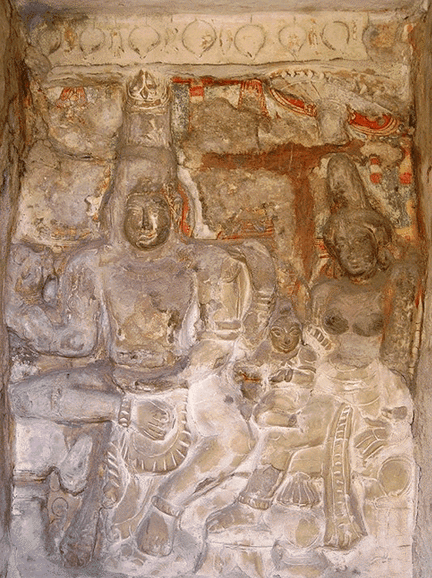
Mr Murti identified the Somaskanda panel for the first time in cell (or small shrine) no 41 at the Kailasanatha temple at Kanchipuram in the early 20th century. He mentioned that he copied the Somaskanda painting and identified it.

Somaskanda, 7th Century, Kanchipuram | C Sivaramamurti

He says the most of the painting got defaced due to natural cause and vandalism. When I went to see that now, it is even worse. But whatever exists, it shows the dynamic flow of lines and dye combinations that creates the figure of Siva- the father, Parvati – the mother and Skanda – the child. Other figures are also depicted, including what some believe to be Vishnu and the gana-s (attendants) of Kailash.

Somakanda line drawing, South Indian Paintings by C Sivaramamurti

It also has other figures, people say Vishnu, other gana-s of Kailash.

We can recognize the face of Siva. But most of Siva’s torso, the face of Parvati are lost. Baby Skanda is too damaged severely.

Let me quote from Mr Murti..

“It is a lovely theme of fond parents and a frolicsome child, of the ideal mates and the object of their love, of the philosophy of affection which, though lavished on the off-spring, increase
a thousandfold.”

Somaskanda | Picture source unknown

Professor Jouveau Dubreuil, who had discovered the paintings earlier, was pleased with Sivaramamurti’s identification and came to Madras specifically to confirm its accuracy.

The preservation of Kanchipuram, Sittannavasal are important to save our heritage. But even now, the cells are open to public, the paintings are getting damaged every day due to vandalism. Ajanta is decently preserved, partially it is due to the way the cave is excavated. Natural decay occurs slowly there because the cave entrances are small. But caves like Sittannavasal and structural temples like Kailasanatha temple, are facing heavy challenges to survive.

In conclusion, the Somaskanda panel at Kanchipuram’s Kailasanatha temple offers a profound glimpse into Pallava artistry and the enduring ideals of family and divinity.

For further reading

  • South Indian paintings by C Sivaramamurti
  • Indian Painting Tradition by S Swaminathan

This post is part of Blogchatter’s WRITE A PAGE A DAY 2025 campaign.

Sadasiva of Elephanta and Cambodia

I have written about my day out to Elephanta earlier. I finished the panels of the main cave one by one. Finally I was standing before the striking colossal bas-relief of Trimurti Siva or Mahesa Murti Siva or Sadasiva.
Sadasiva or Trimurti Siva | Pandian Ramaiah, 1 Dec 2007

Sadasiva is considered as the highest form of Siva. People believe the concept originated from South Indian Shaiva Siddhanta. Sadasiva has five faces, that represents five holy tasks (panchakritya). Three faces are visible in Elephanta. The fourth and fifth is believed to be at the back.

Standing or sitting in front of this artifact is a different experience. You need to experience it.

The Portuguese, when they came to India, found a massive elephant structure here in the 18th century. As per Sachin KR Tiwari’s presentation, it looks to be they damaged and vandalized this cave and removed valuable inscriptions. I am thinking about similar complaints about a Dutch official who cut the head of the sculptures in Java. What we have now is what they left behind. What India is now is also a result of what they left behind.

Coming back, The hair of siva is elegantly carved with extensive details in jata-makuta (hair crown). The face of the Tatpurusha (the centre face) shows extreme peace.

The linga form, especially the mukha linga form represents Sadashiva. Now I understand why Indian heritage center in Singapore has kept the Mukha Linga infront of Sadasiva sculpture.

Sadasiva and Mukha Linga, Indian Heritage Center, Singapore|Photo (c)thesmartlocal.com

The Sadasiva you see in above is from Tamil Nadu. Yet, the one you see below is from Cambodia.

Bronze of Shiva as Sadashiva or Mahesha, late 12th – early 13th century, Cambodia. Collections of Asian Civilisations Museum. Image (c) roots.gov.sg

The face looks more south-east Asian one. Yet they absorbed the same concept and created this bronze with local art form. It shows the influence of Hinduism, particularly, Shaivism in the Khmer Empire during 11th or 12th centuries.

The world was highly connected, but the later decline of Indian influence in Southeast and East Asia is surprising.

This post is part of Blogchatter’s WRITE A PAGE A DAY 2025 campaign.