Fractured Lotus Stem

Recap: Valli, a fortune teller, arrives at Queen Parvata Vardini’s palace and reveals insights into the queen’s past. She narrates the story of Kandika, who is destined to give birth to a divine child, and the troubled life of that child, Narobha, who becomes a robber. Valli then describes Tara’s virtuous early life.

Chapter 6/26: Fractured Lotus Stem

Part 1/2 of the novella ‘The cursed keris of Taravati’

Valli began, her face devoid of expression, yet tinged with sorrow. “You can offer a caged bird food, your highness, but it yearns for the sky. Alas, humans often fail to realize this in their lifetime.”

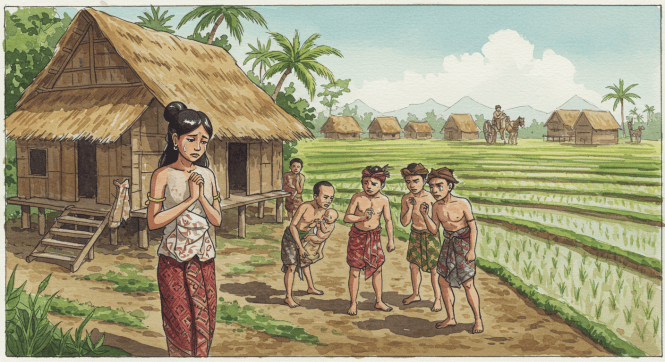
Tungabhadra -the local king – who was hunting for Narobha – the local robber – abruptly changed his plans. Instead of retiring to his bedroom for an afternoon nap, he went to his stables and ordered his attendant to prepare his chariot. The two-horse chariot raced towards its target: Purvadasa Nagadutta‘s – the priest’s – house. He dismounted leisurely, as everyone watched, puzzled by his presence at such an odd hour in such an unexpected place. Opening the gate at his own pace, he entered Nagadutta’s yard. Suga, the clever parrot, began to screech in its deep voice, “Thiiiieeeef! Thiiiieeef!” Tara came to the doorway to investigate the commotion. She was, in fact, shocked to see the king.

She offered a formal greeting and welcomed him inside.

“I wish to meet the priest,” Tungabhadra lied.

“I am sorry, your highness. It is his prayer time. He is in the forest.”

“Oh… he told me… I forgot… Very well, I will come another time.” As he turned to leave, he paused and asked for a cup of water. When she returned with the water jug, he leaned slightly to adjust his posture, then seized her, lifted her, and carried her out of the house.

Everyone watched the tyrant, speechless. The cries of Tara and Suga faded into the distance.

“Crying is not new to this world, your highness,” Valli said. “Rani Sita’s cries were heard. Rani Drowpati’s cries were also heard. Even the toddy shop owner’s daughter’s cry was heard. But it was not enough to save them. The world is designed to consume females. It happens again and again. When we give power to someone, we believe he is a holy person sent to save us. But no, he is fixated on power, to consume whatever he can control. And this will not stop until this world ceases to be a male-dominated society.” Valli’s voice was filled with sadness. The queen listened without reacting.

Tara resisted as much as she could, but eventually, she yielded. Tungabhadra married her that very day, and she became his queen.

Nagadutta returned to his house. Suga was crying out, “Tarra… Tarra…

“What? Why are you screaming?” Nagadutta was unaware of what had happened. His neighbors were all watching him from their steps, fences, roads, and shelters.

Suga continued to cry as Nagadutta entered the house. He assumed she had gone out briefly to play. But one of his neighbors informed him of what had occurred.

“Ammaaaa… Taraaa…” Nagadutta raised his arms towards the sky and cried out to his god. A loud cry burst from his throat, and he fell to his knees on the grass outside his house.

Despite Queen Parvadha Vardini’s eyes glistening with tears, she maintained her composure.

“Which god ever reaches the one who truly needs something, Rani?” Valli exclaimed.

The enraged priest, with his knees and toes pressed to the earth, his body shaking with sobs, looked at everyone around him. His lips stretched wide, his nose wheezing, his whole body trembling with anger, he shouted at the sky and proclaimed, “The one who was supposed to protect his citizens has become a source of trouble for them. The one who abducted my educated, innocent girl is unworthy of her. Let me tell this to nature in the name of the god I worship: he will not last long. He will not live a full life with my daughter. Let it come true,” and he struck the ground with his right hand before going inside.

A sudden flash of lightning tore across the sky, followed by a deafening clap of thunder that seemed to shake the very foundations of the earth.

On the other hand, Tungabhadra was overjoyed at having won the most beautiful girl on earth. He wanted to boast about it, so he declared Tara the queen of the land. His spy network informed him of Purvadasa Nagadutta’s curse. Enraged, he ordered his men to eliminate Nagadutta and continued his duties as usual.

For a ruler of his nature, this was not a significant matter. On the dawn of the next day, his men broke down the door of Nagadutta’s house. Simultaneously, Tara became the queen of the land, known as Maharani Sri Devi Parvata Vardini. As the crown was placed on her head, her father’s head was no longer on his neck.

Upon hearing this, Parvadha Vardini’s mind collapsed. She quickly left the room, fearing she would break down. Valli’s gaze remained fixed on the tiny seashells scattered on the floor. Although Valli did not see the queen, she heard her sobbing.

I’m participating in #BlogchatterA2Z

Note:

  • This fiction is influenced by historical events.
  • Images generated with ImageFx of Google Gemini.
  • Awkward sentences are removed by AI for a smoother reading experience.

Evocative Maiden

Recap: Valli, a fortune teller, arrives at Queen Parvata Vardini’s palace and impresses her with insights into the queen’s past. Valli hints at intertwined curses in the queen’s future. She then narrates the story of Kandika, who is told she will give birth to a divine child. Kandika’s child, Narobha, is born and faces a difficult early life, eventually becoming a robber.

Chapter 5/26: Evocative Maiden

Part 1/2 of the novella ‘The cursed keris of Taravati’

Valli’s face bloomed with happiness. “O queen of boundless compassion, listen to me.” she began, “this valley’s beauty lay not only in the rain-laden clouds and lush greenery that danced in the mountain winds, but also in a maiden of unparalleled kindness: Tara.

“Tara was a special girl in that village. She embodied the virtues of the goddess for whom she was named – limitless mercy and divine compassion. Her benevolence knew no bounds, embracing humans, animals, trees, and the very earth. She spent much of her time at the Bodhisattva temple, which was a serene and beautiful place. Within the temple grounds, there was a lotus pond that mirrored her grace. The lotus buds, as she passed, seemed to stir, yearning for her touch before they were plucked as offerings. Their silent plea reached the swans gliding on the pond, who would ‘kwaark… kwaark…’ to draw her gentle gaze.”

“These calls would capture the attention of the nuns gathering flowers. Seeing Tara, they would smile, captivated by her soft-spoken nature and flawless, almost divine beauty. ‘Look, Tara,’ they’d often laugh, ‘even the swans are longing to talk to you!’”

“Tara would turn and offer a smile, and in that instant, the sunlight would catch the bloom on her cheeks, outshining even the sunflowers by the pond.”

“Her father, Purvadasa Nagadutta, the temple’s head priest, held her in immense affection. He marveled at how so young a girl could possess such devotion. He beamed at her keen intellect, her swift mastery of scripts, and her ability to read epics from the palm leaf manuscripts. Indeed, a Vaishnavite priest from Durgavati, upon seeing her assist in reading the scriptures, was moved to declare her a very form of Saraswati.”

“At home, Tara nurtured two beloved pets: Suga, a parrot, and Manju, a gentle country cow. When she journeyed to the grasslands with Manju, Suga would flutter and perch upon her shoulder or head. Growing restless, Suga would then hop down to sit between Manju’s horns. Manju, unfazed, would continue grazing, her bell tinkling ‘kin.. kin.. kini..‘ softly.”

“With Tara’s patient teaching, Suga learned to speak her name. Whenever someone entered the house, Suga would repeat, ‘Tarra.. Tarra..,’ the sound endearing at first. But Suga, sensing the attention, would become emboldened, repeating it incessantly.”

“Manju, however, was not always a fan of Suga’s squawking. Eventually, her patience wearing thin, she would shake her head to and fro, attempting to dislodge the parrot. Undeterred, Suga would merely fly about her ears, continuing his chorus of ‘Tarra… Tarra…’”

“Tara’s beauty, wisdom, and compassion spread throughout the valley and beyond. It is no wonder that Tungabhadra knew of her when he came to the village in search of Narobha. Upon visiting the temple, he found Tara reading manuscripts with her father, Nagadutta. Tungabhadra was truly astonished by such a radiant girl within his domain.”

“During his visit, while conversing with the influential Nagadutta, their discussion turned to casual matters. Tungabhadra mentioned his habit of taking an afternoon nap after his meal. Nagadutta advised that a brief rest was fine, but a long one was not. When asked about his own afternoon routine after the temple closed, Nagadutta shared that he would go into the forest, filled with jambu trees, to meditate.”

Valli’s eyes grew sad. “Oh, my queen,” she said, “Nagadutta spoke of this casually, with pride. But he did not realize that Tungabhadra had taken careful note…” Queen Parvata Vardini turned her head sharply towards Valli, her movement like the swift turn of a snake’s hood. Valli paused, gathering her thoughts.

..

I’m participating in #BlogchatterA2Z

Note:

  • This fiction is a retelling of a mythology.
  • Images generated with ImageFx of Google Gemini.
  • Awkward sentences are removed by AI for a smoother reading experience.

Dark Inheritance

Recap: Fortune-teller Valli recounts the past of Taravati’s Maharani Sri Devi Parvadavardini, beginning with Narobha’s birth to Sutasoma and Karnika, and his abandonment, after which he was raised by the robber Karmika.

Chapter 4/26: Dark Inheritance

Part 1/2 of the novella ‘The cursed keris of Taravati’

Valli’s face softened as she continued, “O the one with soft palms resembles lotus petals… Motherhood, that’s what guides humanity. That’s what brought you here, and it’s what drove Kandika, mother of the baby. Hearing that her baby was alive, under the protection of a robber, she rushed to his doorstep without delay.”

Valli sang softly:

Mother is here to feed,
Baby is starved.
A pity thread
Parted them both.
No place to go,
For the poor soul.
She was born somewhere,
She went somewhere.
She rushed somewhere,
All the shackles of motherhood
Will come to an end,
When this cursed universe comes to an end!

Karmika had developed a bond with the child Narobha by that time. He refused to give him up. It’s the robber’s way – whatever he stole becomes his. Despite Kandika’s repeated attempts, with no husband to support her and no child to nurture, she was overcome with despair. One day, unable to bear her sorrow any longer, she ran towards the Manvi River. The river offered her the embrace that society denied her.”

“Karmika, in turn, was forced to give Narobha away as a slave to settle his debts. He had never managed to prosper from his robberies, either because his hauls were meager or because he spent them lavishly. He was constantly in debt, and the lender began demanding repayment. One day, the lender refused to leave without payment and proposed a deal: Narobha would become his slave.”

“Young Narobha was playing nearby with pebbles, his prized rooster, bred for cockfights, pecking around him. Despite Karmika’s repeated refusals, Narobha wondered how long his foster father could resist. After the lender finally left, Karmika searched for Narobha, but the boy had fled with his rooster, leaving behind only the scattered pebbles.”

“Narobha sought refuge in the forest, constantly moving to evade the lender’s servants. But survival demanded food, and without hunting tools, he subsisted on roots and tubers. Eventually, he reappeared in the villages with his rooster, earning a meager living from cockfights. Gambling became an obsession for Narobha. When he won, he celebrated with palm toddy. When he lost, he often became violent, and these patterns solidified as he grew increasingly impulsive.”

“Over time, he settled on the city’s outskirts and began to use the skills he had learned from Karmika, robbing passersby and sometimes burglarizing homes. “

“One day, he entered a cockfight for the annual trophy. His opponent was a local girl named Neeli. Narobha’s experienced rooster won, along with Neeli’s bird. As he was about to leave, planning a chicken curry with Neeli’s rooster, he noticed her distress. Despite the gambling rules, she approached Narobha and asked for her rooster back, offering something in return. Surprisingly, Narobha not only returned the rooster but also the gold chain he had won as the trophy, placing it around her neck before walking away. This marked the beginning of a strange connection. She would smile at him, but he would pass by without reaction.”

“One day, Narobha lost a game and, deeply embarrassed, hurried back. He stopped at the toddy shop, but the owner’s daughter refused to serve him because he had nothing to offer. Humiliated and unable to sleep that night, he was consumed by anger. Suddenly, he left his home, driven by an uncontrollable impulse. He went to the toddy shop owner’s house, broke down the door, and, despite her resistance, dragged his daughter into the forest and raped her.”

“The next day, the community was outraged. They looted Narobha’s house, beat him severely, and left him badly wounded. He was taken to the local court and tied to a tree.”

Valli paused, then said to the queen, “It happens repeatedly, Your Majesty. Malevolence triumphs over vulnerable women, exploiting gender and power.”

“For a robber, the fear he instills in society is crucial. Without it, he’s no longer a dangerous snake, but merely a worm. Before he could be punished, Neeli rushed to his defense, claiming he had been with her the previous night. The crowd murmured and dispersed, and Neeli untied him.”

“‘Was it painful?’ Neeli asked kindly.

When Narobha didn’t answer, she looked at him, and he asked, ‘Will you marry me, Neeli?’”

The atrocities of Narobha spread to nearby villages and markets. Traders used to complain to the local chieftain of Taravati, Tungabhadra. He was a tyrant. He was reporting to the Another tyrant Mahakala of Durgavati, on the other side of the mountain. Traders found it is so hard to pay hefty taxes. In between, Narobha too damaged them more. 

Valli exclaimed “Revenue is a pillar for a kingdom. Trust of the people is another one. Tungabhadra took the complaint seriously because it is a direct hit on his revenue. He find a way to save his face, which is already getting damaged among the people. A thug is a thug, when he is alone. If a thug is part of the government, he become a police/guard! Tungabhadra asked his guards to hunt for Narobha. Narobha was on the run once again.”

..

I’m participating in #BlogchatterA2Z

Note:

  • This fiction is a retelling of a mythology.
  • Images generated with ImageFx and Imagen of Google Gemini.
  • Awkward sentences are removed by AI for a smoother reading experience.

Child of Fate

Recap: Maharani Sri Devi Parvada Vardini of Taravati invites Valli, a Tamil fortune-teller, who then begins to narrate the queen’s past.

Chapter 3/26: Child of Fate

Part 1/2 of the novella ‘The cursed keris of Taravati’

Valli focused her gaze on Parvata Vardini’s palm, tracing her fingerprints with her stick. Then, her eyelids closed and she became immersed in her vision. “I see confusion, intertwined curses… a swan is singing lonely…. and loudly…” she spoke to herself as she scattered her mini sea-shells on the floor.

The internal conflict, the simultaneous pull of opposing ideas, forces her to claim her path of destiny using that technique.

Tightening her fist, her eyes fixed on small sea-shells on the floor, she spoke as if channeling a voice from the unknown. “There was a peaceful and beautiful village at the foothills of Ranadhira, the great mountain. Lush greenery covered the slope, and the valley with its fertile soil was filled with blessed farm fields of paddy, millets, sugarcane, ginger, and turmeric.”

Lady Kandika ran along the ridge separating two paddy fields towards her husband. As the paddy roots were surrounded excessive water, her husband farmer Sutasoma was making an outlet to flow to the main canal, preventing the paddy roots from rotting. Mole crickets scurried on the ridge, fearing death under Kandika’s feet. She stopped in front of Sutasoma, catching her breath.

“Are you mad? Why are you running like this?” Sutasoma asked.

“If you heard what I heard, you would be mad too,” Kandika replied.

Sutasoma placed his shovel aside and took the towel wrapped around his head to wipe away his sweat. “What is it?”

“I went to the monastery on the slope,” she said, referring to the monastery maintained by the hermit Visvaka.

“Hmm?” Sutasoma waited for more.

“I go there often to pray for us. But today was the most memorable day,” Kandika exclaimed.

“Why? Did you get more food to fill your belly?” Sutasoma teased.

“No. The hermit said I will give birth to a baby soon,” Kandika said, her eyes and lips wide with surprise.

“Seriously?” Sutasoma sounded amazed.

“Yes. He said it will not be a normal child. It will be a divine child, the child of Lord Vishnu.”

“Narayana…” Sutasoma praised his god and said, “That’s what I wanted to hear, Kandika. Let his statement be true. But when? Did he say anything about it? How a Buddhist priest know about Vishnu’s son? ” A peacock cried out in the shadowed path leading into the forest.

“He said very soon. He told me the rules to observe a vrata – a fasting. Before the vrata ends, I will conceive,” she said.

“Whatever it is, let’s follow it.” He took the food carrier hanging on the palm tree on the ridge and moved to the nearby shade of a golden shower tree.

As they sat down to eat, Kandika said, “We must clean ourselves twice every day and perform the rituals.”

“Okay, then?”

“Ah, I forgot to tell you. We need to observe cleanliness.”

“Yes, that’s essential. What else?”

“No, I didn’t mean that. I mean, you and I…”

“You and I?”

“We need to be separate until I conceive.”

Sutasoma looked confused. “Do you know what you’re talking about?”

“Yes, he told me. Otherwise, the child’s divinity will be diminished.”

“Kandika, don’t joke. How is that even possible?”

“I am sure. It’s divine power.”

“Kandika, he might be comforting you because you go there often and pray for a baby,” Sutasoma said, expressing his disbelief.

But Kandika believed it was true. The next morning, she began observing the rules. She insisted that Sutasoma follow them too. He did so despite his skepticism, just to make her happy. The poor farmer had some knowledge of biology.

One night, Kandika dreamed of heaven. She was lying in a heavenly bed, adorned with ornamental outfits and glittering jewels. A bright spark floated in the air and came towards her. It was a bright seed with cotton wings that entered her. Shivering, she woke up and called out for her husband. Sutasoma was shocked by her scream and dismissed her dream.

“We can dream, but you are daydreaming,” he teased.

“But this is nighttime,” she replied innocently.

Strangely, Kandika showed all the signs of pregnancy. The local midwife confirmed it. Sutasoma was shocked. Unsure of what had happened, he remained confused day and night. Wherever he went, he couldn’t focus on his work. He would return home utterly exhausted, unable to sleep peacefully. As the fetus grew, he began to decline. Around the seventh or eighth month, Sutasoma collapsed in the middle of the day at his farmland and died on the spot.

The whole village gathered at the doorsteps of Kandika and blamed her unborn baby for their misfortune.

“Even before you give birth, he had eaten the soul of his father,” an old woman growled.

“If it comes to this world, he will destroy our village,” her friend murmured.

As days passed by, everybody forgot about the unfortunate Sutasoma and focused on harvesting paddy and sugarcane. But when Kandika gave birth, they gathered again. Despite her protest, her baby was taken away from her. She didn’t know what happened to the baby after that. Villagers said the baby died on the same day. But they are not that cruel. They left the baby in the cemetery at the border of the village.

“Dear queen, the kindness rejected by the habitable land, was offered by the uninhabitable graveyard. When humans abandoned, God offered a helping hand. Yes, on the same night, the local robber and drunkard Karmikan crossed that way. On hearing the baby’s weak cry, he was shocked to see the baby. Since then Karmikan became his father. He named the child as Narobha.” Valli paused for a moment.

I’m participating in #BlogchatterA2Z

Note:

  • The fiction is a retelling of a historic event.
  • Images generated with ImageFx and Imagen of Google Gemini.
  • Awkward sentences are removed by AI for a smoother reading experience.

Beliefs and Lineage

Recap: Valli, a fortune-teller from the Podhigai Hills in Tamil lands, journeyed to the distant island of Taravati. There, she had been invited by the Maharani, Sri Devi Parvadavardini, to offer her divinatory services.

Chapter 2/26: Beliefs and Lineage

Part 1/2 of the novella ‘The cursed keris of Taravati’

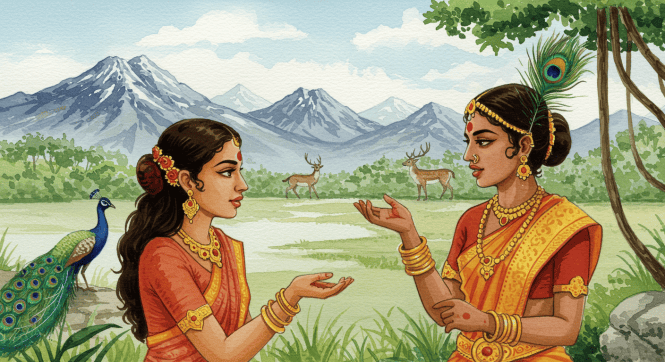
“All hills belong to us, O my revered Rani of Taravati!” Valli started.

“Himalaya is the king of all mountains, where Lord Siva and Parvati dwell. His son Kartikeya rules the hilltops of my land. He is known as Seyon in my land. He is one of the prominent gods we worship, along with Mayon, Vendhan, Varunan and Kotravai. Once, he fell in love with Valli, a girl from a tribal clan of the Tamil hills, and married her. I am named after her, from the same clan,” she explained.

“O, the one whose beauty is worshiped far beyond the borders of this land! Hear this – Agastya, one of the Saptarishi-s and the one who brought Shaivism to your land, found peace in a mountain filled with a rain-forest, where shola-mandhi monkeys swing through the trees, wild stags chase each other in the grasslands, and peacocks spread their feathers in the drizzling grass fields. These mountains are called the Podhigai Hills, which bring the monsoon to the land of the Tamils, generation after generation. Once, a hunter named Kannappan, who lived in these hills, offered his own eyes to Lord Siva. I belong to his clan, called Guru-Avar or Kuravar.”

“That sounds interesting, young girl! You look so young. How can I believe your fortune-telling, dear?” Parvata Vardini asked.

“O, the ruler of an island country with a bustling shipyard! You accomplished what others could not: uniting two countries of different beliefs, Taravati and Durgavati, separated by Mount Ranadhira. Listen to my lineage! -”

“I am the daughter of the matriarch Sirungi, who belongs to the lineage of fortune-tellers of the Pandya kingdom, She taught us worshiping goddess Shenpaka-devi of our hills, along with mother nature. ”

“O! the one with a charming face like a fire-lily, It is not us, but my deity Shenpaka-devi, none other than Meenakshi who rules Madurai, who speaks through me. The one who saves the entire world will save you too.”

The Queen gestured, ready to listen. “Very well. Tell me something from my past to convince me that I can trust your words.”

Valli sat cross-legged, her back straight. She folded her hands, her eyes gazing upwards as her eyebrows partially veiled her fish-like eyes. With a tone like a chisel rubbing against a brass vessel, she began her narration with a prayer:

“I saw your hair, where kondrai blossoms gleam,
which even Brahman’s gaze could not reach!
I saw your hands, with stag and trident’s might
and Vasuki’s bright eyes and his fluttering forked tongues!
I saw your palms with abhaya hasta’s grace
and found my refuge in your holy space!
Oh, Thou, whose son wed Kura-Valli, of our line,
Descend –
with Sri Shenpaka-devi Meenakshi, Your consort divine,
Upon my tongue, let sacred words take flight,
Bestowing grace and everlasting light.
Om Om Om…”

I’m participating in #BlogchatterA2Z

Note:

  • The fiction is a retelling of a historic event.
  • Images generated with ImageFx of Google Gemini.
  • Awkward sentences are removed by AI for a smoother reading experience.

Approach to Taravati

Chapter 1/26: Approach to Taravati

Part 1/2 of the novella ‘The cursed keris of Taravati’

Valli walked along the sandy path. Recent traces of ox carts and palace chariots marked the way. The previous night’s thunderstorm had made the path soggy and slippery. A stream, unexpectedly swollen by the rain, flowed through the thickets of cogon grass on either side, creating a lush, fortress-like passage to the palace of Taravati.

The grass blooms drooped towards the earth, like a bride within her wedding pavilion. Raindrops on the grass and its blooms glittered like a pearl-stringed mathapatti tracing the bride’s hairline. The dense growth of grass gave way to fertile farmland filled with clove plants, some ready to bloom. In the distance, lines of coconut trees led to the towering Mount Ranadhira.

Valli walked steadily, enjoying the sight of cloves, ginger plants and pepper creepers. Her newly woven cotton saree rustled softly with each step. Her brown face was adorned with three lines of sacred ash and a bright red kumkum dot, slightly larger than usual. Her hair bun indicated that her hair was long and healthy. A peacock feather enhanced her beauty. Two strings of pearl and coral formed an arc, ending at the hooks pinned to her hairline above her ears. The makara kundala, fish-motif earrings set with ruby stones, swung in rhythm with her measured gait. Fine carnelian beads and medium-sized pearl beads, connected by a silver thread and fastened with fish-motif hooks, formed a beautiful necklace that graced her neck. Her hands swung gently, like a snake crafted from the heartwood of an ebony tree from the Podhigai Hills, which separated the Pandya and Chera kingdoms in her homeland. The sacred stick in her palm felt warm, signaling that she was on her way to conduct her fortune-telling.

She had been expecting palaces like those in her motherland. Instead, she was somewhat disappointed to see slightly larger houses, thatched with coconut and palm leaves or cogon grass. Security guard posts were built in the trees, supported by bamboo. This appeared to be the city’s edge, as she noticed a lush rainforest behind the palace, ending at the banks of the Manvi River, its water turned reddish-yellow by the recent heavy rain. She mused that a river with transparent water resembled humans with tamo-guna, while the river with rainwater resembled those with rajo-guna.

She entered the grounds easily, finding them poorly guarded. A few guards were going about their work and some men and women were cleaning cloves and placing them into sacks. The chirping of bulbuls and the rhythm of flowing water filled the air. It seemed more like a large landlord’s residence than a royal dwelling.

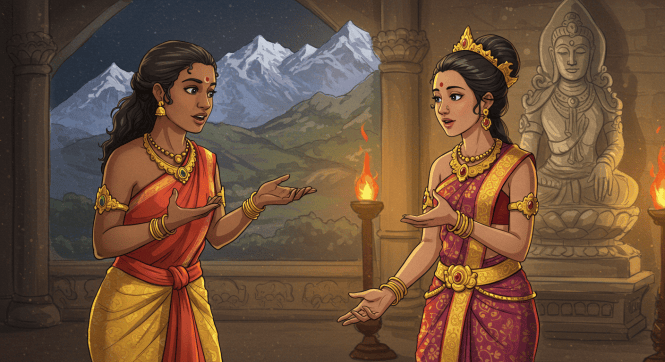
As she approached the entrance, a middle-aged woman, who appeared to be an attendant, emerged from the doorway. Valli was led to an inner sanctum-like room, lit by several oil torches. Coils of cloth soaked in oil lamps were screwed onto iron stems with brass handles, tucked inside holders on the wall.

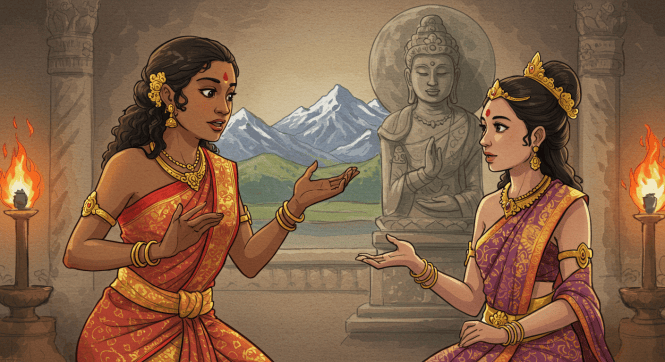
A small sculpture of Prajna Paramita, the Buddhist goddess of wisdom, sat in peaceful meditation. Nearby, a teak ornamental chair with soft red silk cushions on the seat and armrests invited rest. As time passed, Valli realized that the noises from outside were not heard within the room. She deduced that the room must be double-walled, as the attendant had opened two doors, one after the other, to enter. Valli had heard of such secret halls in the Pallava kingdom, but this was her first experience with one.

“The Maharani is arriving,” the lady attendant announced as she opened the door.

Valli stood up, her palms in a greeting position. As the double doors parted, Valli’s breath caught slightly. The queen Parvata Vardini‘s entrance was an example of quiet dignity. Despite the small entrance, she moved with regal grace that commanded attention.

The first thing Valli noticed was the queen’s posture. Even as she bowed her head to enter, there was an inherent strength in her bearing. The dim light of the oil torches cast a warm glow on the queen’s skin, revealing a face of serene beauty. Her features were delicate yet strong, with eyes that held a depth of wisdom and a hint of sadness. With her aquiline nose and full lips, Valli thought the queen would be divinely beautiful if she smiled.

Valli’s eyes were drawn to the queen’s attire. Though not overly ostentatious, it was clear that her clothing was of the finest quality. A richly patterned kain wrapped her lower body, its colors muted yet vibrant in the torchlight. A flower and bird patterned dark red kemben covered her upper torso, and it appeared to be made of a very fine material, likely made and woven locally in Taravati. Subtle gold jewelry adorned her neck and wrists, catching the light with a soft shimmer. Her hair, styled in a neat and elegant fashion, was adorned with small, intricate ornaments, suggesting a semi-formal or casual meeting.

Valli moved a step forward towards the queen and greeted her with folded hands. Parvata Vardini’s gesture conveyed acceptance, and her hands gestured Valli to sit. Valli noted the queen’s hands, delicate yet firm. They bore no signs of excessive adornment, suggesting a woman of inner strength rather than outward display. The queen’s movements were fluid and graceful as she sat down on the thick mattress on the floor. An aura of peace and tranquility surrounded her, a sense of inner calm that filled the room.

Despite her power, she carried herself with quiet humility. Valli sensed a deep intelligence and wisdom emanating from the queen, a quality that resonated with the goddess sculpture in the background.

“My dear young lady, you look strong as a palmyra sprout, yet you seem like a girl. Where have you come from?” Parvata Vardini began the dialogue.

Valli perceived a hint of confusion in the queen’s face, her voice sounding like an excited girl playing with her favorite pet.

I’m participating in #BlogchatterA2Z

Note:

  • The fiction is a retelling of a historic event.
  • Images generated with ImageFx and Imagen of Google Gemini.
  • Awkward sentences are removed by AI for a smoother reading experience.