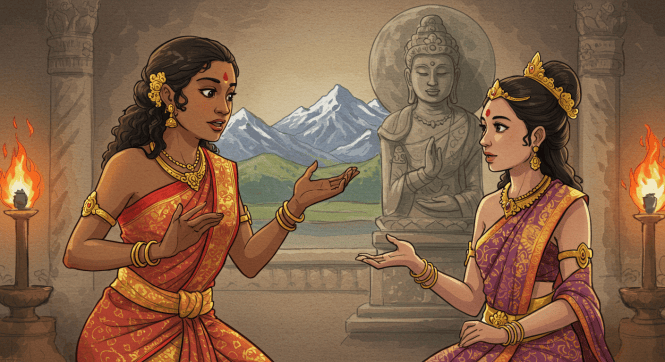
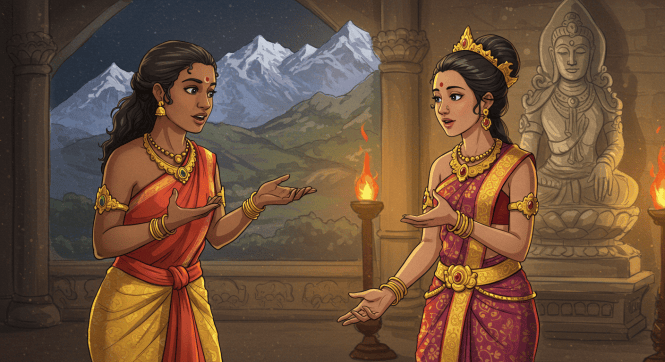
Recap: Maharani Sri Devi Parvada Vardini of Taravati invites Valli, a Tamil fortune-teller, who then begins to narrate the queen’s past.
Chapter 3/26: Child of Fate
Part 1/2 of the novella ‘The cursed keris of Taravati’

Valli focused her gaze on Parvata Vardini’s palm, tracing her fingerprints with her stick. Then, her eyelids closed and she became immersed in her vision. “I see confusion, intertwined curses… a swan is singing lonely…. and loudly…” she spoke to herself as she scattered her mini sea-shells on the floor.
The internal conflict, the simultaneous pull of opposing ideas, forces her to claim her path of destiny using that technique.
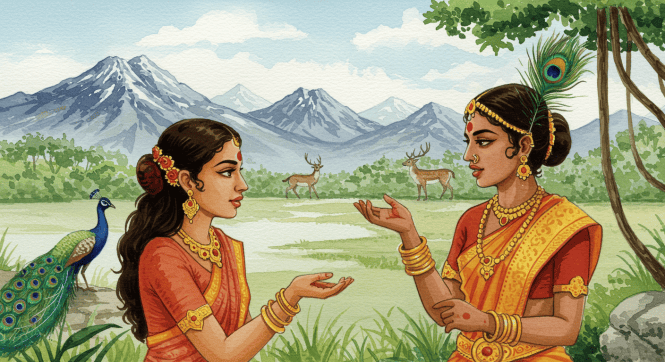
Tightening her fist, her eyes fixed on small sea-shells on the floor, she spoke as if channeling a voice from the unknown. “There was a peaceful and beautiful village at the foothills of Ranadhira, the great mountain. Lush greenery covered the slope, and the valley with its fertile soil was filled with blessed farm fields of paddy, millets, sugarcane, ginger, and turmeric.”
Lady Kandika ran along the ridge separating two paddy fields towards her husband. As the paddy roots were surrounded excessive water, her husband farmer Sutasoma was making an outlet to flow to the main canal, preventing the paddy roots from rotting. Mole crickets scurried on the ridge, fearing death under Kandika’s feet. She stopped in front of Sutasoma, catching her breath.
“Are you mad? Why are you running like this?” Sutasoma asked.

“If you heard what I heard, you would be mad too,” Kandika replied.
Sutasoma placed his shovel aside and took the towel wrapped around his head to wipe away his sweat. “What is it?”
“I went to the monastery on the slope,” she said, referring to the monastery maintained by the hermit Visvaka.
“Hmm?” Sutasoma waited for more.
“I go there often to pray for us. But today was the most memorable day,” Kandika exclaimed.
“Why? Did you get more food to fill your belly?” Sutasoma teased.
“No. The hermit said I will give birth to a baby soon,” Kandika said, her eyes and lips wide with surprise.
“Seriously?” Sutasoma sounded amazed.
“Yes. He said it will not be a normal child. It will be a divine child, the child of Lord Vishnu.”
“Narayana…” Sutasoma praised his god and said, “That’s what I wanted to hear, Kandika. Let his statement be true. But when? Did he say anything about it? How a Buddhist priest know about Vishnu’s son? ” A peacock cried out in the shadowed path leading into the forest.

“He said very soon. He told me the rules to observe a vrata – a fasting. Before the vrata ends, I will conceive,” she said.
“Whatever it is, let’s follow it.” He took the food carrier hanging on the palm tree on the ridge and moved to the nearby shade of a golden shower tree.
As they sat down to eat, Kandika said, “We must clean ourselves twice every day and perform the rituals.”
“Okay, then?”
“Ah, I forgot to tell you. We need to observe cleanliness.”
“Yes, that’s essential. What else?”
“No, I didn’t mean that. I mean, you and I…”
“You and I?”
“We need to be separate until I conceive.”
Sutasoma looked confused. “Do you know what you’re talking about?”
“Yes, he told me. Otherwise, the child’s divinity will be diminished.”
“Kandika, don’t joke. How is that even possible?”
“I am sure. It’s divine power.”
“Kandika, he might be comforting you because you go there often and pray for a baby,” Sutasoma said, expressing his disbelief.

But Kandika believed it was true. The next morning, she began observing the rules. She insisted that Sutasoma follow them too. He did so despite his skepticism, just to make her happy. The poor farmer had some knowledge of biology.
One night, Kandika dreamed of heaven. She was lying in a heavenly bed, adorned with ornamental outfits and glittering jewels. A bright spark floated in the air and came towards her. It was a bright seed with cotton wings that entered her. Shivering, she woke up and called out for her husband. Sutasoma was shocked by her scream and dismissed her dream.
“We can dream, but you are daydreaming,” he teased.
“But this is nighttime,” she replied innocently.
Strangely, Kandika showed all the signs of pregnancy. The local midwife confirmed it. Sutasoma was shocked. Unsure of what had happened, he remained confused day and night. Wherever he went, he couldn’t focus on his work. He would return home utterly exhausted, unable to sleep peacefully. As the fetus grew, he began to decline. Around the seventh or eighth month, Sutasoma collapsed in the middle of the day at his farmland and died on the spot.
The whole village gathered at the doorsteps of Kandika and blamed her unborn baby for their misfortune.
“Even before you give birth, he had eaten the soul of his father,” an old woman growled.
“If it comes to this world, he will destroy our village,” her friend murmured.
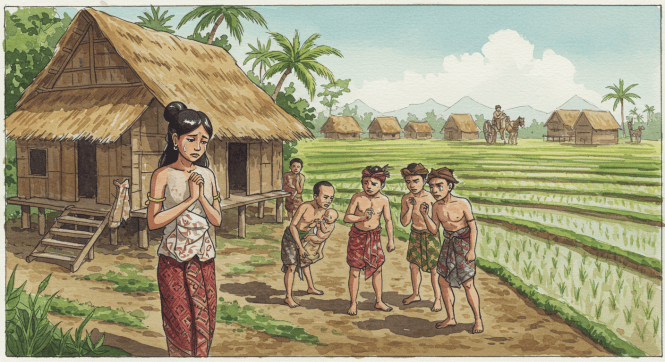
As days passed by, everybody forgot about the unfortunate Sutasoma and focused on harvesting paddy and sugarcane. But when Kandika gave birth, they gathered again. Despite her protest, her baby was taken away from her. She didn’t know what happened to the baby after that. Villagers said the baby died on the same day. But they are not that cruel. They left the baby in the cemetery at the border of the village.

“Dear queen, the kindness rejected by the habitable land, was offered by the uninhabitable graveyard. When humans abandoned, God offered a helping hand. Yes, on the same night, the local robber and drunkard Karmikan crossed that way. On hearing the baby’s weak cry, he was shocked to see the baby. Since then Karmikan became his father. He named the child as Narobha.” Valli paused for a moment.

I’m participating in #BlogchatterA2Z
Note:
- The fiction is a retelling of a historic event.
- Images generated with ImageFx and Imagen of Google Gemini.
- Awkward sentences are removed by AI for a smoother reading experience.