Firewood should be cut for the public eateries known as oottuppura 1. Farmers should submit their bullock carts and bullocks to the adhikara kacheri2.
At least half of the 120 services prescribed for the lower castes must be completed during the Maharaja’s visit, or they will face beheading. Unfortunately, they will not be compensated for their efforts, and not even a sip of porridge will be offered to them. Even the food wastage of oottuppura is off limits to them, as they are forbidden to go there. Refusal to serve will be met with severe punishment, and any delay in tax payment will result in being bowed down and forced to carry a heavy stone on their back. Even the sick and elderly are not exempt from this ‘obligation to serve’.
The men, with their rectangular ears hanging down to their shoulders, adorned by long lead earrings, their mundu not reaching below their knees, and their tufts of hair covering their scruff, ran away without uttering a single word. They shouted for help, screaming “Sudalamaada4 come to my rescue! Kallimaada4 come to my rescue!” Those without families ran to hide, while the family men sought to bribe the authorities in order to escape.
When the hamlet of Palm Huts heard the sound of rushing footsteps as a result of the outflux of people..,
The women, who had been talking in the street here and there, grinding corn in thirukai5, pounding corn with an ulakkai6 in ural7, and chatting to each other while doing their daily chores, abandoned their tools and congregated together. They wore single sarees below the waist, reaching just to their knees, and were completely exposed above the waist.
The lead coils decorated their long ears like men. Apart from that, these women were renowned for their chests freely exposed to the air. As they aged, their breasts became plump like mangoes, withered like bitter gourds, and hollowed like the dried shell of a gourd.
Yesterday, these women, who were accustomed to seeing breasts as just another body part like arms and legs, felt a little embarrassed when they saw the woman in a blouse. She would occasionally appear in front of the palm tree hut, which served as the northern boundary of the southern row of cottages. They were also somewhat envious, wishing they could take off her blouse and put it on their own waist. Even the upper-caste women did not wear a blouse like hers, and instead wore girdles around their breasts. Sometimes, the shoulder strap was wrapped tightly around the back and another loop was attached around the waist. However, the woman in the blouse was wearing a kandanghi8 saree, with floral designs folded into pleats above her breasts. When asked, she said it was a blouse, and ‘It’s the custom of our village’. She told them ‘You should also put it on’, as it was more important than wearing a mangalsutra. To befriend her might cause trouble, similar to the story of a mouse befriending a frog in order to learn how to swim…
Public eatery house with free food – chatram
Bureaucracy office
A garment worn around the waist in the Indian states of Kerala
Rural Hindu deities worshipped predominantly in South India.
A grinding arrangement made in stone to grind small millets into fine flour.
Threshing wood with its top and bottom covered with iron
A stone machine to pound grains like rice, corn.
Woven with thick and coarse cotton in Karaikudi, Tamil Nadu,
The man struck his thandora with great force, echoing the ceremonial words about the King of Travancore. After each announcement, he hit ‘dum‘ thrice and finally ended with a bureaucratic beat – tamara.. tagara.. takka – that thundered through the hamlet.
Fifty or sixty huts, each around six feet tall, were lined up facing each other in the hamlet. Behind these rows were more tiered rows of huts, giving the appearance of a town. Each hut shared its mud walls with its neighbor. A narrow street of its own arose between the rows of huts on both sides, as if it had been created by divine intervention.
The men who were chatting in front of the Kallimaadan pedestal – which was covered with a triangular shape, and had fallen-off lime plaster patches and showing the boulder with red sand inside – looked at the sound of the thandora with panic. They looked to each other for comfort, overwhelmed by the thought of their unpaid taxes and their obligations to serve the king. Their shoulder-length ears hung in coils, swaying up and down in despair.
‘Obligation to serve’ means unpaid work. This service included cutting coconut leaves, tying them in bundles and carrying them for the king’s elephants, carrying horse-grams for his horses, dredging dried-up shrunken rivers called kaayal-s or ponds, offering coconuts, palmyra fruits and sprouts, millets, and carrying bags of salt from the salt-pans.
(to be continued)
This post is a part of the Blogchatter Half Marathon 2023 by https://www.theblogchatter.com/
Thandora Beater stood at the graveyard outside the hamlet, stretching his body as if he believed the hamlet was not fit for him to go in. With a booming ‘Dum Dum‘, he issued the proclamation of the the state of Travancore.
“Sri Uttaram Thirunal Maharaja Thirumanas, Sri Padmanabadasa Vanchipala Marthanda Varma Kulasekara Greedapati, Mannai Sultan Maharaja, Rajya Pakyothaiya Ramaraja Bhagadoorsham Sherjang Maharaja, Suchindram Thanumalayan will visit the temple chariot festival the day after tomorrow, and stay for a duration of two days”.
“In view of this, it is announced to everyone that all the despicable low caste workers, cultivators, come with your offerings and handicrafts and you are ordered to stand 96 feet away from Suchindram Katcheri. Prior to the arrival of the Maharaja, all taxes such as the land tax Prusangdaram, the inheritance tax adiyara, the house tax kuppagalhcha and the palm tree tax, the tax for palm tree ladder enikkaram, the tax for palm fiber thalakkaram, the head tax, the breast tax mulakkaram, the moustache tax meeshakkaram, the mangalsutra tax, and the plantation tax should be paid without any due. In addition, those who have seen, heard, and known through inquiry should immediately inform the higher authorities about the lower castes who do not observe caste rituals. In case of violation of these, it is informed that those who do not disclose this information will be given any punishment including capital punishment.”
(to be continued)
This post is a part of the Blogchatter Half Marathon 2023 by https://www.theblogchatter.com/
“Saraswathi pooja – September 26th, Tuesday” Grandpa was reading the Panchangam in his quavering voice.
Saraswathi, who was descending from her room upstairs, heard that clearly.
“Thatha, no, it appears it is not Tuesday; it appears to be Sunday. Therefore, there will not be a holiday for Circar offices. Didn’t you hear Father saying that yesterday?” Saraswathi descended and inquired of him.
Grandpa removed his glasses and placed them in the case, then spoke to his granddaughter, “Sunday? Panchangams doesn’t specify that, right? It could be one day difference, either earlier or later. Would that mean four or five days difference? No way!”
“Dont know, It is on Sunday for Government alone. Don’t you know? The central Government appointed a Sastri from a foreign country. He got three thousand five hundred rupees as his salary to provide this advice. Lucky chap!”
Saraswathi informed her Grandpa and then went to the kitchen.
Grandpa muttered to himself, “Sastri? Coming from abroad, of all people. These naughty kids must think I’m crazy.”
Saraswathi entered the kitchen as the ‘coffee shop’ was still open. Her brothers had just finished brushing their teeth and were engaged in a lively conversation, each holding a cup of coffee.
She exclaimed, “So noisy! Is this a house or a Kothaval Chavadi?” She then turned to her mother and said, “Mom, you said Saraswathi Pooja was on Tuesday, but it appears to be on Sunday instead. Thatha has already confirmed this.”
“What in the world?” her mother exclaimed as she rushed into the living room. Saraswathi couldn’t help but snicker, covering her mouth with her hand. Her brothers followed suit, eager to witness whatever was unfolding in the living room.
❤️❤️❤️
Do not assume that Saraswathi is only fifteen or sixteen years old. When the month of Aippasi arrives, she will have completed twenty three years of age. She will remain youthful and vibrant as she is in her eighteen. We can not say she is not super pretty; at the same time, we can’t say she is not beautiful. She has a mischievous laugh on her face and speaks with a lot of wit, tease and humor.
Her parents and grandfather were greatly concerned about her marriage prospects. They looked for suitable matches, not only from Chennai Rajdhani but also from cities like Bombay, Calcutta, and Delhi, yet they were still unable to find a suitable partner for her.
Her grandfather often calls her “My girl, come here!”. Saraswathi responds with a smile and goes to stand beside him.
“Do you have any plans to get married, at least by this year or not?”
Saraswathi chuckled and said, “I’m always ready!”
Grandfather sighed, saying, “You’re ready, but the auspicious time for the wedding is being delayed”. It is sad to see Saraswathi like this. She is overwhelmed with disappointment about the postponement of her marriage. Despite her unhappiness, she’s trying to mask it with jokes and laughter.
One evening, close to 7 o’clock, Saraswathi lit the lamp and made her way upstairs with her books in hand. Her grandfather called out to her, “Sarasoo!”
When she spun around to face him, he said, “Sarasu, didn’t I tell you there was a potential groom in Madurai? I had Kalyana Raman investigate him, and he sent this letter to me. Have a look.” With that, he handed her the letter before walking away.
Saraswathi’s face was flushed with both shyness and anger when she received the letter. Kalyana Raman had been the son of a registrar who had lived in the house across from her for quite some time. He had been studying in law school for the past three years. Both families had been close during that time. He had wanted to marry Saraswathi and she had reciprocated the feeling. There had even been talks of marriage. Saraswathi had just finished her intermediate exams and said that she would marry him in two years as she intended to pursue a B.A. degree. She had expected Kalyana Raman to wait for her during that time. But, if it was a question of love between them, Kalyana Raman could have waited not just two years, but even five. However, his parents were not willing to agree to that and began looking for other brides. As Kalyana Raman finished his exams, his family moved to Madurai to start his own law firm.
When she realized he had sent a letter to her grandfather, she was utterly infuriated. Offended by his retort, she thought to herself, “What kind of man behaves like this? He can’t even wait two years for a woman!” With that, she ripped up his letter and threw it in the bin.
❤️❤️❤️
That day was the day of Saraswathi Pooja.
Yes; as her Grandpa confirmed by consulting his Panchangam, the event arrived on September 26th, a Tuesday without fail.
In regards to Saraswathi’s house, the festival not only came on its own, but also brought Kalyana Raman with it.
After the dawn, Saraswathi descended the stairs and was taken aback by the sight of the luggage and bed in her living room. Kalyana Raman appeared the next moment. Out of courtesy Saraswathi asked, “When did you arrive?”. She then hurried to the backyard, her mind filled with thoughts ‘What more to talk with someone who can not wait for just two years for her?’.
She observed her grandfather beaming with joy that day, though the reason remained a mystery to her. He thought ‘As these girls grow older, they became less inclined to behave well. She had barely uttered two words in the morning before disappearing upstairs, not even bothering to come downstairs to talk to him’.
It was 3 o’clock in the afternoon when Kalyana Raman and Saraswathi met each other upstairs.
Kalyana Raman asked, “Are you angry with me? Is that why you won’t even speak to me?”
“I’m not upset with anyone, so why would I talk to you? So I’m just staying quiet!”
“Did you read my letter? Thatha said he handed it to you!”
Saraswathi asked, “Do I have enough time without any tasks, to read whatever the letter delivered here? You might have written about the groom in Madurai. That’s ok. What about your wife? Is she fine? Any kids…?” before her question trailed off.
Kalyana Raman burst into a loud laugher.
Kalyana Raman exclaimed, “You’re so pure and innocent, I’ve never seen anyone like you! Wife? Kids? I never got married to any one! I was holding out for you and came all this way to marry you. I wrote it all in that letter!”
Saraswathi remained quiet as she crouched down and began to piece together the torn letter to read its contents.
—
Saroja Ramamurthy (July 27, 1921 – August 8, 1991) was a modern Tamil writer and Gandhian. She wrote short stories and novels. Her books were nationalized by the Tamil Nadu government. This story is from her nationalized short story collection.
Bagan is an ancient city, filled with archeological sites, located on the banks of the Irrawaddy River in Mandalay, Myanmar. During 9AD and 13BC it served as the capital of Pagan Kingdom. During this time, astonishingly, over 10,000 temples pagodas and monasteries were constructed. Today, an estimated 2,200 of these still remain. This Ancient city was home to various forms of schools such as Theravada/Mahayana/Tantric Buddhism, Shaivism and Vaishnavism.
Pagan (c) Wikipedia
In 2017, Kannan and I attended a lecture at Asian Civilization Museum by Associate Prof Koh Geok Yian about the daily life of Pagan between 1000-1300. During this talk she discussed the excavation project being carried out at Pagan and showed us artifacts, of course in slides, that had been discovered.
The rise of Pagan
Every Archeological site has a rising or flourishing period. Later they move to saturation before a gradual or sudden decline. Bagan is not an exception too. Buddhism and ancient trade tied these regions closely to India.
Pagan empire (c) Wikipedia
I was searching based on Prof Goh’s talk that night. I came to know something very interesting.
Monks from India, Sri Lanka and the Khmer Empire went to Pagan.
It may have the style inherited from Buddhist stupas of Amaravati and Nagarjunakonda in current day Andhra Pradesh and some parts of Sri Lanka.
The ancient name of Pagan was Ari-madana-pura.
It seems there were some similarities between the temples of Pagan with temples of Pala empire of Bengal. There was trade and cultural exchanges between India and Bagan.
The canopy paintings at Pagan were interesting. Before that let’s see the list of places we may need to visit.
Bagan’s Flourishing period.
Kyansittha Palace – Excavation
Kyansittha was the king of Bagan Empire in the tenth century. Following his father Anawrahta, he continued social, economic and cultural exchanges. Excavation pictures from today’s tourist attraction from Bagan Palace were interesting.
Excavations show Pagal’s influence from China. A lot of Chinese vases, Southeast Asian artifacts, pottery, and fragmentary Buddha head sculptures have been found.
A lot of circular structures have been found. It can be seen in the pictures.
Who doesn’t marvel at Buddhist canopy paintings? I have already written about Ajanta briefly in this post. Similar beautiful canopy paintings exist in Bagan temples too. Tap on Google Images.
Being a riverside city, water journeys are depicted in their paintings.
What will be the daily life of a Bagan? I guess it could be like a peaceful life with blooming worship in monasteries, recitation of mantras and agriculture.
Fall of Pagan
Bagan has reached its peak in 11th and 12th century, starting from 10th century. Culture and economy flourished during Anawrahta’s reign. Bagan used to be known as a city of money. The influx of money brought its own problems. Lured by wealth, the sevak-s and the military destroyed the Bagan constitution.
Like the Ghazni Mahmud’s repeated invasion of India, the Mongolians invaded Pagan multiple times and plundered. The city has also been corrupted by Burmese ethnic groups such as the Rakhine-s, the Mon-s, and the Shan-s (seems they are the descendants of Assamese), a Southeast Asian ethnic group.
Pagan looks like a hamlet today, reminds me of Kodumbalur.
Thanks to the following sites for their images and text –
Murugan is revered as the supreme deity above the Trimurti-s and Deva-s in both dream and consciousness. Pamban Adikalar was a devotee who worshipped such a deity in both dream and waking life. He was a follower of Shuddh-advaita and was the Guru of Tamil scholars Thiru Vi. Kalyanasundaranar (Thiru ViKa) and S Sachinandam Pillai. He was a leading sage among other Gurus and was knowledgeable in the ashtama-sidhdhis. Despite his mastery of supernatural powers, he controlled them as they were obstacles to attain moksha.
I will provide a portion of his history here. He was born as a result of the devotion and penance of Saththappa Pillai and Sengamalathammai in Pamban in the Shaiva Velala tradition in 1850. He was named Appavu.
Pamban Adigal had a deep devotion to Lord Murugan from a young age. He regularly recited the six-letter “Sa-ra-va-na-bha-va” mantra, also known as the Sadakkara mantra in Tamil, and received the blessings of Lord Murugan as a result.
With Arunagiri Nathar as his inspiration, Pamban Adigal made a promise to write one poem dedicated to Lord Muruga for every ten poems he wrote. He sought the blessings of the deity and became fluent in classical Tamil language. He began writing poems about his beloved deity, Lord Muruga. Despite leading a household life for some time, he longed for a life of asceticism within.
Let’s know about an incident that happened in 1891. One day, Pamban Adigalar said to his friend Angamuthu Pillai, “I will go to Palani tomorrow”.
His friend asked, “When will you return?”
“I won’t return” Adigalar replied.
His friend asserted, “You started immediately without a word. is it an order from Murugan?”
Adikalar agreed, “Yes”.
In the evening, as Pamban Adigalar was meditating on the terrace, a towering figure appeared before him. The figure was grinding its teeth in anger and pointing its index finger at Adigalar. It shouted at him, “Dey, Did you lied as an order from God? I don’t think I ordered you. Why did you lied?”.
Pambal Swamigal was shaking with fear upon seeing that figure. He was sweating profusely and could not utter a word. Instead, he silently prayed in his mind. ‘Oh my lord, the ocean of kindness! I did not lie to earn a land or wealth. I lied in considering the anma-laabam (benefit of my soul). Kindly forgive me’.
Almighty asked, “Do you want to get the anma-laabam by lieing? Can’t I offer it to you?”. In addition, it ordered, “You should not come to Palani until I order you. tell me you won’t!”
Adigal’s tongue twisted, “I won’t come until I get an order”.
The massive figure vanished.
Adigal rose to his feet and fell to the ground to pay homage to his deity. From then on, he never told a lie, even jokingly, out of fear of incurring divine retribution.
Adigal implored Murugan to call him to Palani, but the deity declined. Adigal visited and venerated all sacred sites except Palani, and was punished for a minor falsehood.
After embracing the ascetic lifestyle, he boarded a boat and crossed the Pamban River. With hands folded in reverence, he silently paid homage to his birthplace. “Oh my mother land, I will not come to this soil with this body”.
He venerated various sacred shrines and was known by the monastic name Kumara Guru Dasar.
In the Tamil month of Panguni (March-April) 1894, he was residing in a village called Pirappanvalasai, where he was attended to by a disciple named Udayanayagam Pillai.
Pamban Swami had a strong desire to see and worship Murugan with his own eyes. He made a firm resolve that he would survive only if he were granted the vision of Kandavel, otherwise, he would not.
Kumara Gurudasa Swamigal (also known as Pamban Adigal) visited a cemetery with his disciple UdayaNayagam Pillai. They erected a pavilion, under which Gurudasa asked his disciple to dig a pit that could accommodate a person. He instructed UdayaNayagam to surround the pit with thorns as a fence.
He said, “UdayaNayagam, I will sit inside the pit and start my penance towards Murugan. I will come back if I happened to see Murugan. Or else, I’ll die and disappear. You keep a small scoop of food without salt in every afternoon. If I did not take it, you don’t have to feed me later. Never ever forget Murugan” and blessed him.
Gurudasa descended into the pit, clasped his hands and placed them on his head. He prayed by uttering “Kumara Guru!” and faced the north direction while sitting inside.
UdayaNayagam Pillai was heartbroken at the sight and, out of fear of disobeying his guru, worshiped him before returning home.
Adigalar concentrated and delved deep into meditation. He battled with his monkey mind for five days while eating saltless food. During this time, a snake appeared and six or seven ghosts of both male and female genders tried to distract him by dancing at night. Despite these disturbances, Adigalar continued to pray with the sadakara mantra, and the ghosts were unable to touch him before eventually disappearing.
A muni with a tall, pure white form approached and entered the pit to lift Adigalar out. The muni used a oak stick as a yoga tandam to beat it, and the stick disappeared into smoke along with the muni. Adigalar loudly recited the sadakara mantra, causing the king of ghosts to retreat a mile to the south before disappearing.
Adigalar prayed and cried towards baby god, “oh my lord, Shanmugha, the ocean of grace, the treasure of mercy, what a challenge I’m facing. Why do I suffering this much? I wanted to see your divine form. I abandoned my relatives, parents, wife and children. I forget all obscenities. Oh the husband of Valli! I am your servant. I forget everything and got down into the pit in graveyard and started this penance to see you. why do you refuse to possess me?”
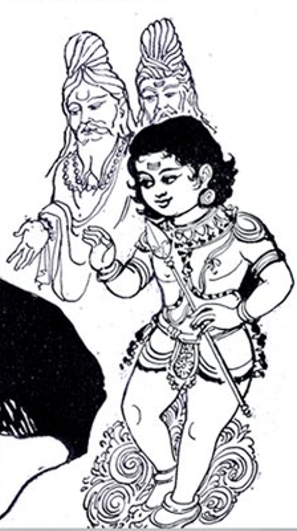
On the seventh day, a male infant appeared and bestowed blessings upon Adigalar. The baby was accompanied by two rishi-s with matted hair on either side. The rishi-s told the baby, “Oh thy baby god, he is in penance towards you”.
The baby, named Velan (meaning “the one with the sphere”), beckoned Adigalar towards him and blessed him. Adigalar rose to his feet and prayed to Velan. The divine being whispered something into Adigalar’s ear and blessed him. Murugan and the rishis disappeared like a thunderstorm towards the west.
Adigalar sat in meditation, following the divine preaching. He remained still, like a tree trunk, and became an embodiment of Saint Arunagiri Nathar’s poetry.
Oh, king of the sphere, who pierced the Grauncha hill! Oh, one with a chest adorned with a garland of Kadamba flowers! I sought solitude to contemplate and focus my mind on you. I have lost myself, this body is but a mere shell.
Kandhar AlangkAram by Thiru Arunagirinathar – 19 sonna kirounja
Adigalar was so absorbed in his devotion that he lost track of time, spending 28 days in contemplation before descending into the pit. After 35 days, there was a loud, thunderous sound and the land and sky appeared to shake.
A brilliant light appeared and a divine voice spoke from the sky. “Ekadasa Rudra-s were coming. You get up!”
Adigalar said, “I will not get up for anybody’s order except Kandavel”
There was another voice “It is the order of Murugan, Get up!”
Upon hearing the divine voice, Adigalar rose to his feet and offered a salute by placing his hands on his head. He then bid farewell after saying “I cant leave this place where I was blessed. I am afraid to refuse the order of my father-like God. Hence I leave”. Moon was shining in west direction.
Adigalar sat on the shaded verandah of UdayaNayagam Pillai’s house. Once dawn broke, UdayaNayagam and other disciples gathered around him. Adigalar asked for a Panchangam (Hindu calendar) to determine the date. He realized that he had been in meditation for 35 days.
Adigalar recorded these events in his poetry.
Adigalar worshipped his deity in both his dreams and waking state and rejoiced repeatedly.
Adigalar had the practice of eating a small lunch devoid of salt, tamarind, chili, mustard, oil, and sugar. He lived an ascetic life, embodying the qualities of a rishi.
On December 27, 1923, Adigalar was involved in a vehicle accident that resulted in a fracture of one of his legs. The British doctors who treated him advised that the leg should be amputated, given his age and habit of avoiding salt and spices. However, on the next day of the new moon, Adigalar prayed to Murugan and requested to be saved.
During his prayer, he saw a vision of a blue peacock dancing in the sky with its feathers spread, and another peacock dancing below. He was amazed and worshipped this sight from his hospital bed.
Adigalar then saw a vision of two small spheres scratching his fractured leg, and suddenly, the leg joined back together. The next day, when the British doctor came to check on him, he saw a child in the bed, but the child disappeared as he approached.
Miraculously, Adigalar was able to walk again, and he attributed this to the intervention of Murugan.
Adigalar composed 6,666 poems in classical Tamil and also wrote prose.
On May 30th, 1929, his soul reached the divine steps of Lord Murugan on the day of Sashti Thithi.
His memorial temple is located in Tiruvanmiyur, Chennai and is considered a place of supreme peace, where enmities are said to be removed upon worship.
Thirumuruga Kirupananda Variyar wrote this article in Kalki Magazine. This is a unofficial translation by me. I am not sure about copyright of this article. If it violates copyright, I’ll take it down.//embedr.flickr.com/assets/client-code.js
Today is Thaipusam day. This is a special post to celebrate the same. It is an ancient Tamil festival celebrated by the Tamil community around the world, including in Tamil Nadu, Sri Lanka, Mauritius, Malaysia, and Singapore. It is not associated with Tamil politics.
Translated to English as part of Blogchatter’s WRITE A PAGE A DAY 2023 campaign.